


How to Memorize Juz Amma Completely – A Step-by-Step Hifz Plan
Learning how to memorize Juz Amma completely is easier when you stop treating all 37 surahs as one large target and instead follow a system built around short daily memorization, constant revision, correct Tajweed, and gradual increases in difficulty.
For most learners, the best starting point is Surah An-Nas at the end of Juz Amma, then working backward toward Surah An-Naba. The shorter, familiar surahs provide early progress before you reach the longer chapters.
The key is not simply reaching An-Naba. Complete Hifz means being able to retain and recite what you memorized earlier while continuing to learn new material.
This guide gives you a practical method for doing exactly that.
A successful plan has four essential parts: a clear surah sequence, a fixed daily study period, a revision system, and a correction method for pronunciation and Tajweed.

1- Start From Surah An-Nas and Work Backward Toward An-Naba
Start with Surah An-Nas, then continue backward through Al-Falaq, Al-Ikhlas, Al-Masad, An-Nasr, and the remaining surahs until you eventually reach An-Naba.
This reverse sequence works because the end of Juz Amma contains many of its shortest and most familiar surahs. An-Nas has 6 ayat, Al-Falaq has 5, and Al-Ikhlas has 4.
Starting directly with An-Naba can be harder because you are beginning with a longer surah before developing a reliable Hifz routine.
Practitioner note: Do not measure progress only by the number of surahs completed. The surahs become progressively more demanding as you work backward, so completing several short surahs may require less effort than securing one longer surah.
2- Listen to the Ayah Before Trying to Memorize It
Correct memorization should begin with correct sound.
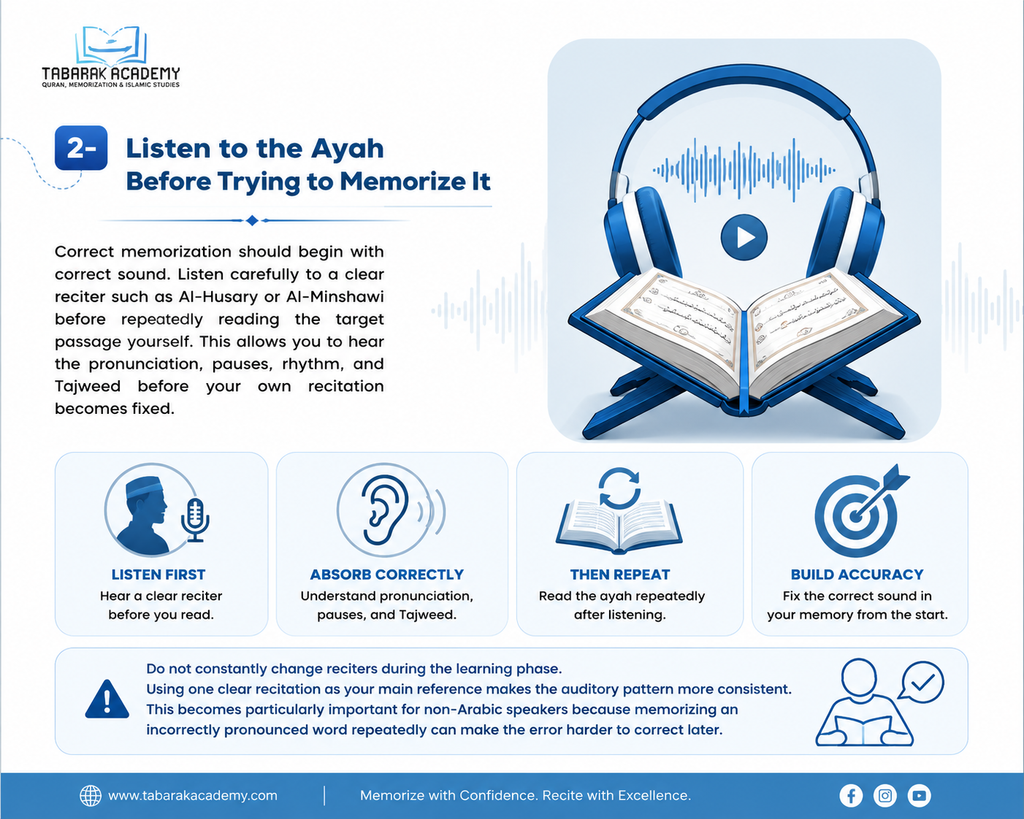
Listen carefully to a clear reciter such as Al-Husary or Al-Minshawi before repeatedly reading the target passage yourself. This allows you to hear the pronunciation, pauses, rhythm, and Tajweed before your own recitation becomes fixed.
Do not constantly change reciters during the learning phase. Using one clear recitation as your main reference makes the auditory pattern more consistent.
This becomes particularly important for non-Arabic speakers because memorizing an incorrectly pronounced word repeatedly can make the error harder to correct later.
3- Break Each Surah Into Small Portions and Link the Ayat Together
Do not approach a longer surah as one memorization unit. Divide it into one or two ayat at a time, or use small groups of approximately 3–4 verses when the verses are especially short and manageable.
Then use this simple cycle:
- Read the target ayah repeatedly while looking at the Mushaf.
- Close or look away from the Mushaf and recite it from memory.
- Check your recitation and correct mistakes.
- Memorize the next ayah using the same method.
- Recite both ayat together before continuing.
The supplied memorization method recommends repeating an ayah while looking, repeating it again from memory, and then linking it with the next verse.
The linking step is easy to overlook. Knowing ayah 1 and ayah 2 separately does not necessarily mean you can move smoothly from ayah 1 into ayah 2.
4- Keep the Same Mushaf Throughout Your Juz Amma Hifz
Use the same Mushaf whenever possible. Repeatedly seeing an ayah in the same position on the same page can create an additional visual cue for recall. Changing between several layouts removes that consistent reference.
Your memory is therefore receiving the ayah through several channels simultaneously: sound, speech, visual position, and meaning.
5- Learn Tajweed While Memorizing Instead of Correcting It Later
Do not memorize the entire Juz first and decide to “fix the Tajweed afterward.” When incorrect pronunciation is repeatedly memorized, the mistake becomes part of the memorized sequence itself. The source material specifically highlights common Juz Amma rules such as Ikhfa, Idgham, and Qalqalah that can be introduced during memorization.
You do not need to complete an advanced Tajweed curriculum before beginning Hifz. You do need a reliable model of correct recitation and correction when your pronunciation is inaccurate.
If you repeatedly hesitate over Makharij or cannot tell whether you are applying Tajweed correctly, structured instruction through Tabarak Academy can help you correct the recitation before the mistake becomes part of your Hifz.
Join the Juz 30 Memorization Course to follow a structured memorization and revision plan while receiving the correction you need to make every new ayah part of a strong, accurate, and lasting Hifz.

6- Understand the Basic Meaning Before Memorizing a Surah
Memorization becomes easier when the words represent a connected message rather than an unexplained sequence of sounds.
You do not need to study detailed Tafsir before every lesson. Read a reliable translation and identify the basic theme of the passage first.
For example, understanding the central message of Al-Ikhlas gives its short verses a logical structure rather than leaving them as four independent lines.
The source material similarly recommends anchoring memorization to meaning because comprehension creates another cue for recalling what comes next.
Original insight: When you forget an ayah, ask yourself whether you forgot its words or its position in the argument. If you know what the surah is saying next, meaning can often prompt the next verse before you need to look at the Mushaf.
Experience Our Interactive Learning
Curious about how we teach? Watch these brief video clips from our recent live sessions to see our structured curriculum, advanced learning platform, and dynamic student-teacher interactions firsthand.
7- Recite New Memorization in Salah
Use newly memorized surahs during your daily prayers once you can recite them reliably. Salah gives you recurring opportunities to retrieve the verses without turning every review into a separate study session.
But Salah should reinforce memorization rather than become the first place where you test an uncertain passage. Verify a new section first, then use it regularly in prayer.
8- Use Quran Memorization Apps to Support Your Daily Hifz
Quran memorization apps can make your daily Hifz routine easier by combining listening, repetition, self-testing, and revision in one place. Apps such as Tarteel can listen to your recitation and help you identify missed words or mistakes while reviewing from memory, making it especially useful for independent revision.
You can also use Al-Mushaf Al-Muallim (المصحف المعلم) to listen to a clear Qari and repeat the same ayah several times before attempting it without looking at the Mushaf. Other Quran apps, such as Ayah, can support reading, listening, and structured repetition.
These tools work best as memorization aids rather than replacements for a qualified Quran teacher, particularly when you need correction in Tajweed, Makharij, and pronunciation.
Read also: Essential Surahs to Memorize for a Better Salah
9- Try Different Quran Memorization Methods to Find What Works for You
Different Quran memorization methods use repetition in different ways. Some focus on short repetition cycles, while others rely on intensive repetition and writing to strengthen long-term retention. You can experiment with the following methods and choose the one that fits your learning style, available time, and current memorization level.
a. The 6-4-4-6 Quran Memorization Method
The 6-4-4-6 method organizes memorization into four repetition stages. Instead of trying to memorize an ayah after reading it only once or twice, you repeatedly expose yourself to the same passage and then test whether you can recall it independently.
A simple way to apply it is:
- Read the target ayah 6 times while looking carefully at the Mushaf.
- Recite it 4 times while gradually relying less on the text.
- Recite it 4 times from memory, checking the Mushaf whenever you make a mistake.
- Finish with 6 correct repetitions from memory to reinforce the ayah.
- Move to the next ayah, then connect the two together before continuing.
The exact repetition pattern can be adjusted if necessary. What matters most is achieving several correct repetitions, rather than completing a particular number while repeating the same mistakes.
b. The 3×3 Quran Memorization Method
The 3×3 method is useful for learners who prefer smaller and more manageable repetition cycles. The basic idea is to work with a short passage through three rounds of three repetitions, moving progressively from reading to independent recall.
For example:
- Read and recite the ayah 3 times while looking at the Mushaf.
- Repeat it another 3 times, trying to look away for parts you already remember.
- Recite it 3 times from memory without looking.
- Check the Mushaf and correct any errors before moving forward.
- After memorizing the next ayah, recite both together three times to strengthen the transition between them.
This approach can work particularly well when memorizing short ayat or Juz Amma, because it keeps each session focused without requiring very long repetition blocks.
c. The Mauritanian Quran Memorization Method
The Mauritanian memorization method is traditionally associated with an intensive approach to learning in Mauritanian Islamic education. Rather than relying on quick memorization, it emphasizes writing, repeated recitation, correction, and extensive review until the material becomes deeply established.
A practical Quran-focused adaptation can look like this:
- Read the passage carefully and make sure its pronunciation is correct before memorizing it.
- Write the ayat by hand to engage visual and physical memory alongside verbal repetition.
- Recite the passage aloud repeatedly, referring back to the written text or Mushaf when necessary.
- Continue until you can recite the entire passage accurately without looking.
- Review it again later that day and combine it with previously memorized passages.
- Keep returning to older material regularly instead of focusing only on new memorization.
The strength of this method is its emphasis on deep retention rather than fast progress. It can require considerably more repetition than lighter memorization techniques, but that intensive review can make it useful for students who tend to memorize quickly and then forget what they learned.
Read also: What Is an Ijazah in Hafs ‘an ‘Asim? Requirements
Which Quran Memorization Method Should You Choose?
You do not have to follow one method permanently. Try the 6-4-4-6 method if you benefit from a fixed repetition structure, the 3×3 method if you prefer short and manageable cycles, or elements of the Mauritanian method if your priority is intensive repetition and long-term retention.
Whichever approach you use, do not measure progress only by how many new ayat you memorize. A successful Hifz method should help you retain yesterday’s portion while adding today’s, with regular correction to ensure that pronunciation and Tajweed errors are not being memorized along with the verses.
With Tabarak Academy, experienced Quran teachers can assess each student’s progress and challenges, then help identify and adapt the memorization method that works best for that individual learner.
Instead of forcing every student to follow the same system, lessons can combine repetition, listening, revision, verse linking, writing, and other techniques to build stronger and more lasting Hifz.

How to Review Juz Amma Without Forgetting Earlier Surahs?
Revision is part of memorization, not something you begin after completing Juz Amma. A common Hifz mistake is continually adding new verses until the learner discovers that the first surahs have become weak.
Separate your Hifz into three categories:
- New: today’s ayat.
- Recent: material memorized during the previous days or weeks.
- Old: established surahs memorized earlier.
Your newest material requires the most frequent repetition, while established material can gradually move into a rotating review schedule.
Use a Simple Test Before Calling a Surah Memorized
Do not mark a surah complete simply because you successfully recited it once immediately after studying it. A useful completion test asks:
Can I start the surah without prompting, move between its ayat correctly, complete it without looking, and maintain acceptable pronunciation?
If not, the surah is still being consolidated.
This distinction prevents a common problem: confusing short-term recall with permanent Hifz.
How to Choose a Realistic Juz Amma Memorization Schedule
There is no single timeline suitable for everyone.
Your appropriate schedule depends on your existing Hifz, Tajweed level, daily study time, concentration, and how much revision you need.
The supplied plan provides three broad scheduling approaches:
| Plan | Best For | Main Priority |
|---|---|---|
| 3 months | Learners wanting a steadier pace | New Hifz + regular Tajweed revision |
| 2 months | Learners with stronger Tajweed or some surahs already memorized | Faster progression with revision |
| 1 month intensive | Advanced learners able to dedicate substantial daily time | High-volume memorization and review |
The important distinction is between covering Juz Amma and retaining Juz Amma.
An intensive learner may move through material quickly, but the Hifz still needs continued revision afterward. A slower learner who remembers everything accurately may ultimately be further ahead.
That is why the best way to memorize Juz Amma completely is the fastest schedule you can maintain without sacrificing retention or Tajweed.
How to Memorize Longer Juz Amma Surahs Without Getting Overwhelmed
The strategy should change as you reach the longer surahs toward the beginning of Juz Amma.
Do not suddenly expect yourself to memorize an entire long passage simply because you could complete shorter surahs quickly.
Divide longer surahs into logical chunks. Work on a small group of verses, secure their transitions, and only then connect that section with the next.
For difficult passages, reduce the amount of new material before reducing revision.
That distinction matters. When students fall behind, they often cut review to preserve their daily new-ayah target. This makes the schedule look successful temporarily while the actual Hifz becomes progressively weaker.
Decision rule: when your old memorization begins deteriorating, reduce new memorization first.
For adult learners who struggle to identify exactly where their Hifz is weakening, a qualified teacher at Tabarak Academy can listen for recurring Tajweed errors, weak transitions, and revision gaps that are difficult to diagnose alone.
Through Online Quran Classes for Men learners can receive personalized guidance, consistent correction, and a structured approach to memorization and revision that helps build stronger, more accurate, and lasting Hifz.

How to Avoid the Most Common Juz Amma Memorization Mistakes
Most unsuccessful plans fail because of the system rather than the learner.
Watch especially for these mistakes: beginning with difficult surahs before building momentum, memorizing too much new material, postponing revision, learning from unclear audio, changing Mushafs constantly, ignoring meaning, repeating Tajweed mistakes, and treating one successful recitation as proof that a surah is permanently memorized.
Another major mistake is chasing someone else’s completion date.
Your target is not merely to say, “I finished Juz Amma.” Your target is to recite the entire Juz reliably after the intensive memorization period has ended.
Step Inside Our Virtual Classrooms
See our engaging teaching methods in action! watch real snippets of our live classes and discover how our expert instructors make learning interactive, memorable, and inspiring for every student.
Start Memorizing Juz Amma With Guided Hifz Support
A memorization schedule tells you what to practice. A qualified teacher can tell you what you are pronouncing incorrectly, which passages are becoming weak, and when you are genuinely ready to progress.
Warsh Recitation | Advanced Tajweed Lesson
Study with Tabarak Academy and build your Juz Amma memorization through structured Hifz practice, Tajweed correction, regular revision, and teacher-guided accountability.
Our Quran Memorization / Hifz Courses
- Online Hifz Program
- Juz 30 Memorization Course
- Hifz for Kids Course
- Hifz for Adults Course
- Hifz for Sisters Course
- Short Surah Memorization Course
- Hifz Ijazah Course

Conclusion
To learn how to memorize Juz Amma completely, start at An-Nas and progress backward, listen before memorizing, learn small portions, link every new ayah to the previous one, apply Tajweed from the beginning, and revise old material every day.
Most importantly, judge progress by retention rather than speed.
A smaller amount memorized correctly and maintained consistently is more valuable for long-term Hifz than rapidly covering Juz Amma only to forget earlier surahs.
Frequently Asked Questions About Memorizing Juz Amma Completely
What is the best way to memorize Juz Amma completely?
The best way is to start with the short surahs at the end, memorize small portions through listening and repetition, review older Hifz daily, and gradually work backward toward An-Naba. Correct Tajweed should be built into the process rather than postponed.
Should I start Juz Amma from An-Naba or An-Nas?
For memorization, starting from An-Nas is usually easier. The shorter surahs provide manageable early goals, while the longer surahs such as An-Naba come after you have developed stronger memorization and revision habits.
Can I memorize Juz Amma completely in one month?
A one-month schedule is an intensive option intended for learners who can dedicate substantial daily study time and already have suitable recitation and Tajweed foundations. For lasting Hifz, completion speed matters less than whether the entire Juz remains accurate after continued revision.
Should I memorize new verses or revise old ones first?
Prioritize revision before adding more material when your old Hifz is becoming weak. New memorization creates progress, but revision protects that progress. A learner who continually adds verses without maintaining previous surahs is covering material rather than building durable Hifz.
Can I memorize Juz Amma completely without a teacher?
You can memorize the words independently, but accurately evaluating your own Makharij, Tajweed, and subtle recitation mistakes is difficult. Teacher feedback is especially valuable before repeatedly storing a pronunciation pattern in long-term memory.
How do I know when I have completely memorized Juz Amma?
You have completely memorized Juz Amma when you can reliably recite its surahs from memory with correct sequence and acceptable pronunciation while maintaining older surahs through regular revision. Finishing An-Naba is therefore the end of acquisition, not the end of maintaining your Hifz.