

5 Effective Ways to Preserve Your Children Identity in The West
Preserving Children’s Identity is a crucial concern in this era. In the past, the Muslim nation lived across one vast territory with no political borders between its regions, and there was no need for a visa or passport to move from one place to another. But in this age, everything has changed, and immigration between countries has become a normal part of life for many families.
Many Muslim parents living in Western countries face a real challenge: raising children who integrate into a society different from their beliefs while still keeping their Islamic identity intact. This is where consistent islamic faith practices at home make the difference between a child who feels disconnected and one who feels grounded. This challenge sits at the center of every conversation about Children Identity in diaspora communities.
According to recent statistics in the USA, nearly 70% of people identify as Christian, 23% identify as having no religion, and less than 1% identify as Muslim. Since our identity is rooted in our religion, our faith, and the Sunnah of our Prophet ﷺ, parents carry the main responsibility of protecting it.
In a well-known hadith on parents and religion, the Prophet ﷺ said:
“Every child is born with a true faith of Islam (i.e. to worship none but Allah Alone) and his parents convert him to Judaism or Christianity or Magianism, as an animal delivers a perfect baby animal. Do you find it mutilated?” ( Sahih al-Bukhari)
Families who want a structured starting point for this can build on programs such as 5 Pillars of Islam for Kids, which turns the core obligations of Islam into lessons children can actually absorb at their age level.
1. Establish A Strong Aceedah ( faith) Since Childhood
The effect of this strong Aceedah must be apparent in their behavior and thinking. In fact, The effect of a strong Aqeedah must be visible in a child’s behavior and thinking, not just in what they can recite. Tawhid (monotheism) is one of the most important pillars of Aqeedah, and one of the greatest gifts Allah gave to Muslims.
A Muslim who believes in Allah, follows Prophet Muhammad ﷺ, and takes the Quran as the constitution of his life carries a strong, stable identity.
Allah says: “Say: Truly, my prayer and my service of sacrifice, my life and my death, are all for Allah, the Cherisher of the Worlds.” (Al-An’am 6:162)
And: “Whoever desires other than Islam as religion — never will it be accepted from him, and he, in the Hereafter, will be among the losers.” (Ali ‘Imran 3:85)
The best way to teach Aqeedah to children is to set a good example, since kids are influenced by what surrounds them daily. Every action and attitude a parent shows influences a child directly or indirectly. It is genuinely difficult to keep children excited about reading Quran or performing Salah — but when they see a parent praying or reading Quran regularly, and are encouraged rather than pressured, that excitement tends to follow naturally.
This daily example is where Children Identity truly begins to take shape, long before a child can explain any of it in words.
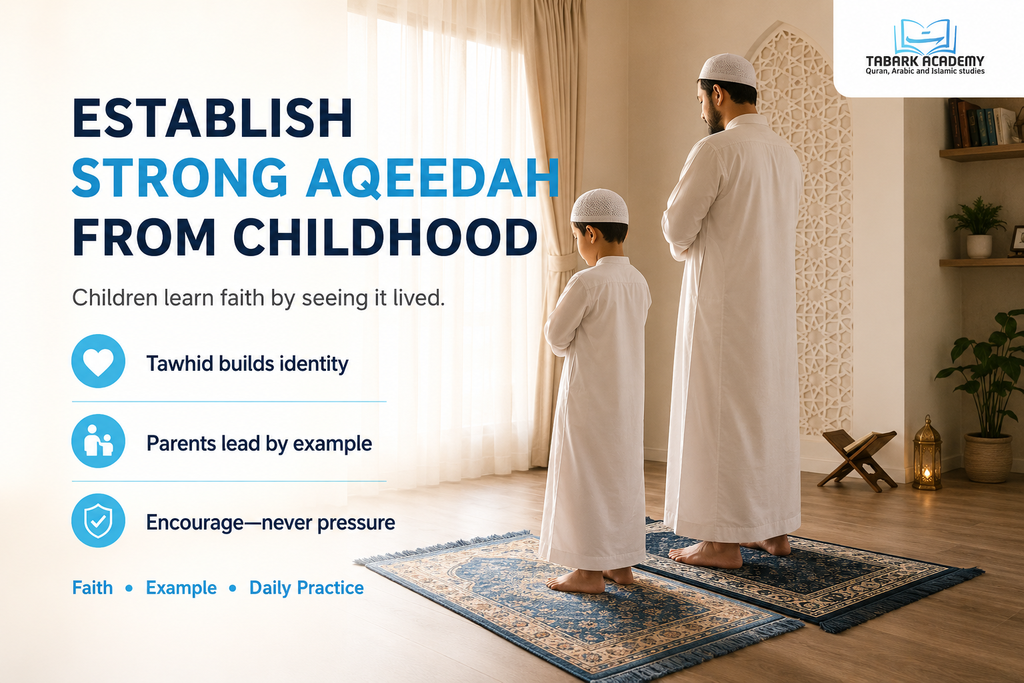
It is a parent’s responsibility to make Salah feel approachable to kids. Games, storytelling, and pictures all help. Everything starts with the parents, because children model their faith after the adults around them before anything else — so parents should focus on strengthening their own practice first.
Abu Huraira (Allah be pleased with him) reported Allah’s Messenger (ﷺ) as saying:
“When a man dies, his acts come to an end, but three, recurring charity, or knowledge (by which people) benefit, or a pious child, who prays for him (for the deceased).” (Sahih Muslim)
This is precisely the stage where Children Identity gets its first real test, long before school or friendships come into play.
Families who want structured support at this stage often combine home habits with a guided curriculum, such as an Islamic Studies for New Muslims program that walks through Aqeedah fundamentals step by step, or a dedicated Tafseer Al Quran Course once a child is ready to understand the meaning behind what they recite, alongside a Quranic Sciences (Uloom Al Quran) Course for the older stages of learning.
Read Also: Time Management in Islam
2. Attach Your Kids Emotionally to Mosques and Islamic Events
Muslims preserve their identity in part by celebrating occasions such as Eid al-Adha (“festival of the sacrifice”), Ramadan (a month when most Muslims observe a degree of fasting), and Eid al-Fitr (“Feast of Breaking the Fast”). These moments give children something to look forward to and associate with belonging, not obligation.
Turning these occasions into lasting memories doesn’t require anything elaborate — a few simple, repeatable habits at home are usually enough to make them stick.
Ways to Celebrate Islamic Occasions
There are several simple ways to make these occasions memorable: decorating the home with Islamic zina, letting your child make their own paper decorations, hanging white twinkly LED lights in a child’s room so it feels festive, or building excitement with a countdown calendar for Ramadan or Eid — full of color, where the child crosses off a day and gets a small treat.
Allah says: “That is so. And whoever honours the symbols of Allah, it is certainly out of the piety of the heart.” (22:32)
These shared celebrations are where Children Identity gets reinforced socially, not just spiritually — a child who celebrates Eid alongside other children learns that this identity is normal, not unusual. Beyond the home, staying connected to a physical community matters just as much.
Regular attendance at the mosque and structured group experiences — such as an Islamic Summer Camp — give children a peer group that reinforces the same values they see at home, which is often what keeps a child’s sense of belonging from feeling isolating during the school year.
Experience Our Interactive Learning
Curious about how we teach? Watch these brief video clips from our recent live sessions to see our structured curriculum, advanced learning platform, and dynamic student-teacher interactions firsthand.
3. Teach Them Islamic History
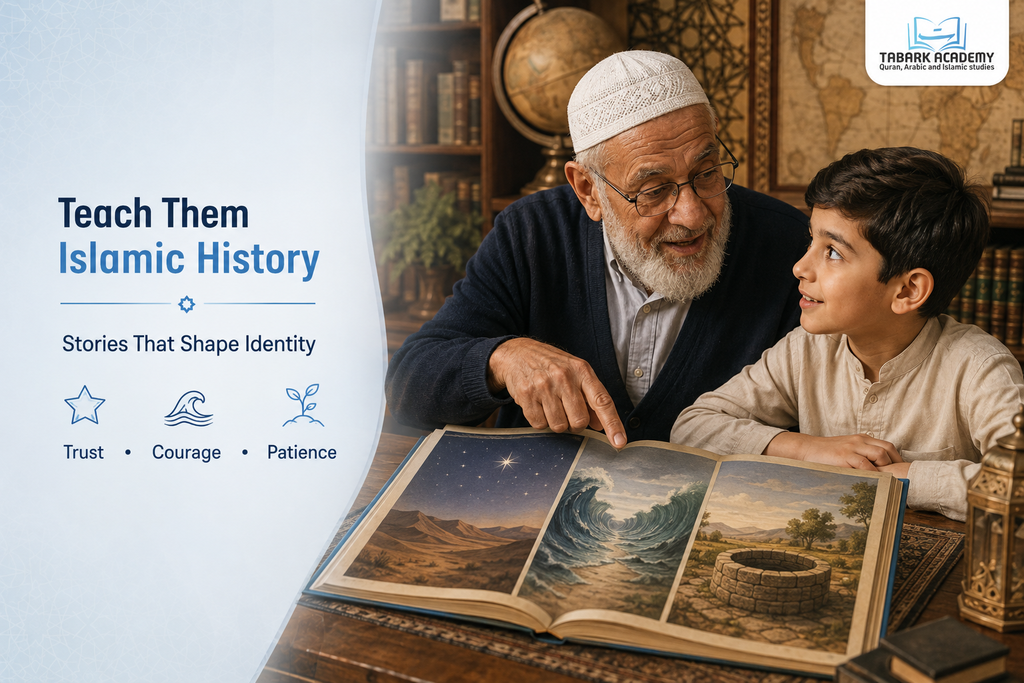
A nation without history and past is a nation without future and identity. Our history shows that the Islamic nation has been distinctive and virtuous among all other nations. This history does not begin with Prophet Muhammad ﷺ and his migration — it begins with Prophet Adam, the father of all prophets.
Allah says:
“It is He who created you from one soul and created from it its mate that he might dwell in security with her. And when he covers her, she carries a light burden and continues therein. And when it becomes heavy, they both invoke Allah, their Lord: ‘If You should give us a good [child], we will surely be among the grateful.“
Rather than treating history as a list of dates, tell it through the stories of the Prophets: Ibrahim’s trust in Allah, Musa’s courage under pressure, Yusuf’s patience through hardship.
Children remember a story long after they’ve forgotten a timeline, and each of these stories gives them a role model for a specific situation they may face themselves. History does more than inform here — it anchors Children Identity in something larger than the family itself, connecting a child to a story that started long before they were born.
4. Preserve the Arabic Language at Home
Arabic is the language of the Quran, and a child who has even a working connection to it reads the Quran differently than one who only hears it in translation. This does not mean formal grammar lessons from day one — it can start with using common Arabic phrases at home, naming everyday objects in Arabic, or listening to Quran recitation as background during the day so the sounds become familiar early.
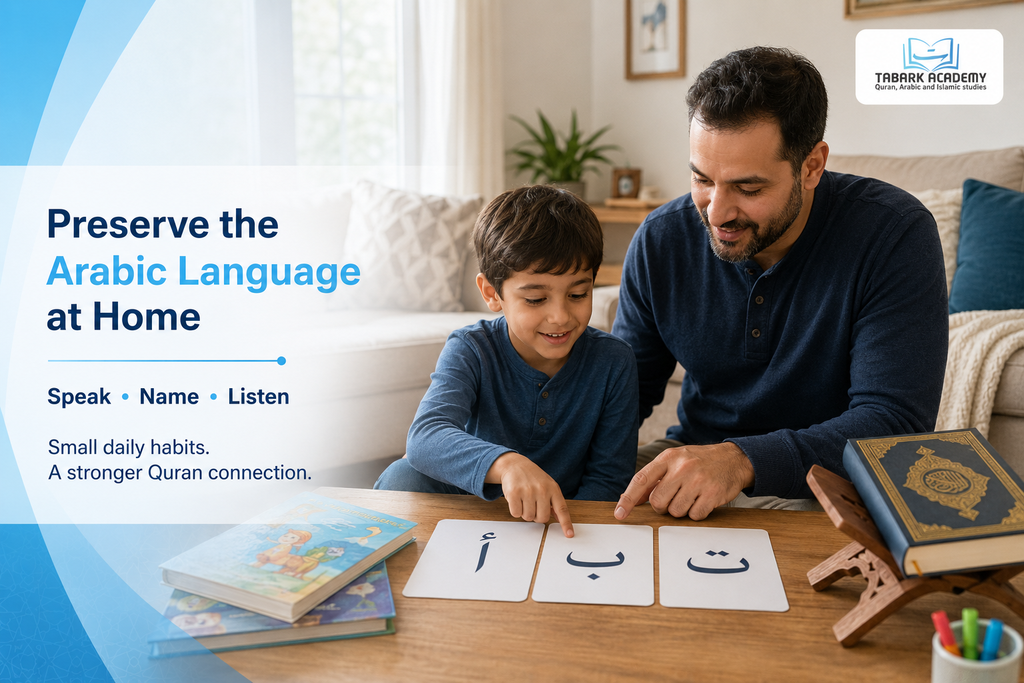
Language is one of the most overlooked pieces of Children Identity in immigrant households. This single habit is one of the most commonly missing pieces in families who otherwise do everything right at the mosque and at home: without some ongoing exposure to Arabic, a child’s connection to the Quran’s actual words stays secondhand.
5. Explain the “Why” Not Just the Rule
In an environment where children are constantly asked to justify their beliefs to skeptical peers, simply saying “this is haram” is not enough. Children need to understand the wisdom behind a ruling — why modesty matters, why fasting builds self-control, why certain behaviors are avoided — not just the rule itself.
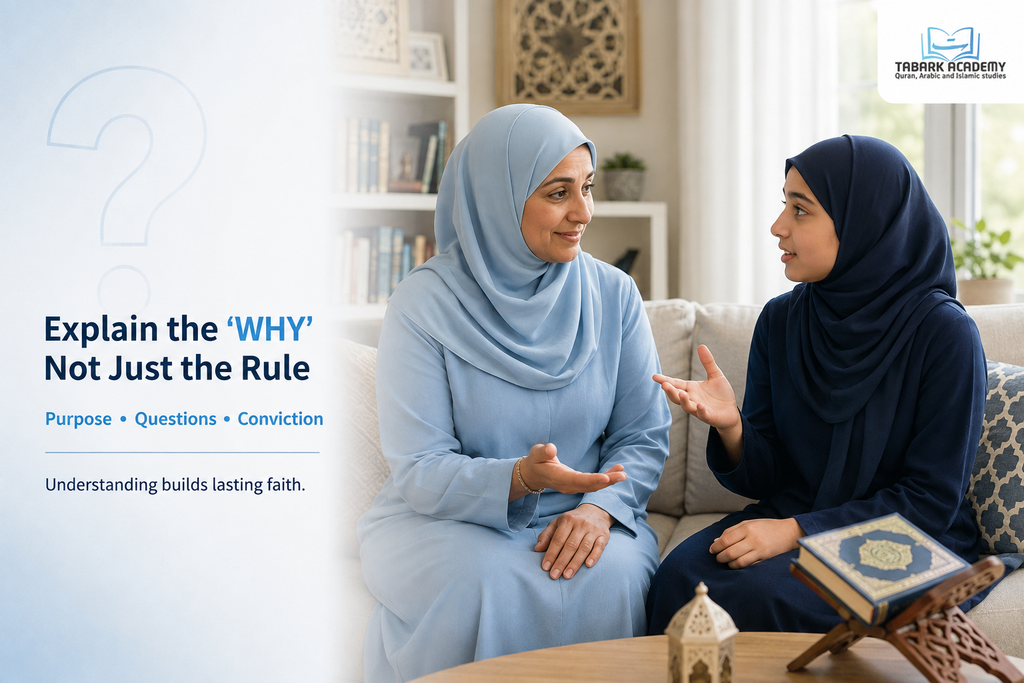
This is sometimes called the Maqasid-based approach: teaching the purpose behind Islamic law, not only its letter. A child who understands why prayer builds discipline, or why honesty is commanded, is far better equipped to hold onto that belief when nobody is enforcing it than a child who only memorized that it is required.
Just as important is creating space for the child to ask questions and voice doubts without fear of being shut down. This kind of dialogue is what keeps Children Identity resilient outside the home, because a child who understands the reasoning doesn’t need to hide behind rules they can’t defend. A question asked and answered patiently builds identity; a question punished or ignored tends to push a child’s faith underground.
Step Inside Our Virtual Classrooms
See our engaging teaching methods in action! watch real snippets of our live classes and discover how our expert instructors make learning interactive, memorable, and inspiring for every student.
Give Your Child a Strong Foundation in Islamic Identity Today
Preserving your child’s Islamic identity in the West is not something that happens by accident — it’s the daily work behind healthy Children Identity, built through a structured, guided approach to faith, language, and community.
Tabarak Academy’s Islamic Studies programs are built specifically to help Muslim families raise children who are confident in their beliefs wherever they live.
Our Islamic Studies Courses:
- Online Islamic Studies Classes
- Islamic Studies for Beginners
- Islamic Studies Classes for Kids
- Islamic Studies for Adults
- Islamic Studies for Ladies
- Islamic Studies for New Muslims
- Tafseer Al Quran Course
- Quranic Sciences (Uloom Al Quran) Course
- 5 Pillars of Islam for Kids
- Islamic Summer Camp
Conclusion
Raising a child with a strong Islamic identity in the West comes down to five connected habits: building a real Aqeedah through example rather than instruction, keeping children emotionally attached to the mosque and Islamic occasions, teaching Islamic history through the stories of the Prophets, preserving a working connection to Arabic, and explaining the reasoning behind Islamic practice rather than just the rule.
None of these islamic faith practices work in isolation — a child who prays but never hears Arabic, or who knows history but never celebrates Eid at home, ends up with a fragmented Children Identity rather than a unified one.
This sense of belonging is strongest when all five habits are present together, consistently, from an early age — this is what real Children Identity looks like in practice. Parents who invest in this now are not just teaching religion — they are giving their children a foundation they will stand on for the rest of their lives.

FAQs
Parents raising Muslim children abroad tend to ask a similar set of questions about faith, language, and belonging. Here are direct answers to the ones that come up most often.
1. What does Islamic identity mean for a child raised in the West?
Islamic identity means a child believes in the core doctrine of Islam, feels proud to belong to it, practices its rituals consistently, and carries its values into daily life — even in a society where most people around them do not share those beliefs. This is the core of Children Identity work in Western communities.
2. How can parents build islamic faith practices into daily home life?
Parents can start with small, consistent habits: praying together when possible, reading or listening to Quran daily, and modeling honesty and kindness so the child sees faith practiced, not just discussed.
3. What age should children start learning about their faith identity?
There is no fixed age — the earlier the exposure, the more naturally it takes root. Simple habits like hearing Quran recitation or joining family prayer can begin as soon as a child can sit and listen, well before formal religious instruction starts.
4. How can Muslim families balance integration and faith preservation?
Balance comes from letting children participate fully in their wider community while keeping firm, non-negotiable habits at home — prayer, Quran, Arabic exposure, and mosque attendance — so integration doesn’t come at the cost of belonging.
5. Why does explaining the reasoning behind Islamic rules matter?
Children who only memorize rules without understanding their purpose are more likely to abandon them under peer pressure. Explaining the wisdom behind a practice gives a child a reason to hold onto it independently, not just because they were told to.