

How To Raise Children In Islamic Way? A Step-By-Step Guide For Parents
The Islamic way of raising a child starts with a single verse from the Quran:
“O you who have believed, protect yourselves and your families from a Fire whose fuel is people and stones.” (Quran, 66:6)
Childhood is considered the most important stage in building a child’s personality and abilities. That’s why Islam gives it special concern and holds parents to an enormous responsibility for their care, support, dealing, and education.
Our children are an amanah — a trust and a gift that Allah gives us — and the best way to take care of that gift is by raising them according to the guidelines of the Quran and the sunnah of Prophet Muhammad ﷺ.
Following this kind of child upbringing in Islam develops the emotional, spiritual, social, and intellectual parts of a child’s character, so that Islam’s goals are reflected across every area of their life.
This guide covers how to raise children in Islamic way — the three foundations you need, a practical age-by-age framework for applying them, and the mistakes that quietly undo good intentions.
A. Instilling the Islamic faith in the hearts of children
Instill the Islamic faith in the hearts of children and help them to acquire the necessary knowledge is where the islamic way of raising a child begins.
Establishing a sound doctrine is a very important matter since childhood. As this stage is the very dangerous and fundamental period in guiding children to the proper faith.
Parents should take advantage of a child’s clarity of mind and their natural gift for memorizing and understanding quickly.
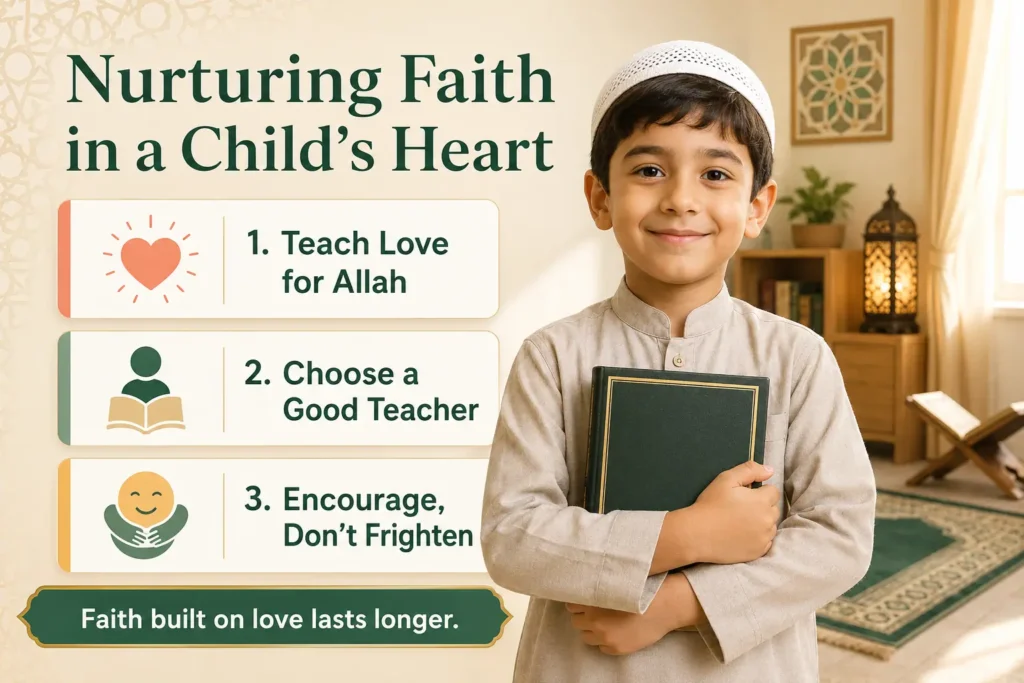
This happens through three specific practices:
1. Teach Them to Love Allah
Teach children to love Allah, since He is the One who brought us from non-existence to existence and gave us countless blessings without our asking.
A child who loves Allah will love His words, the Quran, and once they know that salah is a meeting with Allah, they will keep it no matter what and stop doing anything that displeases Him.
Say, [O Muhammad], “If you should love Allah, and then follow me, [so] Allah will love you and forgive you your sins. And Allah is Forgiving and Merciful.” (Quran, 3:31)
In practice, this means talking about Allah’s blessings in ordinary daily moments — a meal, a safe trip home, a recovery from illness — so a child associates Him with comfort and provision before they ever associate Him with rules.
2. Seek a Good Teacher
Seek a good teacher whose method is simple, interesting, and effective. This can be online or offline, but the teacher’s real job is to help a child understand and extract the good in what they learn, not just to explain it and move on.
A good teacher connects the child’s heart to Allah, is patient and inspiring, and works with the goal of earning Allah’s pleasure, not just finishing a lesson plan.
Our prophet Muhammad is the best teacher as Allah said about him:
“There has certainly come to you a Messenger from among yourselves. Grievous to him is what you suffer; [he is] concerned over you and to the believers is kind and merciful.”(Quran, 9:128)
That same patience and warmth is the standard worth looking for in any teacher you choose, including the instructors at Tabarak Academy.
3. Avoid Terrorizing Them With Fear
Do not focus on terrorizing them regarding hell fire and Allah’s punishment. Since children have an enhanced sense and are young, we shall not terrorize them by any means because it brings its opposite result and instead of making them love Islam and follow it they may be away from it .
There are many styles can be used to teach kids like, encouragement and motivating. A parent can encourage his child by different ways like giving a kiss, a smile, praising, hugging and other means that make the child happy.
A scholar recommended his son’s teacher saying’’ Do not discipline him by anything except praising and nice words as he is not from the type that is disciplined by beatings and torture’’
The same advice applies to most children — faith built on love holds far longer than faith built on fear.
B. Integrate the previous part with the worshipping part
Worshipping is the complete obedience of Allah, the practical part of Islam, and the translation of faith — which is the theoretical part — into action. This is the islamic way of training a child to worship: children should learn how to worship Allah and be trained to pray and fast from a young age, so that worship becomes a lived habit rather than a rule imposed later.
Getting this sequence right — faith first, then worship — is a core part of how to raise children in Islamic way, not two separate lessons taught in isolation.
For example, when learning salah, parents shall start teaching kids the pillars and duties of praying. Prophet (peace be upon him) defined the age of seven as the start of learning.
Sabrah bin Ma’bad Al-Juhani (May Allah be pleased with him) reported; Messenger of Allah (ﷺ) said, “Teach a boy Salat (the prayer) when he attains the age of seven years, and punish him (if he does not offer it) at ten”. ( Riyad as-Salihin)
What Age Should a Child Start Learning Salah?
A child should start learning salah around age seven, with the three years that follow used for practice and gentle correction, not punishment. The gap between seven and ten is intentional — it gives the habit time to form before any consequence is introduced, and it’s a core part of the islamic way of training a child to worship rather than simply comply.
Getting the recitation right during this stage matters as much as getting the timing right.
If a child is going to build their salah around Quran they’ve memorized, learning it with correct tajweed from the beginning prevents habits that are harder to unlearn later, which is exactly what a structured Recitation of Quran with Tajweed Course is designed for.
Experience Our Interactive Learning
Curious about how we teach? Watch these brief video clips from our recent live sessions to see our structured curriculum, advanced learning platform, and dynamic student-teacher interactions firsthand.
C. Give Children A Strong Moral Education
When it comes to how to raise children in Islamic way, moral character is often the piece parents assume will develop on its own — but it needs the same intentional effort as faith and worship. Morals are the spirit of Islamic upbringing, so parents must be aware that a child needs support in their manners and character, not just their worship.
This is the part of child upbringing in islam that is easiest to overlook, because it isn’t taught in a single lesson — it’s built through daily example. Allah said about Prophet Muhammad ﷺ:
“And indeed, you are of a great moral character.” (Quran, 68:4)
And when the Prophet ﷺ was asked,
“Which Muslim has the most perfect faith?” he answered: “He who has the best moral character.” (At-Tabarani)
Parents should teach children manners, and this includes politeness with parents specifically. Allah said:
“And your Lord has decreed that you not worship except Him, and to parents, good treatment. Whether one or both of them reach old age [while] with you, say not to them [so much as], ‘uff,’ and do not repel them but speak to them a noble word.” (Quran, 17:23)
Lead With Kindness Before Correction
Kindness is what makes correction effective rather than resented. The Prophet ﷺ said,
“A’isha, verily Allah is kind and He loves kindness” (Sahih Muslim 2593).
A child who feels loved is motivated to obey; a child raised under constant harshness tends toward either open stubbornness or quiet dishonesty out of fear of the consequences.
Parents teach morals by example even more than by instruction — a well-known hadith illustrates this directly.
When the Prophet ﷺ heard a mother call her son over, promising to give him something, he asked what she meant to give. She said dates. He told her, “If you were not to give him anything, a lie would be recorded against you” (Sunan Abi Dawud, 4991).
Children learn integrity from what they watch, not only from what they’re told. To make your children get close to Allah and learn about other aspects of the deen, let them join our course on Islamic Studies.
The 7-7-7 Framework: A Practical Timeline for Islamic Child Upbringing
The three foundations above answer what to teach. When to teach it matters just as much to child upbringing in islam, and a widely cited framework helps put the pieces in order.
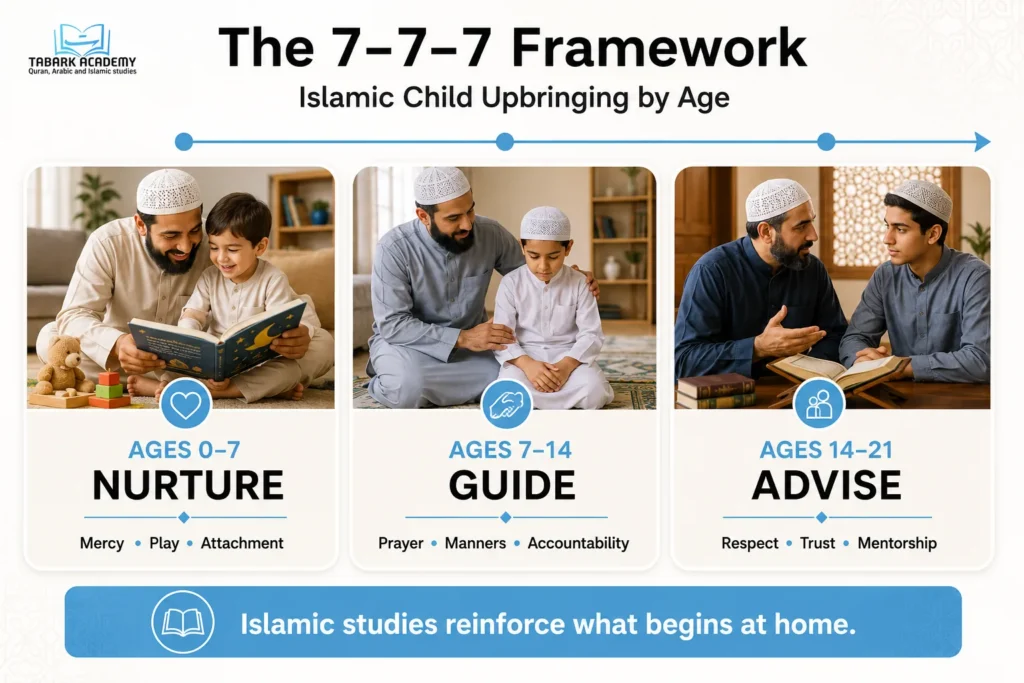
Ages 0–7
At this stage the priority is attachment, not correction. The Prophet ﷺ kissed young children, played with them, and carried them during prayer.
When a man admitted he never kissed his ten children, the Prophet ﷺ replied: “Anyone who does not show mercy will not be shown mercy.” ( Al-Adab Al-Mufrad 371)
Harsh discipline this early produces fear rather than understanding.
Ages 7–14
This is when the salah hadith above applies directly, alongside structure, manners, and accountability.
Al-Ghazali described a child at this stage as “a trust… his heart is pure and receptive — if trained in goodness, he will grow upon it.” Discipline here should be firm and dignified, never harsh for its own sake.
Ages 14–21
Teenagers respond to respect, not orders. Control that stays authoritarian at this stage tends to produce rebellion or secrecy; the parent’s role shifts from enforcer to advisor.
This is also the stage where a child ready for real commitment can pursue certified mastery of their recitation — an Online Ijazah Course turns years of home tarbiyah into a formal, chain-of-transmission qualification.
How Islamic Studies Cultivate Children?
Islamic studies cultivate children comes down to reinforcement: structured classes back up what’s taught at home; they don’t replace it.
A child who only hears about faith, worship, and morals informally from a parent tends to have gaps — a dedicated curriculum covers aqeedah (belief), akhlaq (character), and seerah (Prophetic biography) with a depth and consistency that daily home life doesn’t always allow for.
Part of learning how to raise children in Islamic way is realizing you don’t have to do it entirely alone.
A structured Islamic studies course works well alongside home upbringing because it gives a child regular, guided exposure to belief and character-building, taught by someone trained specifically for that purpose, on a schedule a busy household can maintain.
Common Mistakes Parents Make When Raising Children in the Islamic Way
Most of what goes wrong traces back to a handful of avoidable errors in how to raise children in Islamic way, not a single bad decision.
- Reversing the age stages: Disciplining harshly during the 0–7 love-and-play years, then trying to build friendship with a teenager for the first time at 16, undoes the trust both stages depend on.
- Punishing every misdemeanor: Treating small, age-typical mistakes the same as serious ones teaches a child to hide things rather than admit them.
- Terrorizing instead of teaching: Leading with hellfire and punishment before a child has any love for Allah tends to push them away from Islam, not toward it.
- Inconsistency between words and actions: A parent who demands honesty while lying “just this once” in front of their child is teaching the exception, not the rule.
Step Inside Our Virtual Classrooms
See our engaging teaching methods in action! watch real snippets of our live classes and discover how our expert instructors make learning interactive, memorable, and inspiring for every student.
Enroll Your Child in Tabarak Academy’s Islamic Studies Course Today
Your child’s faith, character, and Islamic identity deserve more than occasional conversations at home.
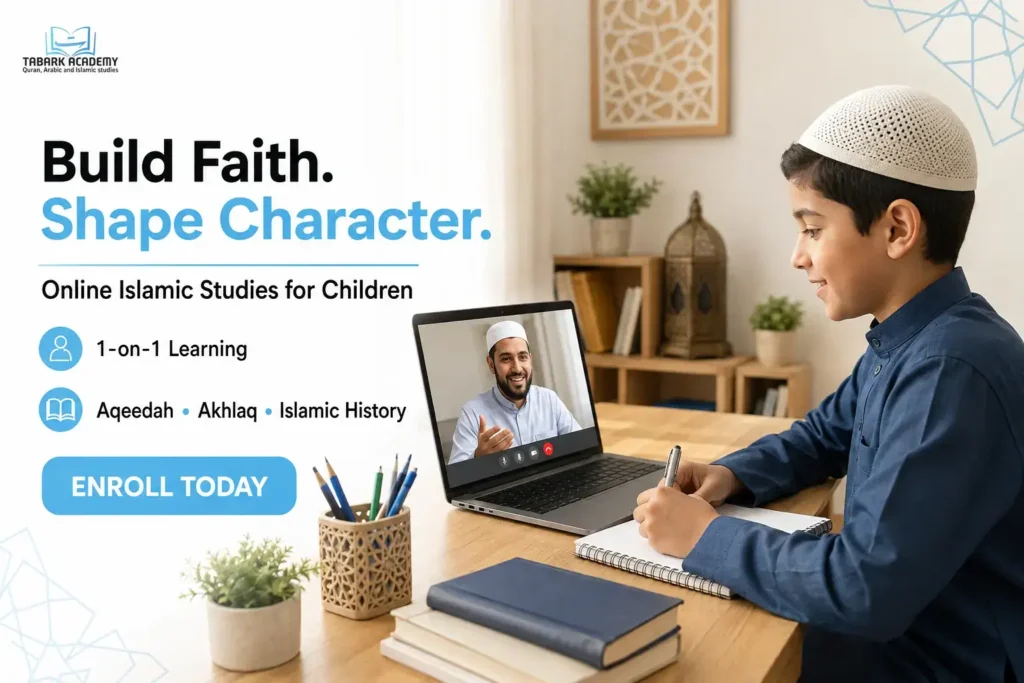
Tabarak Academy’s Islamic Studies Course gives your child structured, one-on-one learning in aqeedah, akhlaq, and Islamic history — taught by instructors trained to make it engaging rather than a chore, at a pace that fits your family’s routine.
Our Courses:
- Online Quran & Arabic Classes | Foundation
- Online Quran Memorization Course
- Modern Standard Arabic Online Course (Fusha)
- Online Ijazah Course
- Recitation Of Quran with Tajweed Course
- Islamic Studies Course Online
Conclusion
Understanding how to raise children in Islamic way isn’t about memorizing rules — it’s about applying a few things in the right order, consistently. The islamic way of raising a child comes down to three things done consistently: building faith through love rather than fear, training worship early enough that it becomes habit, and modeling the moral character you want your child to hold.
Applying these in the right order — love first, then discipline, then friendship, as the 7-7-7 framework lays out — prevents most of the mistakes that undo good intentions.
Child upbringing in islam isn’t a task you complete; it’s a trust you carry for as long as your child is in your care.
Reinforce it with structured Islamic studies where you can, correct with kindness more often than punishment, and remember that the goal is a child who chooses good because they were raised to love it, not one who only obeys out of fear.

Frequently Asked Questions About Raising Children in Islam
Here are quick, direct answers to the questions parents search most often about raising and disciplining children the Islamic way.
1. What is the Islamic way of raising a child?
The islamic way of raising a child rests on three foundations: instilling love for Allah before fear of Him, training the child to worship through salah and fasting from around age seven, and modeling strong moral character at home. All three develop together, not in isolation.
2. What is the Islamic way of training a child to worship?
The islamic way of training a child to worship starts around age seven with the pillars of salah, using seven years of practice and encouragement before any correction is introduced at age ten, based on the Prophet’s ﷺ own guidance.
3. How do you discipline a child in Islam without being too harsh?
Discipline in Islam should follow kindness, explanation, and clear boundaries — punishment is a last resort. The Prophet ﷺ said, “Verily Allah loves kindness in all things,” and correction that targets the behavior rather than the child’s sense of being loved works far better than harshness.
4. What does the Quran say about raising children?
The Quran frames children as part of a parent’s responsibility before Allah: “Protect yourselves and your families from a Fire whose fuel is people and stones” (66:6). It also commands good treatment of parents in return (17:23), making child upbringing in islam a two-directional responsibility between parent and child.
5. How do Islamic studies cultivate children’s faith and character?
How islamic studies cultivate children’s faith and character comes down to reinforcing aqeedah, akhlaq, and Islamic history with a depth and consistency a busy household can’t always provide alone. Structured classes give a child regular exposure to belief and character-building alongside what’s taught at home, rather than replacing it.