


8 Best Apps For Quran Memorization – Compared For Hifz Students
Memorizing the Quran is unlike memorizing any other text. Every verse has to come back letter-perfect, with correct Tajweed, sometimes years after you first learned it. That is why the search for the best apps for Quran memorization is really a search for one thing: a tool that makes daily revision actually happen.
This guide compares eight apps that earn their place on a Hifz student’s phone, each reviewed for what it does well, where it falls short, and who it suits.
If you recite alone, Tarteel, SABR, and Hifz AI are the three apps that check your recitation. If revision is your weak point, Quran Companion and Al Muhaffiz organize it. If you need raw repetition, the Quran.com app and Ayah loop a verse as many times as you set. The rest of this guide covers each in detail.
At Tabarak Academy, our teachers see the same pattern every term: students who finish Hifz pair a qualified teacher with one or two apps, not eight apps and no teacher.
1. Tarteel AI
Tarteel is built around recitation checking, which makes it the first install for anyone who recites alone with nobody to correct them between lessons.
You hide the verses, recite, and the AI flags word-level errors, skipped words, and wrong vowel marks as you go.
Memorization Mode lets you set a verse range and recite it back for verification, and Smart Goals can target memorization, revision, or reading — reviewing Juz 30, for example.
Both of those sit on the Premium plan, along with live mistake detection and hidden-verse mode; the free tier gives you the Mushaf, audio, and search. It runs on iOS, Android, and the web, and the voice features need an internet connection. Its listing does not describe looping a single verse.
Tarteel hears that you dropped a word because it matches your recitation against the text. It cannot hear that your qaf is coming out as a kaf, since that depends on where the letter is articulated from — and those are the errors that set hardest.
2. SABR
SABR pairs an AI recitation coach with a spaced-repetition schedule, wrapped in a Duolingo-style learning path, which is why it suits absolute beginners and restarters who need structure more than feedback.
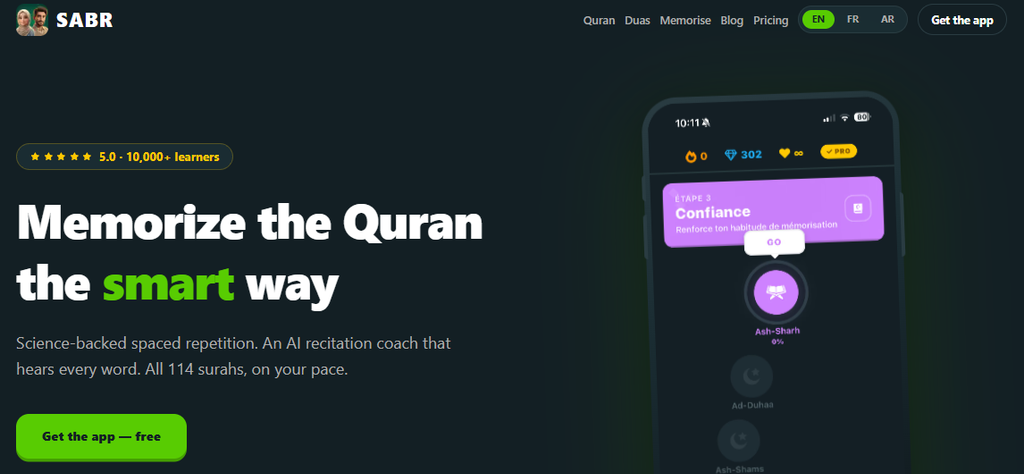
Its site describes word-level feedback with Tajweed-aware scoring, ayah-by-ayah lessons with adjustable repetition, XP, streaks, and daily reminders.
It is available on iOS and Android, free to start, with several plans — Al-Fatihah, Ya-Sin, Al-Mulk, Al-Kahf — marked free and the standard path covering the full Quran.
Its pages do not describe looping a verse on demand, so students who learn by heavy repetition of one ayah will want a second app for that, and the community features are thinner than in Quran Companion.
3. Quran Companion
Quran Companion wraps spaced repetition around the Mushaf and adds group accountability, making it the natural pick for students who struggle to show up daily and want a curriculum plus peers.
You set a daily goal, and the app delivers today’s new verses plus the old verses scheduled for review.
Streaks, badges, and shared progress are built in, which matters because Hifz is, at its core, a habit problem. It runs on iOS and Android with a free tier and paid subscription.
There is no recitation listening, so the app cannot verify that you said the verse correctly, and some learners find the gamification quietly becomes the goal instead of the Hifz.
4. Hifz AI
Hifz AI runs two modes, which is what makes it the one app to try if you want repetition and a mistake check in the same place. Hifz Mode is a listen–pause–repeat loop where you set the number of repetitions and the delay.
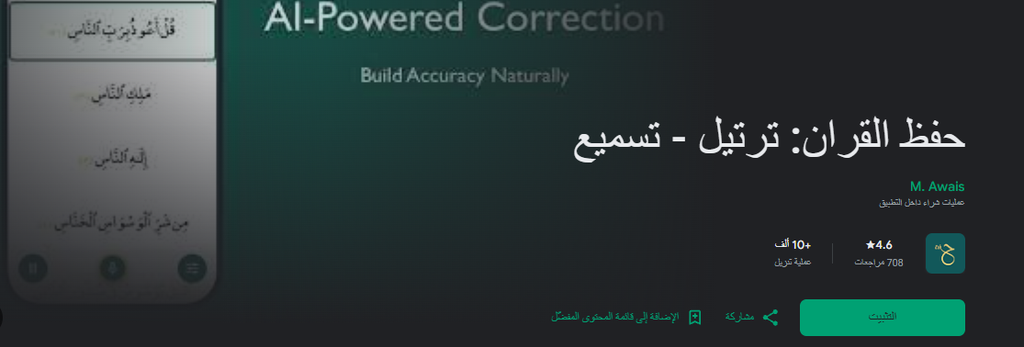
Its AI mode marks mistakes in red and correct words in green, on-device. Its listing describes custom ayah ranges, offline surahs, seven Arabic scripts, and playback speeds from 0.5× to 2×, on iOS and Android, free to try with paid plans.
Neither its site nor its listing describes a review schedule, so revision planning stays on you, and the app is new, with a small review base. The free AI allowance is limited and the exact number is not stated.
5. Al Muhaffiz
Al Muhaffiz is built for the classical Hifz routine, so it fits students whose teacher already works that way and wants a digital tracker for it: new memorization (today’s lesson), recent revision (yesterday’s), and distant revision (the long rotation), each tracked separately.

It also offers A–B repeat, verse highlighting, hide-the-verse self-testing, and downloadable audio, free on iOS, Android, and the web.
The three-track split is what sets it apart: most apps merge all old material into one review queue, while Al Muhaffiz keeps yesterday’s lesson separate from the long rotation — the same separation a Hifz teacher enforces in class.
The interface looks dated, there is no recitation listening, and it is restricted to a single script — a problem if you memorized from an IndoPak Mushaf.
6. Ayah (Quran App)
Ayah is open-source and maintained by IslamicNetwork, which makes it the right choice for students who want a tool rather than a product and bring their own discipline.

Clean Mushaf view, multiple reciters, verse-by-verse repeat with adjustable count and pause, bookmarks, and a personal memorization tag. It is completely free on iOS and Android, with no ads and no in-app purchases.
The development pace is slow and new features arrive rarely, so do not install it expecting the feature set to grow around you.
7. Quran.com App
The Quran.com app has the strongest repeat settings of any free option, which is why it works best as the reading and listening layer beside a memorization-first app.
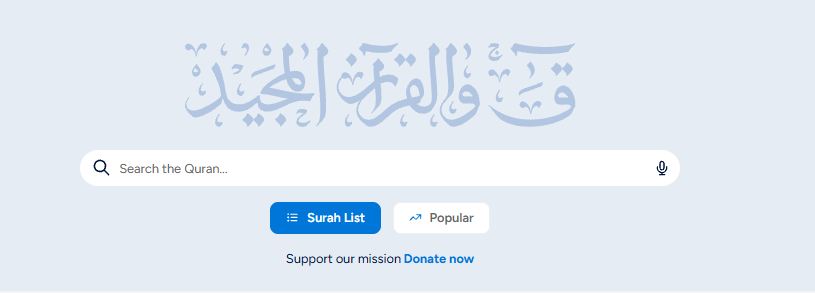
Repeat counts run from 1 to 100, with looping, adjustable pauses, and playback speeds from 0.25× to 2×, and repeat counts for verses and ranges are remembered between sessions.
Word-by-word view, reading goals with streaks, and grouped bookmarks round it out, free and ad-free on iOS, Android, and the web.
It does no recitation checking and schedules no revision, so on its own it is a reference layer rather than a Hifz system.
Read also: What Is Idgham Shafawi?
Start Your Quran Learning Journey
Join Tabark Academy today for structured online lessons with qualified tutors, customized to fit your goals.
Book Your Free Trial Lesson8. Quran Majeed
Quran Majeed is not strictly a memorization app, but its repeat function and reciter library are deep enough to support revision, which suits students who want a single app for reading, Tafsir, and Hifz rather than a stack.
Its Tafsir layer — multiple translations and commentaries — is the strongest on this list, alongside four script choices, offline audio, and prayer utilities, on iOS, Android, and Windows with a free tier and Premium.
The memorization tools are an add-on rather than the core, and the free version carries ads that interrupt a focused revision session.
Comparison Table: Best Apps for Quran Memorization at a Glance
The table below maps each app against the three features that matter most for Hifz. “Yes” and “No” mean the app’s own site or listing confirms or rules out the feature; “Not stated” means it is not described either way, not that it is missing.
| App | Recitation listening | Verse looping | Revision scheduling | Price |
| Tarteel AI | Yes | Not stated | No — goal setting only | Free + Premium |
| SABR | Yes | Not stated | Yes — spaced repetition | Free to start |
| Quran Companion | No | Not stated | Yes — spaced repetition | Free + Premium |
| Hifz AI | Yes | Yes — set count and delay | Not stated | Free to try + paid |
| Al Muhaffiz | No | Yes — A–B repeat | Yes — manual three-part tracking | Free |
| Ayah | No | Yes — set count and pause | No | Free |
| Quran.com app | No | Yes — 1 to 100 repeats | No — reading goals only | Free |
| Quran Majeed | No | Yes | Not stated | Free + Premium |
What Makes An App One Of The Best Apps For Quran Memorization
Not every Quran app helps with Hifz. Most display the Mushaf and stop there. Six features decide whether an app belongs in a memorization routine.
1. Recitation Listening
Recitation listening means the app hears you recite and flags mistakes in real time. It is the single most valuable feature, because it tests recall instead of letting you reread. Without it, you are reading the Mushaf with extra steps.
2. Verse-by-Verse Repetition Control
Repetition control is the ability to loop one verse, or a custom range, with an adjustable repeat count and a pause between repeats.
A new verse settles through hearing it many times in a row with a gap long enough to attempt it from memory. An app that plays a verse once and moves on forces you to restart playback by hand after every attempt, and that friction is what ends a session early.
3. Spaced Repetition for Revision
Spaced repetition schedules old material to resurface at intervals matched to how memory decays. Hifz collapses without it.
A practitioner rule worth remembering: the bottleneck in Hifz is almost never memorizing new verses, it is protecting the old ones.
4. Reciter Selection With a Consistent Qira’ah
Pick one reciter — Al-Husary, Al-Minshawi, Al-Sudais, Mishary — and stay with them through a whole Juz.
Switching reciters mid-Juz is a common cause of collapse, because your ear is memorizing a rhythm, not only words.
5. Mushaf With a Line-Locked Layout
A line-locked layout keeps each page identical every time you open it.
Hifz students memorize the position of a verse on the page — top-left, third line, end of the page — so a layout that reflows text with font size breaks that visual recall. Most Hifz schools teach from the 15-line Madani Mushaf, which is why matching your app to the Mushaf you memorized matters more than the app’s styling options.
6. Offline Mode
Offline mode means audio downloaded ahead of time. Revision happens on buses, in waiting rooms, and in places with no signal. If audio needs a connection, revision quietly stops.
How To Actually Use The Top Apps For Quran Memorization In A Hifz Routine
The most common mistake is downloading four apps and using none of them. Pick one for feedback and one for structure, then stop. Two apps used daily beat eight used occasionally.
The Two-App Rule
Choose one feedback app (Tarteel, SABR, or Hifz AI) and one structure app (Quran Companion or Al Muhaffiz). Add a free reader such as the Quran.com app only if your main app lacks a Mushaf view you like.
A Daily Flow That Works:
- Morning, 15–20 minutes: today’s new verses. Play your chosen reciter, repeat each verse while looking at the Mushaf, then repeat it from memory.
- Midday or commute, 10 minutes: let Tarteel, SABR, or Hifz AI listen to today’s new verses and flag mistakes.
- Evening, 15 minutes: open Quran Companion or Al Muhaffiz for yesterday’s lesson plus the scheduled rotation, and recite aloud.
- Before Salah: revise the verses you will recite in your Fard prayers.
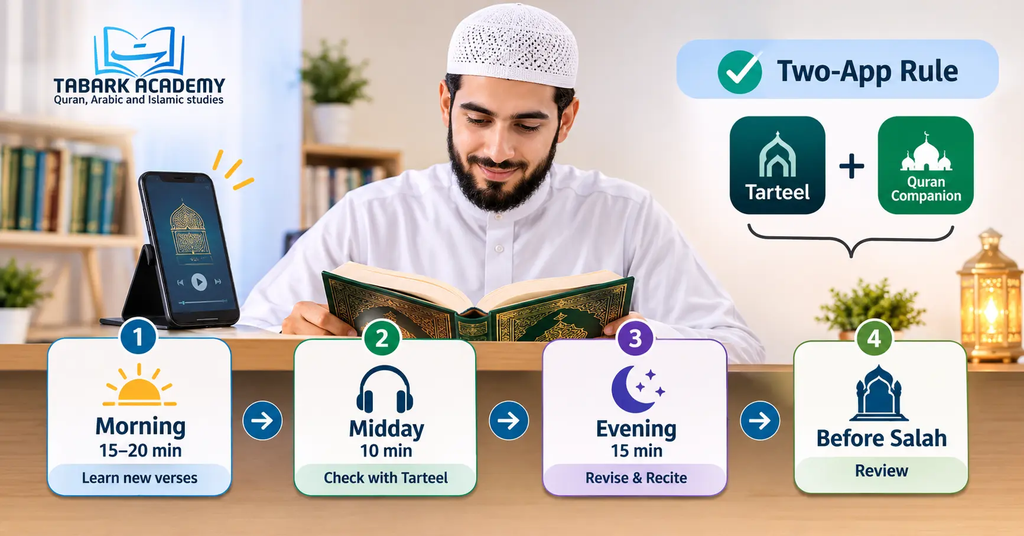
In our teachers’ experience at Tabarak Academy, run consistently, this pattern adds a few new lines a day for adults with full schedules, and considerably more for full-time students.
The Mistake That Costs the Most Time
Students almost never fail at adding new verses — they fail at protecting old ones. Even the best apps for Quran memorization cannot rescue a session with no fixed revision block before the new lesson. Build revision first, then add new memorization with whatever time remains.
Read also: How Many Counts Is A Ghunnah?
Why can’t apps correct your Tajweed?
An app matches your recitation against the text. A teacher matches it against the makharij — the articulation points of each letter — and the rules of Tajweed.
That difference is why Tarteel and Hifz AI catch dropped and swapped words but still miss the degrees of madd, the difference between idghaam with and without ghunnah, and the subtleties of ikhfa.
A teacher also does two things no app does: paces the load, deciding when to push and when to consolidate, and provides accountability that a streak can only imitate.
A single trial lesson with a Tabarak Academy teacher is usually enough to surface the two or three articulation habits an app has been scoring as correct for months.
Start Your Quran Learning Journey
Join Tabark Academy today for structured online lessons with qualified tutors, customized to fit your goals.
Book Your Free Trial LessonStart Your Hifz With A Teacher And The Right App
Apps make daily revision happen. A teacher makes Hifz finish. At Tabarak Academy, every Hifz student gets a one-to-one qualified teacher, a structured schedule of new memorization and three-part revision, and regular progress checks — the framework that turns daily practice into a completed Hifz.
Lessons are one-to-one, your pace is yours, and the trial is a real lesson, so you hear how the teacher corrects you before you commit.
Our Tajweed Courses:
- Online Tajweed Classes
- Tajweed Course for Beginners
- Tajweed Course for Kids
- Tajweed Course for Adults
- Tajweed Course for Sisters
- Advanced Tajweed Course
- Amali (Practical) Tajweed Course
- Learn Quran with Tajweed
- Learn Quran with Tajweed for Kids

Conclusion
The best apps for Quran memorization are the ones matched to your actual bottleneck. If you recite alone with no one to correct you, start with Tarteel, SABR, or Hifz AI. If you are learning new verses, choose an app with real looping control such as the Quran.com app, Hifz AI, or Ayah.
If revision is where you slip, Quran Companion schedules it for you, and Al Muhaffiz gives you the three-part structure to track it yourself. If you keep dropping the habit entirely, the streak-driven apps exist for exactly that problem.
One takeaway holds across all eight of the top apps for Quran memorization: an app is the second tool, never the first. The first is a teacher who hears you recite. Pair one or two of these apps with structured lessons at Tabarak Academy, and the daily habit turns into a finished Hifz.
Frequently Asked Questions About Quran Memorization Apps
These are the questions Hifz students ask most often before choosing between the best apps for Quran memorization, answered briefly so you can decide quickly.
1. Are the best apps for Quran memorization free?
Most offer a free tier. Ayah and the Quran.com app are completely free with no paid tier. Al Muhaffiz is free with no upgrade. Tarteel, SABR, Quran Companion, and Hifz AI charge for premium features such as unlimited AI verification and offline downloads.
2. Which Quran memorization app is best for kids?
Apps built around pattern repetition and a 15-line Madani Mushaf suit children best, because they match how the Quran is taught in classrooms. For older children who can recite back, Tarteel adds verification. Neither replaces a teacher hearing the child read, which is what Tabarak Academy’s children’s classes are for.
3. Can an app correct my Tajweed?
No. An app verifies words; Tajweed is about how each letter is produced, which needs an ear trained on the makharij. The practical workaround is to record one page a week and have a teacher review the recording, so errors get caught within days instead of hardening over a whole Juz.
4. Can I memorize the Quran without a teacher?
You can start with apps and self-study, but very few people finish Hifz alone. The bottleneck is correction, pacing, and revision discipline rather than memorization itself. Pair an app with at least a weekly check-in with a qualified Quran teacher.
5. Can I use more than one of these apps together?
Yes, and most serious students do. The common stack is one memorization-first app for structure, one AI app for feedback, a free reader such as the Quran.com app, and a teacher for Tajweed. Keep the stack as small as you will actually use.
6. How much time does Hifz with a teacher actually take?
Most working adults keep one or two one-to-one lessons a week plus 30 to 40 minutes of daily practice on their own. The lesson is where errors get caught; the daily block is where the memorization is actually built. The trial lesson at Tabarak Academy is free, so you can test the schedule before committing to it.