

How To Recite Quran With Emotion Without Over Singing?
Have you ever finished a recitation and wondered whether you were focused on Allah’s words or on your own voice? Many learners run into this. They want their recitation to move the heart, but they drift into dramatic tunes, long held notes, and borrowed vocal tricks that pull attention away from the meaning.
Learning how to recite the Quran with emotion without over singing comes down to one principle: meaning comes first, and the tune follows it. Humility (khushu’) in recitation grows from understanding and reflection (tadabbur). A calm, sincere tone then follows the words on its own, without being performed for its own sake.
This guide gives you 10 practical steps, a simple self-check to tell emotion apart from over-singing, and a weekly practice routine. It draws on the method the teachers at Tabarak Academy use with students of every level.
The steps below are arranged as a progression. The first two build the inner connection, the middle steps set the technical limits, and the last steps shape your voice within those limits.
1. Read A Simple Tafsir Before You Recite
Reading a short explanation of the verses before you recite is the most reliable way to feel emotion without forcing it. Once you know the context of a passage, what its key words mean, and whether it describes mercy, warning, or a story, your tone adjusts on its own.
A practical routine is to read the tafsir of 5 to 10 verses from an accessible English commentary, then recite those same verses right away. The Quran itself describes its purpose:
“And this Qur’an has been revealed to me that I may warn you thereby and whoever it reaches” (Al-An’am 6:19). Recite as if you are one of the people it has reached.
2. Treat Every Verse As Addressed To You
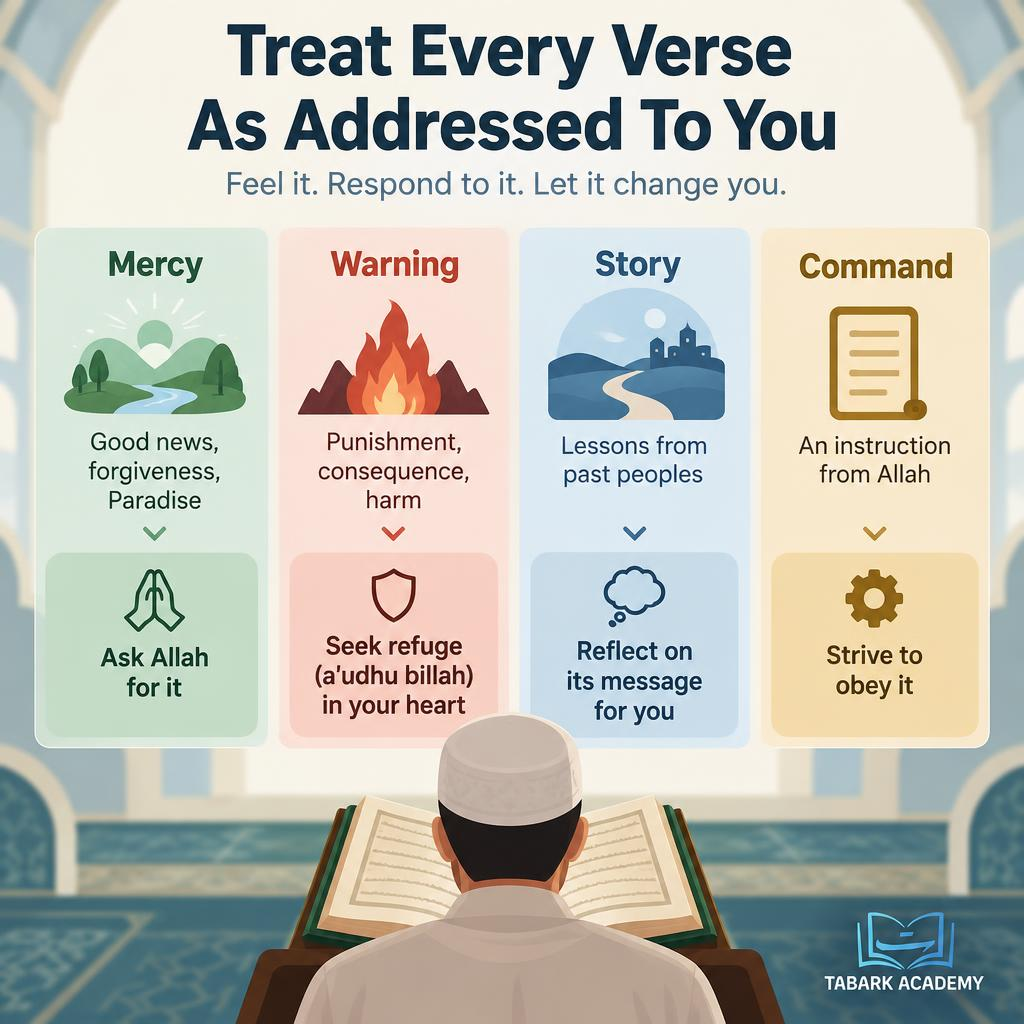
Emotion in recitation comes from feeling that the verses speak to you personally. The Prophet ﷺ modeled this. When he passed a verse of mercy, he asked Allah for it. When he passed a verse of punishment, he sought refuge.
In practice, pause briefly after a verse about Paradise and make a short, silent du’a. After a verse of warning, say “a’udhu billah” in your heart. These small responses bring real feeling into your voice, and nothing about them is performed.
3. Let Tajweed Set The Limits Of Your Voice
Tajweed is the built-in safeguard against over-singing. The rules fix how long each sound lasts, how strong each nasal sound is, and where each letter comes from. A reciter who follows them precisely cannot stretch a vowel just to hold a nice note.
The clearest test is madd (elongation). A natural madd is 2 counts. Connected and separated madd are usually 4 to 5 counts, and a necessary madd is 6.
Over-singing usually shows up when a reciter extends a 2-count natural madd to 5 or 6 counts because the melody “needs” it. That changes the recitation. It does not beautify it.
If your Tajweed foundation is shaky, a structured Quran Reading Course at Tabarak Academy will give you precise madd counts and correct letter articulation before you work on expression.
4. Give Every Letter Its Full Right
Clear articulation (makharij) gives recitation weight and dignity on its own. When each letter comes from its correct point in the throat, tongue, or lips, with its proper qualities (heavy or light, whispered or voiced), the voice sounds reverent without any added ornament.
Umm Salamah described the Prophet’s ﷺ recitation as distinct, “letter by letter.” That description of recitation that moves people says nothing about tune. It is about clarity.
Experience Our Interactive Learning
Curious about how we teach? Watch these brief video clips from our recent live sessions to see our structured curriculum, advanced learning platform, and dynamic student-teacher interactions firsthand.
5. Beautify Your Natural Voice Without Imitating Musical Maqamat
Lawful taghanni means improving the voice you already have. It does not mean copying complex musical scales. The Prophet ﷺ said:
“Beautify the Quran with your voices” (Abu Dawud). In another narration he said: “He is not of us who does not recite the Quran in a pleasant tone” (Riyad as-Salihin).
The best way to recite the Quran with emotion without over singing is to find the comfortable middle range of your voice and stay mostly within it.
Do not reach for extreme high notes to impress. Classical scholars disliked recitation built on musical alhan that distorts letters or adds sounds that do not belong. The limit they drew was where the letters and rules begin to suffer, not beauty itself.
6. Learn from great reciters, but don’t copy their vocal flourishes
Listening to skilled reciters trains your ear for pace, clarity, and restraint. The mistake is copying the flourishes too: sudden jumps in pitch, vibrato on the ghunnah, or long melodic cadences at the end of verses.
Copy their precision and their pauses. Leave their signature ornaments alone. Choose reciters known for a calm murattal style and imitate one verse at a time, paying attention to where they stop and how steady their pace is.
7. Choose stopping points by meaning, not by breath or melody
Correct waqf (stopping) and ibtida’ (starting) show that you understand what you are reading, and that understanding moves the listener more than any tune.
Stop where the meaning is complete. Do not stop because you ran out of breath or because the melody wanted a dramatic ending.
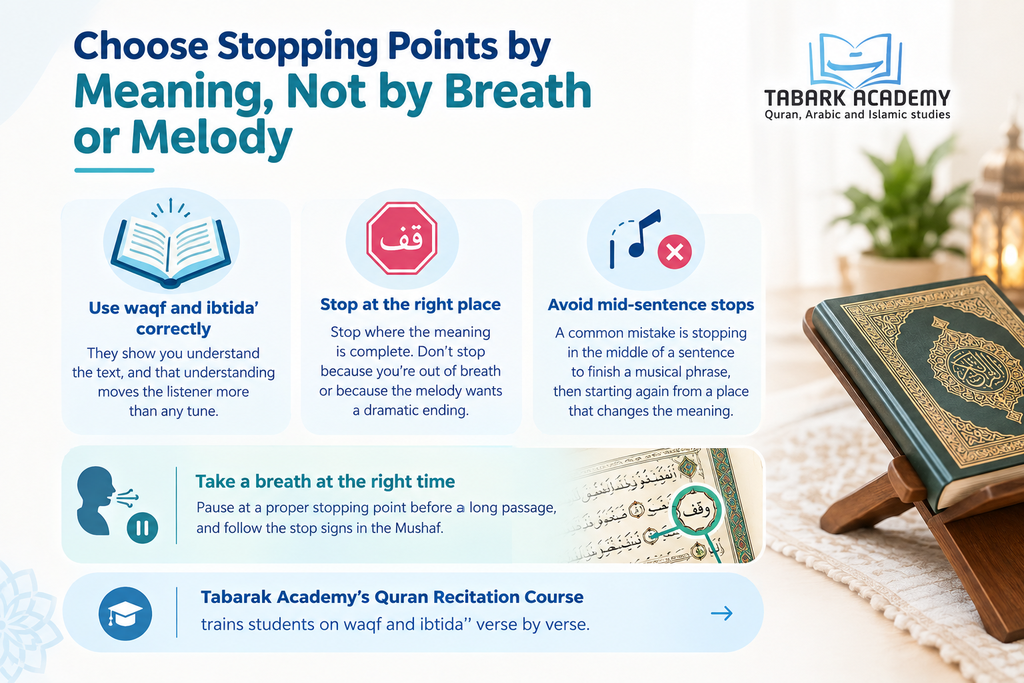
A common mistake is stopping in the middle of a sentence to finish a musical phrase, then starting again from a place that changes the meaning.
Take a breath at a proper stopping point before a long passage, and follow the stop signs in the Mushaf. Tabarak Academy’s Quran Recitation Course trains students on waqf and ibtida’ verse by verse.
8. Recite Slowly And Calmly (Tartil)
Allah commands: “And recite the Qur’an with measured recitation” (Al-Muzzammil 73:4). Tartil means a calm, unhurried pace. Speed wipes out humility, and exaggerated stretching takes the recitation outside its proper limits.
Choose the pace that fits your level. Tahqiq (very slow) suits learners, and tadwir (moderate) suits everyday recitation. Both leave room for reflection.
Anas described the Prophet’s ﷺ recitation as having elongation (madd) in its proper places (Sunan an-Nasa’i). The key words are “in its proper places.”
9. Pick The Recitation Mode That Brings You The Most Focus
You don’t have to recite loudly to recite with emotion. When Aisha was asked whether the Prophet ﷺ recited aloud or quietly at night, she said he did both. The listener replied, “Praise be to Allah who made the matter broad.” (Sunan Ibn Majah)
When you recite alone, a clear, audible voice that isn’t loud often helps concentration. Imam al-Nawawi noted that reading from the Mushaf is generally better, unless reciting from memory brings you more reflection and presence of heart, in which case memory is better. Choose whatever keeps your heart present.
10. Renew Your Intention Before Every Session
The deepest cause of over-singing is reciting for listeners instead of for Allah. When the goal is admiration, the voice starts performing. Before you begin, seek refuge from Shaytan and quietly renew your intention: this recitation is for Allah alone.
Remember whose words you are reciting and that Allah is watching you as you recite. When the Prophet ﷺ asked Ibn Mas’ud to recite for him and he reached An-Nisa 4:41, the Prophet’s ﷺ eyes filled with tears. It was the meaning that moved him, not a melody.

Common Over-Singing Mistakes To Avoid
Over-singing rarely comes from one big decision. It usually creeps in through small habits, which is why some of the most practical recitations of the Quran with emotion without over-singing tips are about what to stop doing.
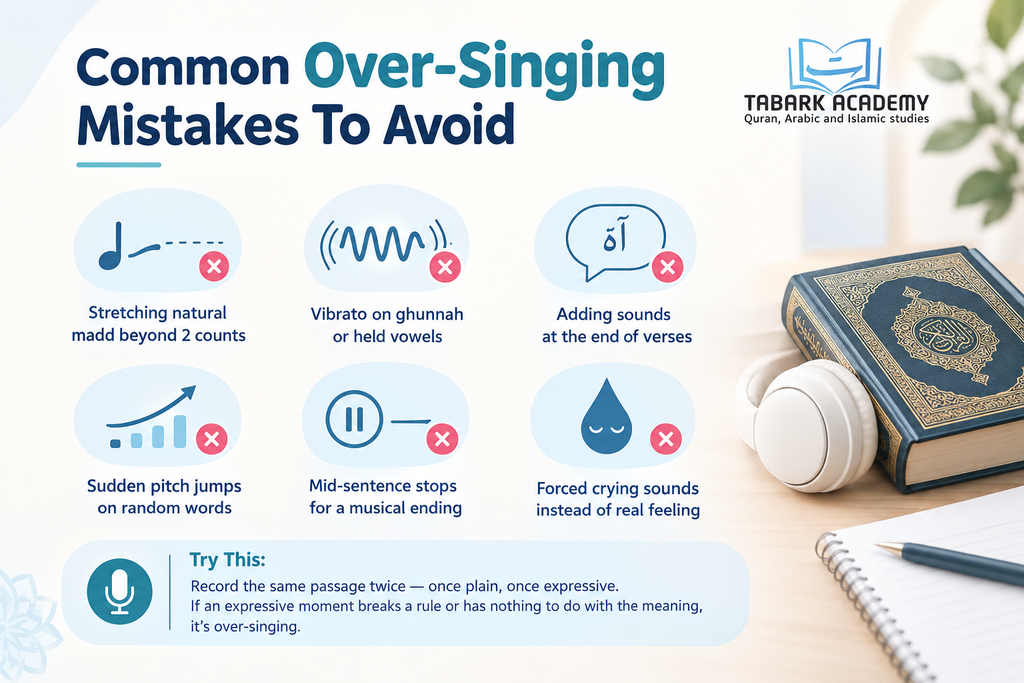
Teachers see these patterns again and again when they review students’ recordings:
- Stretching natural madd beyond 2 counts to finish a melodic phrase.
- Vibrato on ghunnah or on held vowels, which adds a musical tremor that doesn’t belong.
- Adding sounds, such as an extra “aa” or a hamza-like break, at the end of verses.
- Sudden pitch jumps on random words instead of gentle movement that follows the meaning.
- Mid-sentence stops made for a musical ending rather than a complete meaning.
- Forced crying sounds in place of real feeling that comes from understanding.
A useful exercise is to record the same passage twice: once in a plain, flat tone and once “expressively.” When you play them back, any expressive moment that breaks a rule or has nothing to do with the meaning is over-singing.
Tabarak Academy teachers often review student recordings this way, because a trained ear catches in minutes what a learner might miss for months.
A Simple 7-Day Practice Plan
Short daily practice builds controlled, emotional recitation faster than long, irregular sessions. This plan takes 15 to 20 minutes a day, using a short surah such as Al-Asr, Al-Ikhlas, or Al-Fatiha.
| Day | Activity | Focus |
| 1 | Read tafsir, then recite slowly | Meaning before tune |
| 2 | Recite while counting each madd aloud | Tajweed limits |
| 3 | Mark the stop signs and recite by them | Waqf and ibtida’ |
| 4 | Listen to one calm murattal reciter, then imitate verse by verse | Pace and restraint |
| 5 | Record a plain pass and an expressive pass | Spotting over-singing |
| 6 | Recite with personal responses (du’a, isti’adha) | Heart connection |
| 7 | Recite the full surah and run the 3-question check | Putting it together |
Repeat the cycle each week with a new surah. If you are memorizing alongside this, the Online Hifz Program at Tabarak Academy builds these recitation habits into daily memorization so you keep them in every passage you learn.
Step Inside Our Virtual Classrooms
See our engaging teaching methods in action! watch real snippets of our live classes and discover how our expert instructors make learning interactive, memorable, and inspiring for every student.
Start Reciting With True Khushu’ At Tabarak Academy
Knowing the steps is one thing. Hearing your own mistakes is harder. Most learners can’t tell when their madd has stretched too far or their tone has turned into performance. That’s exactly what a qualified teacher corrects in real time.
At Tabarak Academy, you learn one-on-one with certified teachers who listen to every verse you recite, correct your Tajweed, and help you find a natural, emotional voice that stays within the rules.
Classes fit your schedule, and each lesson is built around your level, whether you are a beginner or refining your recitation.
Our Quran Memorization / Hifz Courses
- Online Hifz Program
- Juz 30 Memorization Course
- Hifz for Kids Course
- Hifz for Adults Course
- Hifz for Sisters Course
- Short Surah Memorization Course
- Hifz Ijazah Course
Conclusion
Learning how to recite the Quran with emotion without over singing means putting things in the right order: understanding first, Tajweed as the boundary, and a natural, beautified voice as the result.
Reflect on the meaning, keep every madd within its count, choose your stops by meaning, recite calmly with tartil, and renew your intention before you begin.
The takeaway is simple. Real emotion is felt, not performed. When your heart follows the verses, your voice follows your heart. With steady practice and guidance from Tabarak Academy’s Online Quran Classes, you can build a recitation that is both beautiful and sincere.

Frequently asked questions
Below are clear answers to the questions learners ask most about reciting the Quran with emotion while avoiding over-singing, covering what is permitted, what to avoid, and how to practice.
1. Is it allowed to recite the Quran in a beautiful tune?
Yes. Beautifying the Quran with a pleasant tone is encouraged. The Prophet ﷺ said, “Beautify the Quran with your voices.” It becomes a problem only when the tune breaks Tajweed rules, adds sounds, or pulls attention away from the meaning.
2. Should I use maqamat when reciting the Quran?
You don’t need maqamat to recite beautifully or with emotion. If you do learn them, they should never override Tajweed or become the goal. Most learners are better off building a natural, clear voice first.
3. How can I cry while reciting the Quran without faking it?
Real tears come from understanding and reflection, not from forcing your voice. Read the meaning of the verses, recite slowly, and treat each verse as addressed to you. Never imitate crying sounds. Sincerity matters more than any visible emotion.
4. What is the difference between taghanni and over-singing?
Taghanni is beautifying your natural voice while keeping every Tajweed rule. Over-singing (tatrib) puts the melody first, for example by stretching madd beyond its count, adding vibrato, or stopping for musical effect rather than for meaning.
5. What is the best way to recite the Quran with emotion without over singing?
The best way to recite Quran with emotion without over singing is to read the tafsir first, keep strict Tajweed limits, and use your natural voice at a calm tartil pace. Emotion then comes from understanding, not from an added melody.
6. Can online classes help me recite with emotion?
Yes. A qualified teacher hears over-singing and Tajweed errors that are hard to notice yourself. Tabarak Academy’s one-on-one online classes correct your recitation verse by verse and help you build a natural, emotional voice.