

What Can We Learn From The Life Of Prophet Muhammad? — Moral Lessons and Examples from His Sunnah
What can we learn from Prophet Muhammad (PBUH)? It is one of the most searched questions about Islamic living today — and the answer is not abstract. The life of the Prophet Muhammad (PBUH) is a complete human manual: how to be honest in business, how to treat people who harm you, how to raise a family, and how to stay close to Allah through every season of life.
This article walks through the moral lessons from the life of Prophet Muhammad with concrete examples from the life of Prophet Muhammad, drawn from authenticated Hadith and Seerah — so you can apply them, not just admire them.
1. Engage With the Quran as a Daily Guide, Not a Ceremonial Text
The Prophet Muhammad (PBUH) described the Quran’s role in terms that go far beyond reading for reward. He said:
“When matters become obscure for you like the darkness of the night, then turn to the Quran, for it is the mediating intercessor and the trustworthy deviser. Whoever puts it in front of them, it will lead them to Heaven, and whoever puts it behind them, it may take him to Hell.” (Mustadrak al-Hakim)
The key word in this hadith is obscure — the Quran is positioned as a problem-solving tool for real-life confusion, not just a source of spiritual comfort. The Prophet (PBUH) did not say “recite it for blessings” alone; he said turn to it when you cannot see clearly.
His own relationship with the Quran was one of deep daily engagement. He would recite extensively during the night prayer (Tahajjud), Aisha (RA) reported that on nights before significant events, his recitation would be long and measured, not rushed. He returned to the same passages repeatedly to extract different layers of meaning, demonstrating that the Quran rewards depth more than speed.
How to apply it: Build a daily Quran habit around understanding, not just completion. Even ten minutes of reading with translation and reflection outperforms thirty minutes of mechanical recitation. When facing a decision, open the Quran with intention — the practice of istikhara begins with this mindset.
If you want to build the relationship with the Quran that the Prophet Muhammad (PBUH) described, Tabarak Academy’s Online Quran Classes offer structured learning for all levels — from basic reading to full memorization, with qualified teachers who guide you step by step.
2. Keep Learning Throughout Life
Islam elevated knowledge from the very first revelation — “Read, in the name of your Lord” — and the Prophet (PBUH) lived that elevation fully. Among the clearest moral lessons from the life of Prophet Muhammad is that he consistently placed the act of thinking and learning above quantity of ritual, as he made clear in this hadith:
“One hour of contemplation is superior to an entire year’s worship.” (Musannaf Ibn Abi Shayba)
This hadith is often quoted to justify intellectual curiosity in Islam, but the deeper implication is even more significant: the Prophet (PBUH) valued the quality of an engaged mind over the quantity of ritual acts performed without understanding. Learning, in this framework, is not preparation for worship — it is itself a form of worship.
His companions understood this principle directly from his example. The Prophet Muhammad (PBUH) encouraged his companions to learn from non-Muslims when appropriate — he instructed some of the prisoners of Badr to teach Muslim children to read and write as their ransom. He sent companions to study the languages of surrounding nations for diplomatic and strategic purposes.
He modeled a learner’s humility himself: when asked about matters he had not received revelation on, he would say “I do not know” rather than guess — a practice of intellectual honesty that was itself a lesson.
A practitioner observation relevant to modern Muslims: the hadith on contemplation is frequently cited but rarely operationalized. The trap most people fall into is treating Islamic knowledge as a category separate from professional or worldly knowledge. The Prophet’s (PBUH) framework does not make that division. Learning medicine, engineering, language, or governance with the intention of serving Allah and people is, by this hadith, an act of worship.
How to apply it: Set aside one hour per week specifically for deep reading or study — Islamic or otherwise — with conscious intention (niyyah). Track the topics you’ve studied over three months. The habit of deliberate, structured learning is what the hadith is pointing toward.
3. Remain Humble Regardless of Status or Achievement
Of all the moral lessons from the life of Prophet Muhammad, humility may be the one most at odds with the world’s definition of greatness. He led a community, received divine revelation, and changed the course of history — yet his daily conduct contained none of the markers of superiority that human beings typically associate with such a position. His words on this were equally unambiguous:
“Blessed be he who humbles himself before Allah without having any deficiency, and who humiliates himself without poverty.” (Hadith)
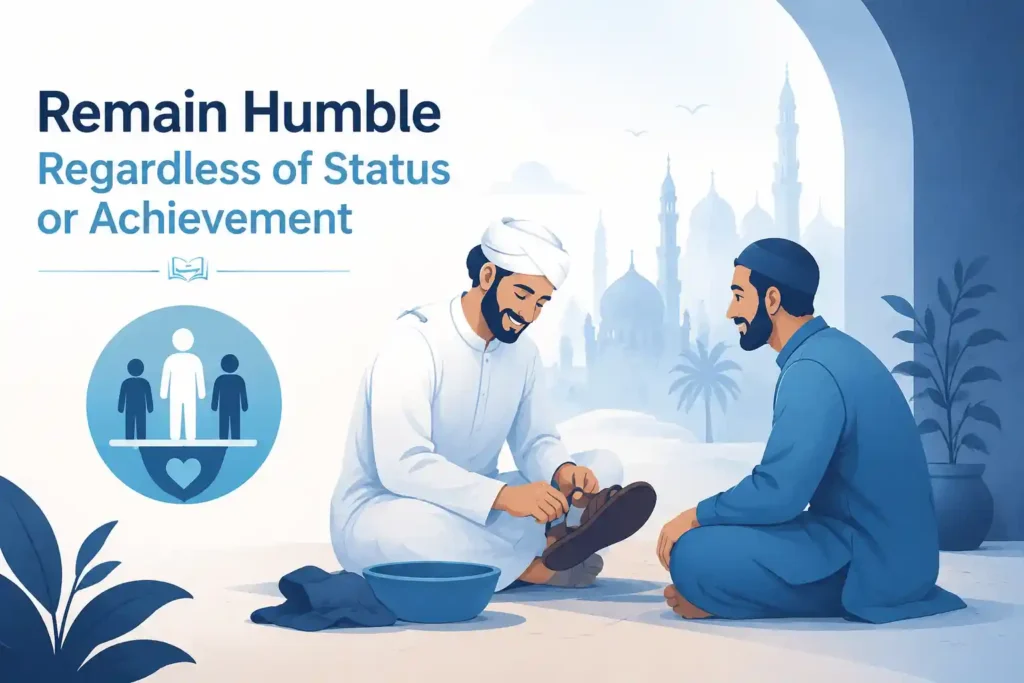
This hadith makes a distinction that is easy to miss: humility chosen freely — not produced by failure, poverty, or weakness — is the highest form. Anyone can become humble when they have nothing. The Prophet Muhammad (PBUH) is describing something harder: choosing humility at the top.
His personal conduct made this hadith lived reality. He mended his own sandals. He helped with housework at home — Aisha (RA) reported that he would sew his own clothes, milk the goats, and serve himself.
He refused to allow companions to stand when he entered a room, disliking any gesture that resembled how rulers were honored. When delegations came to Madinah expecting to meet a king, they found a man sitting among his companions with no visual distinction.
The contrast with contemporary leadership norms is sharp. Status in modern culture is communicated through distance — the executive who doesn’t carry their own bag, the celebrity who doesn’t wait in lines. The Prophet Muhammad (PBUH) communicated authority through closeness: he was the most accessible person in the community, available to anyone who approached him.
How to apply it: Identify one area where status, professional achievement, or education creates distance between you and others — and deliberately close it. The Prophet’s (PBUH) example is not a call to performative simplicity; it is a call to genuine service that doesn’t require an audience.
4. Manage Anger Before It Manages You
Anger is the emotion most likely to produce words and decisions a person regrets. Among the most practical examples from the life of Prophet Muhammad is that rather than offering a general instruction to “control yourself,” he gave a specific, physical, step-by-step protocol — one that works precisely because it does not rely on willpower alone:
“When one of you becomes angry while standing, he should sit down. If the anger leaves him, well and good; otherwise he should lie down.” (Abi Dawud)
This is not metaphorical. It is a physical protocol for interrupting an escalating physiological state — the progressive postural change (standing → sitting → lying) mirrors what modern behavioral science calls a “pattern interrupt.” The Prophet (PBUH) understood, fourteen centuries before neuroscience named it, that the body and the mind are not separate systems.
He also said:
“The strong man is not the one who can wrestle others to the ground. The strong man is the one who can control himself at the moment of anger.” (Muslim)
His own conduct during conflict illustrates this. There is no authenticated account of the Prophet Muhammad (PBUH) raising his voice out of personal anger, striking a servant or family member, or making a major decision in a state of agitation. When provoked — and he was provoked severely, repeatedly — his response was measured, often silent, and frequently redirected toward making du’a rather than retaliation.
A common mistake: many Muslims treat the hadith on anger as a reminder to feel less angry, which is not its instruction. The hadith instructs behavioral change — a physical action taken before the emotional state passes. The goal is not to suppress anger but to prevent it from producing words or decisions you will regret.
How to apply it: When you notice anger rising, apply the three-step protocol literally. Sit down. If it hasn’t passed, lie down. Add the practice of making wudu (ablution), which the Prophet Muhammad (PBUH) also recommended as a physical counterpart to anger, since “anger is from fire and water extinguishes fire.” (Abu Dawud)
Experience Our Interactive Learning
Curious about how we teach? Watch these brief video clips from our recent live sessions to see our structured curriculum, advanced learning platform, and dynamic student-teacher interactions firsthand.
5. Give Charity Consistently (Zakat)
Charity in Islam is not simply a good deed performed from surplus. One of the most often overlooked moral lessons from the life of Prophet Muhammad is that he framed sadaqah as something active — a protective practice that stands between the giver and harm. He expressed this with a directness that challenges the idea of giving “when you can afford to”:
“Give charity without delay, for it stands in the way of calamity.” (al-Bayhaqi)
The framing here is protective, not merely generous. Charity (sadaqah) is described as an active intervention between the giver and misfortune — not a passive act of benevolence performed from surplus. The Prophet (PBUH) himself gave with a consistency that distinguished him from casual generosity: Aisha (RA) reported that it was not his habit to keep money overnight. He would distribute it before sleeping.
His practice also challenged the common psychological barrier to giving — the fear of diminishment. The Quran and Sunnah repeatedly address this directly:
“Allah does not decrease wealth through charity.” (Muslim)
The Prophet Muhammad (PBUH) demonstrated this not by being wealthy, but by giving consistently even in periods of material limitation and teaching his companions to do the same.
One specific detail worth noting: the Prophet (PBUH) gave in ways that preserved the dignity of the recipient. He would give privately when possible, avoiding the public acknowledgment that could embarrass the person receiving. This principle — that how you give matters as much as that you give — is embedded in Islamic charity ethics and distinguishes sadaqah from performative generosity.
How to apply it: Set up a fixed, automatic monthly sadaqah — even a small amount — rather than giving reactively when you feel moved to. The Prophet’s own practice suggests consistency over size. Then find at least one annual occasion to give in a way that specifically protects the recipient’s dignity.
6. Treat Your Neighbors With Active, Not Passive, Care
Neighborly conduct in Islam is not simply about avoiding conflict. The Prophet Muhammad (PBUH) returned to this subject so often and so emphatically that his companions began to wonder whether neighbors might be included among one’s legal heirs. His standard was not tolerance — it was active, sustained responsibility. He anchored it to the fundamentals of faith:
“Anyone who believes in God and the day of judgment should not harm his neighbor.” (Bukhari)
The tradition of “caring for the seventh neighbor” — meaning that your responsibility extends not just to the house next door but to every home within a defined community radius — is one of the most enduring examples from the life of Prophet Muhammad on community ethics.
The Prophet Muhammad (PBUH) made a practical distinction between two kinds of neighborly conduct: not harming (silm) and actively benefiting (ihsan). The first is a minimum. The second is the standard he modeled.
He would send food to neighbors, personally inquire about their wellbeing when they were ill, and attend to their practical needs even when the relationship was not warm. Among his neighbors in Madinah were people of different faiths; his conduct toward them was indistinguishable from his conduct toward Muslim neighbors.
A practitioner observation: in modern urban life, most people do not know their neighbors by name. The Prophet’s standard cannot be fully met without first crossing the basic threshold of acquaintance. The Sunnah here has an entry point as simple as introducing yourself and learning someone’s name.
How to apply it: Learn the names of your neighbors within a realistic radius — apartment floor, street, or block. This is the minimum. Then identify one practical need — elderly neighbor who cannot carry groceries, family with a new baby, neighbor going through illness — and address it actively, without waiting to be asked.
Want to study Islamic ethics and the Prophet’s community conduct in depth? The Islamic Studies Course Online covers the Seerah, Hadith, and Islamic ethics in structured live sessions — taught by qualified instructors at your pace.
7. Take Care of Your Body
The separation between physical health and spiritual wellbeing is a modern invention. The Prophet (PBUH) never made it. He addressed the body as an amanah (trust) from Allah — something you are accountable for maintaining — and he gave dietary guidance that connected overeating directly to a loss of spiritual clarity:
Among the moral lessons from the life of Prophet Muhammad that are least discussed in modern Islamic education is this one: the body and the spirit are governed by the same standard of amanah. The Prophet (PBUH) also said:
“Your body has a right over you.” (Bukhari)
His personal habits were moderate and intentional. He ate small portions, recommended filling the stomach one-third with food, one-third with water, and leaving one-third empty. He walked briskly. He fasted regularly beyond Ramadan — particularly Mondays and Thursdays, and the 13th, 14th, and 15th of every lunar month. He did not practice the artificial separation between body and spirit that characterizes either pure asceticism (starving the body for God) or pure materialism (indulging it without limit).
A point often missed: the Prophet’s (PBUH) dietary guidance is not primarily about physical performance outcomes — it predates that framework entirely. It is about maintaining the clarity of mind and heart that worship requires. Overeating, in his framework, produces ghaflah (heedlessness) — a dullness of spiritual perception that makes consistent worship harder. The body is not an obstacle to the spiritual life; it is its instrument.
How to apply it: Apply the “one-third” principle at your next meal as a deliberate practice, not a diet rule. Fast one voluntary day this month. Assess your sleep habits through the lens of amanah — are you giving your body what it needs to function as an instrument of worship and service?
What Can We Learn From The Prophets?
Beyond the specific question of what can we learn from Prophet Muhammad (PBUH), the Quran presents all the prophets as a collective curriculum. Each carried the same core message under different conditions, and each demonstrated qualities that Muslims are called to learn from directly.
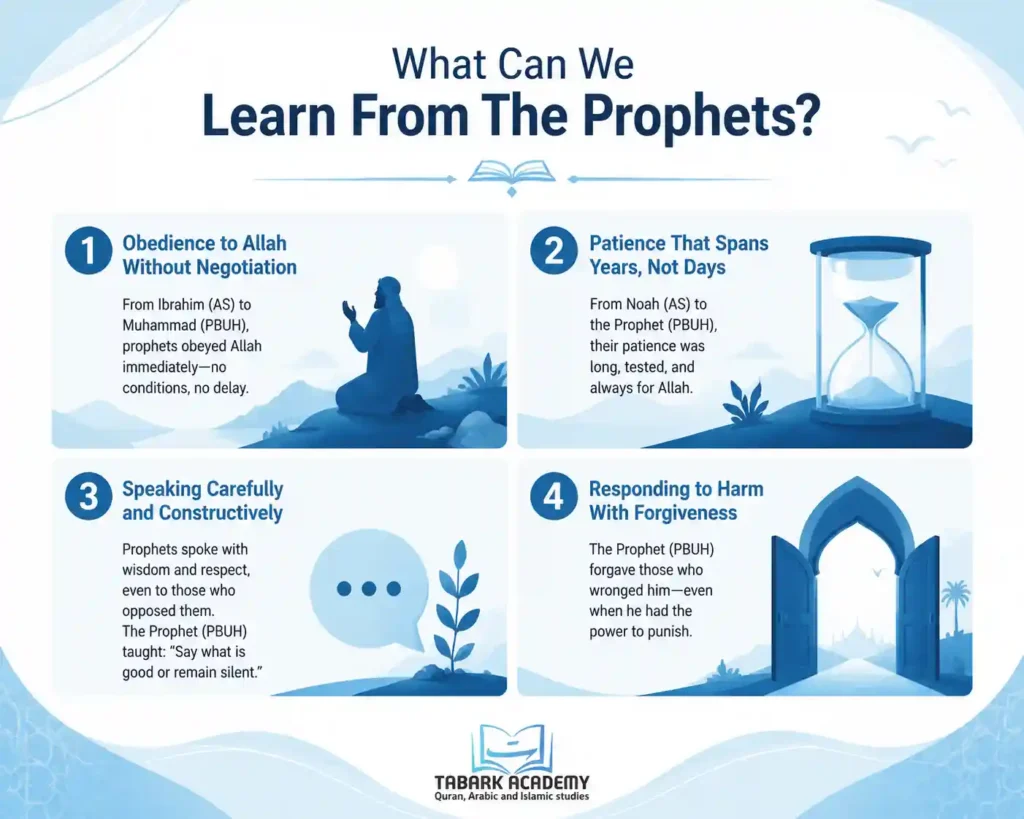
1. Obedience to Allah Without Negotiation
When the Prophet Muhammad (PBUH) received the first revelation on Mount Hira, he was shaken — he went to Khadijah trembling and said “cover me.” He did not choose the timing, the content, or the weight of the mission. He submitted and obeyed immediately, without preconditions.
This first act of submission set the tone for 23 years of prophethood. It is mirrored across every prophet in the Quran: Ibrahim (AS) accepting the command to leave his family in an arid valley, Musa (AS) returning to Pharaoh despite his own fear, Yunus (AS) recommitting after his departure. Obedience, in the Quranic model, is not passive compliance — it is active, costly, and chosen.
2. Patience That Spans Years, Not Days
Noah (AS) called his people to Allah for 950 years before the flood. The Prophet Muhammad (PBUH) preached in Mecca for thirteen years under mockery, boycott, and physical threat before migrating to Madinah. The Ta’if incident — where he was driven out of the city and children threw stones at him until he bled — is among the most documented examples from the life of Prophet Muhammad on the depth of patience demanded by prophethood.
What distinguishes prophetic patience from passive endurance is what it is directed toward. When the angel Jibril (AS) offered to destroy the people of Ta’if, the Prophet (PBUH) refused and made du’a that their descendants would become believers. They did. Patience, in his example, is not resignation — it is sustained belief in an outcome that has not arrived yet.
3. Speaking Carefully and Constructively
Prophets in the Quran consistently engaged their audiences with measured, constructive speech — even when those audiences were hostile, idolatrous, or openly dismissive. They did not speak in anger, they did not belittle their opponents, and they did not use rhetoric designed to shame rather than guide.
The Prophet Muhammad (PBUH) gave a practical standard for this:
“Whoever believes in Allah and the Last Day, let him say what is good or remain silent.” (Bukhari)
His own practice of silence when provoked — choosing not to respond rather than responding poorly — is as much a Sunnah as any positive action.
4. Responding to Harm With Forgiveness
The Conquest of Mecca in 630 CE is one of the most studied examples from the life of Prophet Muhammad in both Islamic scholarship and comparative ethics. He entered as a conqueror after more than a decade of persecution, exile, and warfare — and declared a general amnesty.
“Go, for you are free.” (Sahih al-Bukhari)
This was not naive. It was a deliberate, principled choice that contradicted every norm of 7th-century warfare. It was also consistent with his entire pattern: the Prophet (PBUH) never took personal revenge for wrongs done to him directly. He acted against injustice when it involved others — but against his own injuries, he forgave.
Step Inside Our Virtual Classrooms
See our engaging teaching methods in action! watch real snippets of our live classes and discover how our expert instructors make learning interactive, memorable, and inspiring for every student.
Start Learning the Prophet’s Way Today
The best way to apply the moral lessons from the life of Prophet Muhammad (PBUH) is to engage with the Quran and Islamic knowledge consistently — not once in a while, but as a daily habit.
Tabarak Academy makes that possible with live online classes taught by qualified, experienced instructors who understand your goals and pace your learning accordingly. Whether you are starting from the basics or deepening existing knowledge, there is a course built for your level.
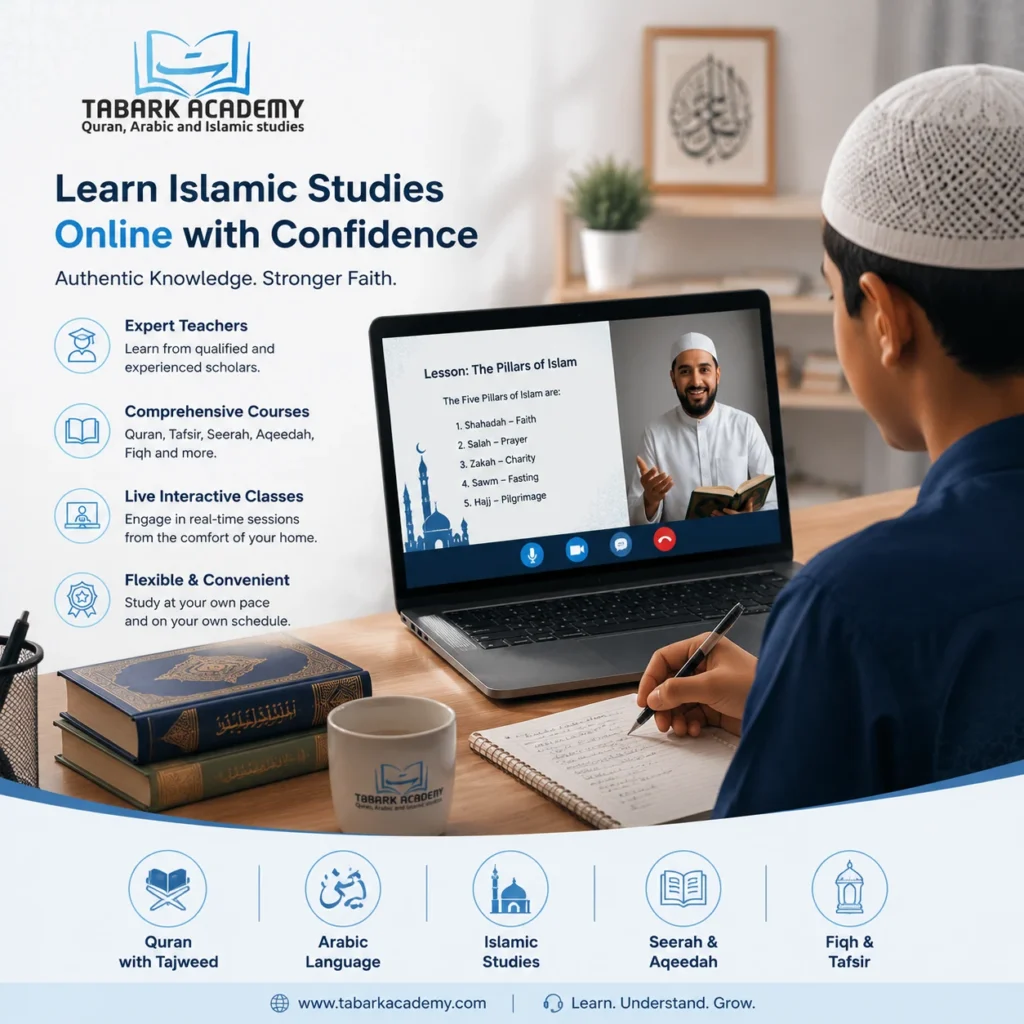
Our Courses:
- Online Quran & Arabic Classes | Foundation
- Online Quran Memorization Course
- Modern Standard Arabic Online Course (Fusha)
- Online Ijazah Course
- Recitation Of Quran with Tajweed Course
- Islamic Studies Course Online
Conclusion
The life of Prophet Muhammad (PBUH) is not a historical archive — it is a living guide. The moral lessons it contains address every part of human experience: how we speak, how we earn, how we respond to injustice, how we treat our bodies, and how we relate to Allah. What makes his example unique among all the prophets is that it was documented in extraordinary detail through the Hadith, preserved across fourteen centuries, and practiced by more than 1.9 billion people today.
What can we learn from Prophet Muhammad (PBUH)? Engage the Quran as a daily instrument of clarity. Keep learning without treating any stage of life as complete. Choose humility freely, before circumstances force it. Interrupt anger physically before it speaks. Give charity consistently, not reactively. Care for neighbors actively, not just harmlessly. Guard the body as a trust from Allah.
The moral lessons from the life of Prophet Muhammad are not qualities that belonged only to the 7th century — they are answers to the exact challenges people face today. And the examples from the life of Prophet Muhammad preserved in the Seerah and Hadith give every Muslim a documented, detailed, and fully applicable model to follow.
None of these lessons require extraordinary circumstances. They are habits for ordinary days. The Prophet Muhammad (PBUH) himself said: “The most beloved deeds to Allah are those done consistently, even if they are small.” (Bukhari & Muslim)
Frequently Asked Questions
Here are answers to the most common questions people ask about the life of Prophet Muhammad (PBUH), the moral lessons he demonstrated, and the examples from his Sunnah that Muslims apply today.
What can we learn from Prophet Muhammad (PBUH)?
We can learn honesty in all dealings, patience under hardship, forgiveness toward those who harm us, humility regardless of status, and consistent devotion to Allah. Each of these is backed by documented examples from his life — not just advice he gave, but behavior he consistently demonstrated across 23 years of prophethood.
What are the main moral lessons from the life of Prophet Muhammad?
The core moral lessons include: living with integrity before and after prophethood, responding to harm with forgiveness rather than retaliation, caring for neighbors and the vulnerable, giving charity, controlling anger, and engaging with the Quran as a daily guide. These principles are drawn directly from authenticated Hadith and the Seerah.
What are the best examples from the life of Prophet Muhammad to follow today?
The most applicable examples are his habit of consulting others before decisions (shura), forgiving personal wrongs while maintaining justice, daily Quran recitation and night prayer, treating his family with consistent kindness, and his honesty in trade. Each can be implemented in modern daily life without requiring extraordinary circumstances.
How did the Prophet Muhammad (PBUH) treat people who harmed him?
He consistently responded with forgiveness, not retaliation. The clearest example is the Conquest of Mecca, where he declared a general amnesty for people who had persecuted, boycotted, and fought against him and his companions for over a decade.
Where can I learn more about the Prophet’s life in a structured way?
Tabarak Academy offers an Islamic Studies Course online that covers the Seerah, Hadith, and Islamic ethics — available for all ages and levels, taught by qualified instructors. You can also explore their Quran memorization and Tajweed courses to build a complete foundation.