


How To Memorize The Quran?
Millions of Muslims around the world have committed the entire Quran to memory, children still in primary school, adults in their forties starting from scratch, professionals working around demanding schedules. The path exists and it has been walked before.
The question is not whether learning how to memorize the Quran is possible for you. The question is which approach fits your life, your pace, and the way your memory works best.
This guide draws on the classical scholarship of Hifz and verified contemporary practice to give you ten specific, actionable steps. These are not abstract motivational memorization of the quran tips. Each one addresses a concrete challenge that memorizers encounter — and each one has a proven answer.
Whether you are a complete beginner, an adult picking up after years away from the Quran, or a parent helping your child build this foundation, these steps apply.
The ten steps below are not alternatives, they form a system. Most serious Huffaz use several simultaneously. Read through all ten, then build your daily structure from the combination that fits your schedule and learning style.
Book Your First Free Session In Our Tajweed For Beginners Course

1. How To Memorize The Quran More Effectively By Using One Mushaf?
The brain stores Quranic verses partly as visual memory — the exact position of words on a page, where a line breaks, the shape of a letter cluster. When you switch between editions, those visual anchors disappear. A verse that feels solid becomes shaky because your memory is searching for a page layout that no longer matches.
Choose one edition before you begin and do not substitute it for a phone app or a different print edition until your memorization is fully consolidated. The Medina Mushaf (Hafs ‘an ‘Asim layout) is the most widely used in structured Hifz education.
Among the remarkable facts about the Arabic language is that Quranic Arabic has remained phonetically unchanged for over 1,400 years — meaning every word you lock into memory is letter-for-letter identical to what the Prophet ﷺ recited.
Reserve your free trial lesson for Online Ijazah Course at Tabark Academy

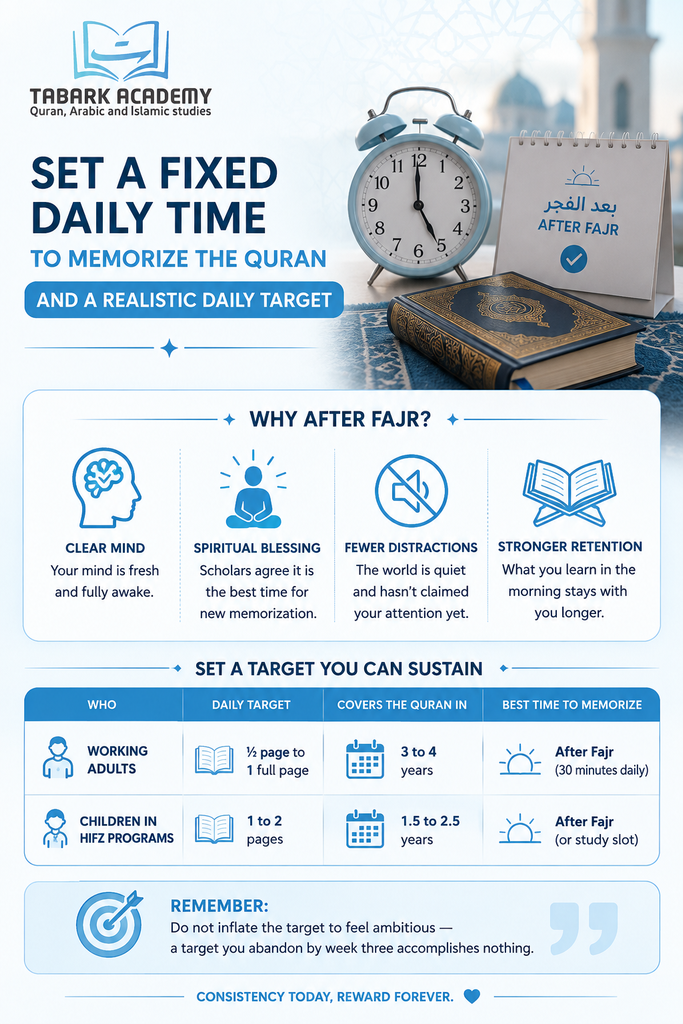
2. The Best Way To Memorize The Quran Is To Set A Fixed Daily Time
Hifz rewards consistency far more than intensity. Thirty minutes every day after Fajr will produce better long-term retention than two hours of weekend cramming. Scholars consistently name the time just after Fajr as the strongest window for new memorization — the mind is clear, the senses are fresh, and the world has not yet made its claims on your attention.
Set a daily target your actual schedule can absorb. For most working adults, half a page to one full page is a sustainable rate that covers the entire Quran in three to four years. For children in Hifz programs with more time, one to two pages is common. Do not inflate the target to feel ambitious — a target you abandon by week three accomplishes nothing.
3. Repeat Each Verse At Least Twenty Times
The Sequential Method (الحفظ التسلسلي) is the most widely recommended technique in classical Hifz scholarship, and the reason is structural: it chains every new verse to the one before it, so the memory cannot drop an ayah without the entire chain revealing the gap.
Read the first verse aloud from the mushaf at least twenty times. Close the mushaf and recite it from memory five times. Open the mushaf, read the second verse twenty times. Close it and recite five times. Then recite both verses together five times from memory. Add the third verse by the same process, then recite all three together.
Finish the page by reading the complete page from the mushaf five times, then reciting it from memory five times. Sheikh Abdul Muhsin al-Qasim‘s widely taught method specifies reading each verse twenty times, then grouping every four verses for twenty combined repetitions — ensuring no isolated ayah is left unattached in memory.
The instinct to stop at five repetitions because the verse “feels memorized” is the single most common error new Huffaz make. What feels memorized after five repetitions often vanishes within two hours.
Read also: 7 Types of Qirat in the Quran – Meaning, History, And Complete Guide
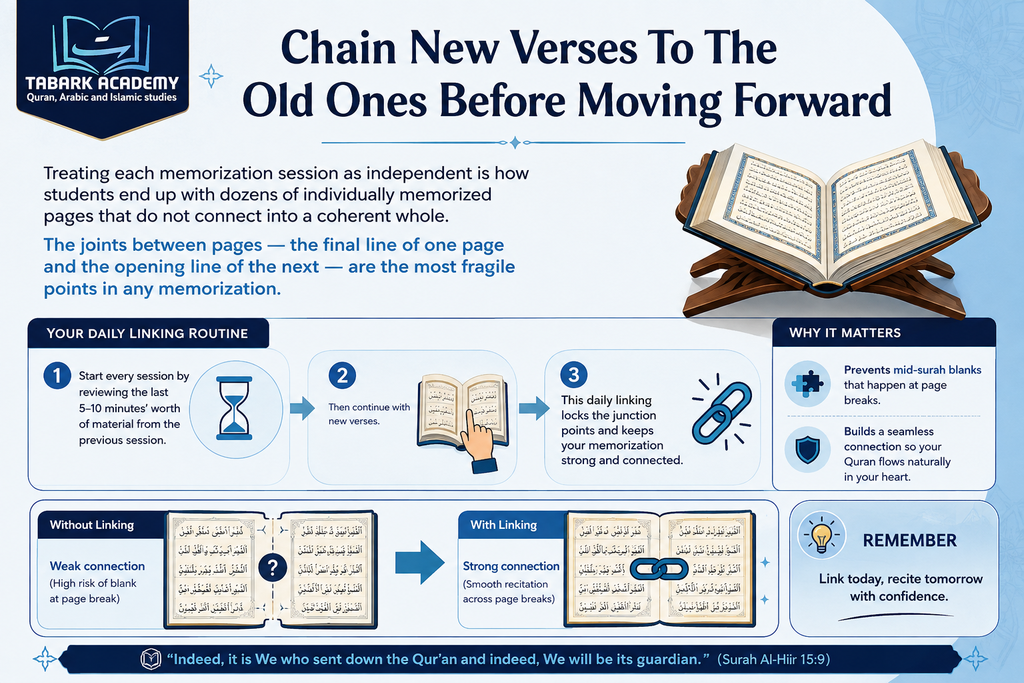
4. Chain New Verses To The Old Ones Before Moving Forward
Treating each memorization session as independent is how students end up with dozens of individually memorized pages that do not connect into a coherent whole. The joints between pages — the final line of one page and the opening line of the next — are the most fragile points in any memorization.
At the start of every session, before touching new material, read the last five to ten minutes’ worth of material from the previous session. This daily linking locks those junction points and prevents the most common type of mid-surah blank: the pause that occurs not in the middle of a page, but precisely at a page break.
5. Read The Meaning Of The Verses That You Memorize Before The Words Stick
Semantic and phonetic memory reinforce each other. When you understand why one word follows another — because it completes a promise, answers an earlier question, or continues a narrative — you give your brain an additional retrieval path for that verse.
A verse with meaning attached is significantly harder to forget than a verse memorized as pure sound. A brief read of a simplified translation before the session is enough.
The importance of the Arabic language becomes directly practical here: even a basic understanding of Quranic root words shows you the logical structure beneath the text, and that logic supports memorization under pressure in ways phonetic repetition alone cannot.
Start your Journey with Tafseer Al-Quran Course with a Free Trial Today

6. Let Listening Do Half The Work The Night Before
Many memorizers use audio passively — Quranic recitation playing in the background while doing other tasks. This helps, but a small adjustment makes it dramatically more powerful: listen to exactly the passage you plan to memorize the following morning for fifteen minutes just before sleep.
This overnight pre-loading technique (التحضير الليلي) is built into structured Hifz programs precisely because it works. When you sit down to memorize after Fajr, your ear already recognizes the sound pattern of each verse.
What seemed difficult yesterday sounds like something you half-know. Repetition time drops measurably. Choose one reciter whose pronunciation is accurate and whose voice helps you concentrate. Stay with that voice the way you stay with one mushaf.

Experience Our Interactive Learning
Curious about how we teach? Watch these brief video clips from our recent live sessions to see our structured curriculum, advanced learning platform, and dynamic student-teacher interactions firsthand.
7. Build A Two-Track Daily Review System Of Memorization That Grows With You
This step separates Huffaz who hold their memorization for life from those who discover, years later, that the entire juz has gone cloudy. The Prophet ﷺ warned that the Quran “escapes from the hearts of men faster than camels escape their ropes.” Review is not optional maintenance — it is the primary work. A practical system operates on two tracks simultaneously:
Near-past review covers the last five to twenty pages you memorized. Review this material every single day before beginning new memorization. As your total memorization grows, this window expands to twenty pages.
Far-past review covers everything beyond those twenty pages. Dedicate time each day to moving through it systematically — ten pages per day at the beginning, increasing to twenty or thirty as your total grows. When you finish the far-past, cycle back and begin again.
The goal, reached gradually through consistent practice, is three juz reviewed per day once your memorization is substantial. The Five Fortresses method (طريقة الحصون الخمسة) provides a full structure for this, allocating weekly reading, nightly preparation, new memorization, near-past review, and far-past review into a single daily framework that scales across the full 30 juz.
Explore our Free Tajweed Quran Course at Tabark Academy

8. Recite Your Memorized Portions In Every Prayer
Prayer is the ultimate field test for memorization. Reciting a memorized surah in salah places you under the conditions of actual worship — standing, focused, without the mushaf — and any weakness in the memorization surfaces immediately.
Make it a consistent practice to rotate your memorized portions through your daily prayers. Newer, less consolidated memorization goes into voluntary night prayers (Tahajjud or Qiyam), where quiet focus sharpens recall. Older, more settled memorization goes into fard prayers.
It tests retention under real conditions, and it gives the memorization a weight that repetition alone cannot provide. The classical Hifz advice on this point is unanimous — reciting in prayer is not incidental review, it is the deepest form of it.

9. Mark The Verses That Look Almost Identical Otherwise They Will Trip You Up
The Quran contains thousands of verses with near-identical phrasing — what scholars call the mutashabihat (المتشابهات). Two verses in different surahs may differ by a single word, a single letter, or only a vowel marking. These are the most common source of errors during formal recitation examinations, and they are the passages that make experienced Huffaz stumble even years after completion.
When you encounter such a verse, do not simply increase repetitions and hope the difference sticks. Write the verse alongside its near-twin. Identify the distinguishing element, a word, a preposition, a plural versus a singular, and create a deliberate mental marker for each. Some memorizers mark these lightly with pencil in their mushaf.
The Seven Surahs of paired similarity (the Hawamim, the Musabbihat, the paired descriptions of Paradise and Hellfire) deserve their own dedicated review pass, distinct from general revision.

10. Find A Teacher And An Accountability Partner From Day One
The Prophet ﷺ — despite being the one to whom the Quran was revealed and the most eloquent of all Arabs — reviewed his memorization with Jibreel every Ramadan, and reviewed it twice in his final year. What can we learn from the life of Prophet Muhammad regarding memorization is this: even the greatest internalization of the Quran does not eliminate the need for a hearing ear and a correcting presence.
A qualified teacher catches makhraj errors before they calcify, confirms correct completion of sections, and provides the Sanad — the chain of transmission connecting your memorization directly to the Prophet ﷺ. Once you complete your memorization and have it verified, you can pursue formal certification through how to get ijazah.
An accountability partner — someone memorizing alongside you — adds the social dimension that learning research consistently shows improves completion rates.

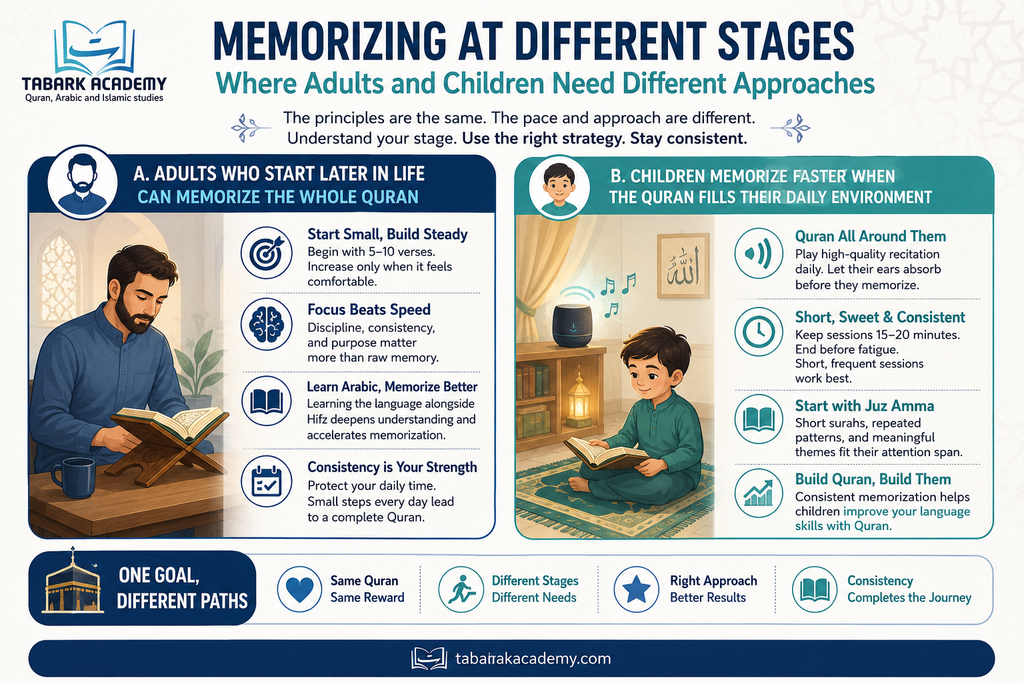
Memorizing at Different Stages where Adults and Children Need Different Approaches
The ten steps above apply universally. But the pace, emotional texture, and practical challenges of memorization differ significantly between adults starting later in life and children beginning early. Each group has specific needs worth understanding directly.
A. Adults Who Start Later in Life Can memorize the Whole Quran
Adults who begin memorization in their twenties, thirties, or beyond often carry the mistaken belief that their memory is too slow or too scattered for the task. The experience of thousands of adult Huffaz worldwide contradicts this. What adults lack in raw speed, they make up for in focus, purpose, and discipline — and those qualities matter more at the level of daily consistency.
The adjustment for adults is in the starting target: begin with five to ten verses rather than a full page. Build the target only when that amount feels genuinely comfortable, not when ambition pushes you to accelerate. Those who invest time to learn Arabic language alongside their Hifz often find that vocabulary comprehension accelerates memorization significantly.
Non-native speakers sometimes feel daunted by the linguistic demands, but while there are 3 reasons why Arabic is difficult as a formal grammatical system, the Quran’s consistent rhyme patterns and rhythmic cadences make it far more accessible to oral memorization than ordinary prose.
B. Children Memorize Faster When The Quran Fills Their Daily Environment
For children, the most durable memorization happens when the Quran is woven into daily life rather than isolated in a formal session. Playing high-quality recitation continuously in the home means that when the child sits down to memorize, their ear already recognizes what they are being asked to learn.
Formal session length should be kept to fifteen to twenty minutes, ending before fatigue sets in. Short, frequent, energized sessions outperform long, exhausting ones at every measured stage of child development.
Start with the short surahs of Juz Amma. The brevity of verses, the frequency of sound patterns within surahs, and the varied subjects make this section uniquely suited to young attention spans. As a lasting benefit, consistent memorization allows children to improve your language skills with Quran.
One practitioner observation worth passing on: children who know how to memorize Quran alongside a parent who is also memorizing consistently outperform children whose parents delegate the process entirely to a teacher. Shared commitment changes the emotional environment of memorization in ways no methodology can replicate.
The Character Behind The Memorization And Why Hifz Demands More Than A Good Memory?
Classical Hifz teachers did not treat memorization as a purely cognitive exercise. They observed, across generations of instruction, that sins weaken the heart’s capacity to hold the Quran, but as a practical reality they verified repeatedly in their students. Reflecting on the important reasons why morals are important reveals why character development is not separate from memorization but inseparable from it.
The student who memorizes while working on their truthfulness, their prayers, their treatment of family, and their avoidance of what Allah has prohibited consistently finds that memorization settles more deeply and resists forgetting more reliably. The Quran, as scholars have always taught, is not a piece of information to be stored.
This is also why a righteous companionship — a Hifz circle, a study group, a trusted accountability partner — multiplies the effectiveness of every technical method above. The Quran was transmitted in community, and it is retained most reliably in community.
Tabarak Academy‘s instructors bring this principle into every session — combining structured Hifz methodology with authentic Tajweed instruction and an environment of consistent accountability. If you have been memorizing alone without results, structured guidance with a qualified teacher removes the guesswork and the drift.
Step Inside Our Virtual Classrooms
See our engaging teaching methods in action! watch real snippets of our live classes and discover how our expert instructors make learning interactive, memorable, and inspiring for every student.
Join Tabarak Academy To Begin Your Memorization CORRECTLY
Tabark Academy has guided students across the globe from their first verse to their completed memorization — young children working through Juz Amma with a patient teacher, adult professionals fitting half a page into their morning routine, sisters completing Hifz in dedicated women-only programs.
Every course is built around the same core principle: correct pronunciation from session one, a structured daily review habit from the very beginning, and a qualified teacher present at every stage.
Students regularly complete their memorization within the timelines they set at enrollment, pass their formal recitation reviews with minimal errors, and hold their memorization years after completing their program because the review systems were built correctly from the start.
Our Courses
- Online Quran & Arabic Classes | Foundation
- Recitation Of Quran with Tajweed Course
- Islamic Studies Course Online
- Arabic Alphabet Learning Course
- Noorani Qaida Course for Adults
- Quranic Arabic Course for Kids
- Arabic and Quran Classes for Kindergarten
- Islamic Summer Camp
- Hifz for Kids Course
- Hifz Course for Sisters
- Hifz for Adults Course
- Online Hifz Program
- Noor Al-Bayan Course
- Quran Recitation Course
- Weekend Quran Classes
- Zoom Quran Classes
Start Your Hifz Journey with Tabarak Academy Today

Conclusion
Memorizing the Quran is one of the few achievements in a Muslim’s life that earns honor in both this world and the next — the Prophet ﷺ described Huffaz as “the People of Allah and His chosen ones.” The path to completing it is not mysterious.
It follows a clear, repeatable sequence: correct your recitation, establish your daily routine, apply the right methods, review without exception, and work with a teacher from the very beginning. The ten steps in this article represent the distilled wisdom of classical Hifz scholarship and verified contemporary practice.
No single step is optional — they work as a system, and systems produce results when every component is maintained. The Huffaz who complete their memorization are not, as a rule, the ones with the best raw memories. They are the ones with the most consistent daily habits and the most honest relationship with their own limitations.
Learning how to memorise the Quran comes down to one practical commitment: twenty to thirty minutes after Fajr, one realistic daily portion, reviewed every single day. That structure is behind every completed Hifz you have ever witnessed. The method is available to everyone willing to hold it.
Frequently Asked Questions
How long does it take to memorize the Quran?
The timeline depends entirely on your daily portion and consistency. At half a page per day, the full Quran takes approximately six to seven years. At one page per day, three to four years. At two pages per day completion is possible in eighteen months to two years.
Can I memorize the Quran without knowing Arabic?
Yes. Millions of non-Arabic speakers have completed memorization of the entire Quran. Those without an Arabic background rely more heavily on phonetic repetition and visual memory — both of which work reliably with sufficient repetition.
What is the single best time of day to memorize the Quran?
The time immediately after Fajr prayer. This is the consensus recommendation across classical Hifz scholarship and contemporary teaching, and the practical reason is consistent: the mind is clear, the night’s rest has consolidated previous learning, and the distractions of the day have not yet begun.
How do I stop forgetting what I have already memorized?
The two-track daily review system described in Step 7 is the direct answer: near-past review (the last twenty pages) done every single day before any new memorization, and far-past review (everything beyond that) worked through systematically at ten to thirty pages per day.
At what age should children begin memorizing the Quran?
Children can begin building familiarity through listening and simple repetition from age three or four. Formal memorization with a structured daily target is most effective from age five or six, when sustained attention becomes more consistently available.
Is it realistic to memorize the Quran as a busy working adult?
It is realistic and it is done regularly by people in exactly that situation. The required adjustment is a smaller starting target — five to ten verses per day rather than a full page — combined with an immovable daily appointment, preferably after Fajr.