

23 Interesting Facts About The Arabic Language You Probably Didn’t Know
Arabic is one of the world’s most influential and widely spoken languages, connecting hundreds of millions of people across the Middle East, North Africa, and communities worldwide. It also holds a unique place in Islam as the language in which the Quran was revealed.
But Arabic is much more than a language written from right to left. Its connected script, root-based vocabulary, distinctive grammar, diverse regional dialects, and centuries-old literary tradition make it a fascinating language to explore.
In this guide, you’ll discover 23 interesting facts about the Arabic language, from its Semitic origins and 28-letter alphabet to Quranic Arabic, Modern Standard Arabic, regional dialects, Arabic calligraphy, and the language’s influence on cultures and vocabulary around the world.
1. Arabic Is a Semitic Language
Arabic belongs to the Semitic branch of the Afro-Asiatic language family. This places it in the same broad linguistic family as languages such as Hebrew and Aramaic.
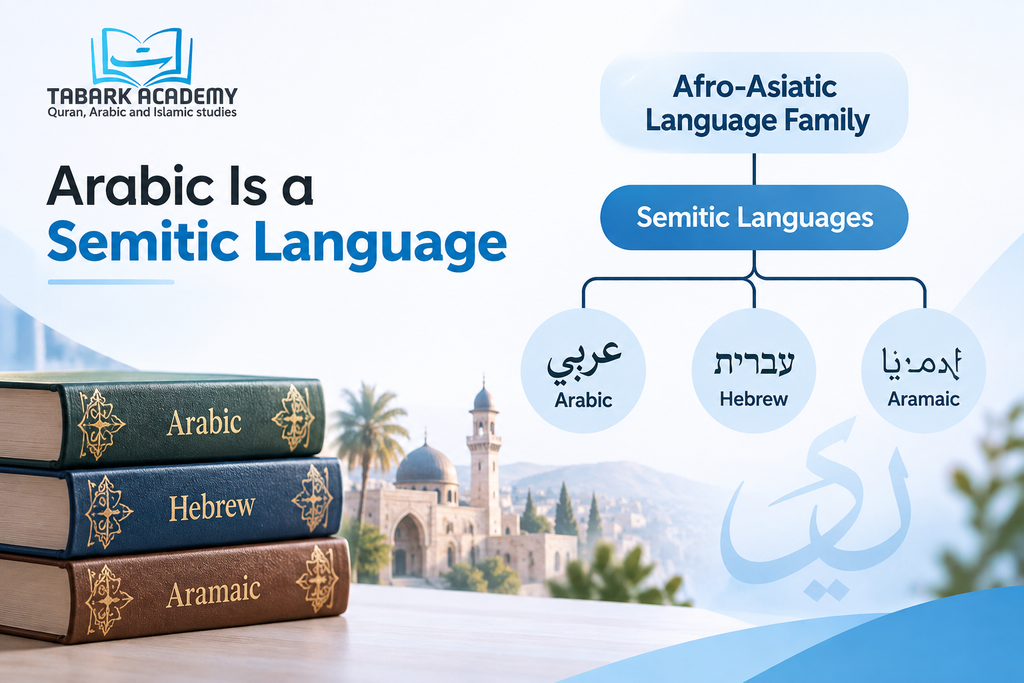
Many Semitic languages share structural features, including consonant-based roots, related word patterns, and similar approaches to forming vocabulary. Arabic, however, developed its own extensive grammatical, literary, and rhetorical tradition over many centuries.
Understanding Arabic as a Semitic language also helps learners make sense of some of its most important features. Once students begin recognizing roots and recurring patterns, many words that initially seem unrelated start to feel more connected and predictable.
This background is especially useful for learners studying Classical Arabic or Quranic Arabic because the root-and-pattern system appears throughout religious texts, traditional scholarship, and formal language.
2. Arabic Is Spoken by Hundreds of Millions of People
Arabic is spoken by hundreds of millions of people worldwide, both as a native language and as an additional language. Its wide geographic reach makes it one of the major languages used across multiple countries, cultures, and communities.
Most Arabic speakers are concentrated across:
- North Africa, including Egypt, Algeria, Morocco, Tunisia, Libya, and Sudan
- The Levant, including Lebanon, Syria, Jordan, and Palestine
- The Arabian Peninsula, including Saudi Arabia, Yemen, and Oman
- The Gulf region, including the UAE, Qatar, Kuwait, and Bahrain
- Iraq and surrounding Arabic-speaking communities
Arabic is not limited to the Arab world either. Large Arabic-speaking communities live throughout Europe, North America, Africa, and other parts of the world, where the language is often used alongside English, French, Spanish, or other local languages.
The exact number of Arabic speakers can vary between estimates because Arabic includes many regional varieties. Some sources count only native speakers, while others also include people who speak Arabic as a second or additional language.
Arabic’s global reach is one reason many learners choose to study the language for communication, travel, education, or Quranic understanding.
Those who want to build their skills through a more focused learning schedule can explore Tabarak Academy’s Intensive Arabic Course.
3. Arabic Has Official Status Across the Arab World
Arabic has official status throughout the 22 member states of the Arab League, although several countries recognize additional official languages alongside Arabic.
Its geographic reach extends across North Africa, the Levant, the Gulf, and the Arabian Peninsula. This makes Arabic one of the major languages connecting a very large and culturally diverse region.
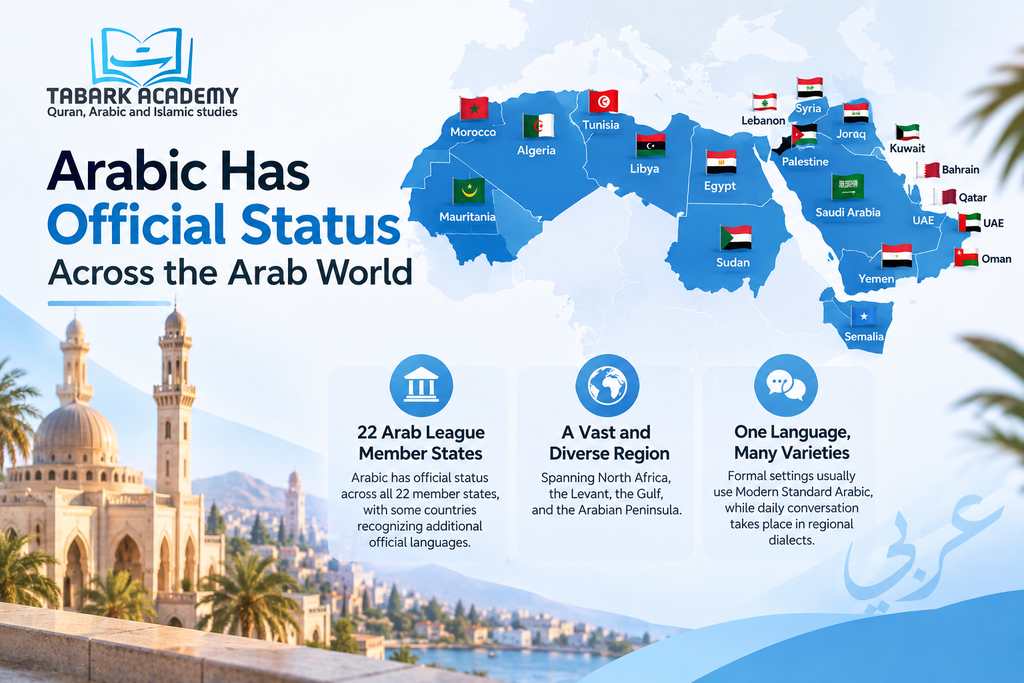
However, the Arabic used in government documents or formal education is not always identical to the Arabic spoken at home, in markets, or among friends. Formal settings generally rely more heavily on Modern Standard Arabic, while daily conversation usually takes place in regional dialects.
This combination of official standardization and local variation is one of the most distinctive features of the Arabic-speaking world.
4. Arabic Is One of the Six Official Languages of the United Nations
Arabic is one of the six official languages of the United Nations, alongside:
- Chinese
- English
- French
- Russian
- Spanish
Arabic became an official UN language in 1973, reflecting its importance as a language spoken across many countries and used in international communication and diplomacy.
Today, Arabic is used in UN meetings, official documents, interpretation, and international discussions. December 18 is also observed as World Arabic Language Day, celebrating the language’s cultural, historical, and global significance.
5. The Arabic Alphabet Has 28 Basic Letters
The Arabic alphabet contains 28 basic letters, each representing a consonantal sound or a sound that functions as part of the Arabic writing system.
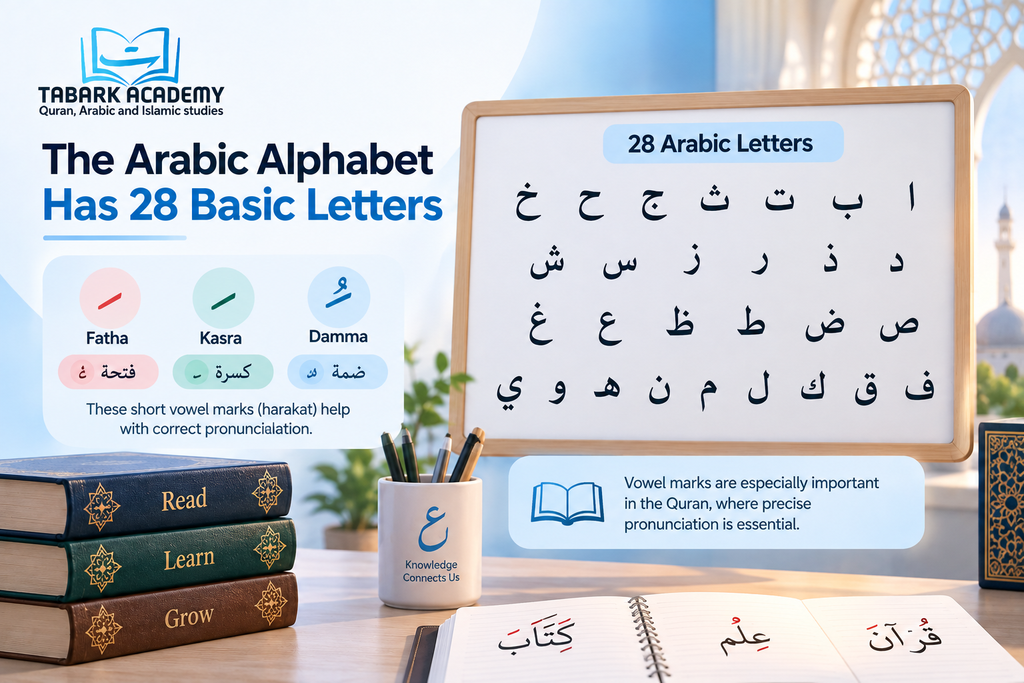
Arabic writing is largely consonant-based, while short vowel sounds can be represented using small marks known as harakat. These include fatha, kasra, and damma, which help readers pronounce words correctly.
Short vowels are often omitted in ordinary modern writing because fluent speakers can usually determine the intended pronunciation from context. However, vowel marks appear much more frequently in children’s books, beginner materials, dictionaries, and religious texts.
They are especially important in the Quran, where precise pronunciation is essential during recitation.
Once learners understand how letters combine with vowel marks, Arabic reading often becomes much more systematic than it first appears.
6. Arabic Is Written From Right to Left
One of the first facts about the Arabic language that beginners notice is that Arabic is written and read from right to left.
This direction applies to individual words, complete sentences, paragraphs, and books. Arabic books therefore open from what English readers would normally consider the opposite side.
The change in reading direction can feel unusual during the first stages of learning, particularly for students whose native language is written from left to right. However, the brain usually adjusts surprisingly quickly with regular practice.
Numbers can sometimes appear differently within Arabic text, which makes the visual structure especially interesting for new learners.
Over time, reading from right to left becomes automatic rather than something students have to consciously remember.
7. Arabic Has No Capital Letters
Arabic does not use uppercase and lowercase letters in the same way English does.
Proper names, the beginning of sentences, and ordinary nouns are not distinguished through capitalization. Instead, readers depend on context, sentence structure, punctuation, and meaning to understand the role of each word.
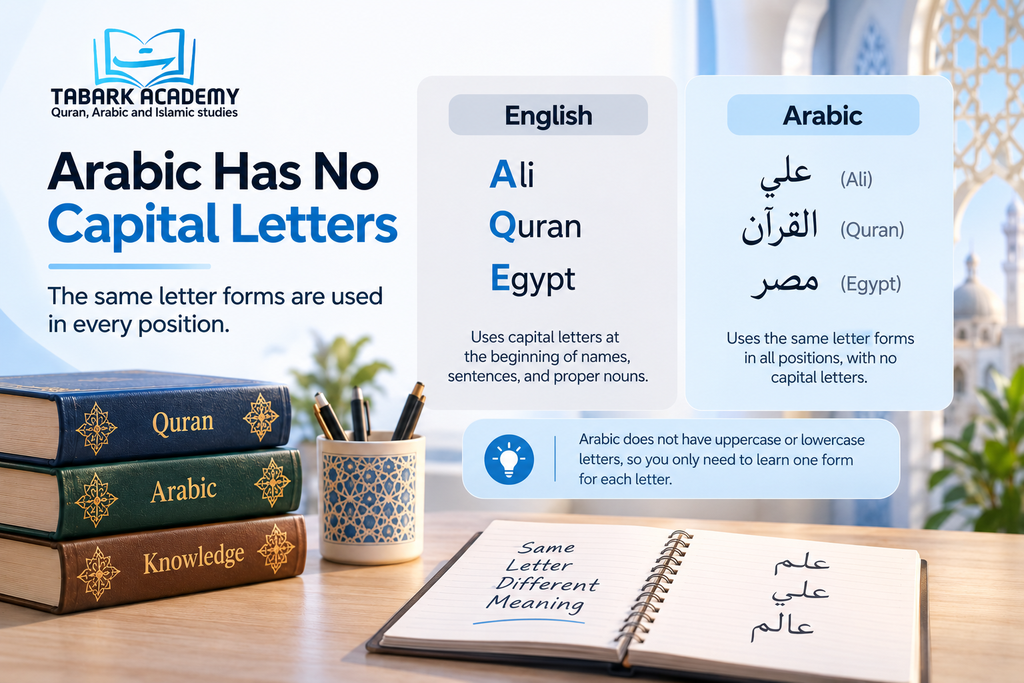
For example, a person’s name does not visually begin with a special capital form of the first letter. The same basic letter shapes are used regardless of whether the word is a name, title, or ordinary noun.
This means Arabic learners do not need to memorize two separate sets of letter forms for uppercase and lowercase writing.
Interestingly, the word Arabic must still be capitalized when written in English, even though Arabic script itself has no equivalent system of capital letters.
8. Arabic Letters Change Shape Depending on Their Position
Learning Arabic involves more than memorizing 28 isolated letter shapes.
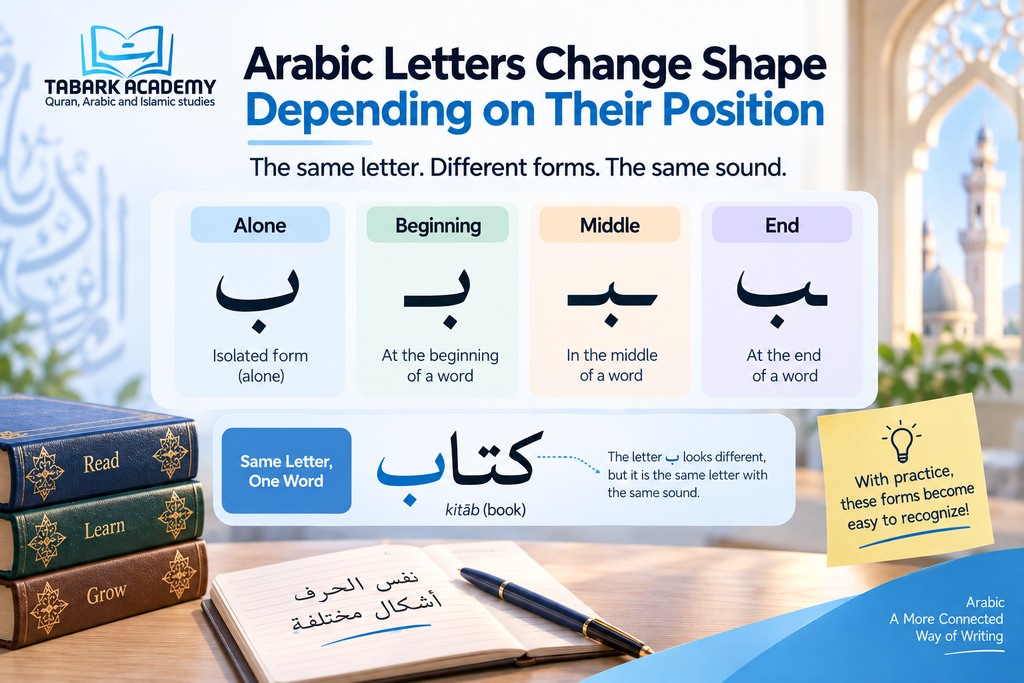
Many Arabic letters change their appearance depending on whether they appear:
- Alone
- At the beginning of a word
- In the middle of a word
- At the end of a word
The identity and sound of the letter do not change. Its written form simply adjusts so that it can connect naturally with surrounding letters.
At first, this can make Arabic words seem as though they contain more than 28 letters because the same letter may look different in several positions. With practice, learners begin recognizing these connected forms as variations of the same basic shape.
This positional system is also one reason Arabic script has such a flowing and visually distinctive appearance.
9. Most Arabic Letters Connect to Each Other
Arabic is naturally written using a connected script Instead of writing every character separately, most letters join together inside a word.
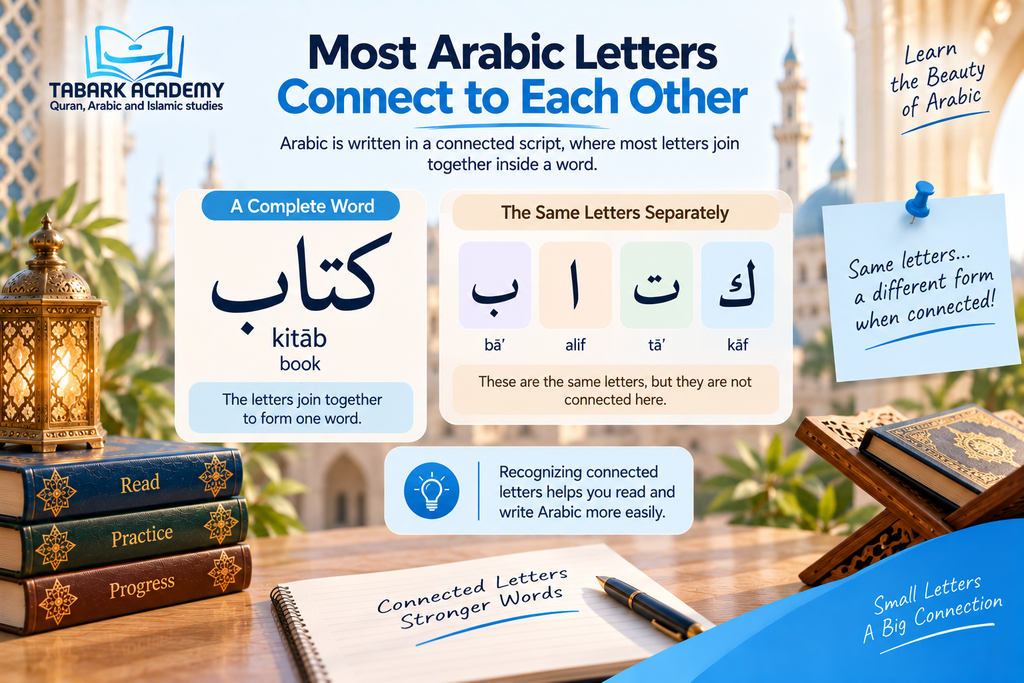
For example:
كتاب — kitāb — book
The individual letters combine into one connected written form rather than appearing as separate symbols.
A small number of Arabic letters do not connect to the letter that follows them. Beginners gradually learn which letters interrupt the connection and how this affects the visual shape of words.
Learning connected writing is important not only for handwriting but also for reading Arabic quickly. Once students recognize common letter combinations, they can process whole words more efficiently.
10. Many Arabic Words Are Built Around Roots
One of the most useful Arabic language facts for learners is that many words are built around consonantal roots.
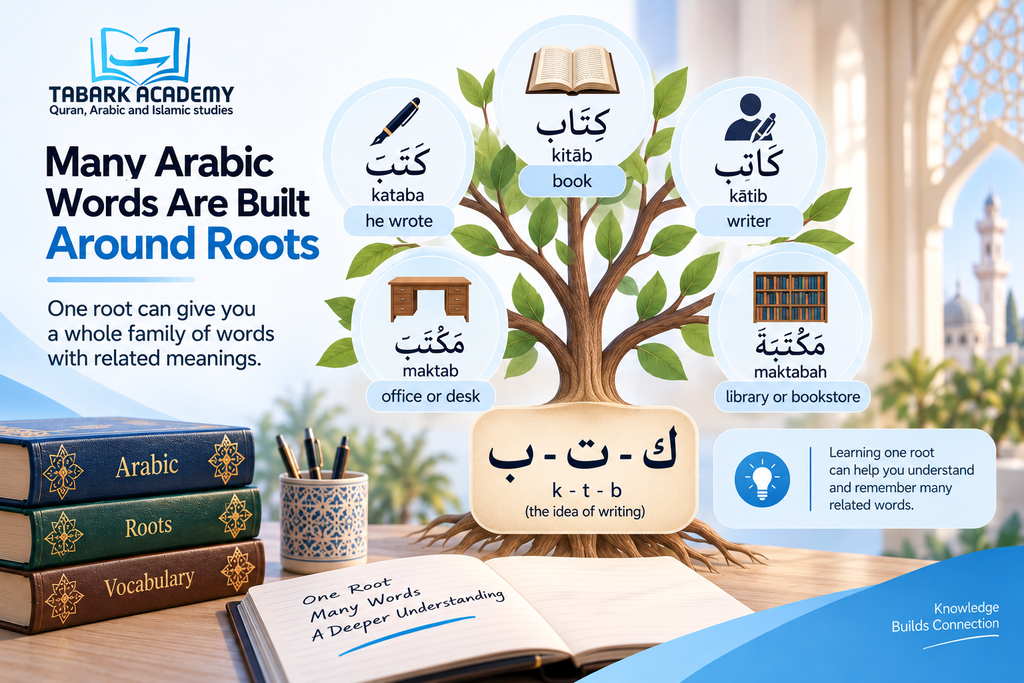
A well-known example is:
ك-ت-ب — k-t-b
This root carries the general idea of writing.
From it come words such as:
- كَتَبَ — kataba — he wrote
- كِتَاب — kitāb — book
- كَاتِب — kātib — writer
- مَكْتَب — maktab — office or desk
- مَكْتَبَة — maktabah — library or bookstore
These words share a common root, making their meanings easier to connect.
Arabic roots often combine with recurring patterns that help create verbs, nouns, professions, places, tools, and other related meanings.
For students, recognizing roots can be one of the most effective ways to expand vocabulary because learning one root may unlock an entire family of words.
This root-based structure is also extremely useful when studying the Quran, where related words may appear in different grammatical forms while still sharing the same underlying root.
11. Arabic Has a Special Form for Exactly Two
Arabic has a unique grammatical feature that distinguishes between one, exactly two, and more than two. Unlike English, which normally uses the plural for anything above one, Arabic has a separate form called the dual (المثنى) specifically for two people, objects, or things.
| Number | Arabic | Meaning |
| Singular | كتاب | one book |
| Dual | كتابان | two books |
| Plural | كتب | books |
For example, كتاب (kitāb) means “a book,” while كتابان (kitābān) means “two books.” When referring to three or more books, Arabic uses the plural كتب (kutub).
The dual is usually formed by adding ـانِ (-āni) in the nominative case or ـيْنِ (-ayni) in the accusative and genitive cases.
Step Inside Our Virtual Classrooms
See our engaging teaching methods in action! watch real snippets of our live classes and discover how our expert instructors make learning interactive, memorable, and inspiring for every student.
12. Arabic Nouns Have Grammatical Gender
Arabic nouns are grammatically classified as either masculine or feminine.
This classification can affect several other words in the sentence. Adjectives, pronouns, demonstratives, and verbs may change form so they agree with the gender of the noun they describe or refer to.
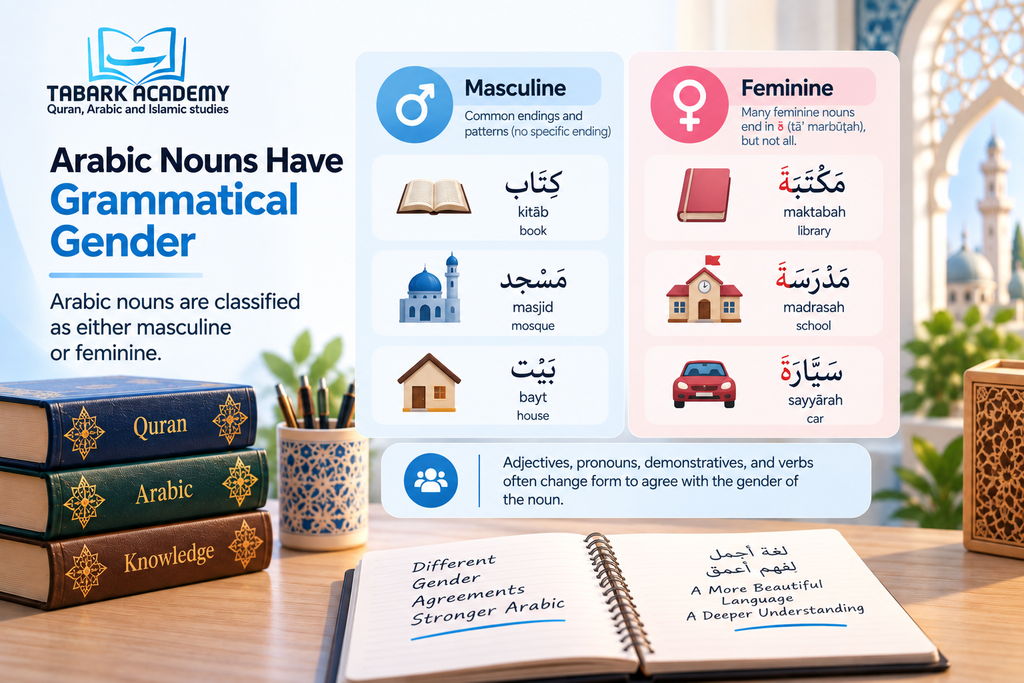
Many feminine nouns end in ة — tāʾ marbūṭah, although this is not true of every feminine word. Some nouns are feminine even without this ending, so learners still need to build familiarity with individual vocabulary.
Gender agreement becomes especially important when students move from memorizing isolated words to forming complete sentences.
For learners coming from English, this feature may require extra attention because English does not classify ordinary nouns in quite the same grammatical way.
13. Arabic Word Endings Can Change Depending on Their Role in a Sentence
One of the most distinctive features of formal Arabic is that the ending of a word can change depending on the grammatical role it plays in a sentence. This system is known as I‘rab — الإعراب.
For nouns, formal Arabic uses three main grammatical cases:
| Case | Arabic | Common Marker |
| Nominative | مرفوع | Dammah (ـُ) |
| Accusative | منصوب | Fathah (ـَ) |
| Genitive | مجرور | Kasrah (ـِ) |
The nominative case (مرفوع) commonly appears with the subject of a sentence. For example, in جاءَ الطالبُ (The student came), the word الطالبُ ends with a dammah because it is the subject.
The accusative case (منصوب) is commonly used for direct objects. In رأيتُ الطالبَ (I saw the student), الطالبَ takes a fathah because it is the object of the verb.
The genitive case (مجرور) often appears after a preposition or within an Idafah construction. For example, in ذهبتُ إلى المسجدِ (I went to the mosque), المسجدِ takes a kasrah because it follows the preposition إلى.
14. The Arabic You Read May Be Different From the Arabic You Hear
One surprising fact for new learners is that the Arabic found in books, news reports, and formal writing is not always the same Arabic they will hear in everyday conversations.
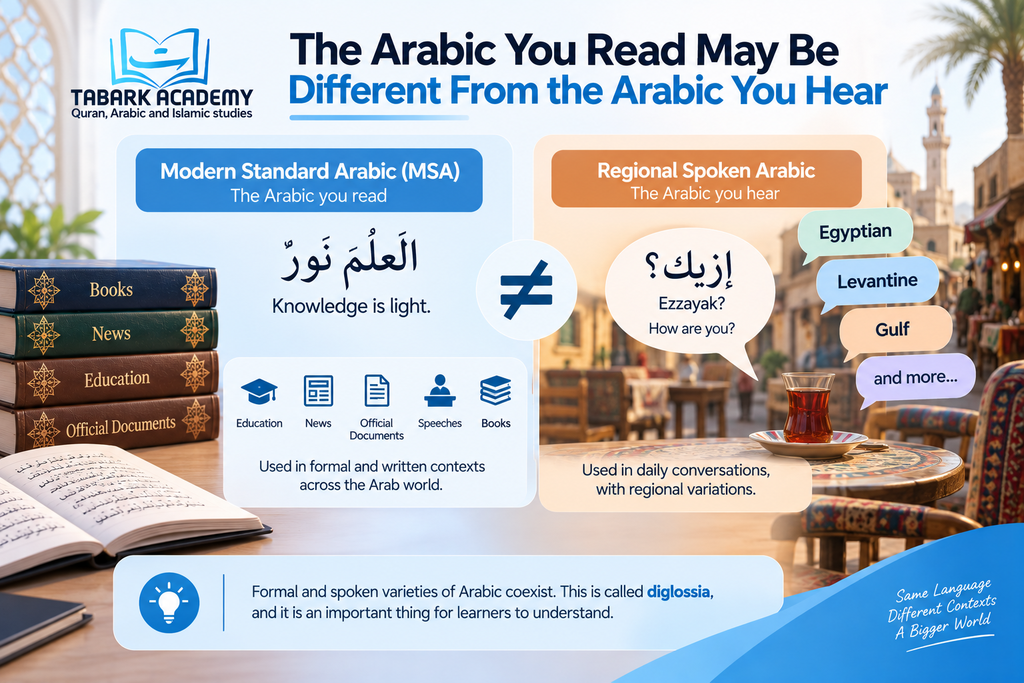
Modern Standard Arabic (MSA) is widely used in education, journalism, books, official documents, speeches, and other formal contexts. Daily conversations, however, usually take place in regional spoken varieties.
Linguists commonly describe this coexistence of formal and everyday varieties as diglossia.
This is why someone can become comfortable reading Modern Standard Arabic yet still need additional practice to understand a fast conversation in Egyptian, Levantine, Gulf, or another regional variety.
15. Quranic Arabic Is Different From Modern Standard Arabic
Quranic Arabic belongs to the Classical Arabic tradition. It shares many roots and grammatical structures with Modern Standard Arabic (MSA), but it also includes classical vocabulary, older expressions, and distinctive rhetorical features.
| Quranic Arabic | Modern Standard Arabic |
| Classical language | Contemporary formal language |
| Used in the Quran | Used in media and formal writing |
| Rich rhetorical structures | Standardized modern style |
| Classical vocabulary | More contemporary terms |
Understanding these differences helps learners recognize Quranic vocabulary and grammar more accurately. Students can develop these skills through Tabarak Academy’s Quranic Arabic Classes.
16. Arabic Dialects Can Differ Significantly Between Regions
There is no single spoken Arabic dialect used everywhere Arabic-speaking communities have developed regional varieties that differ in pronunciation, vocabulary, expressions, and sometimes grammatical structures.
Major groups include:
- Egyptian Arabic
- Levantine Arabic
- Gulf Arabic
- Iraqi Arabic
- Maghrebi Arabic
Even simple everyday words may be pronounced differently or replaced by entirely different expressions depending on the region.
For example, someone speaking Moroccan Arabic may use vocabulary and pronunciation that sound very different from those used by speakers in Egypt, Lebanon, Saudi Arabia, or Iraq.
Some distant regional varieties can even require speakers to simplify their language, switch vocabulary, or move closer to Modern Standard Arabic when communicating with one another.
17. Arabic Is the Language of the Quran
Arabic holds a special place in Islam because the Quran was revealed in Arabic. For Muslims throughout the world, Arabic is therefore much more than a means of everyday communication. It is also the language in which the Quran is recited and an important part of several acts of worship.
Millions of Muslims who do not speak Arabic as their native language still learn Arabic letters, pronunciation, and Quranic vocabulary so they can recite the Quran correctly.
A Muslim does not need to be a native Arabic speaker to recite the Quran. However, learning Arabic can help students move beyond relying entirely on translations and begin recognizing Quranic vocabulary, roots, grammar, and meaning directly.
Even a basic understanding of repeated Quranic words can change the experience of recitation because learners begin connecting familiar sounds with their meanings.
18. Arabic Is Known as “The Language of Ḍād”
Arabic is traditionally known as لغة الضاد — Lughat al-Ḍād, meaning “the language of Ḍād.”
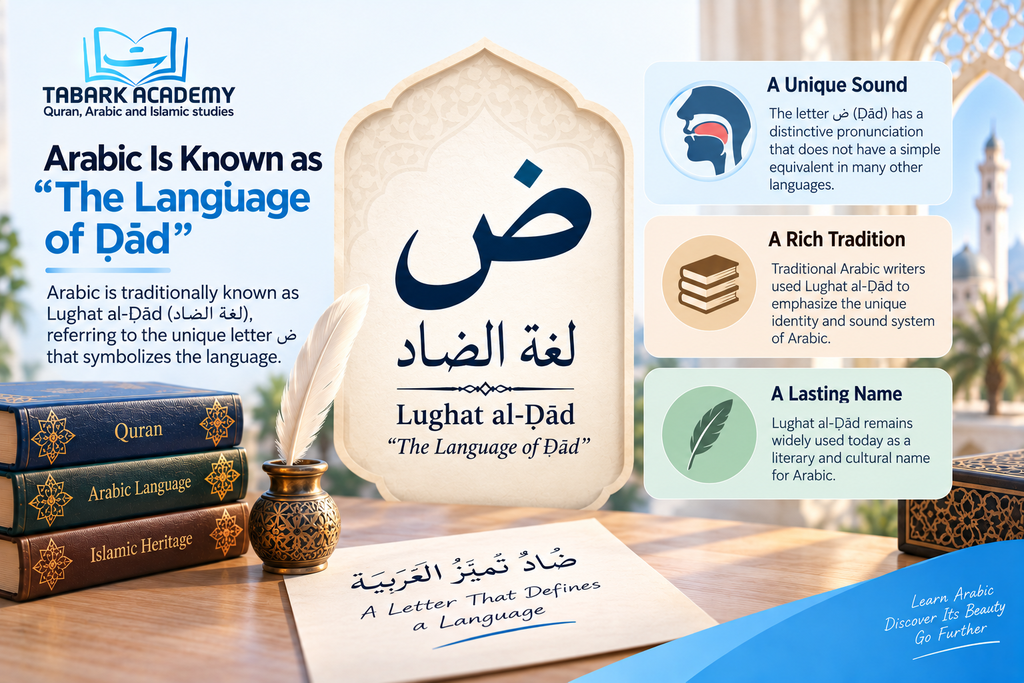
The expression refers to the Arabic letter ض — Ḍād. The sound represented by this letter became strongly associated with Arabic and eventually came to symbolize the language itself.
Traditional Arabic writers often used the expression to emphasize the distinctive sound system and linguistic identity of Arabic. Pronouncing Ḍād correctly can also be challenging for learners because its articulation does not have a simple equivalent in many other languages.
The expression Lughat al-Ḍād remains widely used today as a literary and cultural name for Arabic.
19. Arabic Has Influenced Languages Across the World
Arabic has had an important linguistic influence far beyond the Arab world. Through centuries of trade, religion, scholarship, administration, and cultural exchange, Arabic vocabulary entered numerous languages.
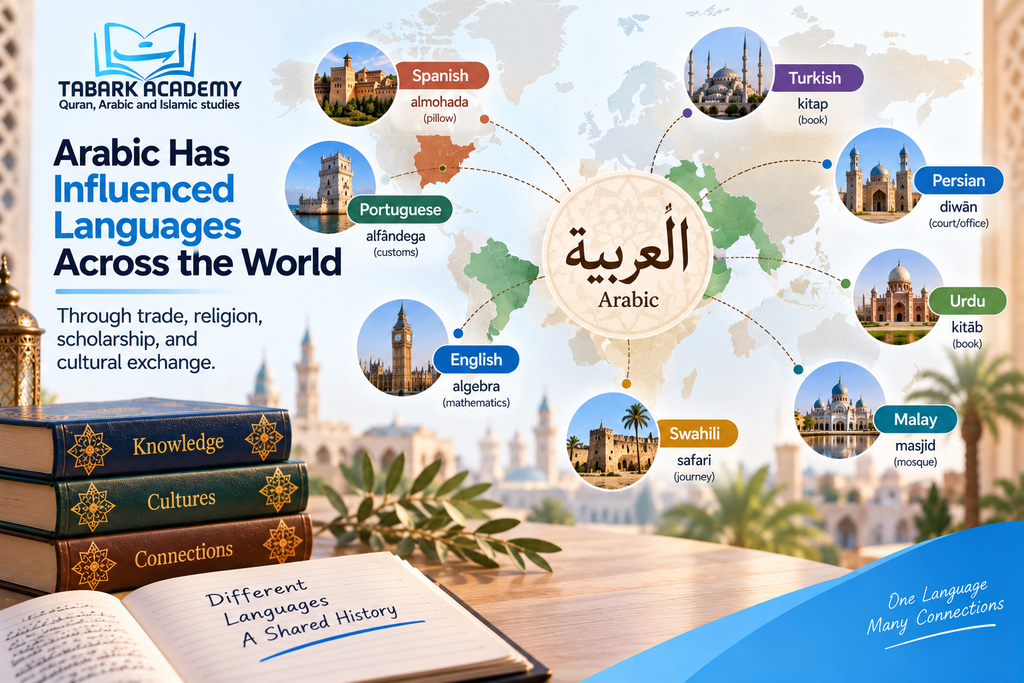
Its influence can be found in:
- Spanish
- Portuguese
- Persian
- Turkish
- Urdu
- Swahili
- Malay
- English
The extent of this influence varies according to history and geography. Some languages adopted Arabic vocabulary primarily through religion, while others were influenced through trade, scholarship, or prolonged cultural contact.
20. Many English Words Have Arabic Origins
Several familiar English words ultimately trace part of their history to Arabic, reflecting centuries of contact between Arabic-speaking societies and Europe.
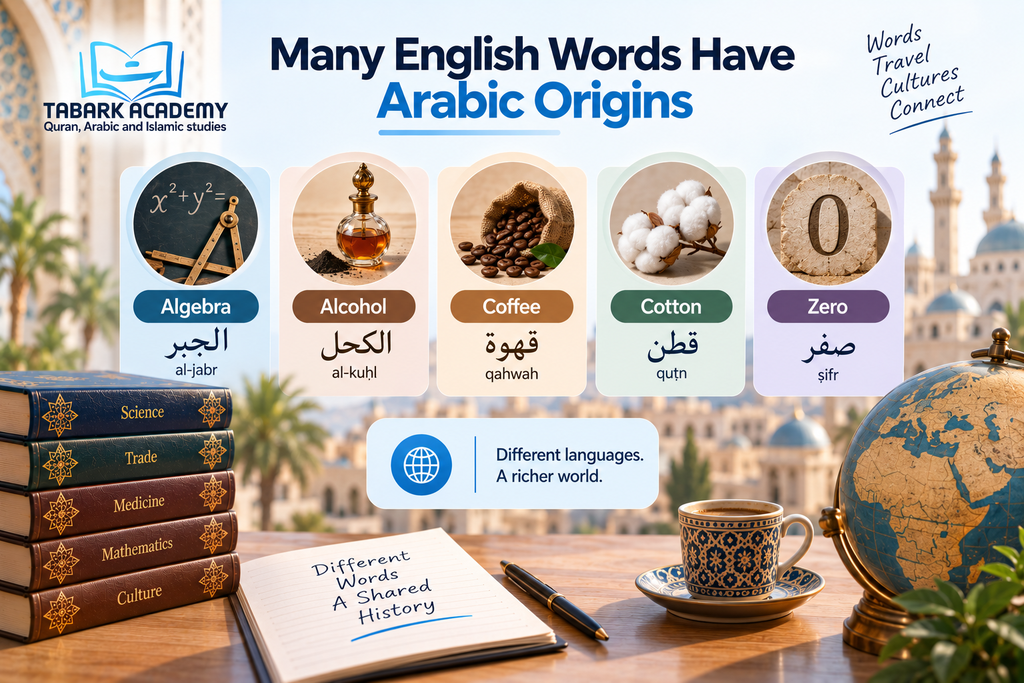
Examples include:
- Algebra — from al-jabr (الجبر)
- Alcohol — historically connected to al-kuḥl (الكحل)
- Coffee — ultimately linked to Arabic qahwah (قهوة)
- Cotton — from Arabic quṭn (قطن)
- Zero — ultimately connected to Arabic ṣifr (صفر)
Many of these words entered English indirectly through languages such as Spanish, Italian, French, and Medieval Latin.
Interesting connection: Many Arabic-derived English words relate to mathematics, science, trade, medicine, and commodities, reflecting centuries of intellectual and commercial exchange.
21. Arabic Script Is Used by Languages Other Than Arabic
The Arabic writing system is not limited to the Arabic language. Modified forms of Arabic script have historically been used, or continue to be used, to write languages including:
- Persian
- Urdu
- Pashto
- Kurdish varieties
- Sindhi
- Malay in Jawi script
These languages adapt the writing system by adding or modifying letters to represent sounds that are not found in Arabic.
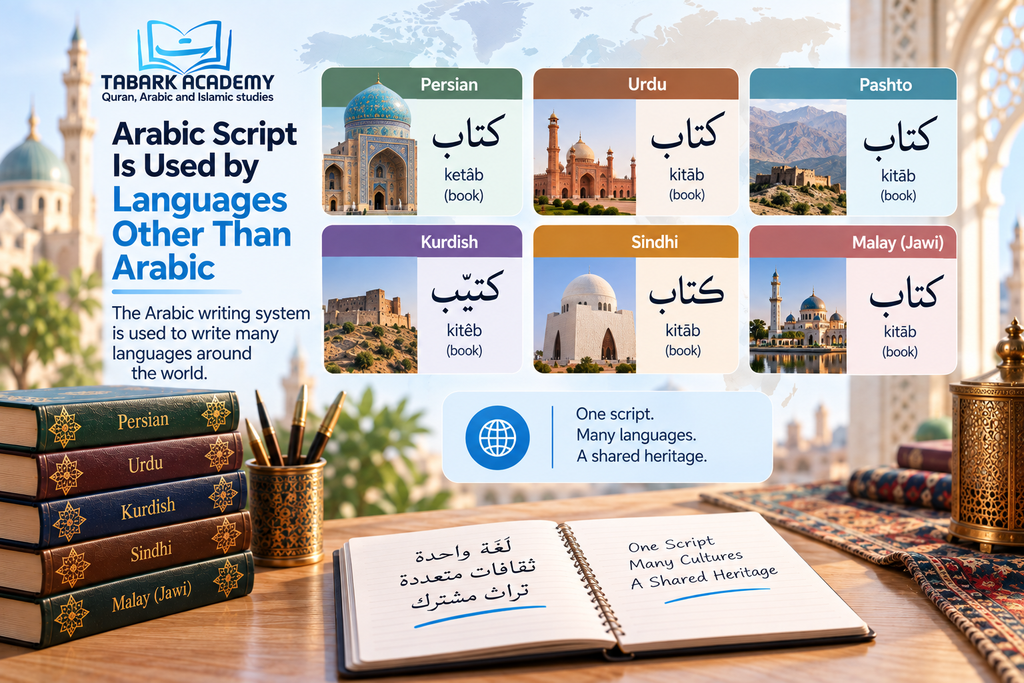
For example, Persian and Urdu use additional letters that Arabic itself does not require. This demonstrates how the Arabic writing system spread far beyond Arabic-speaking communities through centuries of cultural, religious, and intellectual exchange.
22. Arabic Has a Rich Tradition of Calligraphy
Arabic calligraphy developed into a major artistic and cultural tradition over many centuries. Calligraphers created different styles for purposes ranging from copying manuscripts to decoration and everyday writing.
| Style | Known For |
| Kufic | Angular forms and early manuscripts |
| Naskh | Clear, highly readable script |
| Thuluth | Large, elegant decorative lettering |
| Diwani | Flowing and curved forms |
| Ruq‘ah | Simple, practical everyday handwriting |
Calligraphy became especially important in Islamic art and was frequently used for Quranic manuscripts and architectural inscriptions.
Different scripts were chosen according to their function: Naskh became particularly suitable for readable texts, while styles such as Thuluth were widely used for decorative inscriptions.
23. Arabic Has Helped Preserve and Transmit Centuries of Scholarship
Arabic has served as an important language of scholarship for centuries, particularly in fields such as mathematics, astronomy, medicine, philosophy, geography, literature, and religious studies.
Scholars writing in Arabic produced original works while also translating, studying, commenting on, and developing knowledge from earlier intellectual traditions.
Arabic manuscripts therefore became an important part of the transmission and development of knowledge across different regions and historical periods.
This scholarly heritage is another reason Arabic remains valuable beyond everyday communication. Learning the language can give students access to a vast body of classical literature, Islamic scholarship, historical writing, and intellectual works in their original language.
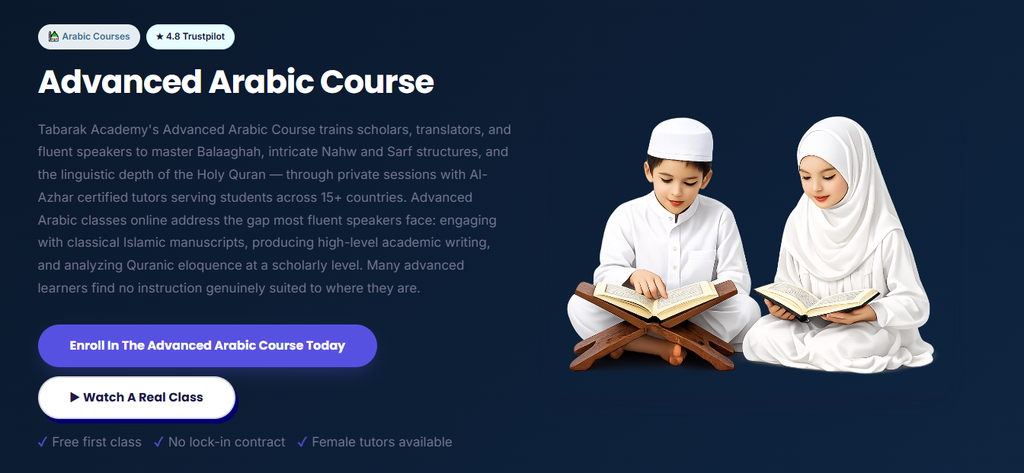
For learners who already have a strong foundation, Tabarak Academy’s Advanced Arabic Course provides an opportunity to develop more complex vocabulary, grammar, and language skills.
What Makes the Arabic Language Unique?
Arabic brings several unusual linguistic features together within one language: a connected right-to-left script, a root-and-pattern vocabulary system, grammatical gender, a special dual form, case endings, and a wide range of spoken dialects.
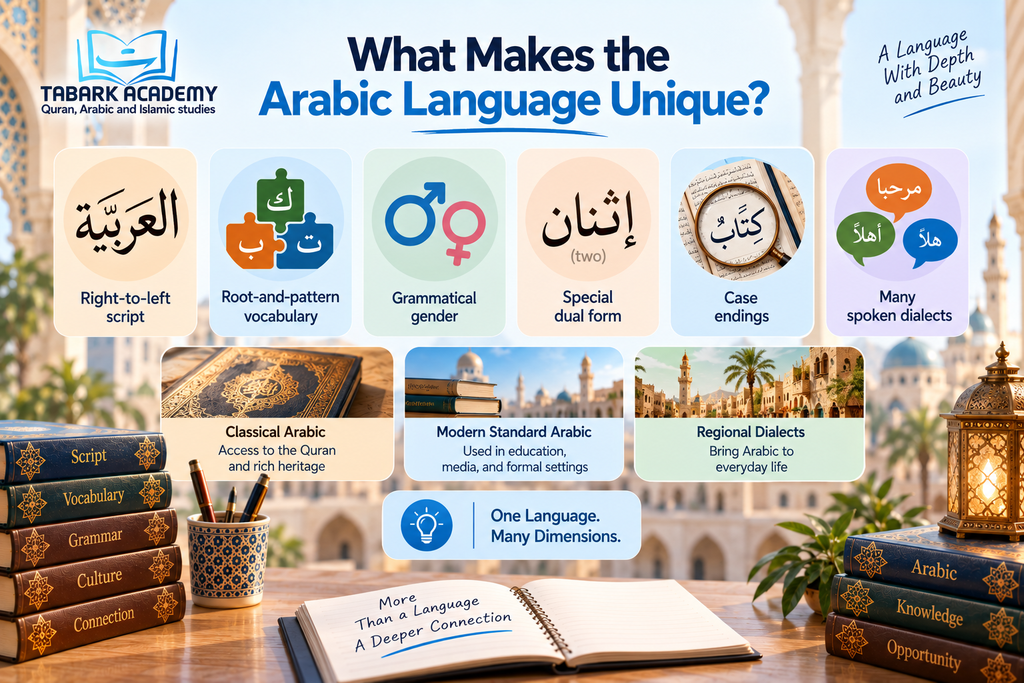
It also connects different historical and modern worlds. Classical Arabic provides access to the Quran and centuries of literature and scholarship, Modern Standard Arabic supports contemporary formal communication, and regional dialects bring the language into everyday life.
For learners, this means studying Arabic is not simply about memorizing vocabulary. It is about gradually recognizing the patterns that connect its words, structures, sounds, and meanings.
Experience Our Interactive Learning
Curious about how we teach? Watch these brief video clips from our recent live sessions to see our structured curriculum, advanced learning platform, and dynamic student-teacher interactions firsthand.
Start Your Arabic Learning Journey With Tabarak Academy
Knowing interesting facts about Arabic is a great start, but Tabarak Academy can help you take the next step and build practical language skills through structured online learning.
Students can develop their reading, vocabulary, grammar, comprehension, and communication at a level that suits them.
Tabarak Academy supports different learning goals, whether you want to communicate confidently in Arabic, improve your reading, study Classical Arabic, or develop a deeper understanding of the Quran. Learners can choose a path that matches their needs and progress with structured guidance.
Our Arabic Language Courses
- Online Arabic Classes
- Arabic Course for Beginners
- Arabic Alphabet Learning Course
- Online Arabic Classes for Kids
- Arabic Classes for Adults
- Arabic Grammar Course
- Intermediate Arabic Course
- Arabic Speaking Course
- Arabic Reading Course
- Learn Arabic Writing Course
- Classical Arabic Course
- Modern Standard Arabic (MSA) Course
Choose the path that matches your goal and start building your Arabic skills step by step with structured guidance.
Conclusion
These facts about the Arabic language reveal a language shaped by centuries of history, literature, and culture. Its distinctive writing system, root-based vocabulary, rich grammar, regional dialects, and connection to the Quran make Arabic a fascinating language to explore.
Understanding these features gives learners a stronger foundation for studying Arabic. Whether your goal is communication, reading, Classical Arabic, or Quranic understanding, regular practice can help you recognize patterns, expand your vocabulary, and build confidence.
The more you explore Arabic, the more connections you begin to notice between its words, roots, and structures. Features that may seem complex at first gradually become clearer, making the language easier to understand and more rewarding to learn.
Frequently Asked Questions About the Arabic Language
What Are Some Interesting Facts About the Arabic Language?
Arabic is a Semitic language written from right to left with 28 basic letters. It has no uppercase or lowercase system, many words are built from consonantal roots, and formal Arabic includes features such as the dual form, grammatical gender, and case endings.
Arabic is also the language of the Quran and one of the six official languages of the United Nations.
How Many People Speak Arabic?
Arabic is spoken by hundreds of millions of people worldwide. Exact estimates vary depending on whether they include only native speakers or also people who use Arabic as a second or additional language.
How Many Letters Are in the Arabic Alphabet?
The Arabic alphabet has 28 basic letters. Many letters change shape depending on their position within a word, while short vowels are usually represented by marks called harakat.
Why Is Arabic Written From Right to Left?
Arabic developed within a historical tradition of Semitic writing systems written from right to left. Today, Arabic words, sentences, and texts continue to follow this writing direction.
Is Quranic Arabic the Same as Modern Standard Arabic?
No. Quranic Arabic belongs to the Classical Arabic tradition, while Modern Standard Arabic is the formal variety widely used today in education, news, books, and official communication.
They share much of their grammar and vocabulary, but Quranic Arabic contains older vocabulary and distinctive classical structures.
What Are the Main Types of Arabic?
Arabic is commonly discussed in three broad forms: Classical Arabic, Modern Standard Arabic (MSA), and regional spoken dialects such as Egyptian, Levantine, Gulf, Iraqi, and Maghrebi Arabic.
The best variety to learn depends on whether your goal is Quranic understanding, formal communication, or everyday conversation.