

Is Arabic A Difficult Language To Learn?
The real answer to “is Arabic a difficult language to learn” is more useful than a simple yes or no. Arabic is challenging in specific, identifiable ways, ways that are teachable, learnable, and far less frightening once you name them clearly.
People say Arabic is one of the hardest languages on earth. That claim has followed the language for so long that most learners accept it before they start and either give up before the first lesson or plunge in without knowing what they are actually dealing with.
Millions of non-native speakers have learned Arabic, are learning it right now, and use it every day in scholarship, diplomacy, business, and faith. By the end, you will know exactly what you are up against, why it is worth it, and what the most effective path forward looks like.
Learners who study with qualified teachers in focused programs reach functional milestones considerably faster. Understanding which specific challenges account for that gap is the first step to clearing them.
This article breaks down 8 honest, research-backed reasons Arabic challenges learners, drawn from linguistic science, classroom experience, and the testimony of those who have walked this road.
Is Arabic A Difficult Language To Learn?
The US Foreign Service Institute classifies Arabic as a Category IV language; its hardest tier, alongside Mandarin, Japanese, and Korean. That Institute is responsible for training American diplomats and government linguists across dozens of languages,
For an English speaker with no prior Arabic exposure, the FSI estimates approximately 2,200 hours of structured study to reach professional working proficiency.
To put that in perspective: French takes around 600 hours. Spanish, 600–750. German, 750. Arabic requires nearly four times the investment of a Romance language for equivalent competency. Here are the 8 challenges that Arabic learners face.

Start the Arabic Course for Beginners With a Free Class Now
1. The Arabic Script Runs Right To Left
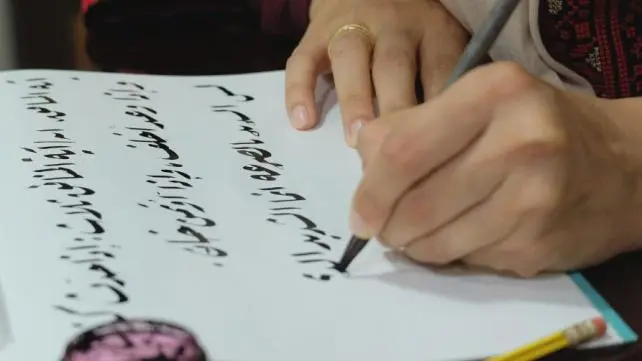
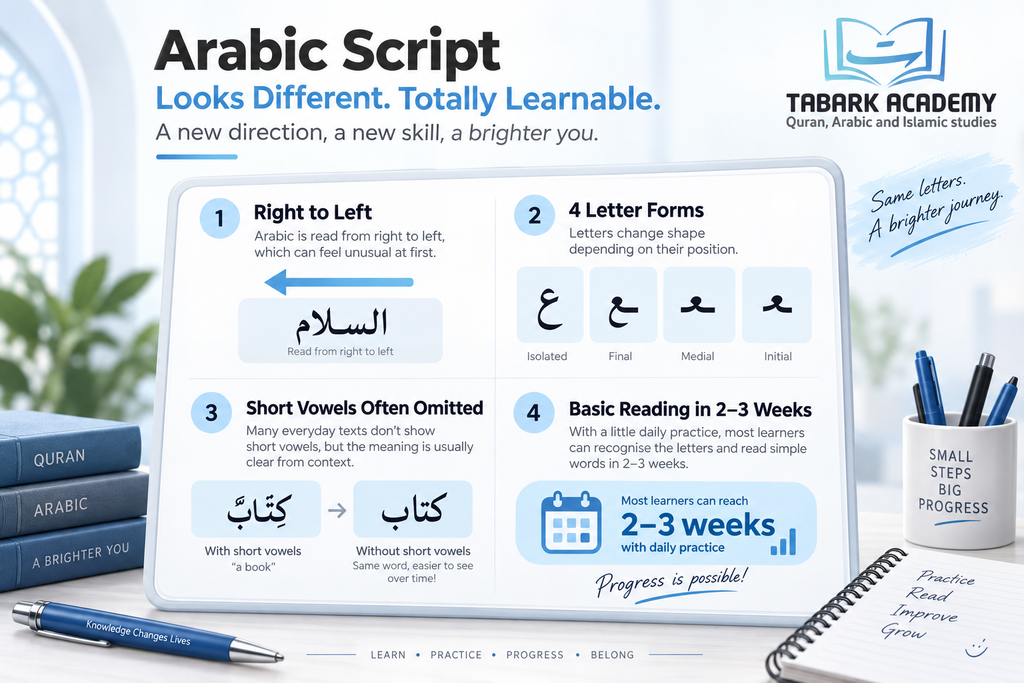
The first obstacle is purely visual. Arabic is written and read from right to left, a complete reversal of every reading habit a Western learner has built since childhood.
More demanding than direction is what happens to the letters themselves: every Arabic letter takes four distinct forms depending on whether it appears at the start, middle, or end of a word, or stands alone.
The letter ع (ʿayn), for example, looks entirely different in each of its four positions. Multiply that pattern across 28 letters and the visual decoding challenges compounds quickly.
The encouraging truth: with daily focused practice, most learners master letter recognition and basic reading within two to three weeks. Arabic is, unlike English, what is written is almost exactly what is said, once the vowel system falls into place.
2. Arabic Has Sounds That Don’t Exist In Any Other Major Language
This is arguably the most surprising answer to why is Arabic hard to learn, and it catches learners completely off guard. Arabic contains consonants that have no equivalent in English, French, Spanish, or any other widely-spoken European language.
Sounds produced deep in the throat, at the pharynx, or with the back of the tongue in ways that English speakers have simply never needed.
The emphatic consonants ص ض ط ظ, the deeply breathy ح (ħa), and the pharyngeal ع (ʿayn) and غ (ghayn) require learners to train parts of their vocal tract that have never been used for speech before.
The غ (ghayn) is a gargled sound resembling a French “r” but produced lower. The ح is a strongly aspirated h-sound from the back of the throat.
These sounds require systematic, targeted practice with a teacher who can model and correct them in real time. Understanding precisely where each sound originates, its Makharij (articulation point), is the proven approach.
Begin Mastering Arabic with Tabarak Academy’s Advanced Course
3. The Existence Of Formal Arabic and Different Regional Arabic Dialects
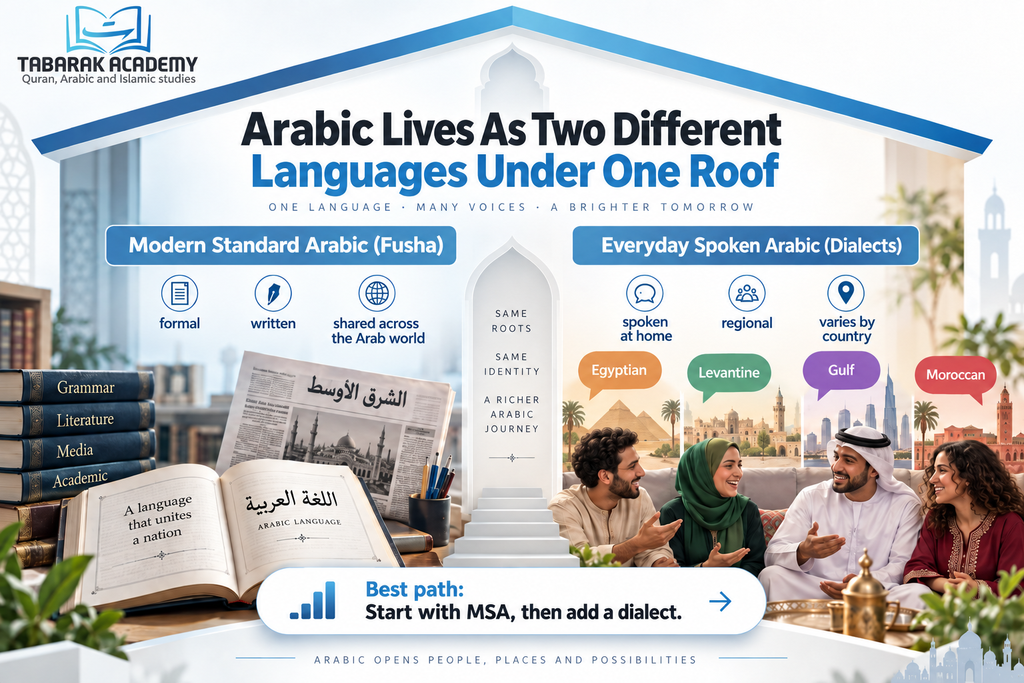
Ask a linguist what “Arabic” is, and the honest answer is: a continuum. The phenomenon is called diglossia, and it is one of the clearest answers to why is Arabic so hard to learn for non-native speakers who approach the language.
Modern Standard Arabic (Fusha) is the formal, written register used in newspapers, academic texts, formal broadcasting, and the Quran.
It is grammatically consistent across all 22 Arab countries and universally understood in formal contexts. But almost no one speaks it at home.
Everyday spoken Arabic is a collection of regional dialects, Egyptian, Levantine, Gulf, Moroccan, that differ from each other and from Fusha in vocabulary, grammar, and pronunciation.
That results in a Moroccan Arabic speaker and a Gulf Arabic speaker may struggle to follow each other.
For a learner, this means a strategic decision at the start: most experienced Arabic educators recommend beginning with Modern Standard Arabic as the structural foundation, then layering on a dialect based on your specific goals.
4. Arabic Grammar Is Built On A Root System
English grammar operates on word order: the position of a word in a sentence signals its role. Arabic grammar operates on an entirely different logic, a root-and-pattern system where meaning is encoded into three-letter consonantal roots.
And grammatical relationships are expressed through case endings (i’rab) that change the vowel at the end of each word.
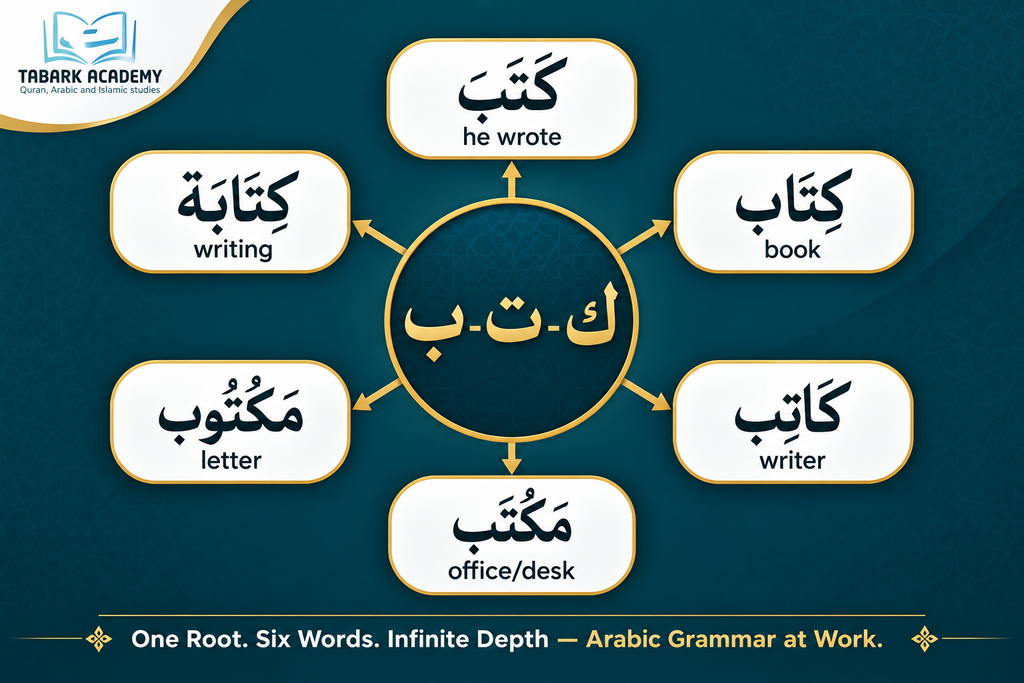
The root ك-ت-ب (k-t-b) encodes the concept of “writing.” From this single root, Arabic generates: كَتَبَ (he wrote), كِتَاب (book), كَاتِب (writer), مَكْتَب (office or desk), مَكْتُوب (a written letter), and كِتَابَة (the act of writing).
A learner who internalizes this root has simultaneously learned six related words and can recognize dozens more.
Achieve real progress from a real Arabic Reading Course at Tabarak Academy
A. How Does The Three-Letter Root System Change Everything?
Once a learner absorbs approximately 300–400 core roots, vocabulary acquisition accelerates sharply. Instead of memorizing individual words, you start recognizing patterns.
Identifying the underlying root in unfamiliar words and inferring meaning with reasonable accuracy. This is one of Arabic’s hidden advantages for committed learners, even though the system feels alien in the early weeks.
The case-ending system (i’rab) is the other structural element that challenges beginners. Because case endings — not word order — signal grammatical roles, Arabic sentences can be arranged in multiple orders without changing meaning.
That flexibility is a feature of the language, not a flaw, but learning to produce and parse it correctly requires dedicated practice with qualified guidance.
Explore our Modern Standard Arabic (MSA) Course at Tabarak Academy
B. How Does Arabic Vocabulary Cut Finer Than English Ever?
The word “friend” in English covers a broad social spectrum. Arabic makes finer distinctions than English can follow.
It has at least six distinct words for different types of friends: Turb (a peer your own age), Azzameel (a colleague in work or school), Al-jalees (someone who shares your gathering)
Al-Samir (someone you spend evenings in conversation with), Al-Nadim (a companion in leisure), and Al-Sahib (a constant daily companion). These are not synonyms — each captures a shade of relationship that none of the others reaches.
5. The Shortage Of Qualified Arabic Teachers For Non-Native Speakers
Teaching Arabic to native speakers, children who already carry the sounds, intuitions, and cultural context, is a fundamentally different discipline from teaching it to someone who grew up speaking English, Spanish, or Mandarin.
A qualified Arabic-as-a-second-language teacher must understand phonetic contrasts between Arabic and the student’s mother tongue.
He designs communicative activities that build all four skills, and adapt methods to different learning styles and age groups.
That combination of skills is genuinely rare. Many Arabic instructors are highly proficient in the language but were trained to teach Arabic-speaking students how to read and write formally.
And not to build the language from zero for a speaker of a completely different linguistic system. The result is that non-native learners often receive instruction designed for a different student entirely.
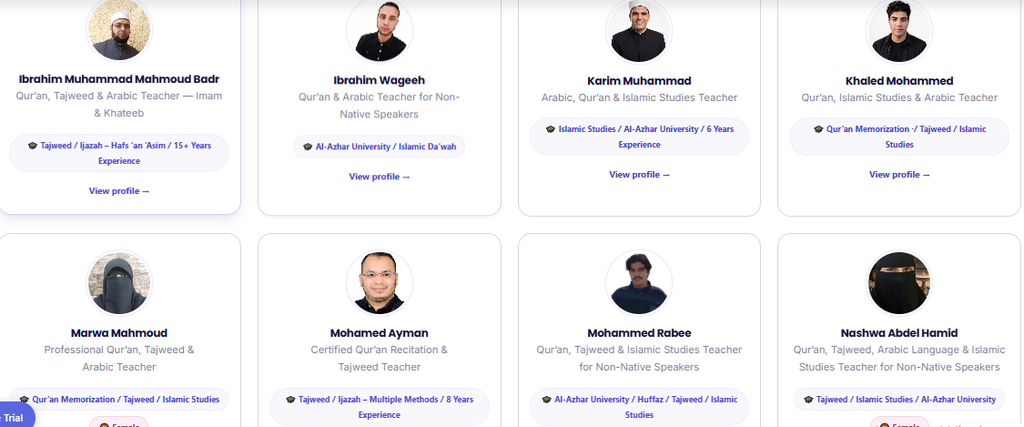
At Tabarak Academy, every instructor is a certified native Arabic speaker trained specifically in second-language acquisition, the science of how adults and children build a new language from scratch.
Experience Our Interactive Learning
Curious about how we teach? Watch these brief video clips from our recent live sessions to see our structured curriculum, advanced learning platform, and dynamic student-teacher interactions firsthand.
6. Good Arabic Learning Resources For Non-Native Beginners Are Still Scarce
A quick search for Arabic learning materials turns up thousands of results. The reality behind that number is more sobering: most materials were designed for Arab students who need to master its formal written register.
Resources built from the ground up for complete non-native beginners, especially adults, are proportionally rare.
This scarcity has real consequences. Learners spend months on textbooks that assume grammatical knowledge they do not have, or on vocabulary apps that teach words in isolation without the root-and-pattern context that makes them stick.
Finding a curriculum that covers listening, speaking, reading, and writing in the right proportions, and that starts from absolute zero, remains harder than it should be.
For those who want to learn Arabic language, the most reliable route is a specialized online academy where instructors are trained to build the language for non-native speakers from the very first letter.
The difference between an excellent resource and a mediocre one can determine whether a learner reaches fluency or stalls at an intermediate plateau for years.
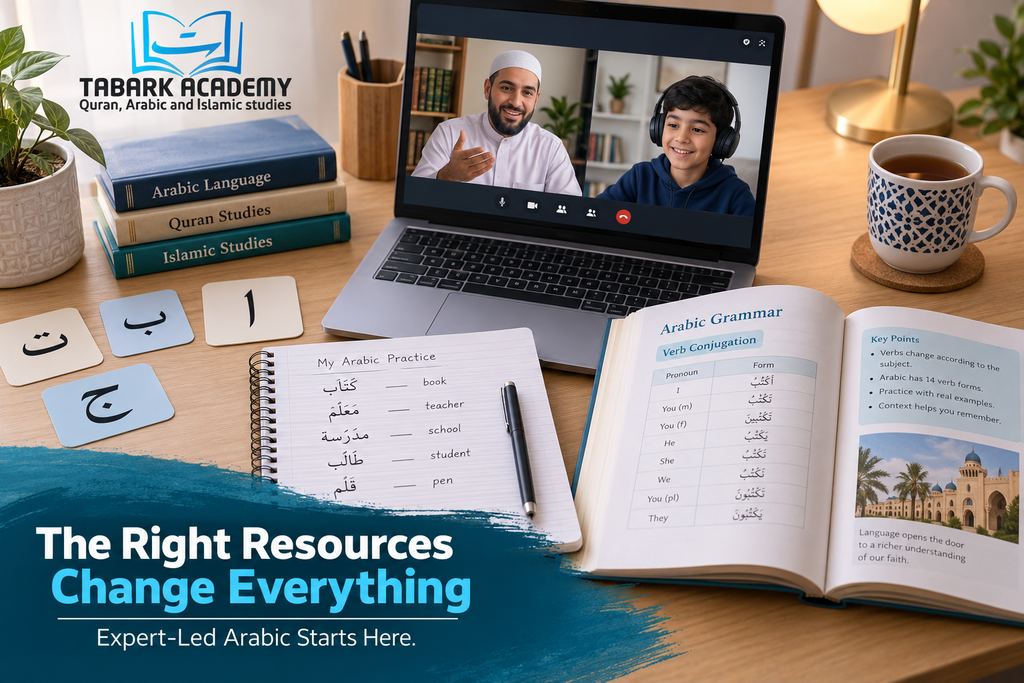
A. Arabic Unlocks The Quran In Its Original Voice
For Muslim learners, and for anyone studying Islam seriously, this reason stands above all others.
The Quran was revealed in Arabic, and scholars from the earliest generations of Islam have consistently held that its depth, precision, and beauty cannot be fully transferred to any translation.
Ibn Taymiyyah wrote that knowing Arabic is a religious obligation precisely because understanding the sacred texts at their deepest level requires it.
Learning Arabic to read the Quran is not merely a pious aspiration, it is a transformative experience that changes how the text is heard and felt.
Muslim families raising children in the West often cite this as the primary motivation for enrolling in Arabic instruction, alongside broader goals around how to raise children in Islamic way, with Arabic as a central pillar of that upbringing.
You can also actively improve your language skills with Quran study as you go, deepening your Arabic and your connection to the sacred text simultaneously.
B. How Learning Arabic Opens Doors To Quranic Scholarship?
Arabic fluency opens the path to a richer and more layered engagement with the Quran than any translation can offer.
Understanding the types of qirat in the quran, the ten valid oral transmission traditions of the sacred text, becomes possible only with a solid Arabic foundation, because each tradition carries subtle phonological distinctions that translation cannot convey.
For those who pursue formal Quranic certification, knowing how to get ijazah begins with the Arabic language skills that make scholarly advancement possible.
Start Quranic Arabic Classes with a free trial Today

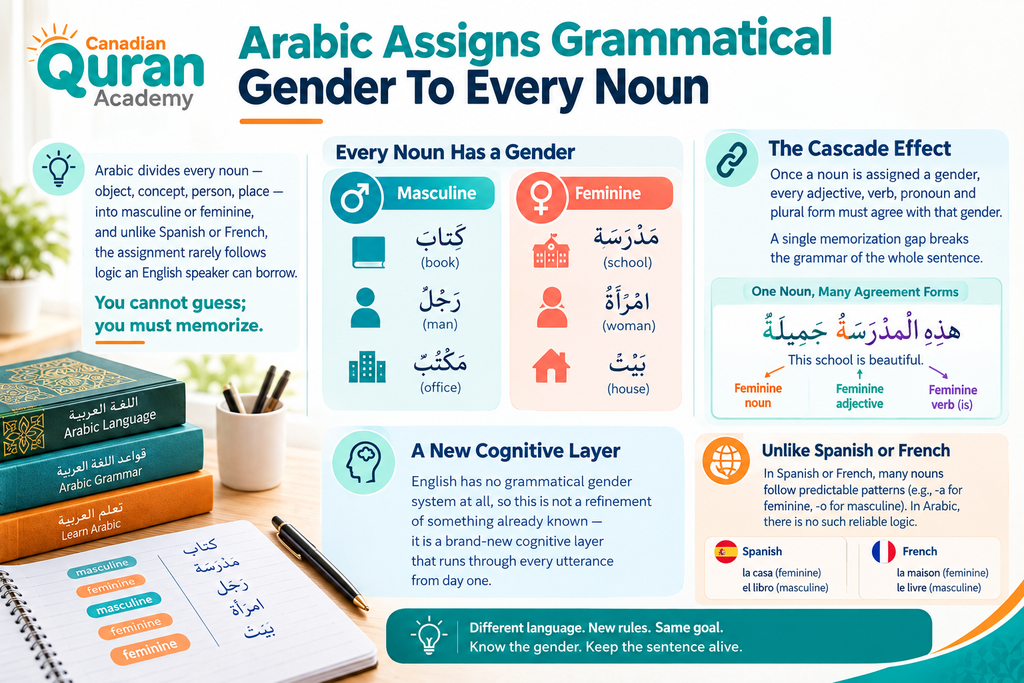
7. Arabic Assigns Grammatical Gender To Every Noun
Arabic divides every noun — object, concept, person, place — into masculine or feminine, and unlike Spanish or French, the assignment rarely follows logic an English speaker can borrow. You cannot guess; you must memorize.
The deeper difficulty is the cascade effect: every adjective, verb, pronoun, and plural form must then agree with that gender, meaning a single memorization gap breaks the grammar of the whole sentence.
English has no grammatical gender system at all, so this is not a refinement of something already known — it is a brand-new cognitive layer that runs through every utterance from day one.
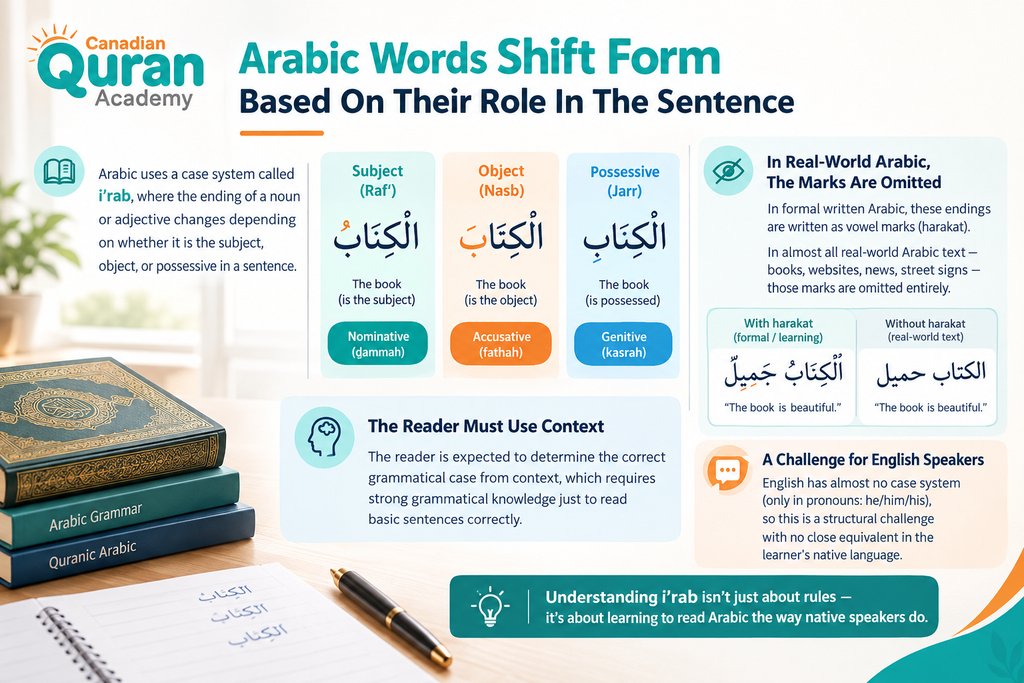
8. Arabic Words Shift Form Based On Their Role In The Sentence
Arabic uses a case system called i’rab, where the ending of a noun or adjective changes depending on whether it is the subject, object, or possessive in a sentence.
In formal written Arabic, these endings are written as vowel marks (harakat). In almost all real-world Arabic text — books, websites, news, street signs — those marks are omitted entirely.
The reader is expected to determine the correct grammatical case from context, which requires strong grammatical knowledge just to read basic sentences correctly.
English has almost no case system (only in pronouns: he/him/his), so this is a structural challenge with no close equivalent in the learner’s native language.
Start your first step in learning Quran Reading at Tabarak Academy Today
Step Inside Our Virtual Classrooms
See our engaging teaching methods in action! watch real snippets of our live classes and discover how our expert instructors make learning interactive, memorable, and inspiring for every student.
Unlock Your Arabic Journey With Tabarak Academy With First Class Free
Tabarak Academy connects learners of all ages with certified, native-speaking Arabic tutors who specialize in non-native student success, from absolute beginners mastering the alphabet to intermediate learners pushing through the plateau.
Live, one-on-one online sessions, a curriculum structured around your personal goals, and scheduling that fits your real life make Tabarak the most effective choice for serious Arabic learners anywhere in the world.
Our Courses:
- Learn Arabic Writing Course
- Arabic Alphabet Learning Course
- Online Arabic Classes
- Noorani Qaida Course for Beginners
- Quranic Arabic Course for Kids
- Arabic and Quran Classes for Kindergarten
Book Your Free Trial Class Today and start replacing guesswork with guided, accurate pronunciation.
Conclusion
Arabic is, without question, one of the most structurally demanding languages an English speaker can choose to learn. The script runs the other way and letters change shape. The sounds require training muscles that English ignores.
The language divides into two registers that function almost independently. The grammar root system has no Western parallel, and the vocabulary goes deeper than English can follow.
The language is also marked by the grammatical gender system, and the case system called i’rab.
Arabic connects you to 420 million people, to 1,400 years of Islamic scholarship, to the Quran in its original language, and to one of the most extraordinary civilizations in human history.
The learners who master it are not the ones who found it easy. They are the ones who understood the challenge clearly, found excellent guidance, and kept going. That journey can begin with your next class.
Frequently Asked Questions
Is Arabic A Difficult Language To Learn For A Complete Beginner?
Arabic is classified by the FSI as a Category IV language, the hardest tier for English speakers, requiring approximately 2,200 hours of structured study for professional fluency.
The script, sounds, and grammar all present significant challenges for beginners. With structured instruction from qualified teachers, learners reach functional milestones far faster than those raw numbers suggest.
Why Is Arabic So Hard To Learn Compared To Spanish Or French?
European languages like Spanish and French share an alphabet, thousands of cognate words, and broadly similar grammatical structures with English. Arabic shares almost none of these.
The script, phonemic inventory, morphological root system, and reading direction are all fundamentally different from anything a Western-language speaker has encountered, making the learning curve steeper across every dimension simultaneously.
How Long Does It Take To Reach Conversational Arabic?
Timelines vary by method, intensity, and native language background.
Learners in structured live-instruction programs with qualified native-speaking teachers regularly achieve functional conversational ability in Modern Standard Arabic within one to two years of consistent daily practice.
Self-study without expert guidance tends to extend this timeline significantly.
What Is The Importance Of Learning Arabic As A Second Language?
The importance of learning Arabic as a second language spans religious access to the Quran and Islamic scholarship in their original language, career advantages in diplomacy, journalism, translation, and international business.
In addition to cultural access to one of the world’s oldest literary and scientific traditions, and meaningful cognitive benefits from engaging a structurally complex language.
For Muslim learners specifically, Arabic is the language through which their faith is transmitted at its most precise level.
Can Adults Learn Arabic Successfully?
Yes, often more effectively than younger learners in grammar and vocabulary domains. Adults bring systematic thinking, stronger motivation, and the ability to understand abstract grammatical rules that children typically cannot articulate.
The area where adults have a relative disadvantage, phonemic flexibility for accent acquisition, is addressed with targeted pronunciation work from the very first lesson. Consistency of practice matters more than age.
How Long Does It Take To Read The Quran In Arabic?
Basic Quranic reading, recognizing letters, applying fundamental pronunciation rules, and reading short verses with vowel markers — is achievable for most adult learners within six to twelve months of structured study with a qualified teacher.
Reading the Quran with full comprehension of its linguistic meaning requires a longer commitment to Arabic grammar, vocabulary, and classical style — typically three to five years of dedicated, consistent work.