


How To Control Your Breath For Long Verses?
You start a long verse with confidence, and halfway through, your air runs out. You gasp, stop in the middle of a phrase, and lose the meaning. If that sounds familiar, learning how to control your breath for long verses is the skill you need most right now.
Breath control in Quran recitation means using your air on purpose: breathing from the diaphragm, spending less air on each letter, and stopping only where Tajweed and meaning allow.
It is not about holding your breath for as long as possible. It is about reciting correctly, calmly, and without strain.
The steps below follow the approach the teachers at Tabarak Academy use with their students. Follow them in order, because each one builds on the one before it.
1. Breathe From Your Diaphragm To Control Your Breath For Long Verses
Diaphragmatic (belly) breathing means pulling air deep into your lungs so your stomach moves outward while your chest stays mostly still. It gives you more usable air than shallow chest breathing, and it is the base for every other step in this guide.
To check yourself, put one hand on your chest and one on your stomach. When you breathe in through your nose, the hand on your stomach should rise more than the one on your chest.
2. Take A Full Breath Without Overfilling
A full breath is enough. When you force in extra air, your chest and throat tighten, and you run out sooner because the tension pushes air out faster.
Breathe in through your nose until you feel full and relaxed, then begin. Make a habit of taking a full breath even before short passages, so it becomes automatic when a long verse comes.
3. Sit Or Stand With A Straight Back
Good posture opens your airway and gives your lungs room to expand. Reciting with a bent back presses on your lungs and limits how much air you can take in.
Keep your back straight, your shoulders relaxed, and your head level. Avoid leaning over the Mushaf. A small book stand helps here.
4. Map The Verse With The Scan–Split–Stretch Method
The best way to control your breath for long verses is to plan the verse before you recite it, rather than finding out halfway through that you’re out of air. The Scan–Split–Stretch method gives you a simple routine you can repeat with any long passage, including Al-Baqarah 282, the longest verse in the Quran.
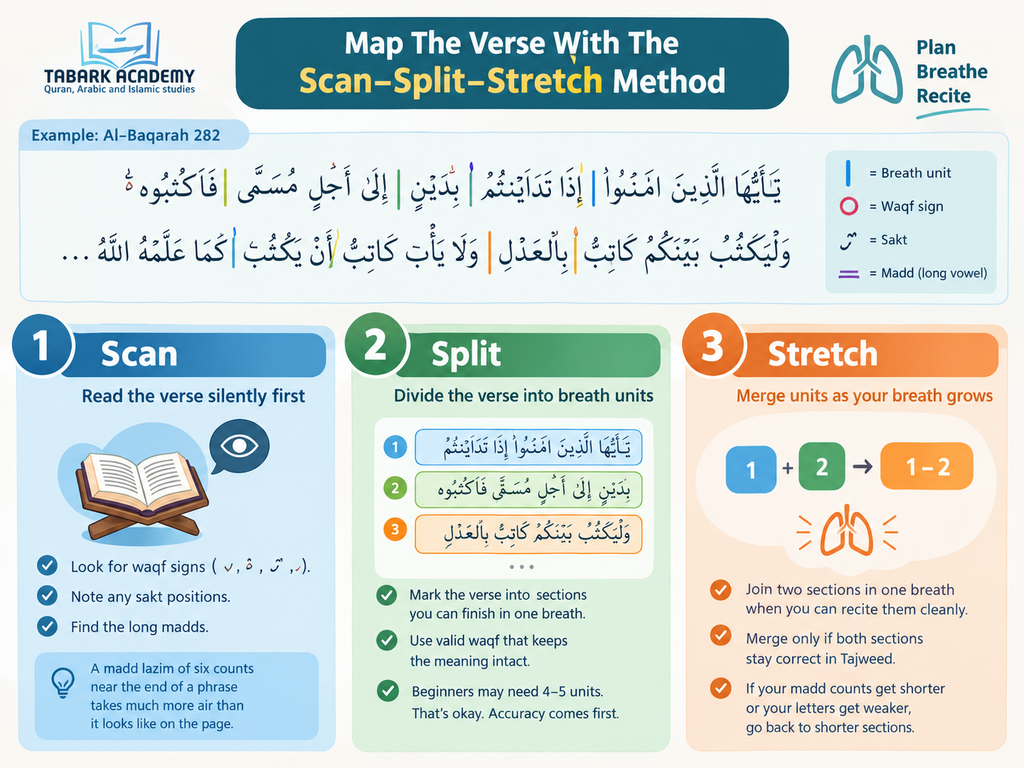
A. Scan: read the verse silently first
Read the whole verse once without reciting. Note the waqf signs (such as ۘ ,ۖ ,ۗ, and ۚ), any sakt positions, and where the long madds fall. A madd lazim of six counts near the end of a phrase takes much more air than it looks like on the page.
B. Split: divide the verse into breath units
Mark the verse into sections you can finish in one breath, and make sure every stop is a valid waqf that keeps the meaning intact. Beginners may need four or five units in a long verse. That’s fine. Accuracy comes first.
C. Stretch: merge units as your breath grows
Once you can recite each section cleanly, try joining two sections in one breath. Merge them only when both sections stay correct in Tajweed. If your madd counts get shorter or your letters get weaker, go back to shorter sections.
Read Also: 10 Common Tajweed Mistakes Beginners Make
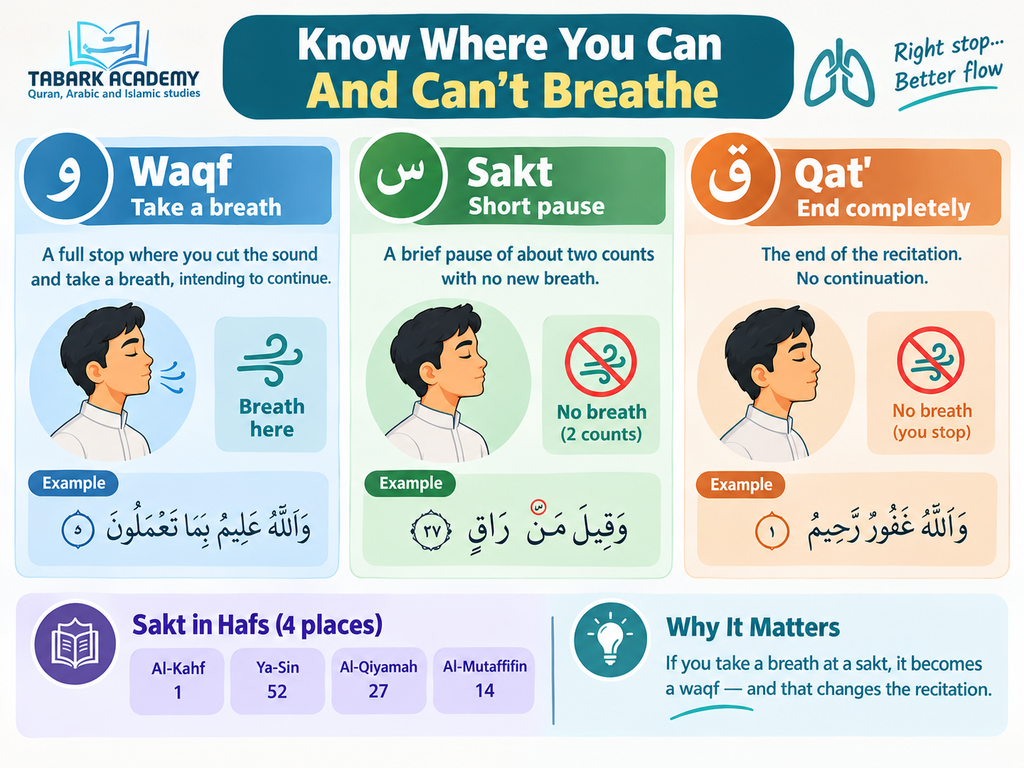
5. Know Where You Can And Can’t Breathe
In Tajweed, waqf is a stop where you cut the sound and take a breath, intending to continue. Sakt is a short pause of about two counts with no new breath. Qat’ is ending the recitation completely.
This matters for breath control. In the narration of Hafs, sakt happens in four places: Al-Kahf 1, Ya-Sin 52, Al-Qiyamah 27, and Al-Mutaffifin 14. Taking a breath there turns a sakt into a waqf, which changes the recitation.
6. Save Air Through Correct Makharij And Sifaat
Accurate articulation points (makharij) and letter qualities (sifaat) save a surprising amount of air. The voiced letters of jahr hold the breath back, while the ten whispered letters of hams (فَحَثَّهُ شَخْصٌ سَكَتَ) let breath flow out.
Two mistakes waste air here. The first is making hams letters too breathy. The second is adding ghunnah (nasal sound) to letters that don’t have it, often because the nasal passage is relaxed. Ghunnah uses a lot of air, so cleaning it up can noticeably lengthen your breath.
If this is new to you, the Online Tajweed Classes at Tabarak Academy focus on these exact details, one letter at a time.
Experience Our Interactive Learning
Curious about how we teach? Watch these brief video clips from our recent live sessions to see our structured curriculum, advanced learning platform, and dynamic student-teacher interactions firsthand.
7. Recite At A Pitch Your Voice Can Hold
A pitch that is too high for your voice shortens your breath quickly. A pitch that is too low also uses up air, because low tones generally need more air than higher ones.
Find a comfortable middle pitch, one you could keep for a whole page without strain. Build your range slowly from there, raising or lowering it a little at a time. Rest your voice for a full day if you feel any strain.
8. Start Each Phrase With A Soft Onset
A soft onset means starting your voice gently after each breath instead of pushing the first letter out hard. A hard start releases a burst of air you can’t get back.
Keep your volume balanced across the verse, too. Give every letter and every madd its full right, but no more. Adding extra length or force to a letter spends air you’ll need at the end of the verse.
9. Train Daily With Breathing Exercises
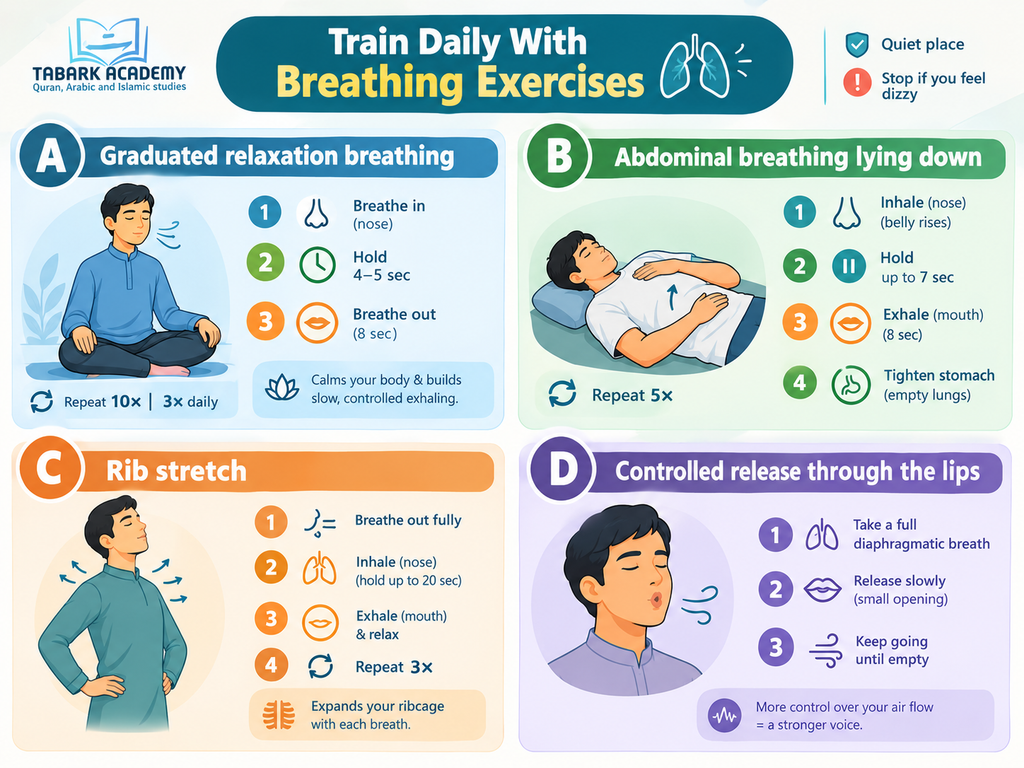
Breathing exercises train your lungs and diaphragm outside of recitation, so you have more air ready when you need it. Do them in a quiet place, and stop right away if you feel dizzy.
A. Graduated relaxation breathing
Sit comfortably and close your eyes. Breathe in deeply and slowly through your nose until your lungs feel full. Hold for 4 to 5 seconds, then breathe out slowly over about 8 seconds.
Repeat ten times in a row, three times a day. This exercise calms your body and teaches slow, controlled exhaling, which is exactly what long verses require.
B. Abdominal breathing lying down
Lie on your back with one hand on your stomach and one on your chest. Breathe in slowly through your nose from your midsection, so the hand on your stomach rises higher.
Hold for up to seven seconds if you can, then breathe out through your mouth for eight seconds. Tighten your stomach muscles at the end to empty your lungs fully. Do five cycles.
C. Rib stretch
Stand straight and breathe out completely. Breathe in slowly until your lungs are full, and hold for as long as feels comfortable, working up to 20 seconds over time. Place your hands on your hips while you hold.
Breathe out slowly, relax, and repeat three more times. This stretch helps your ribcage expand further with each breath.
D. Controlled release through the lips
Take a full diaphragmatic breath. Then release it very slowly through a tiny opening between your lips, about the shape your lips make for iqlab.
Keep releasing until your lungs are empty. With practice, you’ll control the flow of air more precisely, and your voice will hold its strength longer during recitation.
10. Extend your reach one word at a time
Pick a word in the verse where you comfortably run out of breath. In your next session, go one word further. Then one more.
Your breathing and vocal muscles adapt like any other muscles: steady, gradual effort makes them stronger. Pushing too hard too fast strains your voice and can set you back a week or more.
11. Protect Your Breathing Health And Rest Well
Healthy lungs are the base of long breath. Avoid smoking and dust. If you often have phlegm, a constant cough, or a blocked nose, see a doctor, because these affect your voice and breath directly.
Sleep matters as well. Compare how long your breath lasts after a good night’s sleep with how it feels late in the evening when you’re tired. Warm drinks usually suit the voice better than ice-cold ones before practice, and regular cardio like running or swimming helps build lung capacity.
Read Also: Online Hifz Academy
Control Your Breath For Long Verses Tips: Common Mistakes To Avoid
These control your breath for long verses tips come from the mistakes teachers see most often. Fixing even one of them can add several words to each breath.
1. Stopping mid-word when air runs out
If you run out of breath, you may make a compelled stop (waqf idtirari), but only at the end of a complete word, never in the middle. Then go back and restart from that word or from an earlier point that keeps the meaning sound.
2. Chasing breath length over Tajweed
Some reciters shorten madds or rush through ghunnah to get further in one breath. That trades correct recitation for a longer breath, which defeats the purpose. Tajweed always comes first.
3. Breathing in through the mouth
Many people breathe in and out through the mouth out of habit. Train yourself to breathe in through your nose. It fills your lungs more deeply and keeps your throat from drying out.
4. Practicing only when tired
Late-night practice gives you a false picture of your ability and builds bad habits. Schedule your breath training for when you’re rested, even if it’s only 10 minutes.
Why Learning With A Qualified Teacher Speeds Up Breath Control?
Self-study helps, but breath control is closely tied to makharij, sifaat, and waqf, and those are hard to judge on your own. Learning directly from a teacher (talaqqi) is the traditional way of linking breathing, articulation, and recitation, and nothing replaces it.
A teacher hears the extra ghunnah you can’t hear, points out the hard onset that’s wasting your air, and marks the right stopping points in verses that confuse you. At Tabarak Academy, this one-to-one correction happens live, so you fix habits before they settle in.
Whether you’re starting with Online Quran Classes for Beginners or signing your child up for Online Quran Classes for Kids, your teacher builds breath control into every lesson from day one, from home and on your schedule.
Step Inside Our Virtual Classrooms
See our engaging teaching methods in action! watch real snippets of our live classes and discover how our expert instructors make learning interactive, memorable, and inspiring for every student.
Start Reciting Long Verses With Confidence At Tabarak Academy
You don’t have to guess where to breathe or struggle through long verses alone. With Tabarak Academy, you get a qualified teacher who listens to every verse you recite, corrects your Tajweed, and trains your breath step by step, with a plan made for your level.
Join the Online Quran Classes to improve your recitation, or start with the Tajweed Course for Beginners to build the foundation that makes long breath possible. Book your first class today and hear the difference in your recitation within weeks.
Our Quran Memorization / Hifz Courses
- Online Hifz Program
- Juz 30 Memorization Course
- Hifz for Kids Course
- Hifz for Adults Course
- Hifz for Sisters Course
- Short Surah Memorization Course
- Hifz Ijazah Course
Conclusion
Learning how to control your breath for long verses comes down to three things: breathing from the diaphragm, spending air wisely through correct Tajweed, and planning your stops before you recite.
The Scan–Split–Stretch method brings these together into one routine you can use with any passage. Keep your posture straight, pick a comfortable pitch, train with daily breathing exercises, and extend your reach one word at a time.
Above all, never trade correct recitation for a longer breath. With steady practice, and a teacher from Tabarak Academy to guide you, long verses become something you look forward to reciting.

FAQs About How To Control Your Breath For Long Verses
Here are clear answers to the questions reciters ask most about breath control, stopping rules, and building lung capacity for Quran recitation.
How can I control my breath for long verses in the Quran?
You control your breath for long verses by breathing from your diaphragm, taking a full but relaxed breath, and planning valid waqf points before you start. Spending less air on each letter through correct makharij also helps a lot.
Is it allowed to take a breath in the middle of a verse?
Yes, you can breathe at a valid waqf point in the middle of a verse, as long as the stop doesn’t break the meaning. You shouldn’t take a breath during a sakt or in the middle of a word.
What is the best breathing exercise for Quran recitation?
The best breathing exercise for Quran recitation is diaphragmatic breathing with a slow exhale: breathe in through your nose, hold for 4–5 seconds, and breathe out over about 8 seconds. Repeat it ten times, three times a day.
Does Tajweed help with breath control?
Yes. Correct makharij and sifaat stop air from leaking out on letters, and clean ghunnah saves air that over-nasalization wastes. Waqf rules also tell you exactly where you can take a breath.
What should I do if I run out of breath mid-verse?
If you run out of breath, stop at the end of a complete word, then restart from that word or an earlier point that keeps the meaning correct. This is called a compelled stop (waqf idtirari), and it is allowed.
How long does it take to improve breath control for recitation?
Most reciters notice improvement within a few weeks of daily breathing exercises and gradual practice. How long it takes depends on your starting lung capacity, your health, and how accurate your Tajweed is.