


How To Memorize The Quran In 3 Years?
Three years sounds generous — until you open the Mushaf. The Madinah Mushaf holds 604 pages, and 36 months gives you roughly 156 weeks. That means memorizing the Quran in 3 years works out to about four pages a week, or ten lines a day with one full day reserved for revision.
The pace is the easy part. The real challenge is protecting the 200 pages behind you while you add page 201. Most learners who abandon a three-year plan never fail at memorizing — they fail at revision, and the backlog quietly buries them somewhere in year two.

1. Understand the Meaning Before Memorizing Each Page
Before you commit a single word to memory, spend three minutes translating today’s two pages. A passage’s description of Musa’s encounter with Pharaoh provides your memory with a narrative around which to hang the text.
Remembering a complete message is easier than recalling separate sounds. Tafsir adds an important layer of understanding that translation alone may not provide. It explains the reasons behind an ayah, its intended audience, and how it connects to the verses before it.
These connections help your mind follow the sequence of the passage, making it easier to recall the ayat in the correct order. Keep this step simple and practical. Read a brief tafsir, such as Al-Sa’di or a summary of Ibn Kathir, once before starting your memorization.
You do not need to study every detail; you only need a clear picture of the page’s meaning. Mentally identify the main ideas and how the verses relate to one another. These meaning-based connections can guide your memory when you recite the page without looking.
2. Memorize One Page a Day, Five Days a Week
The working target is one page of the 15-line Madinah Mushaf per day, five days per week, which produces 20 pages — one complete Juz’ — every four weeks.
Adding a fifth consolidation week to each cycle gives you a repeating five-week block. Thirty of those blocks equal 150 weeks, which fits comfortably inside the 156 weeks of three years.
That leaves around six weeks of built-in buffer for travel, illness, Ramadan schedules, and the deep-revision blocks described later. The buffer is part of the plan, not a failure of it.
The Plan takes 45 to 60 minutes daily: roughly 25 minutes on the new page and the remainder on revision. If your honest daily window is within that time, the three-year plan will serve you far better
Students who try to memorize in ten rushed minutes almost always lose the page within 48 hours. The time you spend is what converts short-term recall into durable Hifz.
Before committing to any timeline, have your recitation assessed. Our tutors in the Quran Recitation course begin every student with a reading evaluation, because errors memorized today take months to unlearn later.

3. Correct Your Tajweed Before Building New Hifz
Think of Tajweed as the container your memory pours into. A page stored with correct Ghunnah, Madd, and stopping points stays clean for years, while a page stored with guesswork has to be dismantled and rebuilt later.
Recite the new page aloud from the Mushaf to your teacher before memorizing a single line of it. Correcting a mispronounced letter takes thirty seconds on day one. Correcting it after it has been repeated 200 times can take weeks.
If your Makharij and elongations are not yet solid, spend four to six weeks in structured Online Tajweed Classes first. It is the single highest-return delay in the entire journey. Tajweed rules then run alongside Hifz, not after it.
Our online Tajweed classes are built to run in parallel with a Hifz track for exactly this reason, so each new page is stored with its pronunciation already attached.

4. Use the Same Mushaf Throughout the Three-Year Plan
The page is stored by your brain as an image rather than just as sound. You rely on retrieval cues without realizing it, such as line breaks, the location of each verse, the final word’s shape, and the page’s finish.
Because of this, select the Madinah Mushaf, a 15-line Uthmani script that is commonly used in Hifz circles across the globe. Every Juz concludes neatly thanks to its regular page breaks, which make your revision blocks predictable from the first month.
That visual map is erased in a single session when copies are switched mid-journey. Your memory must reconstruct cues it spent months developing when you use a different typeface, a different line count, or a different page layout. This causes recall to substantially slow down for weeks later.
Use the same guideline on your tablet or phone. To ensure that a misplaced or worn-out Mushaf never undoes your work, if you edit online, make sure the app shows the same Madinah layout and retain a second physical copy of the same edition at home.
Experience Our Interactive Learning
Curious about how we teach? Watch these brief video clips from our recent live sessions to see our structured curriculum, advanced learning platform, and dynamic student-teacher interactions firsthand.
5. Follow a Structured Muraja’ah System to Protect Old Hifz
Revision is not the supporting act in a Hifz plan. Over three years, it is the plan — new memorization is simply what feeds it.
The Prophet ﷺ compared memorized Quran to tethered camels that escape the moment they are left unattended. In Sahih Muslim 791, the Prophet ﷺ said: “ Keep refreshing your knowledge of the Qur’an, for I swear by Him in Whose Hand is the life of Mahammad that it is more liable to escape than camels which are hobbled.”
” تَعَاهَدُوا هَذَا الْقُرْآنَ فَوَالَّذِي نَفْسُ مُحَمَّدٍ بِيَدِهِ لَهُوَ أَشَدُّ تَفَلُّتًا مِنَ الإِبِلِ فِي عُقُلِهَا ”
Modern memory research says the same thing in different language: spaced re-exposure is what moves material into durable long-term storage.
By Juz’ 20, the cumulative tier becomes substantial, so split it across the month rather than attempting it in one sitting. If a page falls apart, stop adding new pages immediately and give that page three to five days of concentrated repetition until it is fluent again.
A zero-backlog rule is what separates students who finish in three years from students who finish in six. Weak pages never fix themselves; they multiply.
| Tier | Frequency | Scope |
| Recent | Daily | Last 5–7 pages memorized |
| Rolling | Weekly | Last complete Juz’ (20 pages) |
| Cumulative | Monthly | Everything memorized to date |
Read also: How to Memorize the Quran in 2 Years: Step-by-Step
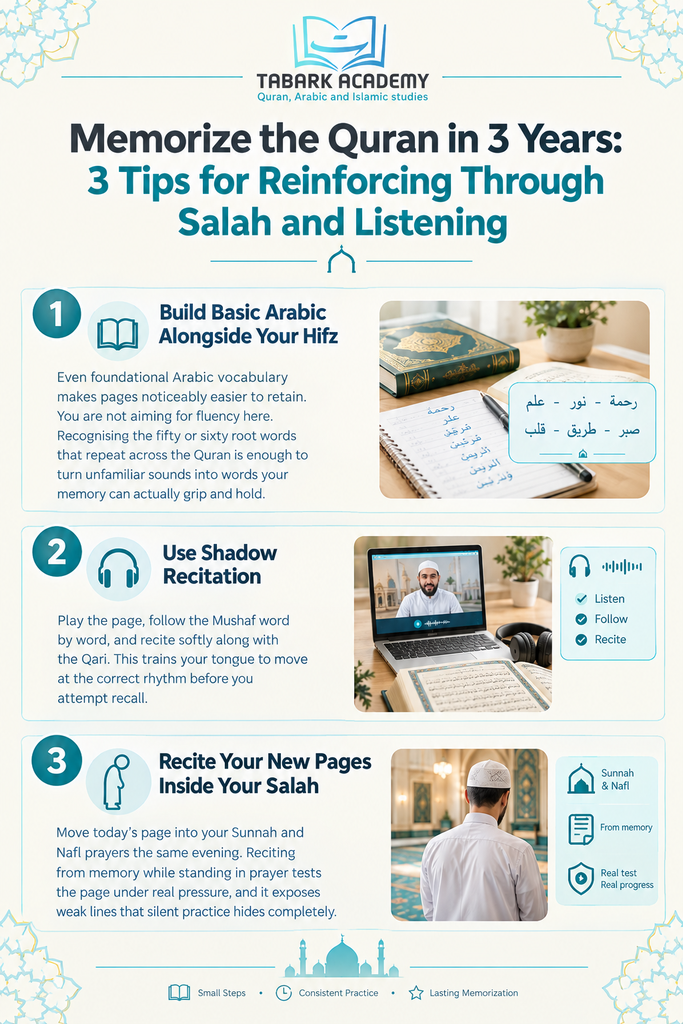
Memorize the Quran in 3 Years: 3 Tips for Reinforcing Through Salah and Listening
Your memorization session is only part of the work. What truly fixes a page is what happens in the hours afterwards — in your prayers, in your listening, and in the Arabic your ear slowly grows used to.
Build Basic Arabic Alongside Your Hifz
Even foundational Arabic vocabulary makes pages noticeably easier to retain. You are not aiming for fluency here. Recognising the fifty or sixty root words that repeat across the Quran is enough to turn unfamiliar sounds into words your memory can actually grip and hold.
Students who pair Hifz with our Online Arabic Classes tend to move through Juz’ 1–10 more smoothly, because so much of the vocabulary has become familiar.

Use Shadow Recitation
Play the page, follow the Mushaf word by word, and recite softly along with the Qari. This trains your tongue to move at the correct rhythm before you attempt recall.
Start at half your normal speed and raise your voice only as the words settle. Matching the Qari’s breath points also teaches you where to stop and resume correctly.
Recite Your New Pages Inside Your Salah
Move today’s page into your Sunnah and Nafl prayers the same evening. Reciting from memory while standing in prayer tests the page under real pressure, and it exposes weak lines that silent practice hides completely.
Spread your recent pages across the five prayers rather than repeating the same portion all day. Over a three-year plan, this single habit turns your daily Salah into a free revision session that costs you no extra time at all.
Read also :Can You Complete Hifz in One Year?
Common Obstacles on a 3-Year Plan and How to Solve Them
Every three-year journey meets the same three obstacles, usually between month eight and month eighteen. None of them signals failure, and each has a fix that costs far less than ignoring it.
Mistake 1: Chasing New Pages and Postponing Revision
The most common mistake is treating revision as optional whenever the day gets busy. New pages feel like progress, so they win the time — and the older Juz’ quietly weakens while the page count keeps climbing.
The damage stays invisible for months. Then a teacher asks for Juz’ 24; the page will not come, and the student discovers that ten Juz’ behind him have all decayed at the same time.
The fix is a hard rule: revision happens first, every session, before a single new line is touched. If there is not enough time for both on a given day, revise and skip the new page without guilt.
Read also: How to Memorize the Quran in 5 Years: Step-by-Step
Mistake 2: Memorizing Alone Without Daily Correction
Many learners rely entirely on an app or a recording and postpone finding a teacher until “the basics are done.” The Mushaf cannot hear you, and a recording cannot tell you that your Qalqalah is wrong.
Errors learned this way are stored exactly like correct text, which is why they resurface years later in Taraweeh. Undoing one stubborn mispronunciation often takes longer than memorizing three new pages.
Recite your new portion to a qualified tutor daily, even for ten minutes, and do not move forward until the page is approved. This is precisely what one-to-one sessions in our Online Hifz Program are built to provide.

Mistake 3: Doubling the Quota After Missed Days
After a missed week, the instinct is to memorize three pages a day until the schedule is “caught up.” This almost always backfires, because the rushed pages are stored weakly and collapse within a fortnight.
Worse, the heavier load crowds out revision at the exact moment the backlog is already growing. Two weeks of catching up frequently costs a student two months of repair work afterwards.
Return to your normal quota, or slightly below it, and restore fluency in your last five to seven pages first. A three-year plan has a built-in buffer for exactly this — use it rather than fighting it.
Step Inside Our Virtual Classrooms
See our engaging teaching methods in action! watch real snippets of our live classes and discover how our expert instructors make learning interactive, memorable, and inspiring for every student.
Start Your 3-Year Hifz Plan With a Free Trial Lesson Today
A written plan is useful. A qualified teacher watching your recitation every single day is what actually gets you to the final page.
At Tabarak Academy, you study one-to-one with certified Azhari tutors who hold Ijazah and specialize in teaching non-Arabic speakers. Your teacher assesses your recitation, builds your personal three-year schedule, and corrects errors before they become habits.
Sessions are flexible around work, school, and time zones, with weekly progress tracking so slow weeks are caught early rather than discovered months later. Programs are available for kids, adults, and sisters, in fully private classes.
Your first lesson is completely free, with no card required. Book it today and let your tutor map out your three-year Hifz roadmap with you — in shaa Allah.
Our Quran Memorization / Hifz Courses
- Online Hifz Program
- Juz 30 Memorization Course
- Hifz for Kids Course
- Hifz for Adults Course
- Hifz for Sisters Course
- Short Surah Memorization Course
- Hifz Ijazah Course

Conclusion
Memorizing the Quran in 3 years is a discipline problem far more than a memory problem. Ten lines a day across six days, with the seventh reserved for consolidation, is the entire engine of the plan.
The methods only work as a set. The daily quota gives direction, layered Muraja’ah builds retention, a teacher protects accuracy, Tajweed supplies the foundation, and Salah with listening keeps every page active between sessions.
Expect the schedule to bend, because illness, exams, and travel are normal parts of a three-year commitment. Reducing your daily portion while holding revision steady is always wiser than stopping and losing your rhythm altogether.
Take-away message: chase a clean page, not a fast one. Renew your intention, secure a qualified teacher, and memorize your first portion today rather than waiting for a perfect week that never quite arrives.
FAQs
How many pages a day do I need to memorize the Quran in 3 years?
About ten lines — two-thirds of a page — on six days a week. That covers all 604 pages of the Madinah Mushaf in roughly 151 weeks, leaving around five weeks of buffer for illness, travel, and revision-only periods.
Is 3 years realistic if I work full time?
Yes. The daily quota usually takes 30 to 45 minutes of focused work, which is far more sustainable than the 45 to 60 minutes a two-year plan demands. The seventh day gives you room to recover a missed session.
Can a child memorize the Quran in 3 years?
Yes. Typically, from age seven upward and after completing Noorani Qaida. Children need the daily portion split into two or three short sessions of 15 to 20 minutes rather than one long block.
Should I start with Juz 30 or Surah Al-Baqarah?
Most learners start with Juz 30 and move backward through Juz 29 and 28, since shorter surahs build confidence quickly and are used in daily prayer. There is no religious requirement either way — choose the order you will stay consistent with.
What is the difference between a 2-year and a 3-year Hifz plan?
A two-year plan requires roughly one page daily across six days; a three-year plan requires about two-thirds of a page. Both use the same revision system — only the pace changes, and the slower plan leaves more room for Tajweed and Tafsir.
What do I do if I fall behind the schedule?
Cut the new quota in half temporarily and keep revision at full strength. Extending your timeline by two or three months is normal, and far better than carrying a backlog of weak pages into the final year.