


What To Do When You Feel Like Giving Up Hifz?
I could barely finish the surah. The verses just weren’t there, and I sat frozen, unable to recite something I’d known cold months earlier. It was the breaking point of two months where my memorization had quietly fallen apart, even though I was putting in the same effort, sometimes more.
I started to doubt my own memory. Had I lost the one thing that let me memorize in the first place?
My teacher stopped me that day, gentler than I expected: “Take it easy. Let’s start fresh at the beginning of the week.” Then she told me she’d once quit every Hifz class she was enrolled in for a year and a half. No dramatic reason, just, “I was so tired.” Hearing a hafidha admit that so plainly gave me permission I didn’t know I needed.
If that sounds familiar, you’re not asking whether to quit, you’re asking what to do instead. Let me help you decide whether you need a pause or a real step back, no guilt attached.

What You’ll Learn
- Five practical steps to work through a Hifz slump without losing your progress.
- How to tell the difference between normal Hifz burnout (fitoor) and truly wanting to quit.
- A decision framework for choosing between pausing and stopping, without guilt.
- Ready-to-use scripts for talking to your parents or teacher about slowing down.
- How to build a formal pause plan that protects what you’ve already memorised.
5 Steps To Take If You Want Give Up Your Hifz
These steps reflect how Hifz teachers and Islamic counselors actually guide students through fitoor, not generic productivity advice repackaged for a religious topic. Each one addresses a specific part of what burnout does to a memorization routine.

a. Take a Short, Deliberate Pause
Give yourself one or two days off. Not indefinitely, and not in secret guilt, but as a deliberate decision. The point is to release the pressure before it curdles into resentment toward the Quran itself. A short, named pause protects the relationship. An unplanned, guilty drift away from it erodes it.
b. Renew Your Intention
Before you pick the Mushaf back up, spend a minute reminding yourself why you’re doing this: you are memorizing the words of Allah, not performing for a teacher, a parent, or a peer group.
Students whose original motivation was external, pressure, comparison and expectation, struggle hardest to restart once that external push disappears. Reconnecting to a personal and sincere reason is what makes the next session possible.
c. Change Something About Your Routine
Boredom compounds fatigue. Shift your memorization time, move to a different room, or switch which Mushaf copy you use if the current one has become linked to frustration. The change doesn’t need to be large. It just needs to interrupt the pattern your brain has started to dread.
d. Shift Your Focus to Revision Instead of New Memorization
When new memorization feels impossible, stop forcing it. Put your energy into reciting what you already know, ideally inside your prayers, following the practice of the earliest generations of reciters.
This keeps your existing Hifz from eroding while you recover, and it removes the pressure of producing something new every day. Once revision starts feeling steady again, you can resume your sabaq, the new portion you memorize each day.
c. Find Companionship to help you in memorizing your Hifz
A study partner or a group memorizing alongside you does something a solo routine doesn’t, as it normalizes the hard days. Fitoor hits much harder in isolation than inside a community where showing up, even imperfectly, is the shared standard.
This is one reason Tabarak Academy builds its Hifz circles around small groups and regular teacher check-ins, so a slow week gets noticed and supported, instead of quietly turning into a stopped one.
Experience Our Interactive Learning
Curious about how we teach? Watch these brief video clips from our recent live sessions to see our structured curriculum, advanced learning platform, and dynamic student-teacher interactions firsthand.
Have a look at the Hifz courses available at Tabarak Academy

Is It Normal To Feel Like Giving Up On Hifz?
Yes, it is completely normal to feel like giving up on Hifz. This temporary drop in motivation, often called fitoor, affects many students and can make memorization and revision feel unusually difficult.
Fitoor is the Arabic term for the dip in motivation that hits almost every Hifz student at some point. It’s the stretch where memorizing feels heavy, revision feels pointless, and the Mushaf stays closed longer than it should.
Rather than immediately abandoning your Hifz journey, the key is to recognize this as a temporary phase, understand what caused it, and adjust your routine accordingly.
Knowing that fitoor is normal is only half the picture. The other half is understanding why it happens, and where the line sits between a temporary dip and a genuine decision to stop.
a- Why Motivation Rises And Falls During Hifz?
The Prophet ﷺ described this pattern directly: “Every deed has a period of energy, and every period of energy is followed by a period of slackness. Whoever’s slackness inclines toward my Sunnah has succeeded” (narrated by Ahmad).
Hifz was never described as a straight line of steady output. The fluctuation itself is named and accounted for in the tradition.
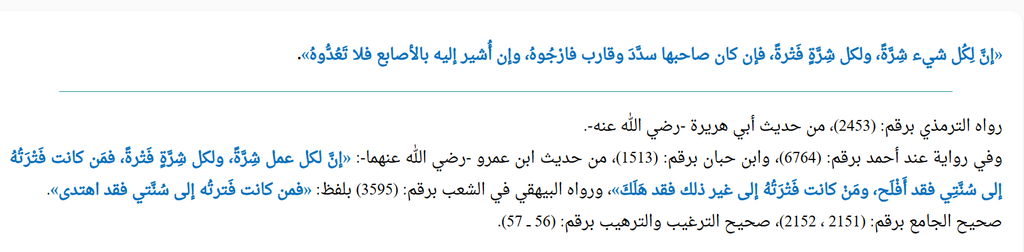
Ali (may Allah be pleased with him) gave the practical response to this: when the soul is eager, take it with resolve. When it turns away, scale back to what’s essential. That’s not permission to abandon Hifz. It’s guidance to reduce the load without stopping completely.
b-The Difference Between Burnout And Wanting To Quit
Burnout looks like slower recall, shorter patience, and dread before a session, but the desire to eventually finish is still there underneath it. Wanting to quit looks different. Even imagining a lighter load or a break from pressure doesn’t bring back any pull toward the Quran.
The steps above are built for the first kind. The framework below is for anyone unsure which one they’re actually facing.
Giving Up Hifz vs. Taking a Break: How to Decide Without Guilt?
Most guidance on Hifz motivation avoids the harder question underneath it: is it actually okay to stop? Islamic teaching gives a real and honest answer, and it isn’t “never.”
a- Abandoning the Quran vs. Pausing
Islam frames a temporary step back very differently from disregard. Allah describes His religion as built on ease: “Allah intends for you ease and does not intend for you hardship” (Quran 2:185).
He also does not burden a person beyond their capacity (Quran 2:286). A pause taken with a clear intention to return is a different act entirely from walking away out of disregard for the Quran. The distinction sits in the intention behind the stop, not in the stop itself.
b- Ask Yourself These Questions Before You Decide
A short set of honest questions can separate a temporary low from a real decision to step back.
- Are you tired of the Quran itself, or of the current setup around it — the pace, the teacher relationship, the schedule?
- If the specific pressure you’re under right now disappeared, would the pull to memorize come back?
- Can you picture yourself returning to active Hifz in six to twelve months, even if not today?
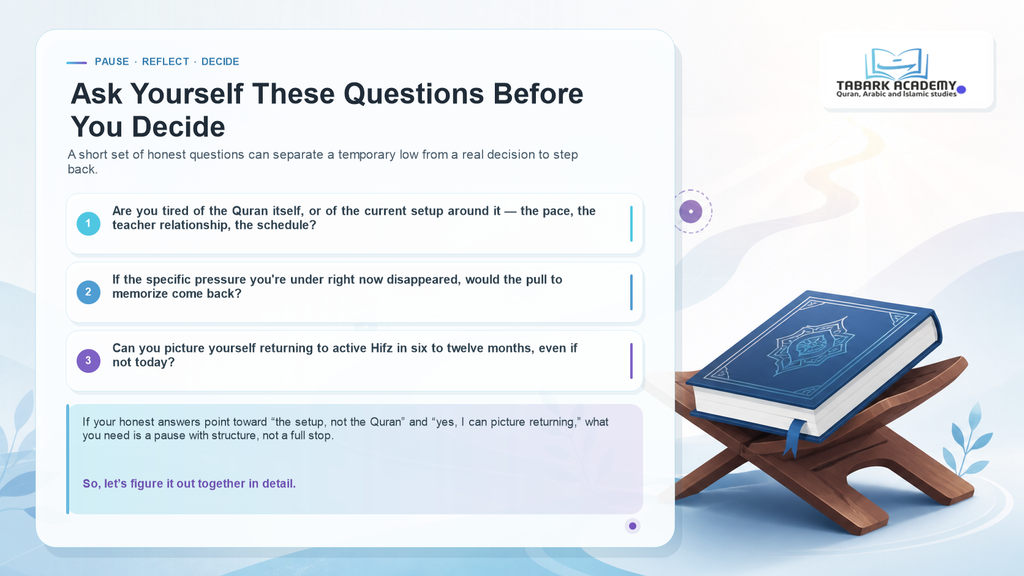
If your honest answers point toward “the setup, not the Quran” and “yes, I can picture returning,” what you need is a pause with structure, not a full stop. So, let’s figure it out together in detail.
How to Talk to Your Parents or Teacher About Slowing Down
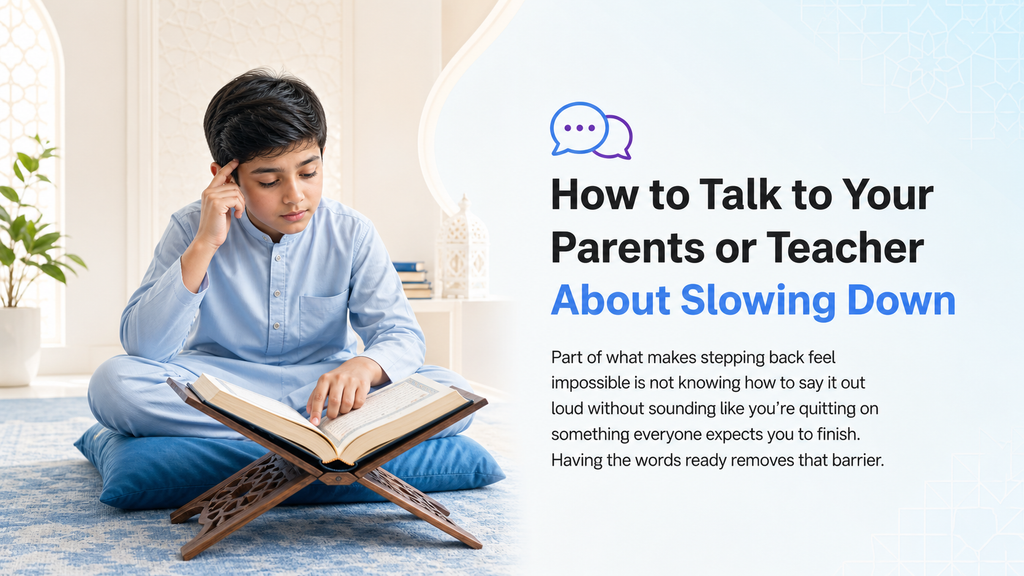
Part of what makes stepping back feel impossible is not knowing how to say it out loud without sounding like you’re quitting on something everyone expects you to finish. Having the words ready removes that barrier.
a- What to Say to Your Parents
Try something direct and specific: “I’m not quitting the Quran. I need to change how I’m doing my Hifz for a while.” Naming the difference between quitting and adjusting up front reframes the conversation before it turns into pressure or disappointment on either side.
b- What to Say to Your Teacher
A version that works well in practice: “I need to pause new memorization for now and focus on revision and my wellbeing.”
A teacher who has walked students through fitoor before, as most experienced Hifz teachers have, will recognize this request immediately and can help structure the pause rather than treat it as a loss of commitment.
How To Build A Formal Pause Plan For Hifz
An unstructured break is what usually turns into a permanent stop. Not because the intention was ever to quit, but because nothing marked when or how it should end. A formal plan solves that by putting a shape around the pause itself. Agree on three things with your teacher or whoever tracks your progress:
- No new sabaq for a set period, such as one to two months.
- A minimal revision target you can hold to even on a bad week — one page a day or one juz’ (one of the Quran’s thirty parts) a week is enough to keep material from slipping.
- A check-in every month to honestly reassess whether you’re ready to resume new memorization or need more time.
This is close to what Tabarak Academy’s teachers already build into a student’s plan when fitoor shows up: reducing the new portion to near zero, protecting the revision core, and setting a real date to revisit the pace, rather than leaving “when I feel better” undefined indefinitely.
Have a look at the hifz teachers of Tabarak Academy

Step Inside Our Virtual Classrooms
See our engaging teaching methods in action! watch real snippets of our live classes and discover how our expert instructors make learning interactive, memorable, and inspiring for every student.
Restart Your Hifz Journey With the Right Support
You don’t have to figure out the pause, the pace, or the comeback on your own. Tabarak Academy’s Hifz teachers work with students through exactly this kind of slump every week, building a revision-first plan, a realistic sabaq, and the kind of accountability that catches a hard month before it becomes a lost year.
Book a session and let a qualified teacher help you set a Hifz pace that survives the low weeks instead of collapsing under them.

Check our Courses
- Online Quran & Arabic Classes | Foundation
- Recitation Of Quran with Tajweed Course
- Islamic Studies Course Online
- Arabic Alphabet Learning Course
- Noorani Qaida Course for Adults
- Quranic Arabic Course for Kids
- Arabic and Quran Classes for Kindergarten
- Islamic Summer Camp
- Hifz for Kids Course
- Hifz Course for Sisters
- Hifz for Adults Course
- Online Hifz Program
- Noor Al-Bayan Course
Conclusion
Feeling like giving up Hifz doesn’t mean you’ve failed, and it doesn’t mean the Quran isn’t for you. It’s a documented and expected phase that almost every memorizer passes through. What separates the students who return from those who quietly disappear is a plan: a short pause, a renewed intention, a shift to revision, and real companionship.
When the low period runs deeper than that, it’s an honest, structured decision between pausing and stopping. Handled this way, what to do when you feel like giving up Hifz stops being a crisis. It becomes a manageable, temporary part of the journey.
FAQs
What should I do when I feel like giving up on Hifz?
Take a short, deliberate pause instead of stopping indefinitely, renew your intention, change something about your routine, shift your focus to revision instead of new memorization, and find a study partner or group. These five steps address the most common causes of Hifz burnout without requiring you to quit altogether.
Is it a sin to take a break from memorizing the Quran?
No. Taking a break with the intention to return, in order to protect your health or manage a real pressure, is different from abandoning the Quran out of disregard. Islamic teaching emphasizes ease and does not burden a person beyond their capacity.
How long is too long for a Hifz pause?
There’s no fixed limit, but an undefined pause is riskier than a planned one. A structured pause of one to two months with a monthly check-in and a minimal revision target keeps a break from drifting into a permanent stop.
Will I forget everything if I stop new memorization for a while?
Not if you keep reviewing. Stopping new memorization while continuing daily or weekly revision, even a page a day, protects what you’ve already memorized. What causes real loss is stopping revision, not stopping new memorization.
What if my motivation drops again after I restart?
Expect it. Fitoor is described in Islamic tradition as a recurring pattern, not a one-time event. Each time it returns, the same response applies: pause briefly, renew your intention, shift to revision, and lean on companionship rather than pushing through alone.
How do I know if it’s burnout or if Hifz genuinely isn’t right for me right now?
Ask whether you’re tired of the Quran itself or of the current setup around it, and whether you can picture returning within six to twelve months. If the answer points to the setup rather than the Quran, and you can imagine coming back, what you’re facing is fitoor, not a final decision.