


Can I Memorize the Quran at 30?
Yes, you can start memorizing the Quran at 30. Hifz, the memorization of the Quran, has no fixed starting age in Islamic teaching. What determines success at 30 is sincerity of intention, a fixed daily routine, and steady revision; not how old you are when you begin.
What You’ll Learn
- Whether Islam sets any age limit on memorizing the Quran, and what a well-known scholarly ruling says about starting at 30.
- Why age 30 can work in a learner’s favor, from mental maturity to genuine motivation.
- The real challenges adults face — busy schedules, self-doubt, and comparison — and how each one is manageable.
- Practical steps to start: a fixed daily portion, a teacher, and a revision routine.
- Memorization techniques suited to adult learners, including sequential memorization and listening before reading.
- How to stay consistent long-term, plus a real example of an adult who started later in life.
Is It Too Late to Start Memorizing the Quran at 30?
No, it isn’t. There is no age restriction in Islamic law on memorizing the Quran. Scholars have consistently affirmed that Hifz remains open to a person at any stage of life.
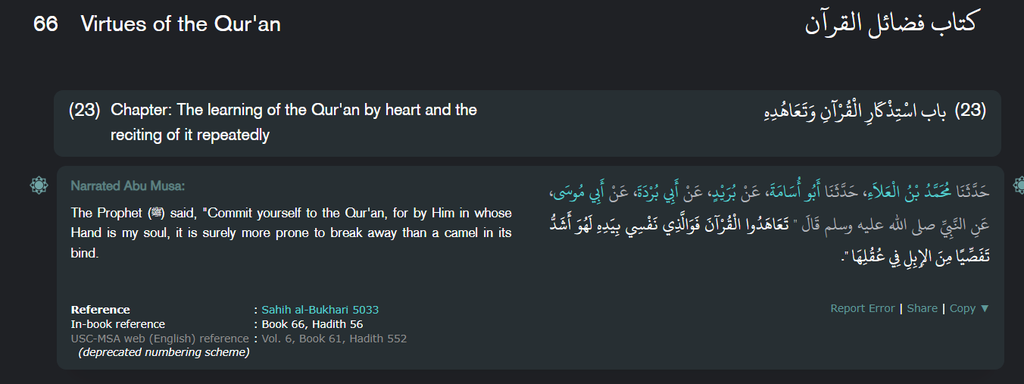
Sheikh Ibn al-Uthaymeen was asked directly whether someone who reached thirty could still memorize the Quran. He answered that memorization has no specific age. He added that the Quran needs more tending than other knowledge, because it is quickly forgotten if neglected. Even, the Prophet Muhammed said that
“Commit yourself to the Quran, for by Him in whose Hand is my soul, it is surely more prone to break away than in its bind.” (Sahih al-Bukhari 5033)
This is why a structured program matters more at 30 than at any earlier age. Tabarak Academy‘s Hifz for Adults course pairs each student with a private, Al-Azhar Ijazah-certified tutor who corrects recitation and manages revision from day one.
Watch Tabarak Academy classes with adult learners
Why Is Age 30 a Good Time to Start Quran Memorization?
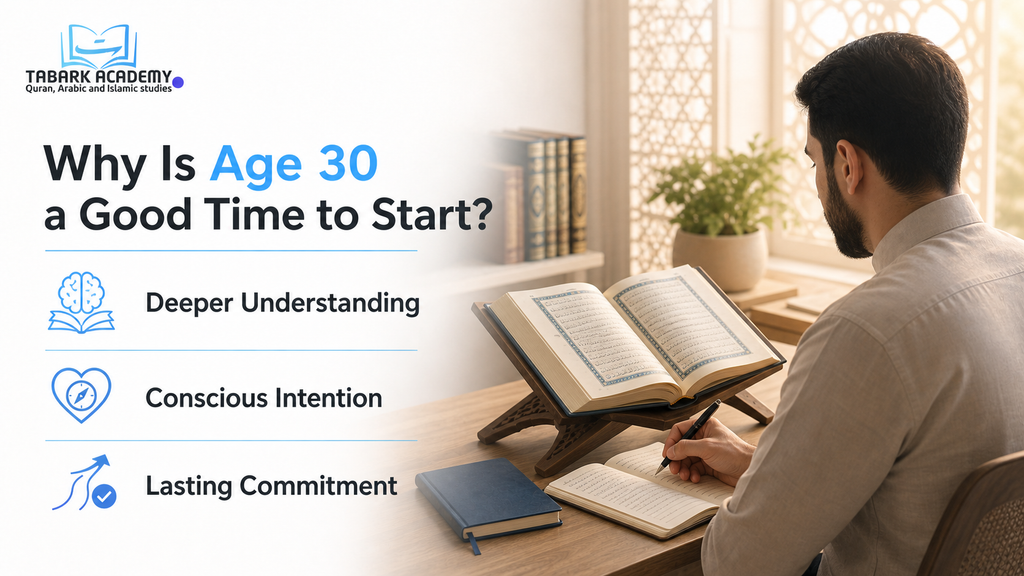
Starting Hifz at 30 isn’t a compromise — it comes with real advantages that childhood memorization doesn’t offer. Adult learners bring three things to the table that matter more than raw memory speed: maturity of mind, clarity of intention, and life experience that makes discipline sustainable.
a- Mental Maturity Improves Understanding And Retention
An adult mind naturally links meaning, context, and structure in ways a child’s mind isn’t yet equipped to do.
This reflective process — tadabbur — lets the meaning of a verse anchor its wording in memory, so recall isn’t built on sound alone but on sense. Repetition still matters, but repetition paired with understanding holds far longer than repetition by itself.
b- Conscious Intention Sustains Adult Memorization
A child typically memorizes because a parent or teacher directs them to. An adult who begins Hifz at 30 does so by deliberate choice — often after years of wanting to, waiting for the right season of life.
That sincerity of intention, niyyah, tends to produce a steadier, more resilient commitment, one that can carry a learner through the inevitable weeks when motivation dips and routine is what keeps the memorization moving.
c- Many Committed Memorizers Began After Thirty
Stories of people completing the Quran in their thirties, forties, and even later in life are common throughout Islamic teaching circles — and they’re shared for a reason: to show that a late start doesn’t predict a weak outcome. Age tells you when someone began. It says nothing about how far they’ll go.
Experience Our Interactive Learning
Curious about how we teach? Watch these brief video clips from our recent live sessions to see our structured curriculum, advanced learning platform, and dynamic student-teacher interactions firsthand.
What Real Challenges Do Adults Face Memorizing the Quran After 30?
Adults face different obstacles than children when memorizing the Quran after 30, mainly rooted in daily responsibilities rather than mental capacity.
a- A full-time job, family, and other commitments leave less dedicated study time than a child in school has.
b- Self-doubt about starting “too late” can discourage a student before they build any momentum.
c- Without a fixed routine, attention can drift between lessons, apps, and other daily demands.
d- Comparing progress to younger students or Huffaz who started as children creates unnecessary pressure.
None of these challenges are permanent. Each responds directly to structure: a fixed daily portion, a teacher who holds the student accountable, and a schedule realistic for a working adult’s week.
Tabarak Academy‘s Hifz for Adults course is built around exactly this kind of structure, with private sessions scheduled around a student’s own work and family commitments rather than a fixed class time.
How Can Adults Practically Start Memorizing the Quran at 30?
The plan matters more than the pace. Adults starting Hifz at 30 succeed by building three things into a routine: a small fixed daily portion, a teacher for correction, and a revision habit that protects what’s already been memorized before adding more.
a- Set a Fixed Daily Quran Memorization Portion
Choose an amount you can realistically repeat every single day — even if it’s just a few verses, or half a page. The specific number matters far less than its sustainability.
A modest portion kept up for two years will always outperform an ambitious one abandoned after three weeks, because Hifz is won by accumulation, not by any single burst of effort.
b- Commit to a Teacher for Correction and Accountability
Memorizing alone makes it easy to absorb small errors in pronunciation and Tajweed — and much harder to unlearn them once they’ve settled into muscle memory.
A qualified teacher listens to each recitation in real time, corrects mistakes before they take root, and keeps your pace grounded in what’s actually sustainable rather than what feels urgent.
Accountability also does quiet work here: a scheduled session each week is often the difference between a plan and a habit.
c- Prioritize Continuous Revision Over New Memorization
The Prophet ﷺ compared the Quran to a hobbled camel — quick to slip away if not held onto, no matter how firmly it was tied down at first.
That image applies directly here: what’s already memorized needs active, ongoing review, or it fades faster than new material is gained. When the two compete for time, revision should win. A smaller portion held permanently is worth more than a larger portion that’s already begun to slip.
Read also: How to Overcome the Urge to Quit Hifz?
What Techniques Help Adults Memorize the Quran Faster After 30?
Adult learners don’t need more willpower — they need methods suited to how an adult mind actually retains language.
The techniques below work because they build on understanding and structured repetition, rather than relying on the pure rote drilling that works well for children but tends to fade faster in adults without reinforcement.
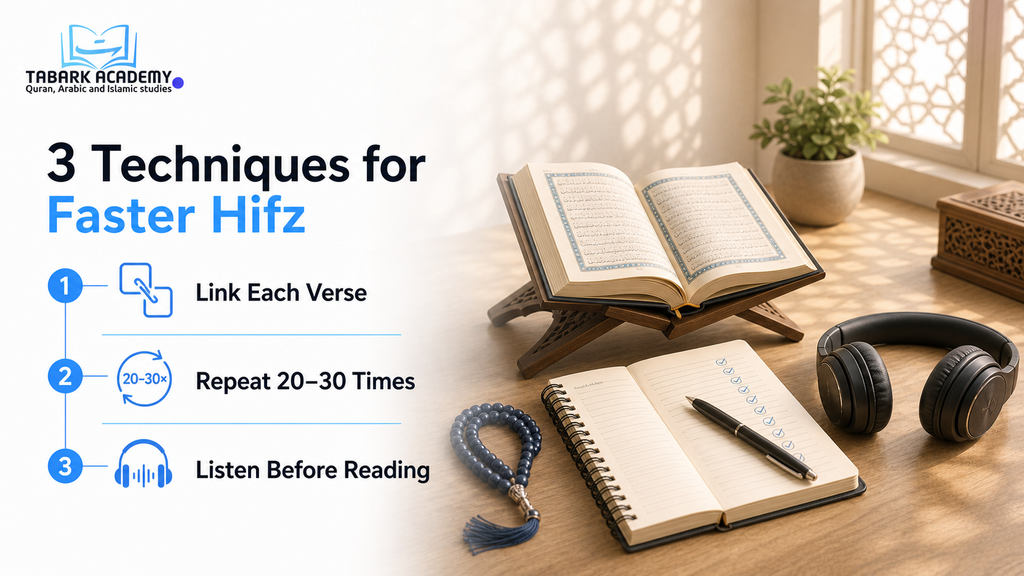
a- Sequential Memorization Links Each Verse To the Next
Memorize one verse until it’s fully secure — able to recite without hesitation or prompting — then move to the next. Recite both together before adding a third, and both again before adding a fourth.
This method builds a chain rather than a pile: each new verse reinforces the ones before it, so by the time you reach verse ten, you’ve effectively reviewed verses one through nine along the way.
b- The Repetition Method Fixes Verses Through Sound
Repeat a single verse aloud, in slow and measured recitation, roughly twenty to thirty times before moving on.
This isn’t mindless repetition — reciting the same wording again and again trains the ear and the tongue together, so the verse becomes something the mouth knows how to say almost independently of conscious recall.
That physical memory is often what holds up under pressure, like reciting in Salah, when purely mental recall can falter.
c- Listening Before Reading Improves Pronunciation and Recall
Before attempting to memorize a verse, listen to it recited by a qualified, skilled reciter — ideally more than once.
This fixes the correct pronunciation and rhythm in your ear first, so you’re memorizing the accurate sound from the outset rather than memorizing your own approximation and correcting it later.
For adult learners especially, this ordering matters: it’s far easier to learn a verse correctly the first time than to unlearn a habitual mispronunciation after it’s already been repeated dozens of times.
How Do Adults Stay Consistent With Quran Memorization After 30?
Consistency after 30 comes from weaving memorized verses into daily worship, protecting review time, and avoiding comparisons with faster learners.
Reciting newly memorized verses in the five daily prayers reinforces them naturally, without requiring extra study time.
Reviewing older material before adding anything new prevents a common pattern: finishing new pages while forgetting earlier ones.
Progress should be measured against a student’s own consistency, not against how quickly someone else memorizes. Tabarak Academy structures each Hifz for Adults session in that order — review first, correction second, new memorization last — with morning, afternoon, evening, and weekend slots for working schedules.

A Real Example of Starting Quran Memorization Later in Life
Tabarak Academy shares an account from one parent: her daughter completed Juz Amma in under a year. Watching that progress motivated the mother, who had never memorized before, to begin her own Hifz journey.
This pattern is not unusual. Many adults report the same experience — starting later than they expected to, and progressing regardless, once a fixed routine and a teacher are in place.
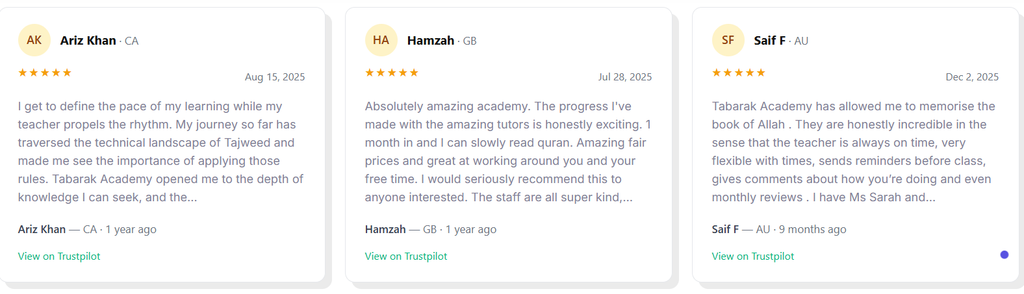
Have a look at the reviews of the students of Tabarak Academy.
Step Inside Our Virtual Classrooms
See our engaging teaching methods in action! watch real snippets of our live classes and discover how our expert instructors make learning interactive, memorable, and inspiring for every student.
Start Your Hifz Journey With Tabarak Academy TODAY
Starting Hifz at 30 works best with a teacher who corrects every recitation and a schedule that fits an adult’s week. Tabarak Academy builds its Hifz for Adults course around exactly that structure.
Every tutor holds a verified Ijazah from Al-Azhar, and sessions run privately, one-on-one, so the full class is spent on the student’s own recitation and revision. Morning, afternoon, evening, and weekend slots are available, and female tutors are offered at no extra cost for sisters who prefer them.
Book your free trial class with Tabarak Academy today and start memorizing the Quran with a structured, correction-focused plan built around your schedule — no payment or commitment required.

Check Our Courses
- Online Quran & Arabic Classes | Foundation
- Recitation Of Quran with Tajweed Course
- Islamic Studies Course Online
- Arabic Alphabet Learning Course
- Noorani Qaida Course for Adults
- Quranic Arabic Course for Kids
- Arabic and Quran Classes for Kindergarten
- Islamic Summer Camp
- Hifz for Kids Course
- Hifz Course for Sisters
- Hifz for Adults Course
- Online Hifz Program
- Noor Al-Bayan Course
Conclusion
So, can you memorize the Quran at 30? Absolutely. There is no fixed age limit for Hifz, and starting at 30 can bring valuable advantages: greater maturity, stronger intention, better understanding, and the ability to build a deliberate learning routine.
Success does not depend on memorizing large portions quickly. Start with a realistic daily portion, learn with a qualified teacher, review consistently, and use methods that combine repetition, listening, understanding, and recitation in Salah.
Your work, family responsibilities, or slower pace do not prevent progress when your plan is built around the life you actually live. Most importantly, do not measure your Hifz journey against someone who started as a child or has more time available. Measure it by consistency and retention.
A few verses memorized correctly and reviewed every day are more valuable to your long-term progress than an ambitious pace you cannot sustain. Thirty is not too late to begin. Start with what you can manage today, protect what you memorize through regular revision, and allow steady consistency to carry you forward—one verse, one page, and eventually one Juz at a time.
Frequently Asked Questions About Memorizing the Quran at 30
Do Adults Need Long Daily Hours to Memorize the Quran?
No, adults do not need long daily hours to memorize the Quran. A short, consistent session with regular revision produces steadier results than occasional long sessions.
Does a Busy Work Schedule Prevent Successful Memorization at 30?
No, a busy schedule does not prevent successful memorization. Adults who organize a realistic, flexible routine around their responsibilities can progress at a sustainable pace despite full-time work.
What Is the Best Way to Review Memorized Verses?
Daily, regular review in small portions is the most reliable way to protect memorized verses. Reviewing a little every day prevents the forgetting that comes from long gaps between sessions.