

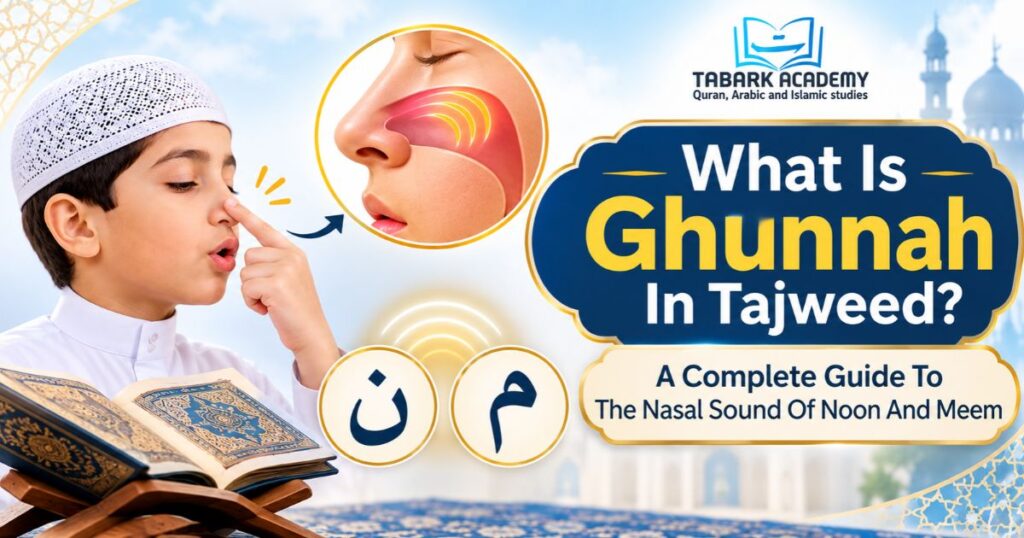
What Is Ghunnah In Tajweed? A Complete Guide To The Nasal Sound Of Noon And Meem
Ghunnah appears in nearly every few words of the Quran, yet many students recite for years without ever being told what it is or where the sound actually comes from.
If you have ever wondered what is ghunnah in tajweed, the short answer is this: ghunnah is a nasal resonance produced from the Khayshum — the nasal passage — and it belongs permanently to two letters only, Noon (ن) and Meem (م).
Understanding ghunnah is not a decorative detail. It affects how you read Ikhfa, Idgham, Iqlab, Noon Mushaddad and Meem Mushaddad — rules that cover a large share of every page of the Mushaf. At Tabarak Academy, this is one of the first sounds our instructors train, because a student who hears ghunnah correctly learns every related rule faster.
This guide explains the ghunnah in tajweed meaning, its articulation point, its five levels of strength, its exact duration, the mistakes students repeat most often, and how to verify your own pronunciation at home.
What You’ll Learn in This Article
- What is ghunnah in tajweed, and where in the mouth and nose it is produced.
- Why only Noon and Meem carry this nasal quality.
- The five levels of ghunnah, ranked from strongest to lightest.
- Exactly how long ghunnah is held — and when it is not held at all.
- The three most common ghunnah mistakes and how to self-correct them.
What Is Ghunnah in Tajweed?
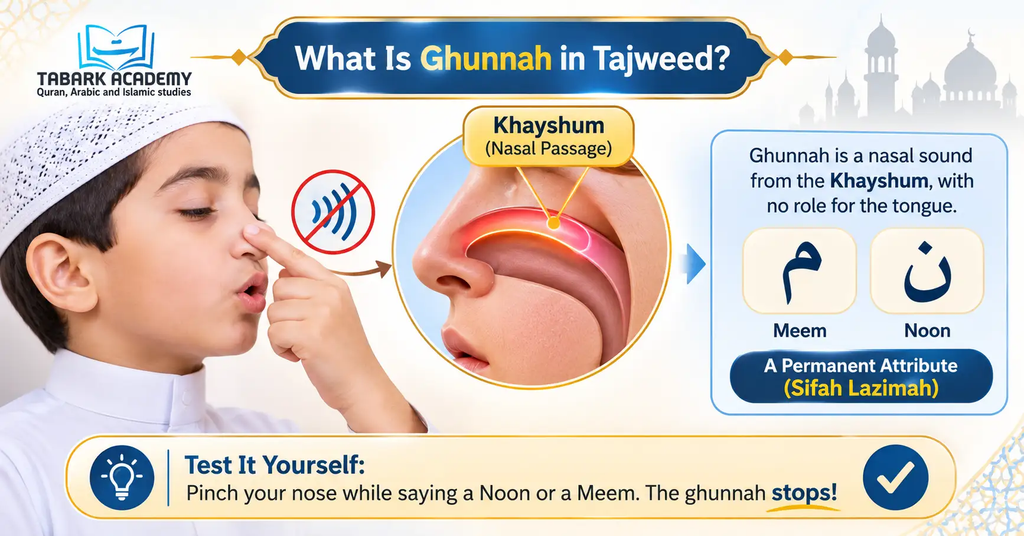
Ghunnah is a nasal sound that exits through the Khayshum, the inner nasal passage, with no involvement of the tongue whatsoever. It is a permanent, inseparable attribute — a Sifah Lazimah — of Noon (ن) and Meem (م), present whether those letters carry a vowel, a sukoon, a shaddah, or are assimilated or concealed.
The Arabic word ghunnah (غُنَّة) literally describes a sound produced nasally. That definition is not theoretical, and you can test it in two seconds — but test it on the right letter.
Pinch your nose gently while holding the Noon in إِنَّ. The sound stops completely, because a Mushaddad Noon is carried almost entirely by the nasal passage.
Do the same on a voweled Noon such as نَعَم and the sound does not stop, since the vowel itself escapes through the mouth.
That difference is the point, not a flaw in the test: ghunnah is strongest where the letter is doubled, concealed or assimilated, and lightest where the letter carries a vowel. Use the Mushaddad Noon and Meem as your reference sounds when checking yourself.
What Is the Makhraj of Ghunnah?
The makhraj of ghunnah is the Khayshum (الخيشوم), the nasal cavity drawing inward toward the throat.
This is what separates ghunnah from every other sound in Quranic recitation. Ordinary letters are articulated in the throat, on the tongue, or at the lips. Ghunnah is articulated in none of those places.
The tongue has zero role in producing it — a point that matters enormously once you reach the common mistakes later in this guide.
Why Does Ghunnah Belong Only to Noon and Meem?
Noon and Meem are the only Arabic letters whose articulation includes a built-in nasal resonance chamber. No third letter shares this quality.
Two practical consequences follow. First, Noon is considered the stronger of the two in ghunnah. Second, Tanwin (ـً ـٍ ـٌ) carries the same ruling as Noon Sakinah in every ghunnah-related rule, because it is phonetically a Noon with sukoon. Every time you see a tanwin, read it as a Noon for the purposes of these rules.
| Letter | Arabic form | Carries ghunnah? | Note |
| Noon | ن | Yes | The stronger of the two in nasal resonance |
| Meem | م | Yes | Equal in duration, slightly lighter in weight |
| Tanwin | ـً ـٍ ـٌ | Yes | Takes the same ruling as Noon Sakinah |
If you are building your foundation from the ground up, Tabarak Academy’s Tajweed courses introduce ghunnah in the very first lessons and train your ear to recognise the sound before asking you to memorise a single rule — because a rule you cannot hear is a rule you cannot apply.
Read also: What Is Idgham Shafawi?
Ghunnah in Tajweed Explained: The Five Levels
Ghunnah is not one uniform sound. It has five distinct levels (maratib), ranked by strength from the most resonant to the lightest.
Students who ask what is ghunnah in tajweed usually expect a single answer, and this ranking is where a proper explanation separates itself from a surface-level definition — because it settles the question that follows immediately: do I hold every Noon and Meem for two counts? The answer is no, and the levels tell you exactly which ones you do.
| Level | Name | Condition | Example |
| 1st | Al-Mushaddad | Noon or Meem with shaddah | إِنَّ / عَمَّ |
| 2nd | Al-Mudgham | Idgham with ghunnah | إِن يَشَأ / مَن يَعْمَلْ |
| 3rd | Al-Mukhfa | Ikhfa Haqiqi, Iqlab, Ikhfa Shafawi | مِنۢ بَعۡدِ / فَٱحۡكُم بَيۡنَهُمۡ |
| 4th | Al-Sakin al-Muzhar | Noon/Meem Sakinah with Izhar | مِنْ عِلْمٍ / أَمْ عِندَهُمْ |
| 5th | Al-Mutaharrik al-Mukhaffaf | Noon or Meem with any vowel | نَعَم / مَلَك |
Levels one, two and three are held for two full counts. Levels four and five carry only the letter’s inherent nasal quality, with no measured elongation.
1. Ghunnah in Al-Mushaddad
The strongest and most prominent ghunnah occurs on a Noon or Meem carrying a shaddah, whether the shaddah sits inside a single word or results from two words merging through complete assimilation.
إِنَّآ أَعۡطَيۡنَٰكَ ٱلۡكَوۡثَرَ
Innā aʿṭaynākal-kawthar (Al-Kawthar 108:1)
The Noon carries a shaddah: hold the ghunnah for two counts, then release — without letting it bleed into the Alif Madd that follows. That bleed is one of the most frequent corrections our instructors make in live sessions.
هَمَّتۡ بِهِۦ
Hammat bih (Yusuf 12:24)
Here the Meem carries the shaddah, and the nasal resonance must be fully audible for the same two counts.
2. Ghunnah in Al-Mudgham
The second level covers Idgham Naqis — incomplete assimilation — specifically Noon Sakinah or Tanwin merging into Waw (و) or Yaa (ي). The Noon disappears into the following letter, but the ghunnah survives as an audible trace for two counts.
مِن وَرَائِهِمۡ
Min warāʾihim (l-Buruj 85:20)
The assimilation is called incomplete precisely because the ghunnah remains. When Noon Sakinah merges into Noon or Meem instead, the assimilation is complete and the result is a Mushaddad letter, which belongs to level one.
Remember the four letters of Idgham with ghunnah as a group: ي، ن، م، و. These four are what separate Idgham Bil Ghunnah from the plain, non-nasal Idgham that occurs before Laam and Raa.
3. Ghunnah in Al-Mukhfa
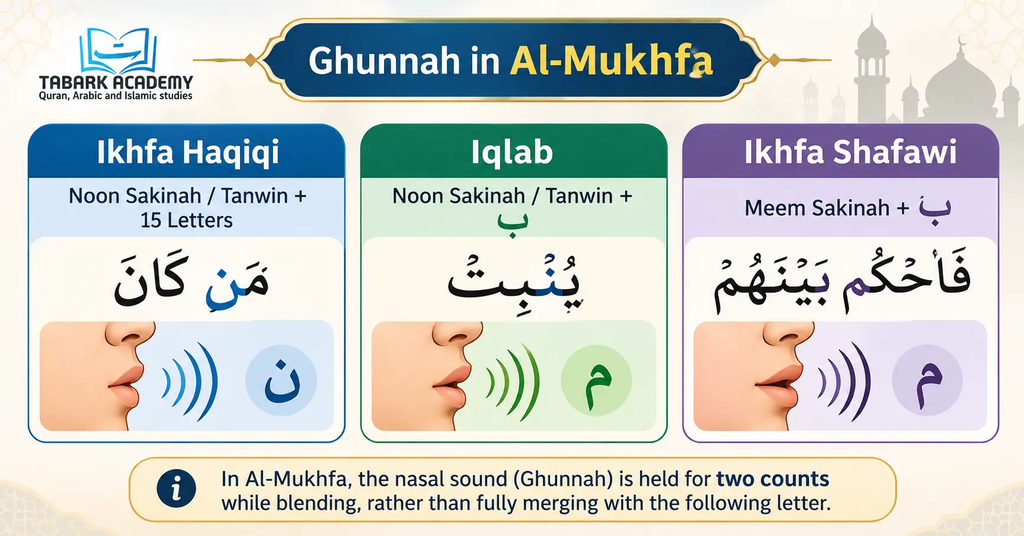
The third level covers all three types of concealment. In each, the nasal sound is held for two counts while blending toward the articulation point of the following letter, rather than fully merging with it.
| Type of concealment | Trigger | Example |
| Ikhfa Haqiqi | Noon Sakinah / Tanwin + 15 letters | مَن كَانَ |
| Iqlab | Noon Sakinah / Tanwin + ب | يُنۢبِتُ |
| Ikhfa Shafawi | Meem Sakinah + ب | فَٱحۡكُم بَيۡنَهُمۡ |
Ikhfa Haqiqi applies before the fifteen letters ت، ث، ج، د، ذ، ز، س، ش، ص، ض، ط، ظ، ف، ق، ك. The tongue does not press fully into the makhraj of Noon; the sound sits between clear pronunciation and full merging.
Iqlab is the simplest ghunnah rule in the entire system because it has exactly one trigger letter: ب. The Noon converts into a concealed Meem sound carried on ghunnah, as in يُنۢبِتُ (An-Nahl 16:11).
Ikhfa Shafawi applies to Meem Sakinah followed by Baa, as in فَٱحۡكُم بَيۡنَهُمۡ. The ghunnah is held for two counts on the Meem while the lips are prepared for the Baa but never closed with pressure.
Schools differ on the detail: most teachers of Hafs have the lips meet lightly without any pressure, while others teach a slight gap between them. Both positions agree on what actually breaks the rule — pressing the lips shut.
Full lip closure turns the concealed Meem into a clear one and produces Izhar Shafawi instead of Ikhfa. If you can feel tension in your lips before the Baa, you have closed them too early.
4. Ghunnah in Al-Sakin al-Muzhar
The fourth level applies to Noon Sakinah pronounced clearly before the six throat letters (Izhar Halqi), and to Meem Sakinah followed by anything other than Baa or Meem.
مِنۡ عِلۡمٍ
Min ʿilm (Al-Kahf 18:5)
The ghunnah is present but minimal. Izhar means clarity: the Noon must be pronounced cleanly and released, not stretched. Over-extending here is a direct contradiction of the rule being applied.
5. Ghunnah in Al-Mutaharrik al-Mukhaffaf
The lightest level belongs to Noon and Meem carrying a vowel — fathah, kasrah or dammah — without a shaddah, as in نَعَم and مَلَكٌ.
The ghunnah here is the bare natural resonance that makes these letters what they are. Do not suppress it, and do not inflate it. Students at this stage tend to do one or the other.
Start Your Quran Learning Journey
Join Tabark Academy today for structured online lessons with qualified tutors, customized to fit your goals.
Book Your Free Trial LessonHow Long Should Ghunnah Be Held?
Ghunnah duration follows one clear dividing line. Levels one, two and three — Mushaddad, Mudgham and Mukhfa — are each held for exactly two counts (harakatayn), the same measure as a natural Madd Asli. A count is the natural length of a single short vowel.
Levels four and five carry only the inherent ghunnah of the letter. No measured elongation is required, and adding one is an error, not extra care. Anyone working through what is ghunnah in tajweed in practice arrives at this distinction eventually: the question is never whether ghunnah is present, only how long it is held.
| Levels | Duration | Applies to |
| 1st, 2nd, 3rd | Two counts (harakatayn) | Mushaddad, Mudgham, Mukhfa |
| 4th, 5th | Inherent ghunnah only | Muzhar, Mutaharrik Mukhaffaf |
Keep the two counts consistent across your recitation. A ghunnah held for two counts in إِنَّ and three counts in عَمَّ is an inconsistency a trained ear catches immediately.
Three Common Ghunnah Mistakes And How To Fix Them
Across every level of student, ghunnah errors cluster into three repeating patterns. Recognising yours is usually faster than relearning the rules.
1. Dropping ghunnah entirely on voweled Noon and Meem
Students who learn ghunnah as a list of rules apply it only in “rule situations” — Ikhfa, Idgham, Iqlab — and forget that the fifth level exists in every single voweled Noon and Meem in the Quran.
The fix is to stop treating ghunnah as an event and start treating it as a property of the two letters.
2. Stretching ghunnah into a Madd
When a shaddah sits on a Noon or Meem immediately before a Madd letter, students run the nasal sound straight into the elongation and produce four or five counts where two were required.
The rule is precise: two counts of ghunnah, release, and the Madd then begins independently if its own conditions exist.
3. Producing ghunnah with the tongue
Because Noon involves the tongue and Meem involves the lips in their full articulation, students instinctively press harder with the tongue to “make” the nasal sound. Ghunnah requires an open, active nasal passage and a relaxed tongue.
If you feel tongue pressure increasing as the nasal sound grows, you are producing the sound in the wrong place.
Place a finger lightly on the bridge of your nose while reciting a Mushaddad Noon. A clear vibration means the sound is reaching the Khayshum. No vibration means you are producing it in the mouth.
This test takes two seconds and is the most reliable home correction available. Together with the nose-pinch test above, it gives you two checks on the same Mushaddad Noon: one confirms the sound is reaching the nasal passage, the other confirms it is not escaping through the mouth.
Both tests tell you that something is wrong, not what. That part needs an ear. Tabarak Academy’s one-to-one Tajweed sessions use audio-first correction with certified instructors precisely because these three patterns are difficult to hear in your own voice.
How Ghunnah Connects to Other Tajweed Rules
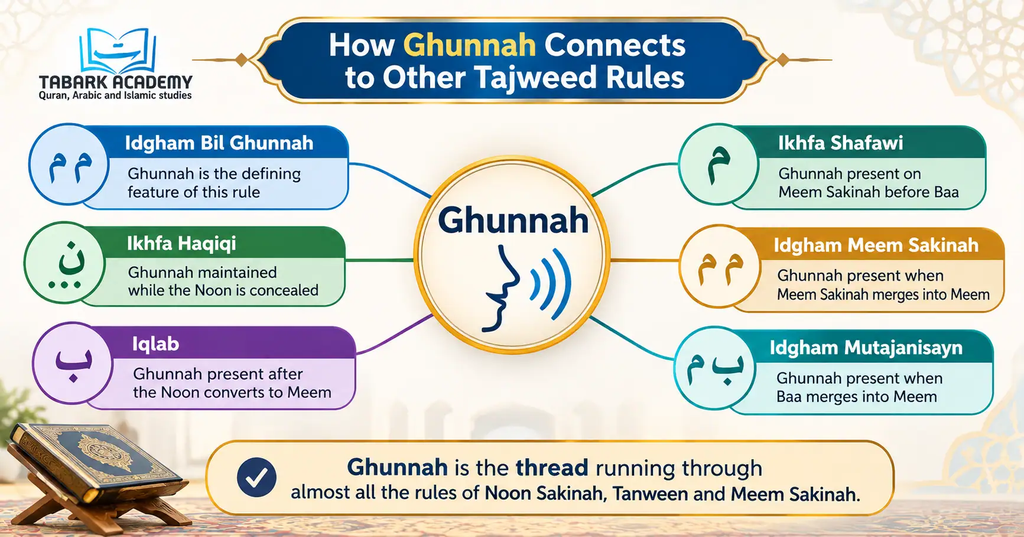
Ghunnah does not stand alone. It is embedded in several major rules, and recognising the connection is what moves a student from memorising definitions to reciting accurately.
| Rule | Connection to ghunnah |
| Idgham Bil Ghunnah | Ghunnah is the defining feature of this Idgham category |
| Ikhfa Haqiqi | Ghunnah maintained while the Noon is concealed |
| Iqlab | Ghunnah present after the Noon converts to Meem |
| Ikhfa Shafawi | Ghunnah present on Meem Sakinah before Baa |
| Idgham Meem Sakinah | Ghunnah present when Meem Sakinah merges into Meem |
| Idgham Mutajanisayn | Ghunnah present when Baa merges into Meem |
Seen this way, ghunnah is not a chapter in the Rules of Noon Sakinah and Tanween — it is the thread running through almost all of them.
Students who master it early find that Ikhfa, Idgham and Iqlab stop feeling like three separate topics.
Read also: What Is Izhar Shafawi?
Start Your Quran Learning Journey
Join Tabark Academy today for structured online lessons with qualified tutors, customized to fit your goals.
Book Your Free Trial LessonBook Your Free Tajweed Trial with Tabarak Academy Today
You now know what is ghunnah in tajweed in theory. Producing all five levels correctly, at the right duration, in live recitation is a different skill — and it requires a trained ear correcting you in real time.
At Tabarak Academy, Tajweed is taught one-to-one by qualified instructors with flexible scheduling for students in any time zone.
You will start with sound, not rules — hearing ghunnah before naming it — and progress from these fundamentals to confident, accurate recitation of the full Mushaf.
Our Tajweed Courses:
- Online Tajweed Classes
- Tajweed Course for Beginners
- Tajweed Course for Kids
- Tajweed Course for Adults
- Tajweed Course for Sisters
- Advanced Tajweed Course
- Amali (Practical) Tajweed Course
- Learn Quran with Tajweed
- Learn Quran with Tajweed for Kids

Conclusion
What is ghunnah in tajweed, summarised: a nasal resonance produced from the Khayshum, belonging permanently and exclusively to Noon and Meem, with Tanwin following the same ruling as Noon Sakinah.
It appears across five levels of strength — Mushaddad, Mudgham, Mukhfa, Sakin Muzhar and Mutaharrik Mukhaffaf — of which the first three are held for exactly two counts and the last two carry only the letter’s natural nasal quality.
The one takeaway worth carrying into your next recitation session: ghunnah is a property of two letters, not a rule that switches on and off. Once you hear it that way, Ikhfa, Idgham and Iqlab stop being separate lists to memorise and become variations of a single sound you already know how to produce.
Frequently Asked Questions About Ghunnah in Tajweed
These are the questions students most often bring to their first Tajweed lessons at Tabarak Academy. Each answer is short enough to use as a quick reference while you practise.
1. What is the difference between ghunnah and Ikhfa?
Ghunnah is a sound — nasal resonance from the Khayshum. Ikhfa is a rule that requires that sound. Ikhfa conceals Noon Sakinah or Tanwin before fifteen specific letters while ghunnah is held for two counts. Ghunnah exists in many contexts beyond Ikhfa; Ikhfa cannot exist without ghunnah.
2. How many counts should ghunnah be held for?
Ghunnah is held for two counts (harakatayn) in the first three levels: Mushaddad, Mudgham and Mukhfa. In the fourth and fifth levels — Izhar and voweled letters — only the inherent nasal quality is present, with no measured elongation.
3. Does ghunnah apply to all Noon and Meem letters in the Quran?
Yes. Ghunnah is a permanent attribute of both letters in every state. What changes is its strength and duration, not its presence. A voweled Noon still carries minimal ghunnah; a Mushaddad Noon carries it for two full counts.
4. Is the ghunnah of Noon stronger than that of Meem?
Yes, Noon is considered stronger in ghunnah than Meem. Both are held for the same two counts in the first three levels, but Noon carries greater nasal weight in its articulation.
5. Do I need a teacher to learn ghunnah, or can I self-study?
You can learn the rules from a written guide, but duration and nasal placement are heard, not read. Most students can self-study the theory and then need an instructor to correct the three common errors above, which are difficult to detect in your own recitation.