

Ask any Arabic learner why Arabic is called the language of the dhad, and most will point to one thing: a single letter that no other language on earth can properly reproduce. That letter is ض (Dhad), and the title “language of the Dhad” (لغة الضاد) has followed Arabic for centuries.
At Tabarak Academy, this is one of the first questions new students ask once they start working through the Arabic alphabet.
Many people specifically search for Arabic called the language of the Dhad reasons before they even start lessons, wanting the full picture first.
Below are the seven documented reasons Arabic carries this name, the phonetic facts behind them, and what they mean for anyone learning to pronounce Dhad correctly.
1. The Letter Dhad Has No Exact Match in Any Other Language
Dhad (ض) is a consonant produced by pressing the side of the tongue against the upper molars while the back of the tongue lifts toward the soft palate, a quality called itbaq (emphasis). No other living language documents an identical sound in its phoneme inventory.
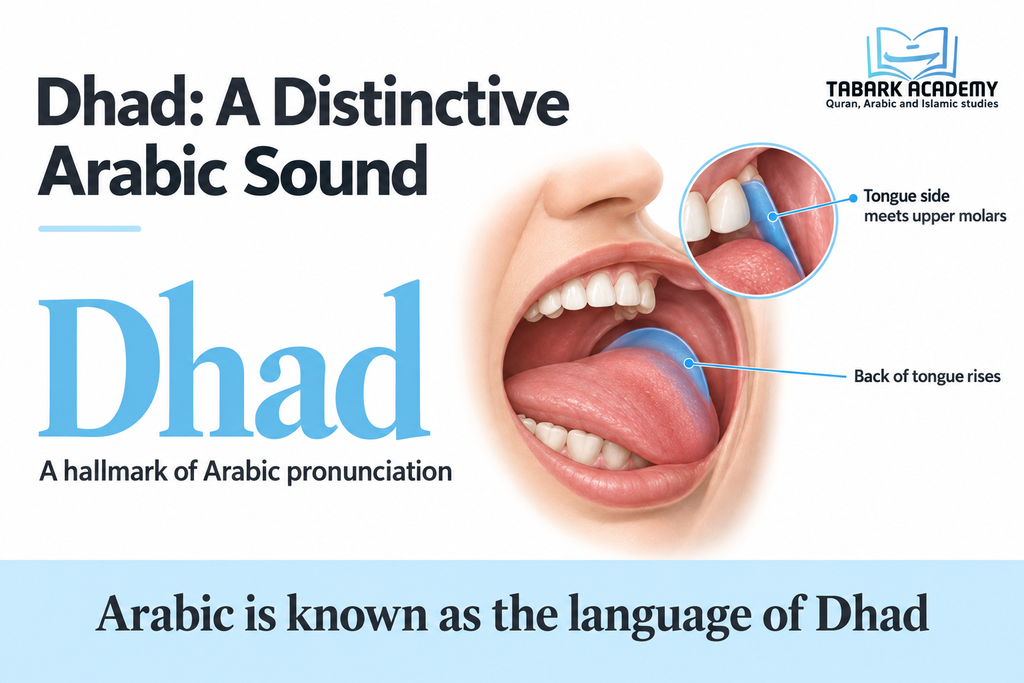
This is the single biggest reason why is Arabic called the language of the Dhad: linguists across centuries have been unable to find a true equivalent to it in Persian, Hebrew, English, French, or Spanish.
A sound that exists in exactly one language, and defines that language’s phonetic identity, is a strong enough marker to become a title.
2. A Widely Cited Hadith Names The Prophet As Most Fluent In Dhad
The phrase most often quoted to explain why Arabic is called the language of the Dhad is:
أَنَا أَفْصَحُ مَنْ نَطَقَ بِالضَّادِ
“I am the most eloquent of those who pronounce the Dhad.”
This statement is attributed to the Prophet Muhammad (peace be upon him) in popular usage, and it is the reason many articles present the name as settled fact.
A responsible answer needs one caveat competitors usually skip: hadith scholars including Ibn Kathir, al-Sakhawi, al-Ajlouny, and Mulla Ali Qari all classified this specific wording as la asla lahu (of no traceable chain), even while agreeing that its meaning is sound.
In other words, the sentiment is accepted by scholars as true in substance, but the exact wording is not established as an authentic narration back to the Prophet.
That distinction matters for anyone citing this as a historical or religious source. The name “language of Dhad” is best understood as a linguistic tradition that grew around this saying, not as a hadith with a verified chain of transmission.
Experience Our Interactive Learning
Curious about how we teach? Watch these brief video clips from our recent live sessions to see our structured curriculum, advanced learning platform, and dynamic student-teacher interactions firsthand.
3. Classical Arab Linguists Documented the Sound Centuries Ago
Long before modern phonetics existed, grammarians such as Sibawayh studied the exact place and manner of articulation for every Arabic letter, and Dhad received special attention because of how differently it behaved from anything else in the language.
Later scholars, including Ibn Khaldun and al-Jahiz, referenced the same uniqueness in their writing on the Arabic language.
This historical documentation is why the title is not a modern marketing phrase. Arab scholars were already calling their language “the language of Dhad” in classical texts, centuries before comparative linguistics confirmed the sound’s rarity through instrumented study.
Read Also: How To Pronounce Dhad Correctly (ض)?
4. Non-Native Speakers Find Dhad Genuinely Difficult to Reproduce
Dhad requires a combination three things happening at once: contact between the side of the tongue and the upper molars, emphatic (heavy) resonance, and a feature called istitalah, where the sound elongates along the side of the mouth rather than releasing instantly like most consonants.
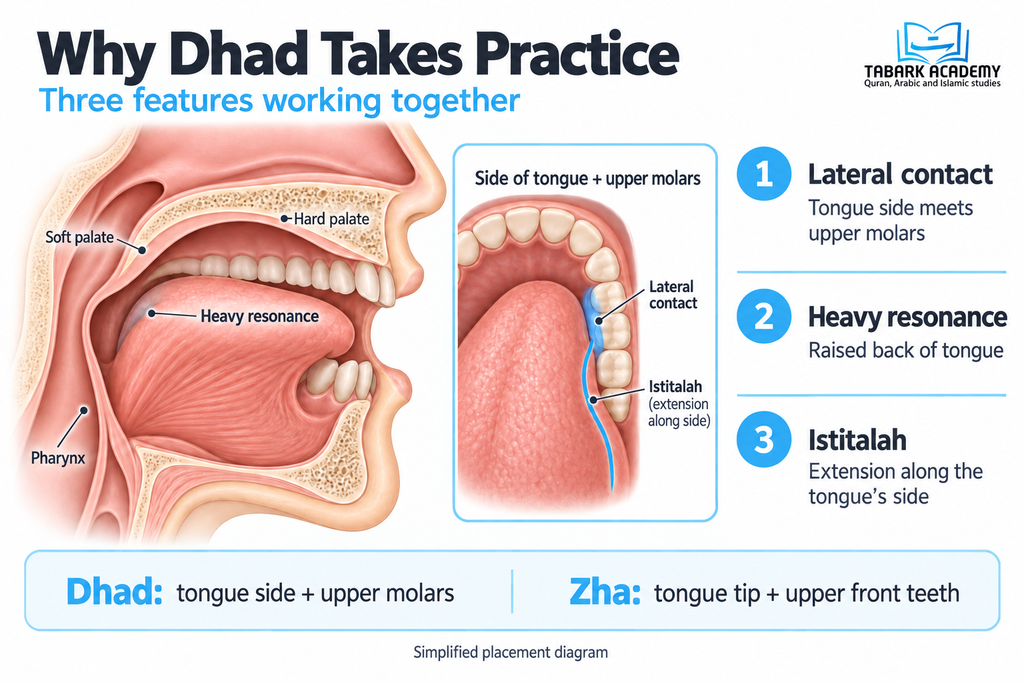
This is the reason advanced learners can spend months correcting their Dhad even after they’ve mastered the rest of the alphabet. It’s also where Arabic and the near-identical letter Zha (ظ) get confused.
The two are often lumped together as “the emphatic sounds,” but they are pronounced at different points in the mouth and change word meaning entirely — ضَلَّ (he was misguided) and ظَلَّ (he remained) are two completely different words that differ only in this one letter.
Students working through Tabarak Academy’s Arabic Alphabet Learning Course usually spend a dedicated session isolating just this pair before moving on.
5. Arabs Historically Took Pride In The Sound As A Marker Of Identity
Beyond phonetics, the name carried social weight. Classical poets referred to themselves as Ahl al-Dhad (“the people of Dhad”), using command of the letter as a mark of eloquence and belonging.
The 10th-century poet Al-Mutanabbi wrote lines celebrating this exact idea, tying command of the language to command of the sound itself.
This pride element is central to why Arabic is called language of Dhad in everyday cultural memory, not just in academic texts, which is part of why the title survived as a badge of identity rather than fading into a technical footnote.
6. Dhad Carries Real Weight in Quranic Recitation
Correct articulation of Dhad is a formal requirement in Tajweed, the discipline governing Quranic recitation, because mispronouncing it can change the meaning of a word being recited.
The clearest example is al-daalleen in Surah Al-Fatihah, recited by hundreds of millions of Muslims daily in the five daily prayers, where the correct makhraj (articulation point) of Dhad is taught explicitly rather than left to guesswork.
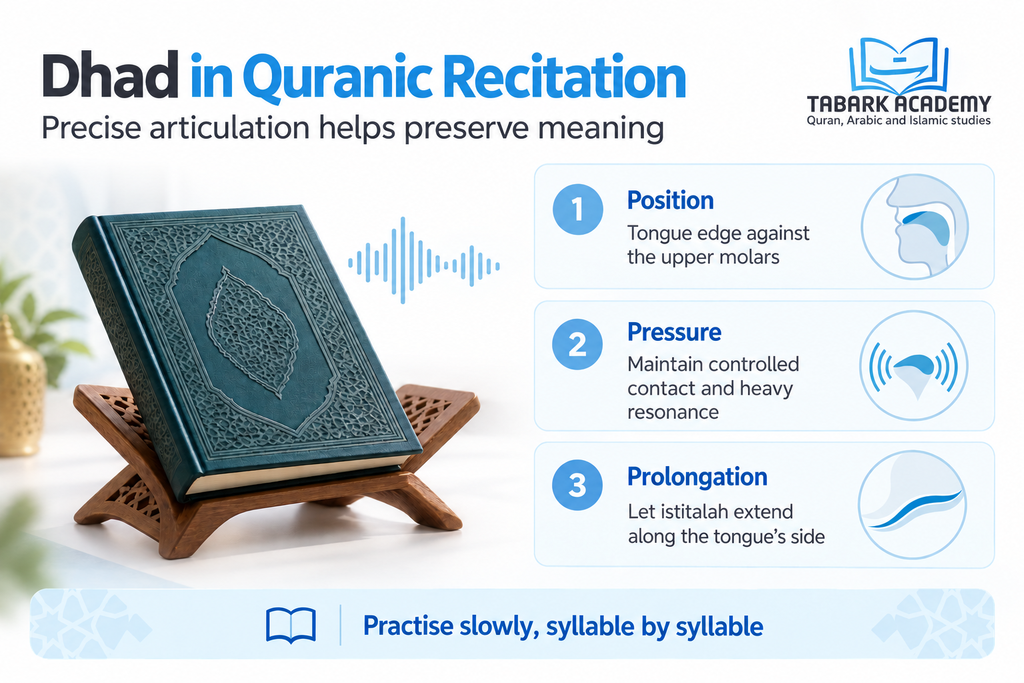
This is one reason Dhad training isn’t treated as a side skill for Quran students. A framework that helps here is what instructors sometimes teach as Position, Pressure, Prolongation:
Place the tongue’s edge against the upper molars (position), press firmly enough to create the emphatic quality (pressure), then let the sound elongate rather than clipping it short (prolongation, matching istitalah).
Working through this sequence slowly, syllable by syllable, is usually faster than trying to imitate the sound whole.
It’s a method Tabarak Academy’s Online Arabic Classes build directly into pronunciation drills, since reading about Tajweed and producing the sound correctly are two different skills.
7. Arabic Retained A Sound That Related Languages Lost
Dhad has cognates in other Semitic languages — Hebrew and Aramaic both once carried related sounds — but those languages shifted the pronunciation over time or merged it with another letter. Arabic is the one Semitic language that kept the original articulation largely intact.
This retention, alongside heavy and consistent use of the letter across everyday vocabulary, is the linguistic reason Arabic ended up as the sole claimant to the name, rather than one of several related languages sharing the title.
Read Also: 23 Interesting Facts About The Arabic Language
Step Inside Our Virtual Classrooms
See our engaging teaching methods in action! watch real snippets of our live classes and discover how our expert instructors make learning interactive, memorable, and inspiring for every student.
Start Building Real Arabic Pronunciation With Tabarak Academy
Reading about why Arabic is called the language of the Dhad is one thing. Producing the sound correctly, in real words, under a teacher who can hear the difference between a near-miss and the real articulation, is what actually moves the needle.
Tabarak Academy’s live, one-on-one classes are built around exactly this kind of correction — instructors listen to your Dhad, Zha, and every other letter in real time and adjust your tongue placement until it clicks.
Our Arabic Language Courses
- Online Arabic Classes
- Arabic Course for Beginners
- Arabic Alphabet Learning Course
- Online Arabic Classes for Kids
- Arabic Classes for Adults
- Arabic Grammar Course
- Intermediate Arabic Course
- Arabic Speaking Course
- Arabic Reading Course
- Learn Arabic Writing Course
- Classical Arabic Course
- Modern Standard Arabic (MSA) Course
- Advanced Arabic Course
- Intensive Arabic Course
- Madinah Arabic Course
- Egyptian Arabic Course

Conclusion
Arabic is called the language of Dhad because of a rare combination of factors: a phonetically unique letter, a widely repeated (if not fully authenticated) prophetic saying, centuries of documentation by classical grammarians.
Additionally, it holds genuine difficulty for non-native tongues, cultural pride, and a central role in Quranic recitation that keeps the letter in daily use by hundreds of millions of speakers. Few languages can point to one sound carrying this much linguistic and cultural weight.
If you’re working through why Arabic is called the language of Dhad because you’re trying to learn the sound yourself, the short answer is that it takes structured, corrected practice — not just repetition. That’s the gap Tabarak Academy’s instructors are there to close, one session at a time.

Frequently Asked Questions About The Language Of The Dhad
The questions below cover the details learners most often ask after they understand why Arabic is called the language of the Dhad, from the letter’s exact pronunciation to how the name is used today.
1. Is Arabic called the language of the Dhad for religious or linguistic reasons?
Both, though the linguistic reason is the more historically solid one. The letter’s unique phonetics were documented by grammarians independent of religious texts, while the popular hadith about the Prophet’s fluency in Dhad added a cultural and religious dimension to the name even though its chain of transmission is considered weak.
2. What are the main reasons Arabic is called the language of Dhad?
The core reasons are the letter’s phonetic uniqueness, its difficulty for non-native speakers, its documentation in classical Arabic scholarship, its role in Quranic recitation, and the cultural pride Arabs historically attached to pronouncing it correctly.
3. Why do people confuse Dhad (ض) with Zha (ظ)?
Both letters share the emphatic, heavy quality that makes them harder for non-native speakers, but they are produced at different points in the mouth and change word meaning completely, as in ضَلَّ versus ظَلَّ. Confusing them is one of the most common early mistakes Arabic learners make.
4. How long does it take to master pronouncing Dhad correctly?
There’s no fixed number, but instructors commonly see it take several months of focused, corrected practice for the sound to become natural, longer than most other Arabic letters. Consistent feedback from a teacher who can hear the difference shortens this significantly compared to self-study alone.
5. Is the letter Dhad only found in Arabic?
Yes. The precise articulation of ض, including its emphatic quality and elongation (istitalah), is not documented as a native phoneme in any other living language, which is why it functions as a defining marker of Arabic specifically.
6. How is the Arabic letter Dhad written in different positions?
Like most Arabic letters, its shape changes by position: alone it is ض, at the start of a word it appears as in ضبع, in the middle as in منضدة, and at the end as in بيض. The sound stays the same; only the connecting strokes change.




0 Comments