


How Long Does It Take to Get an Ijazah?
If you are wondering how long does it take to get an Ijazah, a common timeframe for a well-prepared student studying consistently is around 6 months to one year. However, there is no universal deadline.
The time to get an Ijazah depends on your starting level, the strength of your Tajweed and memorization, how frequently you study with your Sheikh, and how many corrections must be resolved before your recitation meets the required standard.
Most importantly, Ijazah is based on mastery rather than speed. Finishing the Quran quickly does not qualify a student if Makharij, Tajweed, Waqf, or memorization remain inconsistent.
A student who is already highly proficient may progress relatively quickly. Someone who still needs to strengthen Hifz or correct deeply established pronunciation habits may need considerably longer.
How Long Does It Take to Get an Ijazah?
Getting a Quran Ijazah may take approximately 6 months to one year for a well-prepared student following a consistent schedule. However, the process can be shorter or considerably longer depending on the student’s Tajweed, Hifz strength, lesson frequency, and the Sheikh’s assessment.
An Ijazah is based on demonstrated proficiency, not a fixed number of lessons. When accompanied by a Sanad, it also documents the chain through which the authorized recitation was transmitted.
For this reason, six months to one year should be treated as a planning range rather than a guaranteed completion date. A student who still needs to strengthen Hifz or correct recurring Tajweed errors may require significantly more preparation before receiving authorization.

Estimated Ijazah Timeline Based on Your Current Quran Level
Your starting level is one of the strongest indicators of how long the process may take. A student with stable Hifz and advanced Tajweed can focus primarily on completing the formal recitation, while someone still developing Tajweed or memorization needs additional preparation first.
| Starting Point | What Usually Determines the Timeline |
| Strong Hifz + advanced Tajweed | Primarily the time required to complete the full recitation and resolve occasional corrections |
| Full Hifz + recurring Tajweed errors | Correction and stabilization may extend the process |
| Strong recitation but weak Hifz | Memorization and revision may be required before a full Hifz-based Ijazah |
| Still learning Tajweed fundamentals | Preparation should normally come before formal Ijazah recitation |
| Beginning Quran study from scratch | Quran reading, Tajweed, and potentially Hifz must come before the certification stage |
This is why comparing your timeline with another student’s can be misleading. Two students may attend the same number of weekly classes yet finish months apart because their starting accuracy and correction needs are different.
Why Your Ijazah Timeline Depends on Proficiency, Not a Fixed Number of Lessons
An Ijazah is competency-based rather than attendance-based. You do not receive it simply because you have studied for six months or completed a predetermined number of lessons.
The Sheikh must be satisfied that your recitation meets the requirements of the specific Ijazah you are pursuing. For a full Hifz-based Ijazah, this may involve assessing readiness, listening to the Quran systematically, correcting weaknesses throughout the Khatmah, and confirming the required standard before authorization.
A useful way to understand the timeline is:
Your schedule determines how quickly you can cover the Quran; your accuracy determines how quickly your Sheikh can approve your recitation.
In practice, the second factor is often what determines when the Ijazah is finally granted.
Experience Our Interactive Learning
Curious about how we teach? Watch these brief video clips from our recent live sessions to see our structured curriculum, advanced learning platform, and dynamic student-teacher interactions firsthand.
What Factors Determine How Long It Takes to Get an Ijazah
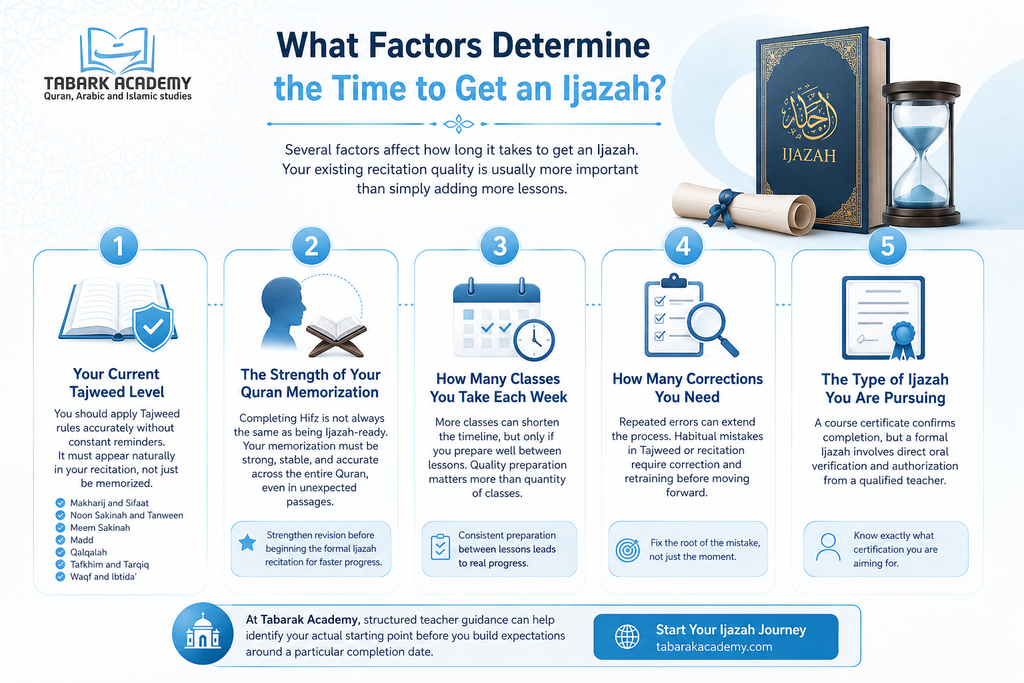
Several factors directly affect how long it takes to get an Ijazah, but they do not carry equal weight. Your existing recitation quality and preparation are usually more important than simply increasing the number of lessons you take.
1. Stronger Tajweed Skills Reduce the Correction Needed During Ijazah
A student should be able to apply Tajweed accurately without constant reminders. This includes reliable control of:
- Makharij and Sifaat
- Noon Sakinah and Tanween
- Meem Sakinah
- Madd
- Qalqalah
- Tafkhim and Tarqiq
- Waqf and Ibtida’
Knowing the names and definitions of these rules is not enough. They should appear naturally and consistently in your recitation. The more foundational Tajweed mistakes your Sheikh needs to correct, the longer the formal recitation process is likely to take.
Read also: How to Choose an Ijazah Certified Quran Teacher Online
2. Stable Quran Memorization Helps Progress Through the Khatmah Faster
For an Ijazah based on complete Hifz, finishing memorization and being Ijazah-ready are not necessarily the same milestone.
A Hafiz may know every Surah but still hesitate when asked to begin from an unexpected passage, confuse similar Ayat, or struggle with portions that have not been revised recently.
Starting the formal Khatmah with unstable Hifz can therefore add significant time to the process. Strengthening older portions and Mutashabihat through consistent Muraja’ah before beginning often leads to smoother progress later.
3. More Weekly Ijazah Classes Shorten the Timeline When You Are Prepared
More frequent sessions give you additional opportunities to recite to your Sheikh and can reduce the calendar time required to complete the Quran.
However, frequency only helps when preparation between lessons remains strong. Attending several sessions with poorly revised portions can produce slower progress than taking fewer classes and arriving thoroughly prepared for each one.
4. Recurring Tajweed and Pronunciation Errors Extend Your Ijazah Process
The number and type of corrections you receive also affect your timeline. An Ijazah Khatmah is not simply about reaching the final page; your Sheikh must verify consistent accuracy throughout your recitation.
Recurring mistakes in Makharij, Madd, Ghunnah, Waqf, or other Tajweed areas may require additional practice before you continue.
Errors that have become established habits can take particularly long to correct because the underlying recitation pattern must change, not just one verse.
Read also: How Much Does an Ijazah Course Cost? Price Guide
5. The Type of Ijazah or Quran Certification Changes the Requirements and Timeline
Not every Quran credential follows the same process or requires the same amount of preparation.
A course-completion certificate may simply confirm that you finished a program, while a formal Ijazah involves direct recitation and verification by a qualified Sheikh according to the requirements of the authorization being pursued.
Before estimating how long your journey will take, clarify what type of Ijazah or certificate you are working toward, what you must recite, and what standard your Sheikh requires for completion.
Reserve your free trial lesson for Online Ijazah Course at Tabark Academy
How to Know If You Are Ready to Start a Quran Ijazah
You are ready to begin formal Ijazah preparation when your recitation is strong enough for the process to focus mainly on verification, correction, and refinement, rather than teaching foundational Quran reading or Tajweed from the beginning.
Before starting your Khatmah, assess yourself in three areas: practical Tajweed, Hifz stability, and consistency during longer recitations.
a. Apply Tajweed Consistently Without Repeated Correction
Your Sheikh should not need to remind you of the same foundational Tajweed rules throughout every session. Occasional mistakes are expected and can be corrected, but repeated errors in Makharij, Madd, Ghunnah, Qalqalah, or Waqf and Ibtida’ suggest that further Tajweed preparation may be needed first.
The closer your Tajweed is to becoming automatic, the more efficiently you can progress through the Ijazah Khatmah.
b. Maintain Strong Hifz Even When Tested From Different Parts of the Quran
For a memorization-based Ijazah, strong Hifz means more than being able to recite the Quran sequentially after recent revision.
Test whether you can begin from different Surahs and passages, distinguish between similar Ayat, and recall older portions as confidently as recently reviewed ones. Frequent hesitation or confusion between similar verses is a sign that your Muraja’ah needs strengthening before the formal Khatmah.
c. Maintain Accurate Tajweed and Hifz Across Long Quran Recitations
Reciting one well-rehearsed page accurately is different from maintaining the same standard across many pages. During Ijazah preparation, your Sheikh evaluates whether your Tajweed, pronunciation, and Hifz remain consistent as the recitation continues.
Your readiness is therefore better measured by the accuracy of your weaker regularly reviewed portions, not only by your strongest Surahs. A readiness assessment with a qualified Sheikh can identify these weaknesses before the Khatmah begins and help prevent avoidable delays later.
Read also: The Difference Between Sanad and Ijazah Explained
What Makes an Ijazah Valid?
The Sheikh granting the Ijazah must be qualified to do so and must themselves hold an authentic Ijazah and connected Sanad for the relevant recitation.
“The student, meanwhile, must demonstrate the level of mastery required by that Sheikh and Ijazah pathway. Students should also check the teacher’s own Sanad before committing to a certification program.”
A polished certificate is not a substitute for an authentic chain.
This is one of the most important checks to make before worrying about whether a program takes six months or twelve.
Can You Get a Quran Ijazah Online?
Yes, a Quran Ijazah may be obtained online when the qualified Sheikh can hear the student’s complete recitation clearly and directly, provide real-time correction, and verify that all required standards have been met.
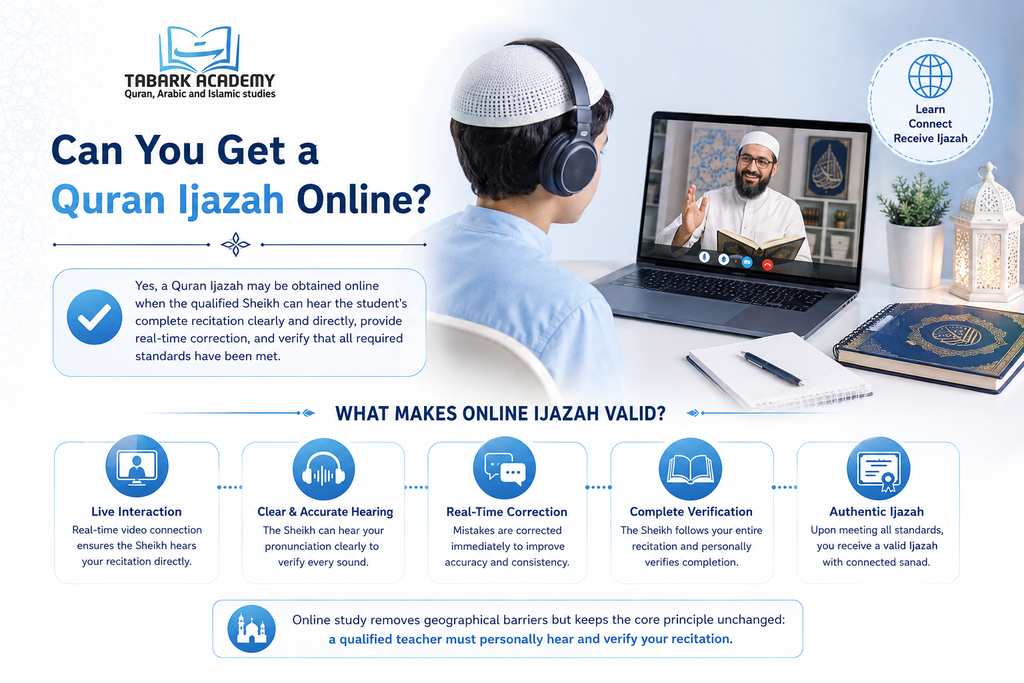
A proper online process should allow the teacher to hear pronunciation accurately, interrupt and correct mistakes, follow the student’s recitation consistently, and personally verify completion.
The attached material likewise notes that many scholars accept live video Talaqqi, while recorded submissions or asynchronous review do not provide the same direct teacher-student verification.
Online study can therefore solve the problem of geographical access without eliminating the traditional principle behind Ijazah: a qualified teacher must personally hear and verify the student’s recitation.
For students who cannot regularly travel to a qualified Sheikh, this makes structured online Ijazah study a practical option.
Ready to start your certification journey from home? Join the Online Ijazah Course at Tabarak Academy and recite live with a qualified, Sanad-connected Sheikh who can guide you step by step toward your Ijazah.

When Should You Get an Ijazah?
A Quran Ijazah is not an individual religious obligation required before every Muslim can read or learn the Quran.
It becomes particularly valuable when a student wants formal verification of advanced recitation and wishes to participate in the traditional chain of Quranic transmission.
You should consider pursuing it when your Quran recitation has reached a high standard, your Tajweed is consistently accurate, and—for a Hifz-based Ijazah—your memorization is sufficiently strong for complete recitation under a qualified Sheikh.
Do not treat Ijazah as the next automatic step simply because you have finished memorizing.
A better sequence is:
Complete → stabilize → assess → begin Ijazah.
That small distinction can significantly reduce the actual time spent in the certification stage.
Step Inside Our Virtual Classrooms
See our engaging teaching methods in action! watch real snippets of our live classes and discover how our expert instructors make learning interactive, memorable, and inspiring for every student.
Start Your Ijazah Journey With Tabarak Academy
Strengthen your recitation with structured Tajweed training and qualified teacher guidance at Tabarak Academy. Improve your Makharij, pronunciation, and practical application of Tajweed rules at a pace suited to your current level.
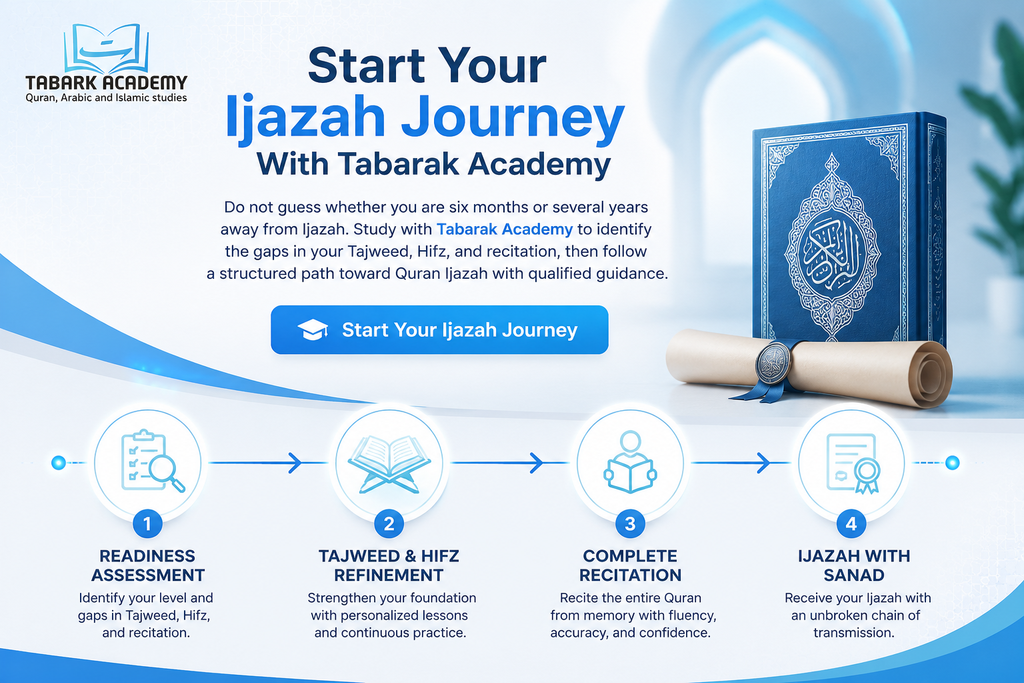
Do not guess whether you are six months or several years away from Ijazah.
Our Quran Courses
- Online Quran Classes
- Online Quran Classes for Beginners
- Online Quran Classes for Kids
- Online Quran Classes for Adults
- Online Quran Classes for Men
- Online Quran Classes for Sisters
- Quran Reading Course
- Quran Recitation Course
- Online Ijazah Course
- Online Qirat Course
- Quran for Toddlers / Young Children
- Weekend Quran Classes
- Intensive Quran Course
- Al-Azhar Quran Course
- Zoom Quran Classes
- Noor Al-Bayan Course
Conclusion
So, how long does it take to get an Ijazah? For a well-prepared student following regular lessons, approximately 6 months to one year can be a reasonable planning range, but the actual timeline depends on proficiency, lesson frequency, memorization strength, and the teacher’s required standard.
Some full Hifz Ijazah pathways may require substantially longer verification, especially when every portion of the memorized Quran must be tested and corrected carefully.
The goal should therefore never be to receive an Ijazah as quickly as possible. The goal is to reach the level at which a qualified Sheikh can confidently authorize your recitation and attach their own scholarly chain to it.
Frequently Asked Questions About the Time to Get an Ijazah
How long does it take to get an Ijazah in Quran?
A well-prepared student may complete the process in approximately 6 months to one year, although the timeline can be shorter or longer depending on Tajweed, Hifz strength, lesson frequency, and the Sheikh’s assessment.
Can I get an Ijazah in 6 months?
Yes, it may be possible for an advanced student who begins with strong Tajweed and stable memorization. Six months should not be treated as a guaranteed deadline because Ijazah is awarded for demonstrated mastery, not attendance time.
Do I need to memorize the whole Quran for an Ijazah?
For a full traditional Hifz Ijazah with connected Sanad, complete memorization and accurate recitation from memory are the established standard. Some scholars and programs distinguish other forms of recitation certification or permission, so students should confirm exactly which credential is being offered.
Can I get an Ijazah online?
Yes. Online Ijazah can be valid when a qualified Sheikh hears the student’s recitation live and clearly, provides direct correction, and verifies the complete required recitation. Recorded-only assessment is not equivalent to live Talaqqi.
What can make my Ijazah take longer?
Weak Hifz, recurring Tajweed mistakes, inconsistent attendance, inadequate revision, and beginning formal Talaqqi before you are ready can all extend the timeline. Strong preparation before starting is usually more effective than trying to rush once the Ijazah process begins.