


How to Learn Quranic Arabic – A Beginner-Friendly Guide
Learning Quranic Arabic can help you connect with the Quran and understand its words beyond translation. The best way to learn Quranic Arabic is to take a gradual approach: start with reading Arabic, build your Quranic vocabulary, learn essential grammar, and practice directly with verses from the Quran.
The best way to learn Quranic Arabic is to combine structured learning with regular practice using the Quran itself. Rather than trying to memorize large amounts of Arabic at once, focus on a few essential skills and build them gradually.
A simple learning path is to:
- Learn to read Arabic and recognize letters, vowels, and basic word patterns.
- Build Quranic vocabulary by studying frequently repeated words in context.
- Learn common Arabic roots to recognize connections between related words.
- Study essential grammar to understand how words function within verses.
- Practice with familiar surahs, starting with shorter passages and gradually moving to more complex verses.
- Review consistently through reading, listening, vocabulary practice, and verse analysis.
- Learn with qualified guidance when possible to receive correction and follow a structured curriculum.
The key is consistency. Even a short daily study session can be more effective than studying for several hours occasionally.
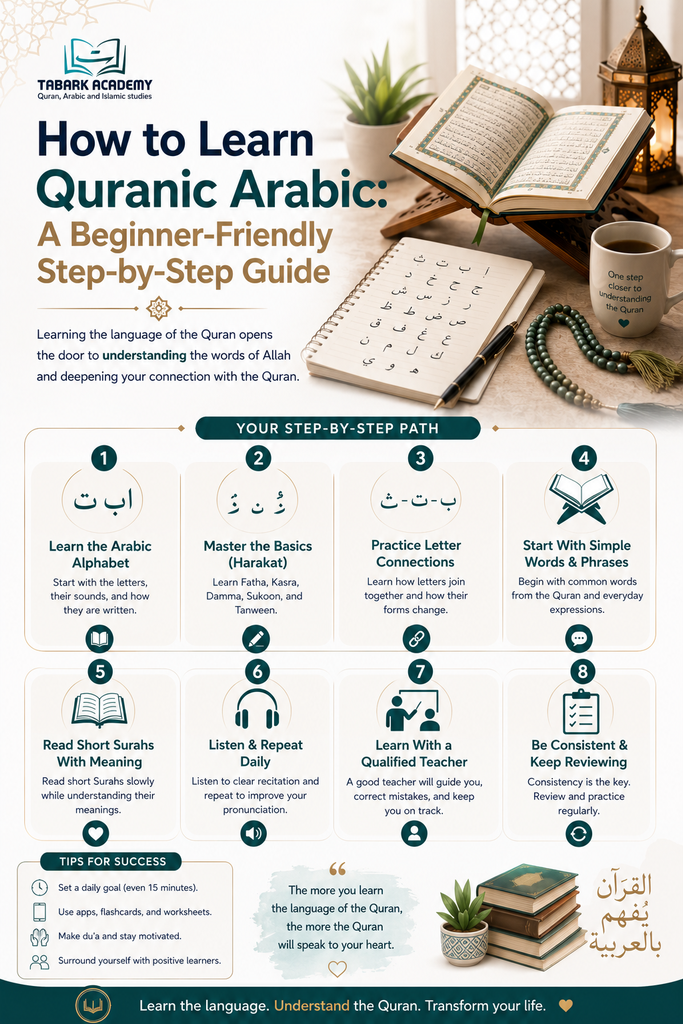
1. Learn to Read Arabic Script Before Focusing on Quranic Grammar
Start by building the ability to recognize and pronounce Arabic letters directly from the script. Learn the 28 Arabic letters, their different forms at the beginning, middle, and end of words, and how they connect.
Then practice the main Harakat Fathah (َ), Kasrah (ِ), and Dammah (ُ) before progressing to signs such as Sukoon, Shaddah, Tanween, and Madd.
At this stage, your primary goal is not to understand every word you read. Focus on developing the ability to look at an Arabic word and pronounce it without depending on transliteration.
A structured resource such as Noorani Qaida or a beginner Arabic reading course can help you progress systematically from individual letters to complete Quranic words.
2. Build Your Quranic Vocabulary With Frequently Repeated Words
Once you can read basic Arabic script, begin learning words that frequently occur in the Quran. Recognizing high-frequency vocabulary means that the same words become familiar when you encounter them in different Surahs.
Instead of memorizing long vocabulary lists without context, begin with words from Surahs you already recite. For each new word, learn its Arabic form, basic meaning, and how it is used within the Ayah.
For example, you might begin with familiar Quranic words such as رَبّ (Rabb – Lord), رَحْمَة (Rahmah – mercy), كِتَاب (Kitab – book), يَوْم (Yawm – day), and نَاس (Nas – people).
Keep a small Quranic vocabulary notebook and record words you repeatedly encounter. Regular exposure is more useful than trying to memorize hundreds of unrelated words at once.
Experience Our Interactive Learning
Curious about how we teach? Watch these brief video clips from our recent live sessions to see our structured curriculum, advanced learning platform, and dynamic student-teacher interactions firsthand.
3. Learn Common Arabic Roots to Recognize Related Quranic Words
A major advantage of studying Quranic Arabic is learning to recognize the root system behind Arabic vocabulary. Many Arabic words are built around a set of root letters, often three consonants, from which related words are formed.
For example, the root ك-ت-ب (k-t-b) is associated with writing and appears in related words such as:
كِتَاب (Kitab) – book
كَتَبَ (Kataba) – he wrote
كُتِبَ (Kutiba) – it was prescribed/written
Instead of treating each form as an entirely unrelated vocabulary item, recognizing the root helps you notice the relationship between them.
However, do not assume that knowing a root automatically gives you the exact meaning of every derived word. Word patterns, grammatical form, and Quranic context also affect meaning. Use roots as a recognition tool while continuing to learn vocabulary in context.
Read also: Learning MSA: Is It Essential to Understand the Quran?
4. Learn Essential Quranic Grammar to Understand How Words Work Together
Vocabulary tells you what individual words can mean, but grammar helps you understand how those words relate to one another inside an Ayah.
You do not need to master advanced Arabic grammar before benefiting from Quranic study. Begin with the grammatical concepts that appear repeatedly:
- Nouns, verbs, and particles: Learn to distinguish the three main categories of Arabic words and their basic functions.
- Pronouns: Recognize independent and attached pronouns so you can identify who or what a verse is referring to.
- Verb forms: Learn to recognize common past, present, and command forms before moving into more detailed verb patterns.
- Gender and number: Distinguish masculine and feminine forms as well as singular, dual, and plural nouns.
- Prepositions: Learn frequently occurring particles and how they affect the words that follow them.
- Attached endings: Notice how suffixes can indicate possession, objects, or pronouns.
- Grammatical case: Gradually study Raf’ (رفع), Nasb (نصب), and Jarr (جر) and how grammatical endings can help reveal a word’s role within a sentence.
Do not study these concepts only as abstract grammar rules. After learning each rule, find examples of it in short Quranic Ayahs you already know.
Study the Quran While You Learn Arabic
In fact, studying how to learn Quranic Arabic can help you remember vocabulary and grammar more effectively. Start with short surahs that you already know, such as Al-Fatihah or the shorter surahs of Juz’ Amma. Choose one verse at a time and follow a simple process:
- Read the verse in Arabic slowly.
- Identify words you already recognize.
- Look for new vocabulary and their meanings.
- Identify familiar roots and basic grammatical patterns.
- Read a reliable translation to confirm your understanding.
- Listen to the verse and follow along with the Arabic text.
- Review the same verse again later.
This approach turns the Quran itself into part of your learning process. Instead of studying Arabic as a separate academic subject, you continually connect new words and grammar to verses you recite and hear regularly.
Read also: How to Experience the Quran Without Knowing Arabic
How to Practice Quranic Arabic Every Day
You do not need to spend hours studying every day; a focused 20-30 minute daily routine can help you make steady progress. Try this simple study routine:
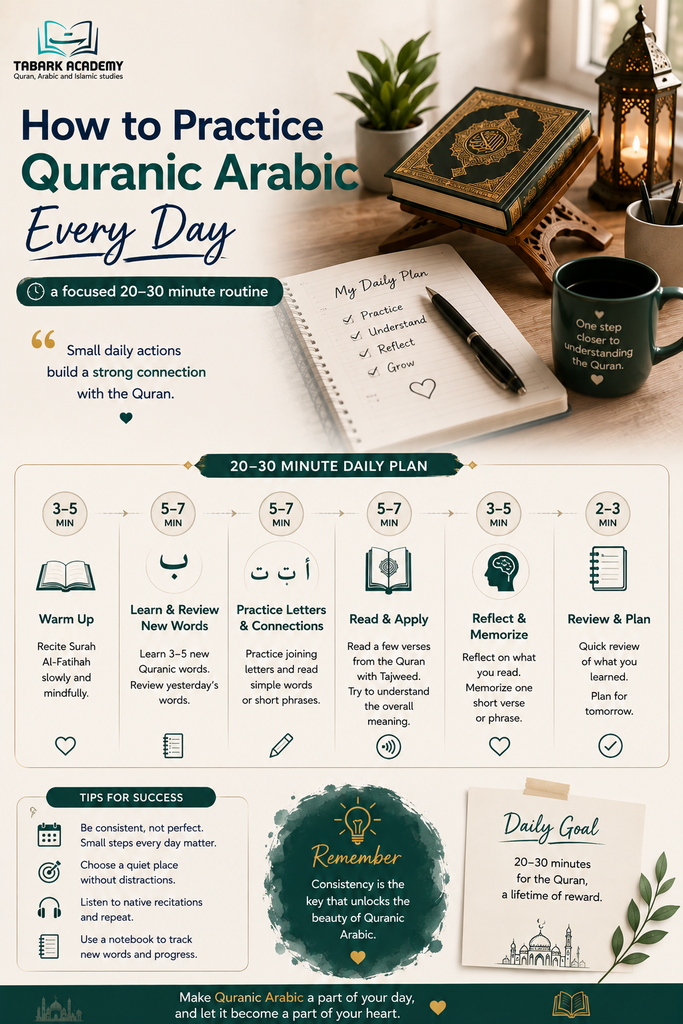
- 5 minutes: Review previously learned Quranic vocabulary.
- 5 minutes: Learn a few new words or review common Arabic roots.
- 5-10 minutes: Study one or two basic grammar concepts.
- 10 minutes: Read and analyze a short Quranic passage.
- Optional: Listen to the same verses while following the Arabic text.
Keep your routine realistic and repeatable. It is better to study for a short time every day than to study for several hours once a week and then stop.
Read also: Learn Quran Working Full-Time Without Arabic
How Long Does It Take to Learn Quranic Arabic?
There is no single timeframe for learning Quranic Arabic because progress depends on your starting level, study routine, previous Arabic knowledge, and the quality of instruction you receive. Instead of focusing only on becoming “fluent,” set smaller milestones:
- First stage: Read Arabic words and pronounce them correctly.
- Next stage: Recognize common Quranic vocabulary and expressions.
- Intermediate stage: Understand basic grammar and sentence structures.
- Progressive stage: Understand the meaning of familiar verses with less dependence on translation.
- Advanced stage: Analyze more complex vocabulary, grammar, and Quranic expressions.
Studying consistently can help you progress much faster than irregular learning. Your goal should be steady improvement rather than expecting to understand the entire Quran after a few weeks.
Read also: Quranic Arabic vs Modern Standard Arabic: What’s the Difference?
Tips for Learning Quranic Arabic Faster and More Effectively
If you want to learn Quranic Arabic tips more effectively, focus on consistency and practical application rather than trying to memorize everything quickly.
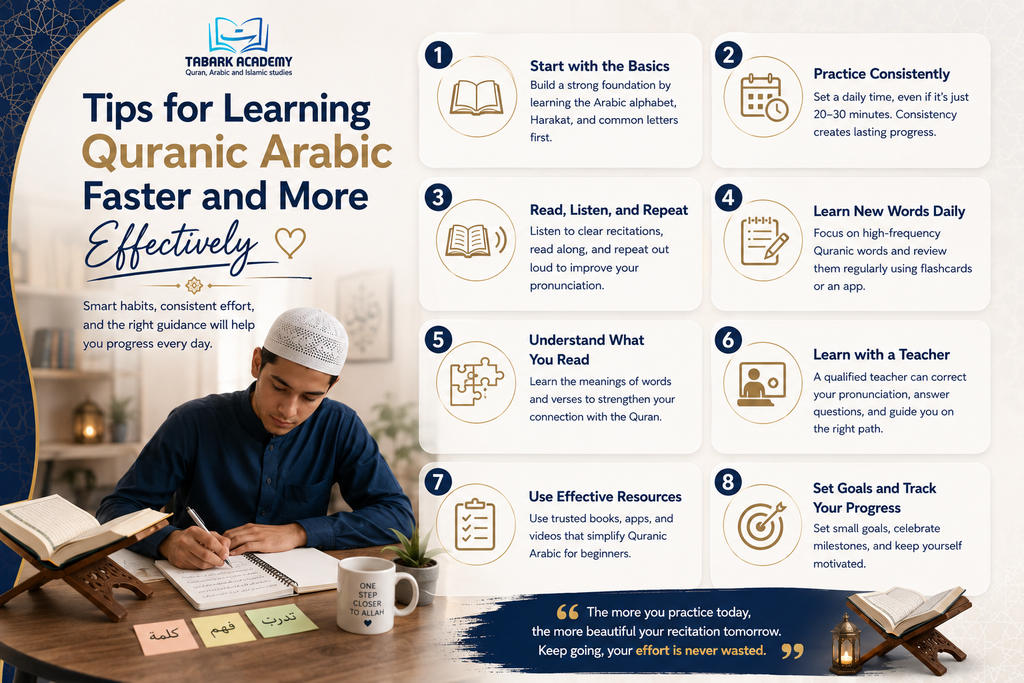
These simple learn Quranic Arabic tips can make your study sessions more productive:
- Study every day: Even a short daily session helps you retain vocabulary and grammar.
- Start with frequent words: Prioritize Quranic words that appear repeatedly instead of learning random vocabulary.
- Begin with familiar surahs: Studying verses you already recite can make new Arabic concepts easier to remember.
- Learn common roots: Recognizing related words from the same root can help you expand your vocabulary naturally.
- Practice grammar through verses: Rather than memorizing rules alone, identify grammar patterns in the Quran.
- Listen while reading: Following an authentic recitation with the Arabic text can improve pronunciation and reading familiarity.
- Use reliable learning resources: Choose materials that explain Quranic Arabic accurately and at an appropriate level for beginners.
- Get qualified guidance: A knowledgeable teacher can correct mistakes, answer questions, and help you follow a structured learning path.
Most importantly, give yourself time. The goal is not simply to memorize Arabic words but to gradually develop the ability to recognize, analyze, and understand the language of the Quran.
Step Inside Our Virtual Classrooms
See our engaging teaching methods in action! watch real snippets of our live classes and discover how our expert instructors make learning interactive, memorable, and inspiring for every student.
Learn Quranic Arabic Online with Tabarak Academy
Learning how to learn Quranic Arabic on your own is possible, but having a structured program and qualified guidance can make the journey clearer and more consistent.
Tabarak Academy provides online Quran learning for students and families who want to develop their Quran reading and learning skills from the comfort of home.
Why Choose Tabarak Academy?
- Qualified teachers: Learn with instructors who can guide you through your learning journey.
- Structured learning: Follow lessons designed to help you progress step by step.
- Online convenience: Attend Quran classes from home without the need to travel.
- Personalized guidance: Receive support based on your learning level and goals.
- Family-friendly learning: Make Quran learning easier to incorporate into your family’s routine.
Ready to start learning and take the next step toward understanding and engaging with the Quran in Arabic, here’s our courses:
- Online Hifz Program
- Juz 30 Memorization
- Hifz for Kids
- Hifz for Adults
- Hifz for Sisters
- Short Surah Memorization Course
- Hifz Ijazah Course
Conclusion
Learning how to learn Quranic Arabic is a gradual journey, and you do not need to master the entire language before you can begin understanding the Quran. Start with the Arabic script, build your vocabulary, learn essential grammar, and apply what you learn directly to familiar verses.
If you are ready to take the next step, Tabarak Academy can provide structured online Quran learning and guidance to help you build a consistent and meaningful learning journey.
Start learning today and take a step closer to understanding the Quran in its original language with Tabarak Academy.
FAQs
Do I need to know Arabic before learning Quranic Arabic?
No. Beginners can study Quranic Arabic without knowing conversational Arabic. A focused course can introduce the reading, vocabulary, and grammar skills needed to understand Quranic language.
Can I learn Quranic Arabic online?
Yes. Online courses can provide structured lessons, qualified teachers, and flexible study schedules. Choose a program that focuses specifically on your Quranic Arabic goals and provides opportunities for practice and feedback.
Is it allowed to read the Quran in transliteration?
Transliteration can be used as a temporary learning aid for someone who cannot yet read Arabic, but learners should work toward reading the Quran in its original Arabic script.
Should I learn Modern Standard Arabic or Quranic Arabic?
It depends on your goal. If your primary goal is understanding the Quran, studying Quranic Arabic directly can help you focus on the vocabulary and grammatical structures most relevant to the Quran.
Can I understand the Quran without becoming fluent in Arabic?
You can develop meaningful Quranic understanding without becoming fluent in conversational Arabic. By learning frequently used vocabulary, roots, and essential grammar and applying them to Quranic verses, you can gradually understand more of the text directly.