


How Long Does It Take To Re Memorize A Juz?
You open the Mushaf to a juz you once recited without a mistake, and by the third line the words start slipping. So, how long does it take to re memorize a juz you once knew by heart? The answer depends on a few things you can check today.
At Tabarak Academy, we meet returning memorizers every week. Some are parents who stopped after having children, some are students who paused for university, and some are reverts who memorized quickly and then got busy.
Almost all of them ask the same thing: “Did I lose it for good?” This guide gives you realistic timelines, the factors that speed up or slow down your return, and a plan that stops your juz from fading again.
Here’s what you’ll take away from this guide:
- Realistic timelines for a lightly, moderately, or fully forgotten juz.
- The factors that shorten or lengthen the time to re memorize a juz.
- A three-step plan to rebuild your juz page by page.
- A review routine that protects your hifz long after you finish.
How Long Does It Take To Re Memorize A Juz?
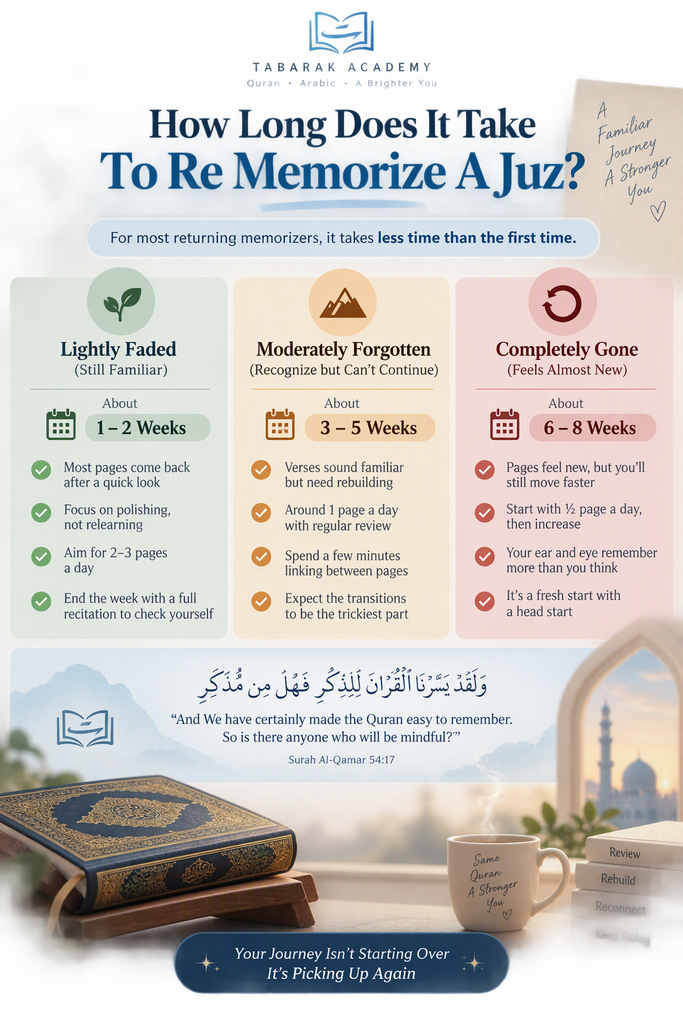
Most returning memorizers can re memorize a juz in about 2 to 6 weeks if they study 20 to 40 minutes a day. A juz that has only faded may come back in under two weeks. One that feels completely gone can take closer to two months.
A juz in the standard 604-page Madani Mushaf is about 20 pages, and you’ve already walked through every one of them. Psychologists call this head start the “savings” effect: relearning something takes less time than learning it the first time.
That’s why the answer to how long does it take to re memorize a juz is almost always “less time than before.” The range is still wide, so the three levels below will help you place yourself honestly.
1. Timeline For A Lightly Faded Juz
If you can still recite most pages once you glance at the first word, expect about 7 to 14 days. You aren’t relearning here. You’re polishing connections that are already in place.
Aim for two to three pages a day. Read each page aloud three times while looking, then recite it without looking. Mark any spot where you hesitate with a pencil so tomorrow’s session starts where you stumbled.
The biggest risk at this level is overconfidence. Many learners skim, decide they feel “fine,” and stop too soon. Finish the week by reciting the whole juz in one sitting to someone who can check you.
2. Timeline For A Moderately Forgotten Juz
If you recognize the verses when you hear them but can’t carry on alone, the answer to how long does it take to re memorise a juz is about 3 to 5 weeks. The meaning and rhythm are familiar. The exact word order is what needs rebuilding.
One page a day works well for most adults, along with a review of the previous five pages each session. Our guide How Long Does It Take To Memorize One Page Of Quran? shows that most learners need 15 to 30 minutes per page, and returning memorizers often land at the faster end.
Expect the moves from one page to the next to be your weak points. Spend the last few minutes of each session linking the final verse of one page to the first verse of the next.
Ready to get your juz back without guessing? Tabarak Academy’s Online Hifz Program starts with a level check and builds your plan around the exact pages you’ve forgotten.

3. Timeline For A Juz That Feels Completely Gone
If the pages feel almost new, give yourself about 6 to 8 weeks. You’ll still likely move faster than the first time, because your ear and eye keep traces of your original hifz.
Allah (Glorified and Exalted be He) says:
“وَلَقَدۡ يَسَّرۡنَا ٱلۡقُرۡءَانَ لِلذِّكۡرِ فَهَلۡ مِن مُّدَّكِرٖ”
“And We have certainly made the Quran easy to remember. So is there anyone who will be mindful?” Surah Al-Qamar 54:17
This verse appears four times in Surah Al-Qamar, and it speaks directly to anyone who is starting over. Allah has made His Book easy to remember, so the real question isn’t whether you can bring it back. It’s whether you’ll begin.
Start with half a page a day in the first week, then add more once you feel momentum. Think of it as a fresh start with a head start, not a failure you have to fix.
Experience Our Interactive Learning
Curious about how we teach? Watch these brief video clips from our recent live sessions to see our structured curriculum, advanced learning platform, and dynamic student-teacher interactions firsthand.
Start Your Quran Learning Journey
Join Tabark Academy today for structured online lessons with qualified tutors, customized to fit your goals.
Book Your Free Trial LessonKey Factors That Affect The Time To Re Memorize A Juz
Two people can forget the same juz and still get very different answers to how long does it take to re memorize a juz. Three factors explain most of that difference, and knowing them helps you plan without frustration.
The first is time. The second is how well you memorized in the first place. The third is your daily routine. Let’s look at each one.
1. How Long Ago You First Memorized It
The longer the gap, the more rebuilding you’ll need. A juz you last revised six months ago usually comes back in days. One you haven’t touched for ten years may need several weeks of steady work.
The Prophet Muhammad (peace be upon him) said:
“تَعَاهَدُوا الْقُرْآنَ فَوَالَّذِي نَفْسِي بِيَدِهِ لَهُوَ أَشَدُّ تَفَصِّيًا مِنَ الإِبِلِ فِي عُقُلِهَا”
“Commit yourself to the Qur’an, for by Him in whose Hand is my soul, it is surely more prone to break away than a camel in its bind.” Sahih al-Bukhari 5033
In this hadith, the Prophet (peace be upon him) compares memorized Quran to a tied camel that breaks loose the moment its owner stops watching. Forgetting after a long gap isn’t a sign of weak ability. It’s the natural result of going without regular review.
Scholars also stress that the blame lies in neglect, not in forgetting despite effort. To read the full scholarly guidance, see this IslamQA answer on the problem of forgetting the Quran.
2. How Strong Your Original Memorization Was
A juz memorized slowly, with a teacher and plenty of review, tends to come back quickly. One rushed through before a deadline often fades faster and returns more slowly, because it never took deep root.
Tajweed matters too. If you first learned with errors, you’ll need extra time to unlearn them, because fixing an ingrained mistake takes longer than memorizing correctly from the start.
If you want every word of your memorization checked with full precision, Tabarak Academy’s Hifz Ijazah Course is the natural next step. You recite from memory to an Al-Azhar certified Sheikh, who corrects each letter’s Makhraj and Tajweed rule, and it can lead to an Ijazah with a connected Sanad.

3. Your Daily Routine And Mushaf Consistency
If you want the shortest answer to how long does it take to re memorize a juz, keep your sessions daily. Twenty focused minutes every day beat two hours once a week, because each session makes your brain pull the verses back up.
Using the same printed Mushaf you first memorized from also saves time. You remember where each verse starts and which line each word sits on, and that layout is a strong cue. It’s one of the core ideas in How To Memorize Quran Fast And Never Forget: 10 Strategies.
Finally, protect your best hour. Many returning memorizers find the time after Fajr the clearest, but any regular slot with your phone out of reach will work.
Busy schedule, big goal? The Hifz for Adults Course at Tabarak Academy fits your revision around work and family, with private sessions you can reschedule without penalty.

A Step-By-Step Plan To Re Memorise A Juz Faster
Knowing how long does it take to re memorize a juz is only half the picture. The other half is a method that doesn’t waste your time.
If you’re still wondering how long does it take to re memorise a juz in your case, a clear method is what shortens the timeline. Follow these three steps in order and a vague goal becomes a daily routine you can track.
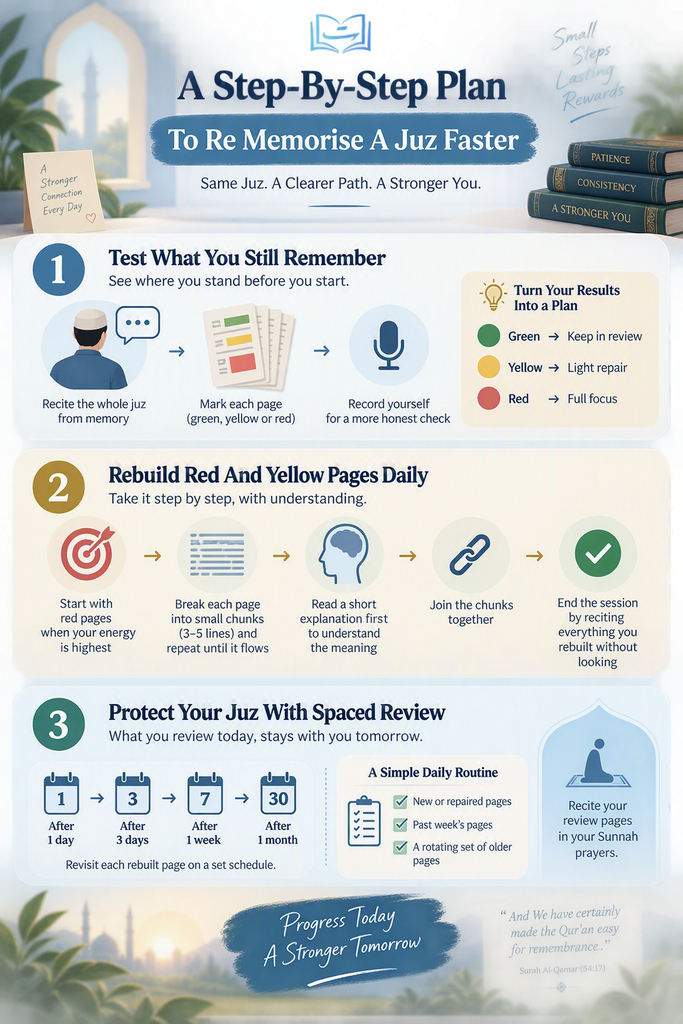
Step 1 – Test What You Still Remember
Before memorizing anything, recite the whole juz from memory, page by page. Grade each page green (solid), yellow (shaky), or red (forgotten). This takes one or two sessions and can save you weeks.
Recording yourself makes the test more honest. When you play it back with the Mushaf open, you’ll catch skipped words and small errors you’d miss while reciting.
Your color map is now your plan. Green pages go straight into review, yellow pages get light repair, and red pages get full memorization time.
Step 2 – Rebuild Red And Yellow Pages Daily
Start with red pages while your energy is highest, then move to yellow ones. Split each red page into chunks of three to five lines, repeat each chunk until it flows, then join the chunks together.
Add one step many people skip: read a short explanation of the verses before memorizing them. Once you understand what a passage says, the word order starts to feel logical instead of random.
End every session by reciting everything you rebuilt that day without looking. If you stumble, note the spot and make it the first thing you recite tomorrow.
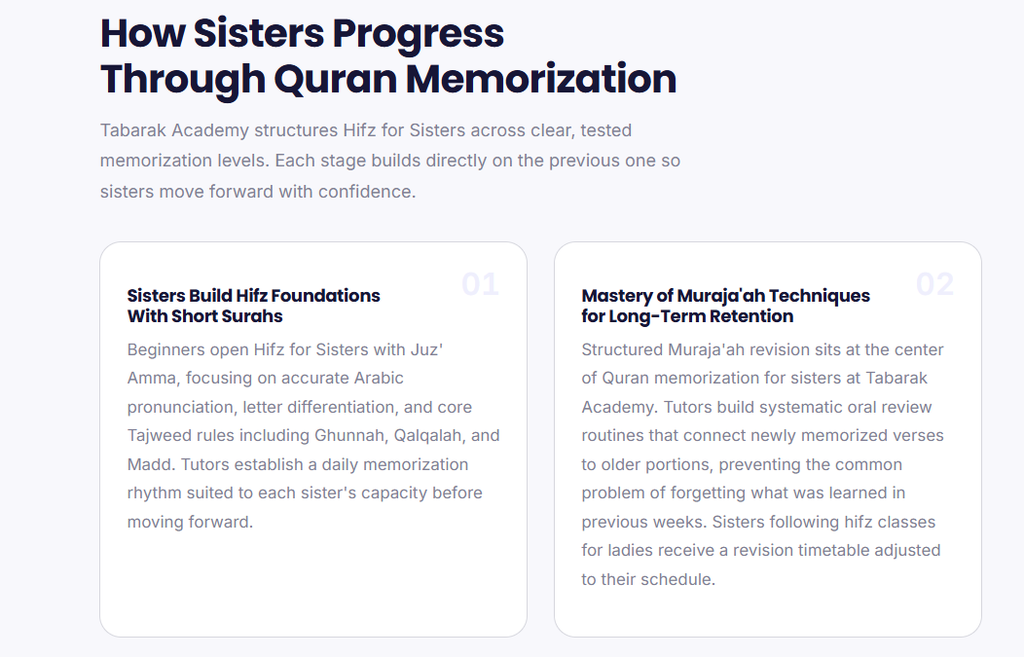
Sisters, your revision deserves a safe, focused space. Tabarak Academy’s Hifz for Sisters Course connects you with certified female Hafizat who guide every step of your return.
Step 3 – Protect Your Juz With Spaced Review
All the time you spent rebuilding a juz is lost if it fades again, so build in review from day one. Revisit each rebuilt page after one day, three days, and a week, then once a month.
Spacing your review works because each time you recite a page after a short break, your mind has to pull it back up from memory. That effort is what keeps a page firmly in memory, which is why short, spread-out sessions work better than cramming the whole juz in one weekend.
A simple daily split works well: new or repaired pages, plus the past week’s pages, plus a rotating slice of older pages. Reciting your review pages in your Sunnah prayers is one of the best ways to keep them fresh.
Tabarak Academy Helps Returning Memorizers Rebuild Their Hifz With Confidence
Whatever your answer to how long does it take to re memorize a juz, the hardest part is rarely the memorizing. It’s staying consistent once motivation dips in week two. That’s the gap Tabarak Academy was built to close.
Every hifz student here follows a three-layer Muraja’ah system: today’s pages, last week’s pages, and older sections on a monthly cycle. It’s the spaced review routine from this article, except your tutor schedules it and checks it for you.
You also won’t move forward on shaky ground. Each juz passes an assessment before you continue, and you get written monthly progress reports on your accuracy, review completion and Tajweed. You’ll always know where you stand.
Behind all of this are Al-Azhar certified tutors with verified Ijazah, backed by 25 years of Quran teaching and more than 6,800 students in 15+ countries. Every class is private and one-on-one, and female tutors are available at no extra cost.
If the juz you’re bringing back is Juz Amma, the Juz 30 Memorization Course at Tabarak Academy is a good place to start again. It covers all 37 surahs from An-Naba to An-Nas, with daily Muraja’ah and Tajweed correction built into every session.

Step Inside Our Virtual Classrooms
See our engaging teaching methods in action! watch real snippets of our live classes and discover how our expert instructors make learning interactive, memorable, and inspiring for every student.
Start Your Quran Learning Journey
Join Tabark Academy today for structured online lessons with qualified tutors, customized to fit your goals.
Book Your Free Trial LessonStart Rebuilding Your Juz With Tabarak Academy Today!
Stop wondering how long does it take to re memorize a juz and start finding out for yourself. Book a free trial class with Tabarak Academy. There’s no payment and no contract.
In your first session, a certified tutor will listen to your recitation, map which pages are solid and which need work, and give you a realistic timeline for your own juz.
Send us a message on WhatsApp or email today, and we’ll reply within 24 hours to book a time that suits your schedule. The juz you once carried in your heart is closer than you think.

Start Your Quran Learning Journey
Join Tabark Academy today for structured online lessons with qualified tutors, customized to fit your goals.
Book Your Free Trial LessonConclusion
Relearning is faster than learning from scratch. A lightly faded juz can come back in one to two weeks, a moderately forgotten one in three to five, and a juz that feels fully gone in about six to eight.
How far back you memorized it, how well you learned it, and how consistent you are now all shape your timeline. Testing yourself, rebuilding page by page, and spaced review will get you there faster.
So, how long does it take to re memorize a juz? Less time than you fear, as long as you start today and never let review slip again. Relearning is faster than learning from scratch, and with consistency, your forgotten knowledge will return sooner than you think.
Frequently Asked Questions
How Long Does It Take To Recite A Juz?
Reciting a full juz takes roughly 30 to 45 minutes at a steady pace with proper Tajweed. A fluent reader using the faster Hadr style can finish in about 20 to 25 minutes.
How Long Will It Take To Memorize Juz Amma?
Most learners memorize Juz Amma in 3 to 6 months at a few lines a day, while complete beginners may need longer. At Tabarak Academy, certified tutors set a daily target that fits your pace so you move steadily from An-Naba to An-Nas.
How To Memorize 2 Pages Of The Quran A Day?
Split each page into small chunks, memorize one page after Fajr and the second in the evening, and review yesterday’s pages before starting new ones. Tabarak Academy’s tutors turn this into a clear daily plan and check your recitation so the extra pace doesn’t cost you accuracy.
Can I Become Hafiz By Myself?
You can memorize on your own, but without a teacher it’s easy to lock in errors you never notice. Tabarak Academy pairs you with an Al-Azhar certified tutor who listens to every page and keeps your hifz accurate.
What’s The Easiest Juz?
Many learners find Juz 30 (Juz Amma) the easiest, because its surahs are short and already familiar from daily prayers. Juz 29 often comes next, since it is also made up of shorter surahs with a steady rhythm.