


How To Pronounce The Arabic Letter Ain (ع) – A Complete Tajweed Guide
Have you ever paused mid-recitation because the letter ع suddenly sounded like a strained cough instead of a clear Arabic sound? You are not alone.
Learning how to pronounce the Arabic letter ain correctly is one of the biggest hurdles for non-native Quran learners, and it is also one of the most misunderstood letters in Tajweed.
This guide explains the best way to pronounce the Arabic letter ain using the classical Tajweed description of its makhraj (point of articulation) and sifaat (characteristics).
You will find step-by-step pronunciation instructions, the most common mistakes learners make, and real Quranic examples to practice with.
By the end of this article, you will have practical, actionable tips to pronounce the Arabic letter ain with confidence, and you will understand exactly why this single letter carries so much weight in correct Quran recitation.
1. Locate The Makhraj In The Middle Of The Throat
The makhraj of ain is wasat al-halq, the middle of the throat. This middle zone sits between the two other throat regions, which is why the sound of ain requires its own deliberate practice to get right.
The middle of the throat is neither as narrow as the deepest part of the throat (aqsa al-halq, where hamza and haa/هـ are produced) nor as open as the area closest to the mouth (adna al-halq, where ghain and khaa are produced).
Because this middle zone has a moderate width, the sound of ain naturally comes out moderate too: it begins with a very slight stop, then releases a small amount of airflow before the tongue and throat return to rest.
2. Apply Jahr (Voicing) When You Pronounce Ain
Jahr means the breath is withheld rather than released freely when the letter is pronounced. Ain is classified as majhoor (voiced) in Tajweed, so your breath should stay held back at the moment of articulation, not flow out through the throat.
This is the characteristic most learners lose first, since it is easy to let air slip through once the throat relaxes. Practicing jahr on its own, holding the sound of ain for a moment before releasing, helps train this control.

3. Keep It Mutawassit (Medium) Between Shiddah and Rakhawah
Tawassut means the sound of ain is neither fully blocked (shiddah, a hard stop) nor fully released (rakhawah, a completely open flow). This medium quality comes directly from the moderate width of ain’s makhraj in the middle of the throat.
Give the letter a timing that sits exactly between these two extremes. If you cut it off too sharply, it turns into a hard stop; if you let it flow too long, it loses its Tajweed character entirely.
Watch a real practical tajweed session:
Introduction to Warsh Recitation | Advanced Tajweed Lesson
4. Keep the Tongue Low and Relaxed
Istifal means the body of the tongue stays low in the mouth, and infitah means the tongue separates from the roof of the mouth rather than pressing against it. Together, these two characteristics are why ain is pronounced with a light (raqiq) tongue posture by default.
Ain also carries the sifah of ismaat, meaning it cannot be pronounced quickly in succession with ease, since its articulation point sits far from the tip of the tongue. Keep the tongue relaxed and unhurried while producing the sound.
Read also: How To Learn Arabic Language?
Experience Our Interactive Learning
Curious about how we teach? Watch these brief video clips from our recent live sessions to see our structured curriculum, advanced learning platform, and dynamic student-teacher interactions firsthand.
5. Avoid Over-Tightening the Throat and Common Mistakes
Squeezing the throat too hard produces a pressed, exaggerated sound known as asr al-ain, instead of the natural medium articulation ain requires. Draw the jaw back slightly to narrow the throat without pressing it shut.
Watch out for these frequent errors as you practice:
- Adding tension that sounds like shaddah: forcing the letter out in a way that resembles gagging rather than a clean, medium articulation.
- Wrongly making ain heavy (tafkheem): this often happens when ain is followed by a heavy letter or an alif, such as in “فَعَقَرُوهَا” (Surah Ash-Shams, 91:14). Ain should stay light by default because of its istifal characteristic.
- Elongating ain when it should be short: stretching a sakin or shaddah ain, for example in “يَعْلَمُونَ”, breaks its required medium timing.
- Dropping the damma to a kasra at the start of a word: in “وَعُيُونٍ”, some reciters shift the ain to a kasra sound because it feels easier to pronounce, instead of preserving the damma.
- Sliding into imalah (leaning the vowel): over-softening ain before an alif, as in “الْعَالَمِينَ”, can cause the sound to lean unnaturally instead of staying a clear, open fatha.
- Mixing in ghunnah (nasal resonance): letting the sound of ain escape through the nose rather than the throat is a distinct and avoidable error.
Because these mistakes are subtle and hard to hear in your own voice, working with a live teacher makes a real difference. Tabarak Academy pairs learners with certified Quran tutors who can identify these exact errors during recitation and guide the correction in the moment, rather than leaving you to guess.
Read also: How to Pronounce Haa vs. Khaa in Arabic Correctly

6. Practice With Real Quranic Examples and Get Feedback
Reading the rules is not enough on its own; ain needs repeated practice on real words until the sound becomes automatic. Use the tips below, then work through the Quranic examples that follow.
- Practice minimal pairs: repeat ain and haa (هـ) back to back so your ear learns to distinguish the two sounds.
- Record your recitation and compare it against a qualified reciter to check whether your ain becomes too heavy or loses its medium timing.
- Slow down deliberately on any word containing a doubled or repeated ain, since repeated throat letters are naturally harder to articulate clearly.
- Get feedback from a certified Tajweed teacher, since self-correction alone rarely catches every subtle mistake.
Tabarak Academy pairs learners with certified Quran tutors who can identify these exact errors during recitation and guide the correction in the moment, rather than leaving you to guess.

Practice Ain (ع) With These Quranic Examples
The examples below let you practice ain in different positions: next to another throat letter, next to a heavy letter, and inside a common, frequently repeated word.
1. Surah Aal-Imran (3:185)
Begin with this Ayah to practice producing Ain clearly within a short, familiar word. Focus on keeping the sound controlled as you move from Ain into the following letters without adding pressure or extending the sound unnecessarily.
فَمَن زُحْزِحَ عَنِ النَّارِ وَأُدْخِلَ الْجَنَّةَ فَقَدْ فَازَ
“Whoever is drawn away from the Fire and admitted to Paradise has truly succeeded.” Here, ain in “عَنِ” gives you a chance to practice a clean, moderate release of the letter from the middle of the throat. Aal-Imran 3:185
Read also: An Easy Step-by-Step Guide to Reading the Quran in Arabic
2. Surah An-Nisa (4:46)
This Ayah gives you another sound environment for Ain, making it useful for practicing the transition between Ain and the letters around it. Pay attention to maintaining Ain’s distinct articulation and medium sound flow throughout the word.
وَاسْمَعْ غَيْرَ مُسْمَعٍ
“And hear, may you not be made to hear.” The ain here is followed by a rakhawah (fully flowing) letter, which makes it a useful drill for keeping ain’s medium timing instead of letting the sound flow completely. An-Nisa 4:46 on
3. Surah Al-Fatiha (1:2)
This familiar Ayah is especially useful because it lets you practice Ain in a word you are likely to recite frequently. Here, the main goal is to preserve the natural quality of Ain as you move directly into the following Alif.
الْحَمْدُ لِلَّهِ رَبِّ الْعَالَمِينَ
“All praise is due to Allah, Lord of the worlds.” The ain in “الْعَالَمِينَ” sits directly before an alif, which is exactly the position where learners most often mistakenly add unnecessary heaviness (tafkheem) to the letter. Al-Fatiha 1:2
Read also: Understanding the Count of Makharij in Arabic Phonetics
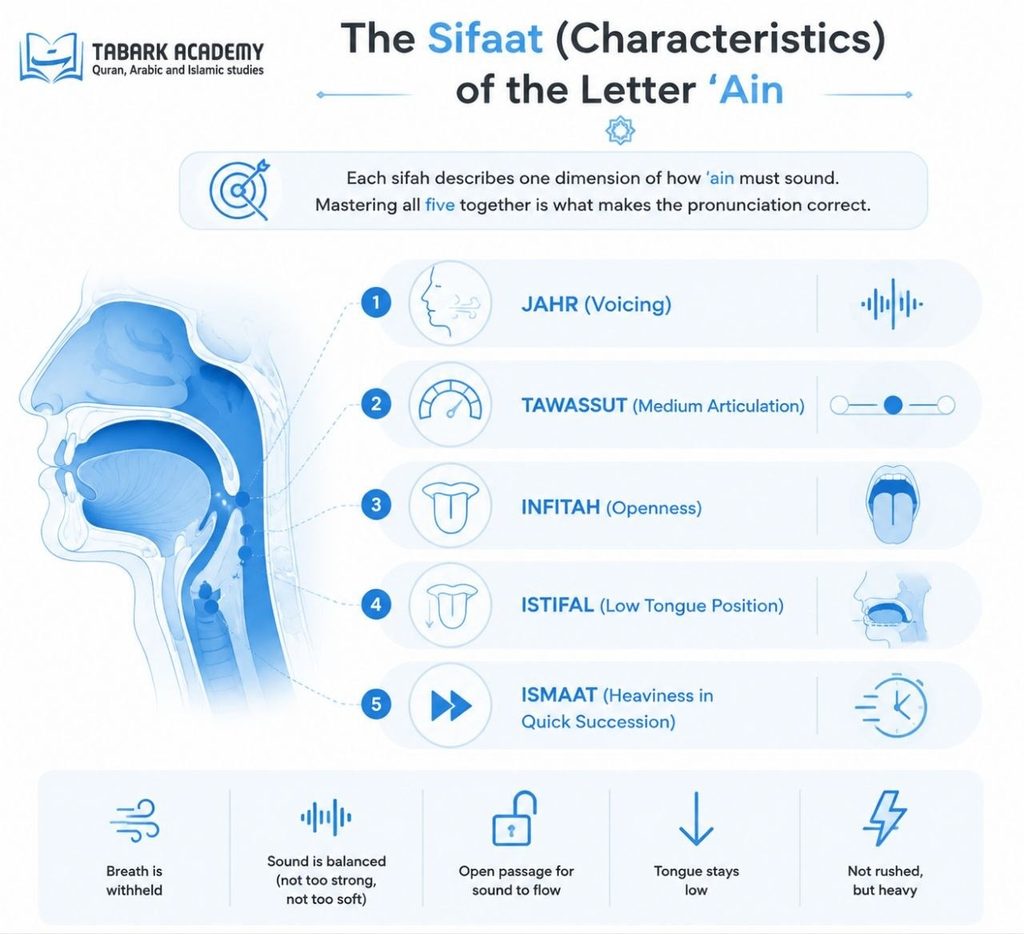
The Five Sifaat That Define the Correct Sound of Ain
Each Sifah contributes something specific to the pronunciation of Ain. Correct pronunciation depends on combining all five qualities rather than focusing only on its articulation point.
- Jahr: Keep the sound voiced rather than allowing excessive breath to escape.
- Tawassut: Give Ain a medium sound duration—neither completely stopped nor continuously flowing.
- Infitah: Keep the tongue separated from the roof of the mouth.
- Istifal: Keep the tongue low so Ain retains its naturally light quality.
- Ismaat: Recognize that Ain is not a letter produced easily in rapid succession because of its deeper articulation point.
At Tabarak Academy, certified tutors listen to your recitation in real time and correct the exact moment your ain drifts toward haa or becomes too heavy, which is difficult to catch on your own.
Read also :Arabic Haa Pronunciation Guide: ه vs. ح Explained

Step Inside Our Virtual Classrooms
See our engaging teaching methods in action! watch real snippets of our live classes and discover how our expert instructors make learning interactive, memorable, and inspiring for every student.
Book Your Free Trial Class
Reading about Tajweed rules is useful, but hearing your own ain corrected in real time is what actually changes your recitation. Tabarak Academy offers one-on-one online Quran classes with certified, ijazah-holding tutors for children, adults, and families around the world, with flexible scheduling to fit your time zone.
Our Tajweed Courses
- Online Tajweed Classes
- Tajweed Course for Beginners
- Tajweed Course for Kids
- Tajweed Course for Adults
- Tajweed Course for Sisters
- Advanced Tajweed Course
- Amali (Practical) Tajweed Course
- Learn Quran with Tajweed
- Learn Quran with Tajweed for Kids
- Learn Quran with Tajweed for Sisters
Book a free trial class today and let a certified Tabarak Academy tutor listen to your pronunciation of ain and guide you toward the correct sound, step by step.

Key Takeaways on Pronouncing Ain Correctly
The Arabic letter ain is articulated from the middle of the throat and carries five defining characteristics: jahr, tawassut, infitah, istifal, and ismaat.
Understanding how to pronounce the Arabic letter ain means applying all five together, not just imitating the sound by ear.
The most reliable way to pronounce the Arabic letter ain correctly is to isolate it from haa (ح) and haa (هـ), keep its timing medium rather than short or long, and avoid adding unnecessary heaviness or nasal resonance.
Practicing with real Quranic examples, and getting feedback from a certified teacher, is the fastest way to fix the common mistakes covered in this guide.
FAQs
Is ain the hardest Arabic letter to pronounce?
Ain is widely considered one of the more challenging letters for non-native speakers because its makhraj, the middle of the throat, does not exist as a distinct articulation point in most other languages. With focused practice and feedback from a teacher, learners can master it.
Can non-Arabic speakers learn to pronounce ain correctly?
Yes. Non-Arabic speakers can learn to pronounce ain correctly with consistent practice, exposure to qualified reciters, and direct feedback from a certified Tajweed teacher who can catch subtle mistakes the learner cannot hear in their own voice.
Why does ain sometimes sound heavy (mufakham)?
Ain is naturally a light (raqiq) letter due to its istifal characteristic, but learners often add unnecessary heaviness when ain is followed by a heavy letter or an alif, such as in “فَعَقَرُوهَا” or “الْعَالَمِينَ”.
The letter itself should stay light unless the surrounding context in that specific word calls for it.
How long does it take to master the pronunciation of ain?
The time needed varies by learner, but consistent practice combined with regular correction from a certified Tajweed teacher typically produces noticeable improvement within a few weeks of focused sessions.