

How Many Makharij Are There in Arabic?
How many makharij are there in Arabic? Ask any qualified Tajweed teacher, and you will get an answer rooted in more than a thousand years of scholarly agreement: seventeen.
Every letter recited in the Qur’an leaves the mouth, throat, or nasal cavity from a specific, identifiable point, and learning these points the makharij al-huruf is the foundation of correct Quranic pronunciation.
Every Arabic letter has one, and some letters share a makhraj with one or two others.
There are Two Types of Makharij:
- A muhaqqaq, or precise makhraj, relies on a specific point of contact between two articulators, such as the tongue and the palate, or the two lips.
- A muqaddar, or estimated makhraj, has no fixed point of contact at all; this second type applies only to al-jawf, the region that produces the three long vowel letters.
What You Will Learn
- The exact number of makharij scholars agree on, and why three different opinions exist.
- The five general regions of the mouth, throat, and nose where Arabic letters are produced.
- A full breakdown of all seventeen specific makharij, with accurate Qur’anic examples for each region.
- A practical technique for finding any letter’s makhraj yourself, in under a minute.
- Where to get live, one-on-one feedback on your makharij from a certified Quran teacher.
How Many Makharij Are There in Arabic?
Makharij al-huruf are the seventeen points inside the mouth, throat, and nasal cavity from which the letters of the Qur’an are articulated, according to the view held by the majority of reciters and grammarians, including Al-Khalil ibn Ahmad and Ibn al-Jazari.
This seventeen-point view is the standard taught in Tajweed classes worldwide, including at Tabarak Academy, and it is the framework used throughout the rest of this article.

a. Scholars Differ on Whether There Are 14, 16, or 17 Makharij
Classical scholars of Arabic phonetics did not fully agree on how many exit points the language’s letters require, mainly because a few letters sit very close together physically.
Three positions emerged from this disagreement, and understanding them helps explain why you may see the number 14, 16, or 17 in different Tajweed books.
b. The Majority of Tajweed Scholars Recognize 17 Makharij
The majority of Qur’an reciters, along with the linguist Al-Khalil ibn Ahmad and the Tajweed authority Ibn al-Jazari, held that Arabic has seventeen makharij.
Ibn al-Jazari summarized this directly in his famous didactic poem: “Makharij al-huruf sab’ata ‘ashar, ‘ala alladhi yakhtaruhu man ikhtabar” “The makharij of the letters are seventeen, according to what the experienced have chosen.”

c. Sibawayh and Al-Shatibi Counted 16 Makharij Instead of 17
The grammarian Sibawayh and the scholar Al-Shatibi counted sixteen makharij by removing al-jawf (the oral-throat cavity) as an independent region.
In their view, the long-vowel letters produced there were instead distributed among nearby makharij the elongated alif joined the hamzah’s point in the throat, the elongated ya joined the middle-tongue letters, and the elongated waw joined the lip letters.
d. Al-Farra and Qutrub Counted Only 14 Makharij
The grammarians Al-Farra and Qutrub went a step further and counted only fourteen makharij. Like Sibawayh, they removed al-jawf as a separate region, and they also merged the lam, noon, and raa three letters produced at the tip of the tongue into a single shared exit point instead of three. Neither of these two minority views is used in mainstream Tajweed instruction today.
How to Find a Letter’s Makhraj Yourself
You can locate any letter’s makhraj by adding a vowelled hamzat al-wasl before it, making the target letter silent (sakin) or doubled (mushaddad), and pronouncing the combination slowly.
Wherever the airflow or sound stops is the letter’s makhraj. For example, saying “ab” shows that the baa is produced at the two lips, while saying “an” shows that the noon is produced at the tip of the tongue against the upper gum ridge.
Watch a real life at our academy:
The Five General Points of Articulation
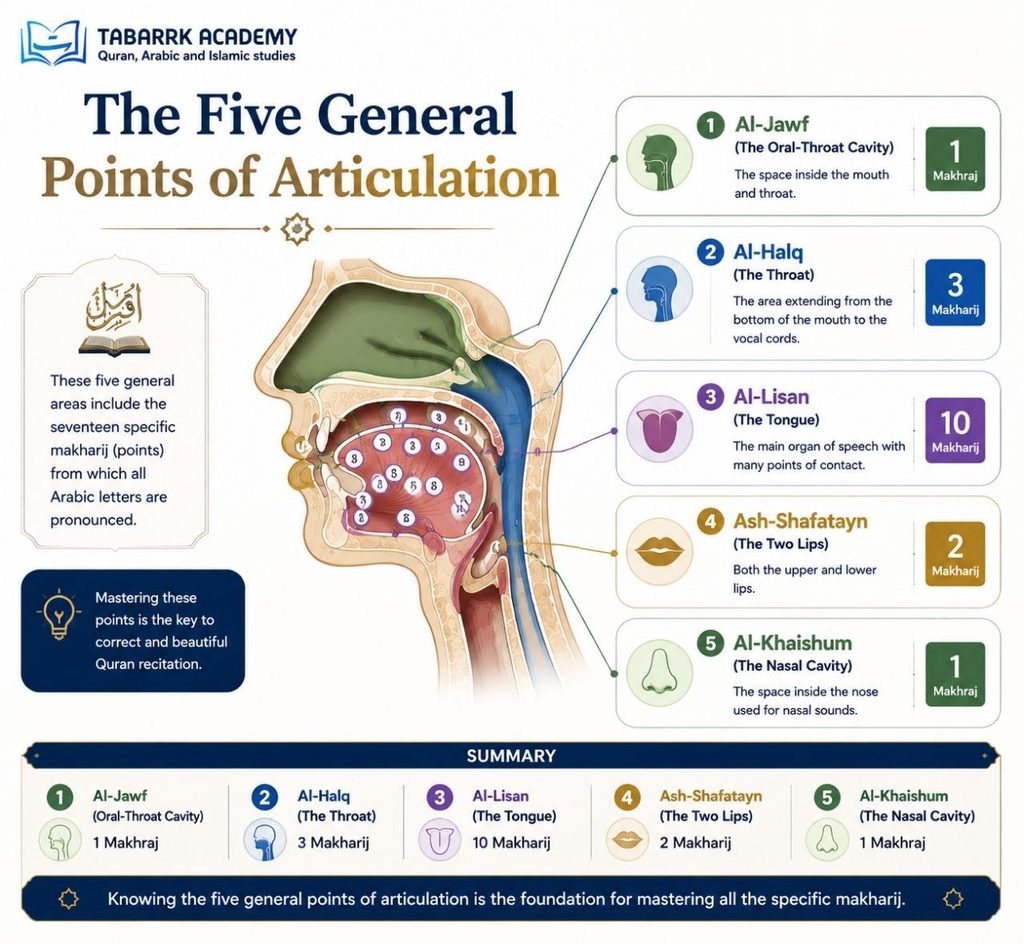
The seventeen detailed makharij are not scattered randomly; they fall into five general regions, moving from deep inside the body outward to the lips. Recognizing these five regions first makes the seventeen individual points much easier to remember.
1. Al-Jawf (The Oral-Throat Cavity) One Makhraj
Al-jawf is the open cavity spanning the throat and the mouth, and it produces the three long vowel sounds of Arabic: the elongated alif preceded by a fatha, the elongated waw preceded by a damma, and the elongated ya preceded by a kasra.
These letters have no fixed point of contact, which is why al-jawf is classified as a muqaddar, or estimated, makhraj.
“In the name of Allah, the Entirely Merciful, the Especially Merciful.”
Surah Al-Fatiha
In this opening verse, the alif of “الرَّحْمَٰنِ” and the ya of “الرَّحِيمِ” are both elongated madd letters produced from al-jawf, alongside the meem and baa produced at the lips.
Read also: Easy Tajweed Rules to Learn First
2. Al-Halq (The Throat) Three Makharij
The throat produces six letters from three separate points, moving from deep inside the chest toward the mouth. The deepest point, aqsa al-halq, produces the hamzah and haa.
The middle of the throat, wasat al-halq, produces the ʿayn and haa (ح). The point nearest the mouth, adna al-halq, produces the ghayn and khaa.
“[All] praise is due to Allah, Lord of the worlds.”
Surah Al-Fatiha
Here, the haa (ح) of “الْحَمْدُ” and the ʿayn of “الْعَالَمِينَ” both originate from the middle of the throat, illustrating wasat al-halq clearly.
3. Al-Lisan (The Tongue) Ten Makharij
The tongue is the busiest articulator in Arabic pronunciation, containing ten separate Makharij that produce eighteen letters, more than any other articulation region.
The easiest way to understand these Makharij is to follow the tongue naturally from the back toward the middle, edges, and tip, noticing how small changes in position produce different groups of Arabic letters.
The Back and Middle of the Tongue
At the back of the tongue, Qaf (ق) is produced from the farthest part against the soft palate, while Kaf (ك) is articulated slightly forward from it. Their Makharij are close, but Qaf should sound deeper while Kaf is produced from a more forward position.
Moving toward the center, Jim (ج), Shin (ش), and the non-elongated Ya (ي) are produced from the middle of the tongue as it approaches the hard palate.
These positions form the first part of the tongue’s articulation map, moving gradually from its deepest point toward the center.
The Edges and Tip of the Tongue
The side of the tongue plays an important role in producing Dad (ض), which emerges when one or both edges of the tongue meet the upper molars. Lam (ل) is produced farther forward, from the edge of the tongue near its tip against the gum ridge behind the upper front teeth.
The remaining Makharij are concentrated around the tongue tip and teeth. Nun (ن) and Ra (ر) each have closely positioned but distinct articulation points near the upper gum ridge.
Ta (ط), Dal (د), and Ta (ت) are produced from the tongue tip near the roots of the upper front teeth, while Dha (ظ), Dhal (ذ), and Tha (ث) involve the tip of the tongue at the edges of the upper incisors.
Finally, Sad (ص), Zay (ز), and Sin (س) are articulated toward the front of the mouth near the lower incisors.
Together, these back, middle, edge, and tip positions account for the ten specific Makharij of Al-Lisan.
Practice the Tongue Makharij With Surah Al-Fatihah
After learning where the tongue letters originate, the next step is to practice several of them together during continuous Quran recitation. Surah Al-Fatihah provides a useful example because its final Ayah contains several letters produced from different parts of the tongue.
صِرَاطَ الَّذِينَ أَنْعَمْتَ عَلَيْهِمْ غَيْرِ الْمَغْضُوبِ عَلَيْهِمْ وَلَا الضَّالِّينَ
“The path of those upon whom You have bestowed favor, not of those who have evoked [Your] anger or of those who are astray.” Surah Al-Fatihah, Ayah 7
This single verse provides practice with several tongue letters, including Sad and Ta in صِرَاطَ, Dhal in الَّذِينَ, Nun in أَنْعَمْتَ, and Dad in الضَّالِّينَ. Instead of immediately repeating the entire Ayah, isolate the words containing the target letters first:
Then return to the complete Ayah and try to preserve the same articulation while reciting naturally.
Read also: How to Pronounce Dhad Correctly (ض): Step-by-Step
Compare Qaf and Kaf to Practice Two Neighboring Tongue Makharij
Qaf and Kaf deserve additional practice because their articulation points are close to one another at the back of the tongue. Comparing them inside familiar Quranic words can help you feel the difference in tongue position.
For Qaf, recite:
“Say, ‘He is Allah, [who is] One.’” Surah Al-Ikhlas, Ayah 1
Then compare it with the Kaf in:
“It is You we worship, and You we ask for help.”Surah Al-Fatihah, Ayah 5
The Qaf in قُلْ and the two occurrences of Kaf in إِيَّاكَ demonstrate how two letters can originate from neighboring areas while still requiring distinct articulation.
4. Ash-Shafatayn (The Two Lips) Two Makharij
The two lips are responsible for two makharij and four letters in total. The faa is produced where the inner lower lip meets the tips of the upper front teeth.
The remaining three letters come from both lips together: the baa when the lips fully close, the meem when the lips close with added nasal resonance, and the non-elongated waw when the lips round and open slightly.
“Say, “I seek refuge in the Lord of daybreak.””
Surah Al-Falaq, Ayah 1
The faa of “الْفَلَقِ” and the baa of “بِرَبِّ” both come from the lip region, though from two different points within it.
5. Al-Khaishum (The Nasal Cavity) One Makhraj
Al-khaishum is the nasal passage, and it is responsible for the ghunnah, the nasal resonance that must accompany the noon and meem in specific Tajweed rulings, including idgham, ikhfa, and iqlab, as well as any doubled (mushaddad) noon or meem.
“Indeed, We have granted you, [O Muhammad], al-Kawthar.”
Surah Al-Kawthar, Ayah 1
The doubled noon in “إِنَّا” must be held with a clear two-count nasal ghunnah from al-khaishum a rule that is easy to read about but genuinely difficult to self-correct without a teacher listening in real time.
Reading about the makharij is a useful starting point, but Tajweed is ultimately a skill of the ear and the tongue, not just the eye.
Structured practice with a certified teacher the kind offered in Tabarak Academy’s live, one-on-one online Quran classes helps learners hear the difference between similar letters, such as the taa and the emphatic taa, in real time rather than guessing from a description.

Letters like the dhad and the dhaa are notoriously difficult for non-Arabic speakers to tell apart by ear alone, which is exactly the kind of correction that personalized Tajweed sessions with Tabarak Academy are designed to provide, alongside a structured curriculum for children, adults, and families.

Step Inside Our Virtual Classrooms
See our engaging teaching methods in action! watch real snippets of our live classes and discover how our expert instructors make learning interactive, memorable, and inspiring for every student.
Start Correcting Your Makharij with a Certified Teacher
Learning that there are seventeen makharij in Arabic is only the first step; hearing your own recitation corrected letter by letter is what turns that knowledge into a lasting skill.
Tabarak Academy connects Quran learners of all ages, anywhere in the world, with certified teachers for live, one-on-one Tajweed and Quran recitation classes built around each student’s pace and goals.
Book a free trial class with Tabarak Academy today and start correcting your makharij with expert, real-time guidance.

Our Tajweed Courses
- Online Tajweed Classes
- Tajweed Course for Beginners
- Tajweed Course for Kids
- Tajweed Course for Adults
- Tajweed Course for Sisters
- Advanced Tajweed Course
- Amali (Practical) Tajweed Course
- Learn Quran with Tajweed
- Learn Quran with Tajweed for Kids
- Learn Quran with Tajweed for Sisters
Conclusion
So, how many makharij are there in Arabic? According to the majority of scholars, including Ibn al-Jazari and Al-Khalil ibn Ahmad, the answer is seventeen, distributed across five general regions: al-jawf, al-halq, al-lisan, ash-shafatayn, and al-khaishum.
Sibawayh and Al-Shatibi counted sixteen, and Al-Farra and Qutrub counted fourteen, but the seventeen-makhraj view remains the standard taught in Tajweed instruction today.
The take-away message is simple: knowing how many makharij are there in Arabic, and precisely where each one sits, gives you the anatomical map you need to recite the Qur’an letter by letter, exactly as it was revealed.
Pair that map with regular practice and guided, live feedback, and steady improvement in your recitation will follow.
Frequently Asked Questions
How many makharij does the letter noon have?
The noon has one primary makhraj at the tip of the tongue against the upper gum ridge. It also involves al-khaishum, the nasal cavity, whenever a Tajweed rule such as ghunnah, idgham, ikhfa, or iqlab applies to it.
What is the difference between makharij and sifat?
Makharij refers to where a letter is produced the specific point in the mouth, throat, or nose. Sifat refers to how a letter is produced its qualities, such as heaviness, lightness, breathiness, or emphasis. Both are needed for fully correct Tajweed.
Which makhraj is hardest for non-Arabic speakers?
Most learners find the tongue-edge letter dhad the hardest to isolate, since it has no close equivalent in most other languages and is easily confused with the tongue-tip letter daal. Regular, guided repetition with a teacher is the most reliable way to correct it.
Are the seventeen makharij agreed upon by all scholars?
No. Seventeen is the majority opinion, held by Al-Khalil ibn Ahmad, Ibn al-Jazari, and most Qur’an reciters. Sibawayh and Al-Shatibi counted sixteen by removing al-jawf, and Al-Farra and Qutrub counted fourteen by also merging the lam, noon, and raa into one point.
Do I need to memorize all seventeen makharij before I start reciting?
No. Many students begin reciting with a teacher’s live correction and absorb the makharij gradually through practice, rather than memorizing the full list first.
Structured Tajweed lessons, such as those offered at Tabarak Academy, typically introduce the makharij region by region alongside real recitation.