


Ratio Of New Hifz To Revision – A Quran Memorization Plan
How much of your daily Quran memorization time should go toward new verses, and how much should you spend reviewing what you already know?
For many Hifz students, finding the right ratio of new Hifz to revision is the difference between steady progress and repeatedly relearning old lessons.
A practical starting point is to dedicate 20–30% of your daily effort to new memorization and 70–80% to revision. This is a flexible guideline, not a fixed religious requirement; your ideal balance depends on your current memorization, retention, available time, and teacher’s assessment.
In this guide, you will learn how to organize your daily Hifz routine, adjust the balance for children and adults, recover forgotten portions, and build a sustainable revision system. You will also find practical examples and guidance for working with a qualified Quran teacher.
Take Away — What You Will Learn
- How to use the 20–30% new Hifz and 70–80% revision guideline.
- Why revision should increase as your memorized portion grows.
- How to plan daily and weekly review for children and adults.
- When to reduce new memorization and strengthen weak portions.
- How a qualified teacher can support your Tajweed, recitation, and Hifz progress.

Ratio of New Hifz to Revision
The ratio of new Hifz to revision describes how you divide your available Quran study time and effort between memorizing new verses and strengthening previously memorized passages. For a sustainable routine, revision should receive the larger share.
A useful starting point is 20–30% for new Hifz and 70–80% for revision. For example, in a 60-minute session, you might spend 15 minutes learning new verses and 45 minutes reviewing earlier memorization.
This approach supports accurate recall and helps prevent the common problem of accumulating new pages while older portions become difficult to recite. The exact ratio should change as your memorized Quran grows.
Why Revision Should Receive More Time
Memorizing a verse is only the beginning of the learning process. Repeated retrieval, accurate recitation, and correction help strengthen your ability to recall it later without looking at the Mushaf.
The Prophet Muhammad ﷺ encouraged Muslims to regularly maintain their relationship with the Quran, as narrated in Sahih al-Bukhari 5033. The Prophet (ﷺ) said, “Commit yourself to the Qur’an, for by Him in whose Hand is my soul, it is surely more prone to break away than a camel in its bind.
“ تَعَاهَدُوا الْقُرْآنَ فَوَالَّذِي نَفْسِي بِيَدِهِ لَهُوَ أَشَدُّ تَفَصِّيًا مِنَ الإِبِلِ فِي عُقُلِهَا ”.
Revision also allows you to correct Tajweed mistakes, distinguish similar verses, and improve fluency. A student who reviews carefully can make meaningful progress even when the amount of new memorization is small.

How Much New Hifz Should You Memorize Daily?
New memorization should be based on what you can retain accurately, not on a target that looks impressive. A beginner may start with a few lines, while a more experienced student may manage half a page or one page.
If your previous lessons are weak, reduce the new portion temporarily. A smaller, well-established lesson is more useful for long-term Hifz than a larger portion that requires frequent relearning.
| Student stage | Example new Hifz target |
| Beginner | A few lines or a short passage |
| Developing student | Quarter to half a page |
| Experienced student | Half a page to one page, if retention is strong |
These are illustrative targets, not mandatory amounts. Your teacher can help determine a suitable daily lesson after checking your recitation and revision.
How Much Quran Should You Revise Daily?
A common starting point is to revise one to three Juz’ daily, depending on how much Quran you have memorized and how confidently you can recite it. Students with a smaller memorized portion may review less, while advanced students need a broader revision system.
The goal is not to finish the largest amount possible. The goal is to revisit each memorized portion often enough that it remains available for accurate recitation.
If you struggle with a particular page, return to it more frequently. Strong portions may follow a longer review interval, while weak portions require extra attention until they improve.
Experience Our Interactive Learning
Curious about how we teach? Watch these brief video clips from our recent live sessions to see our structured curriculum, advanced learning platform, and dynamic student-teacher interactions firsthand.
How to Balance New Hifz and Revision in a Daily Routine
A practical routine divides the day into manageable study periods. New memorization can take place when concentration is highest, while revision can be distributed throughout the day to make a large memorized portion easier to maintain.
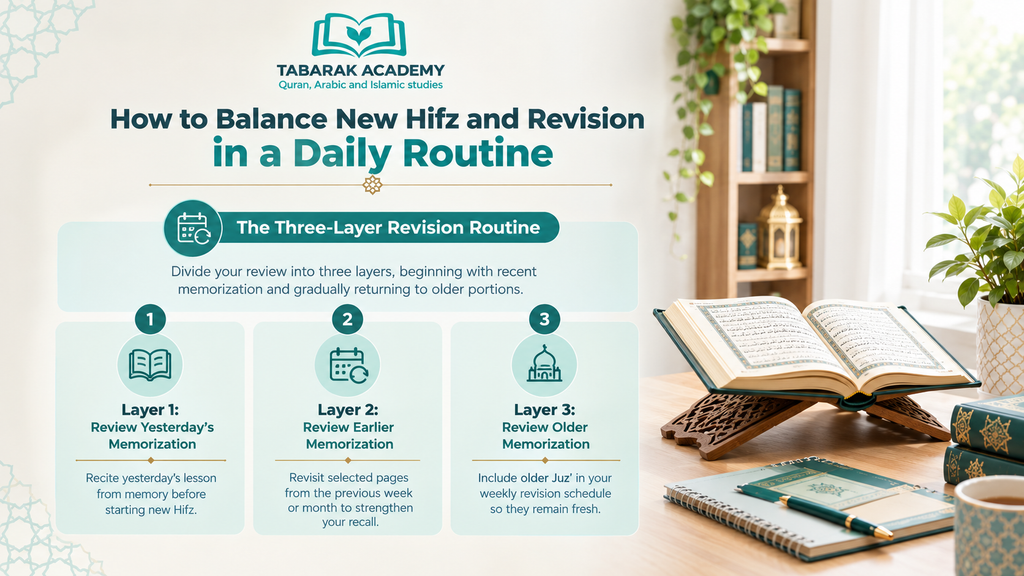
The Three-Layer Revision Routine
A structured revision routine helps you maintain your memorized Quran while continuing to learn new verses. Divide your review into three layers, beginning with recent memorization and gradually returning to older portions.
Layer 1: Review Yesterday’s Memorization
Recite yesterday’s lesson from memory before starting new Hifz. Correct any mistakes with your teacher or Mushaf, and repeat the passage until you can recite it confidently.
Layer 2: Review Earlier Memorization
Revisit selected pages from the previous week or month to strengthen your recall. Use retrieval practice rather than reading everything from the Mushaf, and focus extra attention on verses that cause hesitation.
Layer 3: Review Older Memorization
Include older Juz’ in your weekly revision schedule so they remain fresh. Regularly reciting established portions helps prevent them from being neglected as your new memorization grows.
Read also: 5 Ways to Balance New Hifz and Quran Revision
Plan your Hifz session
A well-organized Hifz session gives both new memorization and revision enough attention. The following example shows how to divide your daily study time using the recommended 20–30% new Hifz and 70–80% revision ratio.
For a 60-minute session, you could spend 15 minutes learning new verses and 45 minutes reviewing previous memorization. Adjust the duration and ratio according to your level, available time, and teacher’s guidance.
At Tabarak Academy, children and adults can learn through online Tajweed, Quran recitation, and Arabic lessons. Explore our Tajweed and Quran recitation classes to strengthen your pronunciation, improve your fluency, and receive guidance throughout your Hifz journey.
Weekly Revision for a Growing Hifz
Daily review protects recent lessons, while a weekly cycle ensures older memorization is not forgotten. Divide your memorized portions into manageable groups and assign each group a regular day.
For example, a student with six Juz’ might review one Juz’ each day for six days, then use the seventh day for a full assessment or extra attention to weak passages. A student with more Hifz may need a longer cycle or multiple daily sessions.
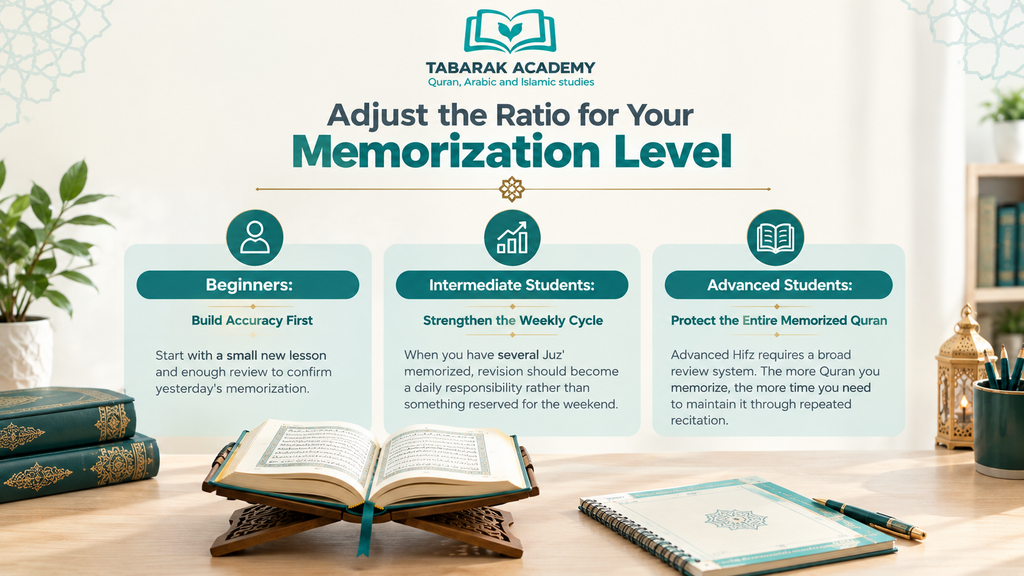
Adjust the Ratio for Your Memorization Level
The best ratio of new Hifz to revision changes as you progress. A beginner has fewer old portions to maintain, but an advanced student must manage a much larger body of memorized Quran.
Beginners: Build Accuracy First
Start with a small new lesson and enough review to confirm yesterday’s memorization. Children may benefit from shorter sessions, frequent encouragement, and a parent who listens to their recitation.
The priority is establishing correct pronunciation and a reliable habit. Once the student can recall the lesson consistently, the teacher can increase the new portion gradually.
Intermediate Students: Strengthen the Weekly Cycle
When you have several Juz’ memorized, revision should become a daily responsibility rather than something reserved for the weekend. A 20–30% new lesson may work if the remaining memorization is stable.
If you repeatedly forget older passages, temporarily reduce new Hifz. Use that time to strengthen weak portions before increasing the pace again.
Advanced Students: Protect the Entire Memorized Quran
Advanced Hifz requires a broad review system. The more Quran you memorize, the more time you need to maintain it through repeated recitation.
Some students may need to dedicate most of their available study time to revision, especially before a Quran assessment or when preparing to recite a large portion from memory. The ratio should follow retention, not a fixed percentage.
Understanding the meaning of the verses can also support your Quran learning journey. If you want to develop your Quranic Arabic alongside Hifz, explore Tabarak Academy’s Arabic learning classes to build vocabulary and deepen your connection with the Quran.
How to Recover Forgotten Quran Memorization
Forgotten portions should not be ignored or treated as a reason to abandon your Hifz goal. Instead, identify the weak pages, review them carefully, and build them back into your regular revision schedule.
Use a Weak-Portion Recovery Plan
Choose a small portion that you can focus on thoroughly. Read it with correct Tajweed, listen to a reliable recitation, and then recite it from memory until you can complete it accurately.
Return to that portion the next day and again later in the week. Once it becomes stable, place it into your normal revision cycle so it does not become neglected again.
Should You Stop New Hifz Completely?
Not always. Some students can continue a small new lesson while rebuilding weak memorization, while others need a temporary revision-focused schedule.
A qualified teacher can assess your recitation and help decide whether to reduce, pause, or maintain new Hifz. This makes the plan responsive to your actual progress rather than a rigid target.
Step Inside Our Virtual Classrooms
See our engaging teaching methods in action! watch real snippets of our live classes and discover how our expert instructors make learning interactive, memorable, and inspiring for every student.
Start Your Hifz With a Sustainable Daily Plan At Tabarak Academy
A personalized Quran learning program can help you balance new memorization with revision while receiving regular feedback on pronunciation and fluency.
At Tabarak Academy, children and adults can learn through online Tajweed, Quran recitation, and Arabic lessons. Working with a teacher gives you the opportunity to identify mistakes, adjust your lesson size, and develop a practical routine.
Whether you are beginning Hifz or rebuilding previously memorized Juz’, consistent guidance can make the process more organized. Explore the academy’s online Quran learning programs to find a learning path that fits your needs.
If you are ready to begin or improve your Hifz journey, visit Tabarak Academy to explore Tajweed, recitation, and Arabic learning options. [Add the enrollment button and promotional image manually when publishing.
Our Quran Memorization / Hifz Courses
- Online Hifz Program
- Juz 30 Memorization Course
- Hifz for Kids Course
- Hifz for Adults Course
- Hifz for Sisters Course
- Short Surah Memorization Course
- Hifz Ijazah Course

Conclusion
The key to successful Quran memorization is maintaining the right balance between new Hifz and revision. A practical starting point is 20–30% new memorization and 70–80% revision, with adjustments based on your retention and memorized portion.
As your Hifz grows, revision should remain the larger part of your routine. Daily recent review, weekly revision cycles, and focused recovery of weak portions can help you maintain what you have learned while continuing to make progress.
Take Away Message: The ideal ratio of new Hifz to revision is the one that helps you memorize accurately and retain what you know. Consistency, patience, and qualified guidance can support both kids and adults throughout their Quran learning journey.
FAQs
What is the ideal ratio of new Hifz to revision?
A practical starting guideline is 20–30% for new memorization and 70–80% for revision. This is not a fixed rule; adjust it according to your memorized Quran, retention, and teacher’s feedback.
Should I revise more than I memorize?
Yes, revision should generally receive more time than new memorization. As your memorized portion grows, increasing revision helps protect older lessons from being forgotten.
How many pages should I memorize daily?
Many students begin with a few lines, half a page, or one page, depending on their level. Choose an amount you can recite accurately and retain consistently.
How many Juz’ should I revise daily?
One to three Juz’ can be a starting point for some students, but the right amount depends on your memorized portion and fluency. The important goal is regular review of all memorized portions.
Should I stop new Hifz if I forget old lessons?
You may need to reduce or temporarily pause new memorization if revision is becoming difficult. A qualified Quran teacher can help you decide how to strengthen weak portions and resume new lessons safely.