


How To Balance New Memorization And Revision? – 5 Practical Tools
Are you memorizing new Quran verses every day but struggling to remember what you learned last week? This is a common challenge for both children and adults who want to continue their Hifz while protecting the portions they have already memorized.
Learning how to balance new memorization and revision means giving both tasks a place in your daily routine. A realistic plan helps you build new Hifz, strengthen older portions, and maintain accurate Tajweed without making your Quran journey unnecessarily exhausting.
In this guide, you will learn how to divide your study time, organize recent and older memorization, and adjust your routine when revision begins to fall behind. You will also find practical schedules for busy adults, children, and learners who need to rebuild weak Hifz.

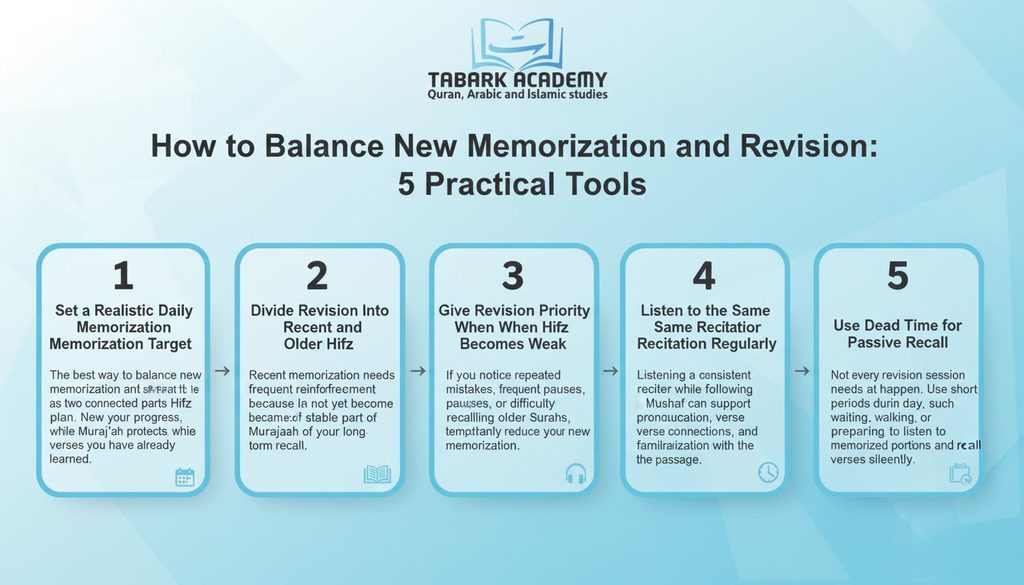
1. Set a Realistic Daily Memorization Target
The best way to balance new memorization and revision is to treat them as two connected parts of one Hifz plan. New memorization adds to your progress, while Muraja’ah protects the verses you have already learned.
Your daily schedule should make room for both, with the revision amount increasing when older portions become difficult to recall. So, start by choosing an amount of new Quran that you can maintain alongside your revision.
This may be half a page, a few verses, or one page, depending on your level and available time. A smaller target that you complete consistently is more useful than a demanding target that leaves no room for review.
For example, a learner who has 30 minutes available for Quran study may spend 10 minutes on new memorization and 20 minutes on revision. This is an illustrative starting point, not a fixed rule for every student.
If your older Hifz is weak, you may need to dedicate the entire session to revision until your recitation becomes more secure. A qualified teacher will notice that and be with you during your Quran recitation time.

2. Divide Revision Into Recent and Older Hifz
Recent memorization needs frequent reinforcement because it has not yet become a stable part of your long-term recall. Older Hifz needs a regular rotation so that previously learned Surahs do not disappear from your daily routine.
A practical schedule can divide your revision into three layers: the new portion from today, the recent portion from the past week, and older memorized Juz that you revisit according to a fixed cycle.
Recent Hifz should be reviewed more frequently because it is still developing into long-term memory. Reciting yesterday’s lesson and the portions memorized during the previous week can help strengthen verse order and reduce repeated mistakes.
You can also assign older Hifz to specific days instead of trying to review everything at once. For example, divide your memorized Juz into smaller sections and rotate them throughout the week, giving extra attention to passages that need more practice.
Tabarak Academy’s online Hifz program uses structured Muraja’ah alongside new memorization and adjusts the plan to each learner’s level and pace.

3. Give Revision Priority When Hifz Becomes Weak
If you notice repeated mistakes, frequent pauses, or difficulty recalling older Surahs, reduce your new memorization temporarily. This is not a failure to progress; it protects the work you have already completed.
Revision should focus on more than reading the page again. Recite the weak passage without looking, mark the exact place where you hesitate, and repeat that section until you can connect it smoothly with the verses before and after it.
You may also divide weak portions into small daily sections instead of attempting to repair an entire Surah in one sitting. This makes the task less overwhelming and gives you a clear way to measure improvement from one session to the next.
For example, a learner who normally memorizes one page daily may reduce the new portion to half a page while spending additional time on weak passages to stay consistent with Quran memorization. Once the older material becomes more reliable, the learner can gradually increase the new target again.
Experience Our Interactive Learning
Curious about how we teach? Watch these brief video clips from our recent live sessions to see our structured curriculum, advanced learning platform, and dynamic student-teacher interactions firsthand.
4. Listen to the Same Recitation Regularly
Listening to a consistent reciter while following the Mushaf can support pronunciation, verse connections, and familiarization with the passage. You can use audio during a walk, commute, or a quiet period at home.
Choose one reliable reciter and listen to the same portion several times before and after your memorization session. Consistent audio can help you become familiar with the rhythm, stopping points, and connections between similar verses.
You can also listen to your assigned portion before sleeping or while preparing for the day. When the passage becomes familiar through repeated hearing, use that familiarity as preparation for reciting independently without relying on the audio.
Listening should complement active recitation, not replace it. The goal is to hear the correct wording and then practice recalling it without looking.
Read also: The Best Hifz-to-Revision Ratio for Memorization
5. Use Dead Time for Passive Recall
Not every revision session needs to happen at a desk. Use short periods during the day, such as waiting, walking, or preparing meals, to listen to memorized portions and recall the verses silently.
Try to remember the next verse before the reciter reaches it. This simple habit turns listening into active mental practice and helps you notice which parts of the passage are firmly stored and which ones still need revision.
You can also repeat a short portion while travelling or completing routine household tasks. If you cannot recite aloud, quietly follow the verse sequence in your mind and check the Mushaf later to confirm your accuracy.
Passive recall should support, not replace, your main Hifz session. Use these small moments to prepare for formal revision, while keeping focused recitation, Tajweed correction, and teacher feedback as the foundation of your routine.
How to Balance New Memorization and Revision With a Daily Schedule
A good Hifz routine should be simple enough to follow during ordinary days and flexible enough to survive busy weeks. The following examples show how children and adults can organize new memorization, recent revision, and older Hifz without treating every day as a long study session.
A Daily Hifz Schedule for Beginners and Children
Children often benefit from short, focused sessions that combine teacher-led memorization with brief revision at home. The parent can help by listening to the child, recording the portion completed, and making sure the child reviews yesterday’s lesson before starting a new one.
| Time | Task |
| Morning | New memorization with Tajweed |
| Afternoon | Review yesterday’s lesson |
| Evening | Revise a short older portion |
The amount should be adjusted to the child’s age, attention span, and recitation level. Shorter sessions are appropriate when the child is tired or has school responsibilities.
A Daily Hifz Schedule for Adults
Adults often need a plan that fits around work, family, and other responsibilities. A morning session may be suitable for new memorization, while short revision periods after prayer or in the evening can help maintain older portions.
| Time | Task |
| After Fajr | New memorization |
| Midday | Recent Hifz revision |
| Evening | Older Hifz rotation |
The schedule can be adapted to your circumstances. If you have only 20 minutes available, use that time for a smaller amount of new memorization and focused revision rather than trying to complete an unrealistic daily target.

How to Balance New Memorization and Revision With Effective Techniques
Once you have a workable schedule, the next step is to use methods that make your revision more effective. These strategies help you check what you actually remember rather than simply rereading the same pages.
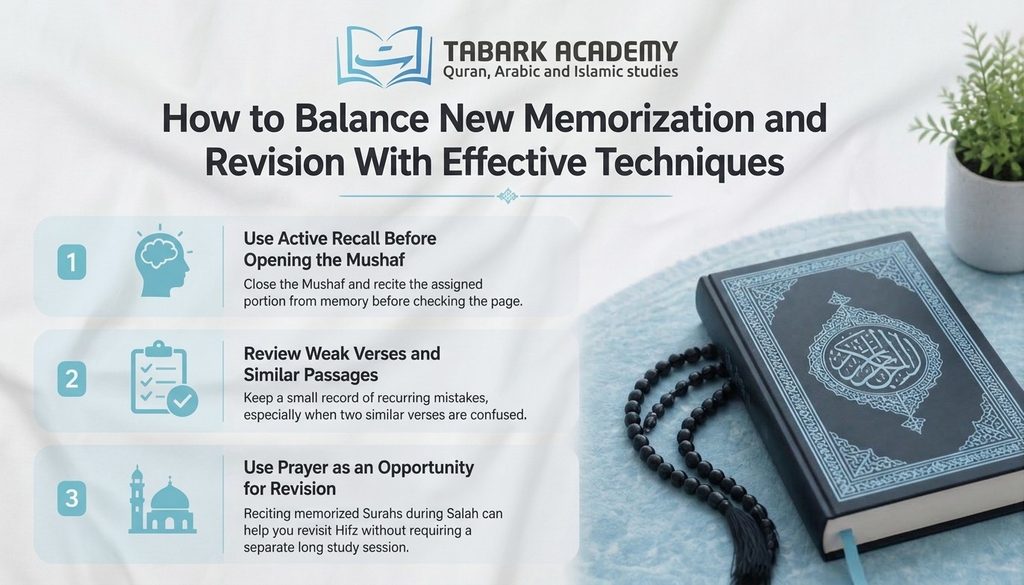
1. Use Active Recall Before Opening the Mushaf
Close the Mushaf and recite the assigned portion from memory before checking the page. This reveals where you hesitate or make mistakes and helps you focus on the exact verses that need attention.
If you make an error, open the Mushaf, correct the passage, and repeat it carefully. A qualified teacher can also listen to your recitation and identify mistakes that you may not notice yourself.
2. Review Weak Verses and Similar Passages
Some verses are difficult because they resemble other passages in the Quran. Keep a small record of recurring mistakes, especially when two similar verses are confused. Reviewing the distinguishing words helps you identify the difference instead of repeating the same error.
For children, parents can use simple oral questions, such as asking the child to begin from the middle of a Surah. This checks whether the child can recall the passage independently rather than relying only on the beginning.
3. Use Prayer as an Opportunity for Revision
Reciting memorized Surahs during Salah can help you revisit Hifz without requiring a separate long study session. Choose portions that you need to strengthen and recite them with care.
For adults, this can be particularly useful when daily responsibilities limit study time. For children, parents can encourage the use of familiar memorized Surahs in prayer while ensuring that the child recites correctly.
How to Balance New Memorization and Revision When You Have Limited Time
A busy schedule does not mean you must abandon your Hifz. The key is to create a minimum daily routine that remains possible during demanding periods.
Start with a small revision target that you can complete even on difficult days. You may choose a few verses, half a page, or another manageable portion.
When you have more time, increase the amount rather than making the minimum so large that you stop entirely during busy weeks.
If you are a parent, consider scheduling your child’s Quran revision around an existing routine, such as after school or before bedtime. Adults may find that linking revision to prayer or a consistent morning habit makes it easier to maintain.

How to Balance New Memorization and Revision
When memorized portions become weak, the first step is to assess what needs attention. Divide your Hifz into strong, moderate, and weak sections. Then create a revision plan that gives extra time to the weak sections while continuing a manageable amount of new memorization.
If a portion is no longer secure, return to the Mushaf and rebuild it carefully. Review the verses with correct Tajweed, recite them without looking, and ask a teacher to check your accuracy. Once the portion becomes stable, add it to your regular revision rotation.
A four-week recovery plan may begin with an assessment of your memorized Surahs, followed by focused revision of weak portions, connection of recent and older Hifz, and a complete review of the memorized amount. The duration should be adjusted to your actual level rather than a fixed deadline.
Step Inside Our Virtual Classrooms
See our engaging teaching methods in action! watch real snippets of our live classes and discover how our expert instructors make learning interactive, memorable, and inspiring for every student.

Strengthen Your Hifz With a Personalized Revision Plan
A structured revision plan can help you continue memorizing new Quran without neglecting the portions you have already learned. At Tabarak Academy, qualified tutors guide students through personalized Hifz schedules, Tajweed correction, and systematic Muraja’ah for long-term learning.
Whether you are a beginner, a parent supporting your child, or an adult returning to Hifz after a break, the academy’s online lessons are designed to fit different levels and daily schedules. You can learn from home with a tutor who helps you identify your current needs and build a realistic memorization routine.
Book a free trial lesson to discuss your goals and explore a Quran learning plan that combines new memorization, revision, and accurate recitation. The aim is to make your Hifz journey consistent, manageable, and supported by qualified guidance.
Our Quran Memorization / Hifz Courses
- Online Hifz Program
- Juz 30 Memorization Course
- Hifz for Kids Course
- Hifz for Adults Course
- Hifz for Sisters Course
- Short Surah Memorization Course
- Hifz Ijazah Course

Conclusion
Learning how to balance new memorization and revision begins with a realistic plan that gives both tasks enough time. Your daily target should reflect your level, responsibilities, and ability to retain what you have already learned.
New Hifz helps you move forward, while Muraja’ah protects your previous effort from becoming weak. Dividing revision into recent and older portions can make your routine clearer and easier to maintain.
When your memorized portions become difficult to recall, reduce the new target and give greater attention to correction and repetition. Active recall, regular listening, prayer-based revision, and short daily practice can all strengthen your Hifz.
The main takeaway is to choose consistency over pressure. With a sustainable routine and qualified guidance from Tabarak Academy, children and adults can continue memorizing the Quran while preserving accurate recitation and long-term recall.
FAQs
How much time should I spend on new memorization and revision?
There is no single ratio for every learner. Start with a manageable amount of new memorization and give revision enough time to maintain accurate recall. If older Hifz is weak, increase revision and reduce new memorization temporarily.
Is it better to memorize Quran in the morning or evening?
Many learners prefer the morning for new memorization because they can focus on a fresh portion. Revision can be placed later in the day or divided into shorter sessions. Choose times that fit your schedule and energy.
Should I stop new memorization if I keep forgetting old Surahs?
If forgetting is widespread, reducing or pausing new memorization can help you rebuild your foundation. Once your older portions become more secure, resume new Hifz gradually.
How can I balance Quran memorization with school or work?
Choose a small daily target and link revision to routines you already follow, such as prayer, commuting, or a quiet evening period. A consistent schedule is easier to maintain than a demanding one.
Can a Quran teacher help me balance new Hifz and Muraja’ah?
Yes. A qualified teacher can assess your recitation, identify weak portions, and help you create a plan that fits your memorization level and available time. Tabarak Academy offers structured online Hifz lessons with revision support for children and adults.