

How To Read The Quran In Arabic Easily – A Beginner’s Guide
Learning how to read the Quran in Arabic easily is possible even if Arabic is not your first language. You do not need to become fluent in spoken Arabic first.
The best approach is to learn the Arabic letters, understand basic Harakat, practice connected letters, and gradually apply Tajweed as you read.
With regular practice and the right guidance, beginners can build confidence and start reading the Quran accurately, one word and verse at a time.
You can learn to read the Quran in Arabic even if you do not speak or understand Arabic. Reading Arabic and understanding Arabic are two different skills.
Reading focuses on recognizing letters, connecting them correctly, and pronouncing the sounds, while understanding requires learning vocabulary, grammar, and Quranic Arabic.
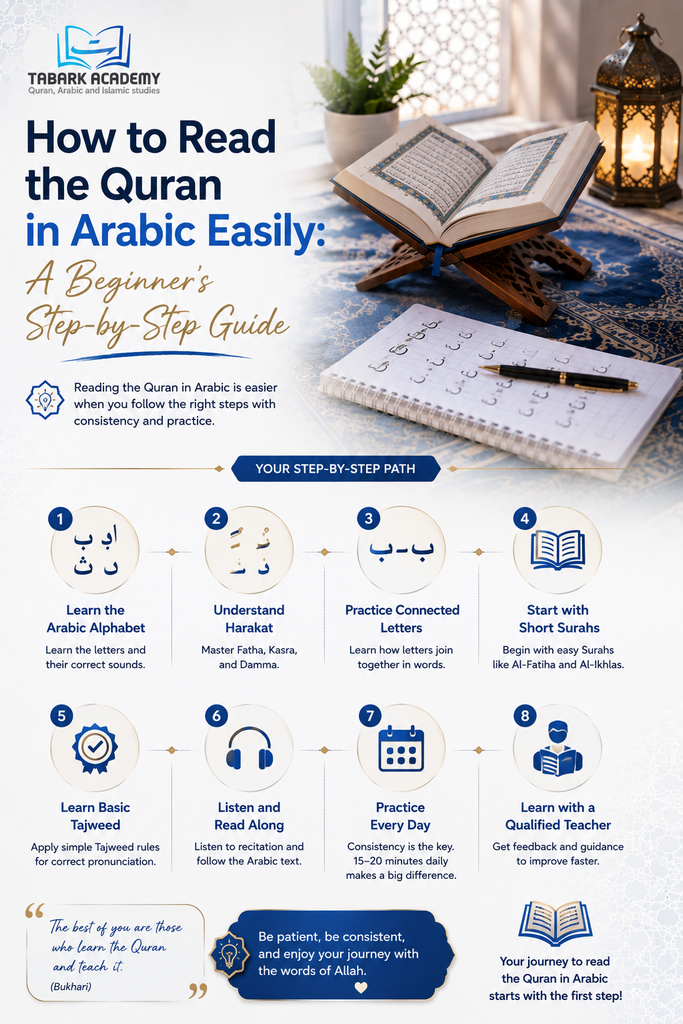
The best way how to read the Quran in Arabic easily is to follow a gradual learning process instead of trying to read full verses immediately. Build your skills in the right order:
Step 1: Learn the 28 Arabic Letters and Their Correct Quranic Sounds
The first step in learning how to read the Quran in Arabic easily is becoming familiar with the 28 Arabic letters. You need to recognize each letter visually and associate it with its correct sound before attempting to read complete Quranic words.
Start by learning a small group of letters at a time rather than trying to memorize the entire alphabet in one sitting. Practice the letter name, shape, and pronunciation together so that seeing the letter automatically reminds you of its sound.
Pay particular attention to Arabic sounds that do not have a direct English equivalent, including ح (Ha), خ (Kha), ع (Ayn), غ (Ghayn), ص (Sad), and ض (Dad). Learning their correct Makharij from the beginning prevents pronunciation habits that can become harder to correct later.
Step 2: Master Harakat and Quranic Reading Signs to Pronounce Each Letter Correctly
Once you recognize the Arabic letters, learn Harakat, the vowel marks that tell you how each letter should be pronounced. These marks transform isolated consonants into readable sounds and are essential for sounding out Quranic words.
Begin with the three short vowels:
| Harakah | Sound | Example |
| Fatha (ـَ) | Short “a” | بَ = ba |
| Kasra (ـِ) | Short “i” | بِ = bi |
| Damma (ـُ) | Short “u” | بُ = bu |
Practice applying all three Harakat to the same letter:
بَ → بِ → بُ
Then gradually introduce Sukoon (ـْ), Shaddah (ـّ), Tanween, and Madd. Do not simply memorize their names; practice recognizing what each sign requires you to do when you encounter it inside a Quranic word.
Read also: Why Is Arabic Known as the Language of the Dhad?
Step 3: Recognize Connected Arabic Letter Forms Inside Quranic Words
Arabic letters can change their appearance depending on whether they occur at the beginning, middle, or end of a word.
Becoming comfortable with these connected forms is essential because Quranic Arabic is read as joined script rather than isolated alphabet characters.
Practice tracing a familiar letter through its different forms and identifying the features that remain recognizable.
Also learn the six letters that do not connect to the letter following them:
ا، د، ذ، ر، ز، و
Knowing these exceptions helps you understand why some Quranic words contain visual breaks even though they form one complete word.
Step Inside Our Virtual Classrooms
See our engaging teaching methods in action! watch real snippets of our live classes and discover how our expert instructors make learning interactive, memorable, and inspiring for every student.
Step 4: Start With Short Familiar Surahs to Build Quran Reading Fluency
Once you can recognize letters, Harakat, and connected forms, begin applying those skills to short Quranic passages rather than jumping immediately into full pages.
Useful Surahs for early practice include:
- Surah Al-Fatihah: familiar because it is recited in every Salah.
- Surah Al-Ikhlas: short and easy to repeat frequently.
- Surah Al-Falaq: useful for practicing a variety of Arabic sounds.
- Surah An-Nas: short enough for repeated reading practice.
- Surah Al-Kawthar: one of the shortest Surahs and a manageable confidence-building exercise.
Read slowly, Ayah by Ayah. If one word causes difficulty, isolate it, identify its letters and Harakat, listen to the correct pronunciation, and repeat it before returning to the complete verse.
Step 5: Add Basic Tajweed Gradually as Your Quran Reading Becomes Stronger
Once basic reading becomes more comfortable, begin introducing Tajweed rules that directly affect pronunciation.
Start with foundational concepts such as:
- Makharij: where each Arabic letter is articulated.
- Ghunnah: nasal resonance associated with specific Noon and Meem rules.
- Madd: when and how long vowel sounds are extended.
- Qalqalah: the controlled echo produced by specific Sakin letters.
- Waqf: knowing where and how to pause appropriately.
You do not need to master every Tajweed rule before continuing to read. Instead, add rules progressively and practice each one inside passages you already know.
Step 6: Listen to a Qualified Reciter and Read Along to Improve Pronunciation
Listening helps connect the Arabic text you see with the sound you are expected to produce.
Instead of listening passively, turn each recording into an active exercise:
- Choose one short passage from a clear, reliable reciter.
- Follow the Arabic text while listening.
- Listen to one Ayah without repeating it first.
- Replay it and repeat aloud.
- Read the same Ayah independently.
- Compare your pronunciation and pacing with the original.
- Repeat difficult words separately before trying the whole Ayah again.
Over time, familiar letter combinations and Quranic words become easier to recognize without relying on transliteration.
Step 7: Follow a Consistent Daily Quran Reading Routine to Build Fluency
Consistency is one of the most effective ways to make Quran reading feel easier. You do not need several hours of study every day; a short, focused routine is easier to maintain and gives you regular exposure to Arabic script.
A simple 15–20 minute daily routine could look like this:
- 5 minutes: Review letters, Harakat, connected forms, or difficult Quranic words.
- 5 minutes: Practice one pronunciation or basic Tajweed skill.
- 5–10 minutes: Read a short Surah or passage aloud.
- Final minute: Identify one mistake or difficulty to work on tomorrow.
Do not rush to complete more pages.
If one verse contains several difficult words, spending the session correcting those words may be more valuable than reading an entire page inaccurately.
The long-term goal is to reach a point where letter recognition, Harakat, word blending, and basic pronunciation happen automatically, allowing you to focus increasingly on fluent and accurate Quran recitation.
Read the Quran in Arabic Easily: Practical Tips for Beginners
If you want to read the Quran in Arabic easily, small changes to your practice can make the learning process smoother and more enjoyable. Keep these read the quran in Arabic easily tips in mind:
- Start slowly: Focus on reading each letter and word correctly before trying to increase your speed.
- Read aloud: Speaking the words helps you notice pronunciation difficulties and practice the sounds more accurately.
- Use transliteration only as temporary support: It can help at the beginning, but gradually train yourself to read directly from the Arabic script.
- Repeat difficult words: Repetition makes unfamiliar letter combinations and Quranic words easier to recognize.
- Begin with short Surahs: Familiar, shorter passages allow you to practice without feeling overwhelmed.
- Listen to Quran recitation: Follow along with the Arabic text to connect correct pronunciation with what you see.
- Learn Tajweed gradually: Focus on the rules that apply to the verses you are currently reading rather than trying to memorize everything at once.
- Practice consistently: A few minutes every day is more beneficial than irregular, lengthy study sessions.
- Get your pronunciation checked: A qualified Quran teacher can identify mistakes that may be difficult to notice when practicing alone.
- Be patient with yourself: Making mistakes is a normal part of learning. With regular practice, reading unfamiliar Quranic words becomes increasingly natural.
If you want to learn how to read the Quran in Arabic easily, focus on making your practice simple, consistent, and structured.
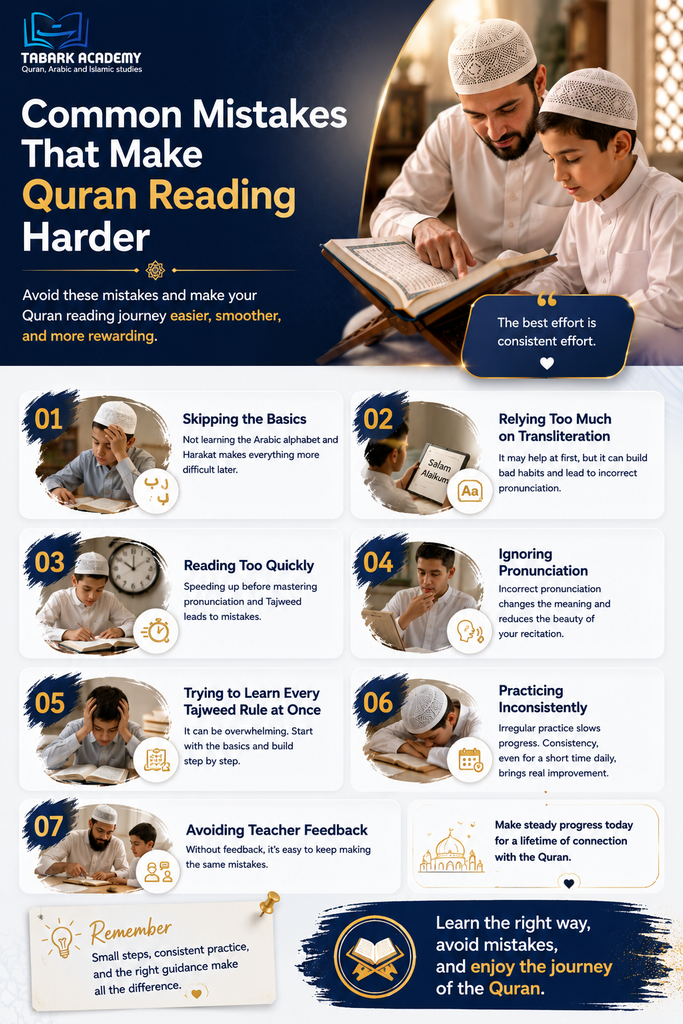
Common Mistakes That Make Learning to Read the Quran in Arabic More Difficult
When learning how to read the Quran in Arabic, beginners can sometimes make the process harder by rushing ahead or practicing without a clear structure.
Recognizing these common mistakes early can help you build stronger reading habits, improve pronunciation, and progress more confidently.
1. Trying to Read Full Surahs Before Mastering Arabic Letters and Harakat
Moving into complete Surahs before you can confidently recognize Arabic letters and their vowel marks often creates unnecessary confusion.
Build the foundation first. Make sure you can recognize the letters, distinguish similar shapes, and read basic Harakat before expecting yourself to read complete Quranic passages smoothly.
2. Depending on Transliteration Instead of Learning to Read Arabic Script
Transliteration can provide temporary support, but relying on it for too long can prevent you from developing direct recognition of Arabic letters and words.
It also cannot represent every Quranic Arabic sound precisely. Gradually reduce your dependence on transliteration and train yourself to look at the Arabic text first.
3. Reading Too Quickly Before Developing Accurate Quran Pronunciation
Reading faster does not necessarily mean reading better. As a beginner, slow down enough to recognize the letters, Harakat, and words correctly.
Concentrate on accurate pronunciation first and allow speed to develop naturally as your reading becomes more automatic.
4. Ignoring Makharij and Repeating Incorrect Letter Pronunciation
Some Arabic letters are difficult for non-Arabic speakers because their sounds may not exist in the learner’s first language.
If you repeatedly pronounce a difficult letter incorrectly, the mistake can gradually become a habit. Learn its correct Makhraj (articulation point), isolate the letter, practice it with different vowels, and then return to Quranic words containing that sound.
5. Trying to Master Every Tajweed Rule Before Building Basic Reading Skills
Tajweed contains many rules, and attempting to learn all of them at once can overwhelm a beginner who is still learning to recognize and connect Arabic letters.
Start with the Tajweed concepts that directly support your current reading level, particularly correct letter pronunciation and Makharij.
Add rules such as Madd, Ghunnah, Qalqalah, and stopping rules progressively as your reading foundation becomes stronger.
6. Practicing Irregularly Instead of Following a Short Daily Quran Routine
A long practice session once a week gives you less frequent exposure to Arabic script than a manageable routine you can repeat consistently.
Even 15–20 minutes of focused daily practice can be used to review letters, read Quranic words, repeat a short passage, or work on a pronunciation difficulty.
The goal is not to make every session long. The goal is to make Quran reading a regular skill that your eyes and tongue repeatedly practice.
7. Practicing Without Getting Pronunciation Feedback From a Qualified Teacher
Some Quran reading errors are difficult to recognize by yourself. A letter may sound correct to you even when its Makhraj, vowel, elongation, or another aspect of its pronunciation needs adjustment.
A qualified Quran teacher can listen to your recitation, identify errors you may not hear independently, and show you exactly what needs to change.
Getting correction early is especially valuable because it prevents repeated mistakes from becoming established pronunciation habits.
By avoiding these common mistakes and following a structured learning path, you can make reading the Quran in Arabic easier, more accurate, and progressively more natural. Focus on building one skill at a time, prioritize accuracy over speed, and use consistent practice and qualified feedback to strengthen your Quran reading step by step.
Experience Our Interactive Learning
Curious about how we teach? Watch these brief video clips from our recent live sessions to see our structured curriculum, advanced learning platform, and dynamic student-teacher interactions firsthand.
How Tabarak Academy Can Help You Read the Quran in Arabic Easily
Tabarak Academy provides online Quran learning designed to help students develop their reading skills step by step, whether they are complete beginners or already have some experience. With guidance from qualified Quran teachers, students can work on:
- Arabic letters and pronunciation from the foundation.
- Harakat and connected letters to improve reading fluency.
- Tajweed fundamentals for more accurate Quran recitation.
- Short Surahs and regular Quran reading to build confidence.
- Personalized correction and feedback to identify pronunciation mistakes.
- Consistent practice through structured online lessons.
Our Quran Memorization / Hifz Courses
- Online Hifz Program
- Juz 30 Memorization
- Hifz for Kids
- Hifz for Adults
- Hifz for Sisters
- Short Surah Memorization Course
- Hifz Ijazah Course
Ready to improve your Quran reading? Start learning with Tabarak Academy and take the next step toward reading the Quran in Arabic with confidence.

Conclusion
Learning how to read the Quran in Arabic easily does not require you to master everything at once. Start with the Arabic alphabet, learn Harakat and connected letters, practice short Surahs, and gradually apply Tajweed as your reading improves.
If you want personalized guidance throughout your learning journey, Tabarak Academy can help you build your Quran reading skills with structured online lessons and qualified teachers.
Start your Quran reading journey with Tabarak Academy today.
FAQs
Can I read the Quran in Arabic if I don’t speak Arabic?
Yes. You do not need to speak Arabic fluently to learn how to read the Quran. Reading focuses on recognizing Arabic letters and producing their sounds, while understanding the meaning requires additional study of Quranic Arabic.
Can I learn to read the Quran by myself?
You can make good progress through self-study using books, audio resources, and beginner lessons. However, working with a qualified teacher can help identify pronunciation and Tajweed mistakes that are difficult to recognize on your own.
Should I use transliteration when learning to read the Quran?
Transliteration can be helpful as temporary support for beginners, but it should not replace learning the Arabic script. Gradually transitioning to the original Arabic text will help you develop more accurate Quran reading skills.
How long does it take to learn to read the Quran?
The timeline varies from person to person. Your starting level, practice routine, pronunciation, and teacher support all influence your progress.
How can I improve my Quran pronunciation?
Practice difficult Arabic letters aloud, listen carefully to qualified reciters, repeat verses regularly, and ask a qualified Quran teacher to correct your pronunciation. Regular feedback can help prevent mistakes from becoming habits.