


How to Recite the Quran Beautifully – Practical Tips for Better Recitation
Learning how to recite the Quran beautifully is not simply about having a naturally beautiful voice. True beauty in Quran recitation begins with correct pronunciation, Tajweed, a steady pace, proper pauses, and sincere reflection on the words of Allah.
In this guide, we’ll share practical recite the Quran beautifully tips, from mastering Tajweed and Makhraj to improving your breathing, listening to skilled Qaris, and developing a simple daily practice routine.
1. Master Waqf and Ibtida to Pause and Resume Without Changing the Meaning
Learning where to pause and where to resume is one of the most important skills for beautiful and accurate Quran recitation. In Tajweed, these stopping and starting rules are known as Waqf and Ibtida.
Correct pauses make your recitation sound more controlled and natural, but more importantly, they help preserve the intended meaning of the verses. Stopping in the wrong place can interrupt the sentence structure or, in some cases, affect the meaning.
To improve your Waqf:
- Learn the common Waqf signs in the Mushaf and what each one indicates.
- Listen closely to skilled Qaris and observe where they pause and resume.
- Practice with short Surahs first, focusing on completing meaningful phrases smoothly.
- Plan your breath before you begin a verse so you are less likely to stop abruptly.
- Avoid pausing only because you are out of breath when a better stopping point is only a few words away.
- Ask a qualified Quran teacher for correction, especially when you are unsure whether a stopping point is appropriate.
With regular practice, proper Waqf can make your recitation sound more fluent while helping you recite with greater accuracy and understanding.
2. Develop Better Breath Control and a Steady Recitation Pace
Strong breath control helps you recite the Quran beautifully without rushing, straining your voice, or breaking the natural flow of a verse.
When your breathing is controlled, it becomes easier to maintain a steady tone, pronounce letters clearly, apply Tajweed correctly, and pause at suitable places instead of stopping unexpectedly.
A simple breathing and pacing exercise is to:
- Choose a short verse or passage that you already know well.
- Identify the natural stopping points before you begin.
- Take a comfortable breath and start reciting slowly.
- Maintain an even pace instead of speeding up near the end of your breath.
- Pause at an appropriate Waqf point and breathe naturally.
- Repeat the same passage several times while keeping your pace consistent.
- Gradually move to longer passages as your breath control improves.
Do not try to hold your breath for as long as possible. The goal is not to recite an entire long verse in one breath, but to develop enough control to recite comfortably, clearly, and without unnecessary interruptions.
Experience Our Interactive Learning
Curious about how we teach? Watch these brief video clips from our recent live sessions to see our structured curriculum, advanced learning platform, and dynamic student-teacher interactions firsthand.
3. Beautify Your Quran Recitation With a Natural, Controlled Voice
Once your pronunciation, Tajweed, breathing, and pacing are becoming consistent, you can begin working more intentionally on the natural beauty of your voice.
Beautiful Quran recitation does not require an unusually deep, powerful, or highly melodic voice. What matters most is that your recitation remains clear, controlled, sincere, and faithful to the rules of Tajweed.
To make your voice sound more pleasant naturally:
- Keep your throat and voice relaxed rather than forcing a deeper or louder sound.
- Use gentle changes in pitch and tone instead of dramatic vocal movements.
- Maintain correct Makhraj and Tajweed even when changing your vocal tone.
- Let the structure and meaning of the verses influence your delivery naturally.
- Avoid excessive imitation of a particular Qari if it causes you to strain your voice or make pronunciation mistakes.
- Focus on clarity before melody, especially while you are still developing your Tajweed.
Over time, your own recitation style will become more natural and confident. The goal is not to sound exactly like another reciter, but to develop the best and most controlled version of your own voice.
Read also:How to Make Your Quran Recitation Beautiful and Correct
4. Understand the Meaning of the Verses to Recite With More Khushu and Expression
One of the most effective ways to make Quran recitation more meaningful and beautiful is to understand what you are reciting.
Beautiful recitation is not limited to pronunciation, rhythm, or vocal tone. It also comes from reciting the words of Allah with attention, reflection, and awareness of their meaning.
Before practicing a Surah or passage, spend a few minutes learning its general meaning. Try to understand the subject of the verses and the emotions or messages they convey.
For example, a passage may speak about:
- Allah’s mercy and forgiveness.
- gratitude and worship.
- guidance and obedience.
- warnings and accountability.
- stories of the Prophets.
- Paradise and the Hereafter.
- supplication and dependence on Allah.
Understanding the context can help you avoid reciting every verse with exactly the same tone. More importantly, it can increase your concentration and help you connect more deeply with what you are saying.
However, emotional expression should always remain natural. Do not exaggerate your voice or alter Tajweed rules simply to create a stronger emotional effect.
5. Study Skilled Quran Reciters to Improve Tajweed, Rhythm, and Vocal Control
Listening regularly to experienced Quran reciters is one of the best ways to develop your ear for correct pronunciation, Tajweed, pacing, Waqf, and natural vocal flow.
However, effective listening involves more than simply enjoying the sound of a beautiful recitation. Treat it as an active learning exercise.
When listening to a skilled Qari, pay attention to:
- How clearly each Arabic letter is pronounced.
- How Madd is lengthened.
- How Ghunna and Qalqalah are applied.
- Where the reciter pauses and resumes.
- How quickly or slowly different passages are recited.
- How the voice rises and falls naturally without becoming exaggerated.
- How the reciter maintains clarity even during melodic passages.
A useful practice method is to choose one short passage, listen to it several times, and then recite it yourself. Record your recitation and compare your pronunciation, pauses, and pacing with the Qari.
The goal is not to imitate another person’s voice exactly. Instead, use skilled reciters as models for accuracy, control, and proper Tajweed, then gradually develop a recitation style that feels natural for you.
Read also: The Ultimate Guide to a Beautiful Quran Recitation Voice
What Is the Best Way to Recite the Quran Beautifully?
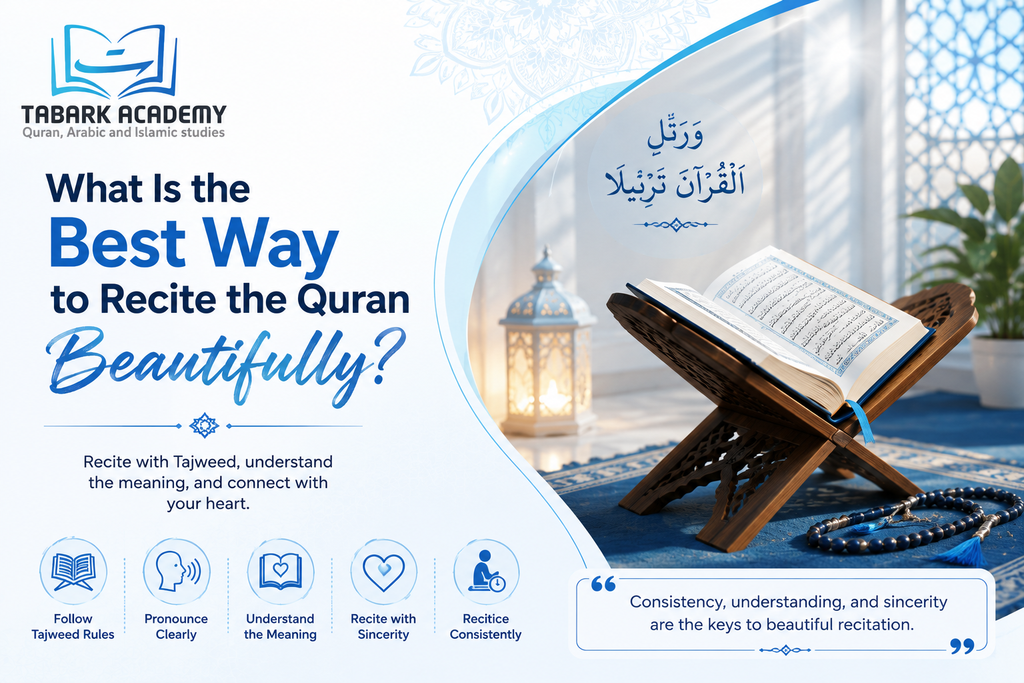
The best way to recite the Quran beautifully is to build your recitation on accuracy first and then gradually develop fluency, vocal control, and expression. A beautiful voice is helpful, but correct Tajweed and pronunciation should always come first. A simple approach is to:
- Learn Tajweed with a qualified teacher so you can correct mistakes early.
- Master Makhraj and pronounce every Arabic letter from its proper articulation point.
- Practice Madd, Ghunna, Qalqalah, and other essential rules until they become natural.
- Learn proper Waqf, so you know where to pause and continue.
- Develop steady breathing and a comfortable pace without rushing.
- Listen to skilled Qaris and study their pronunciation, pauses, and rhythm.
- Understand the meaning of the verses to strengthen your focus and reflection.
- Record yourself regularly and work on specific areas that need improvement.
- Practice consistently, even if you only have 10–15 minutes each day.
- Seek personalized feedback when possible, especially for pronunciation and Tajweed.
Practical Tips To Recite The Quran Beautifully
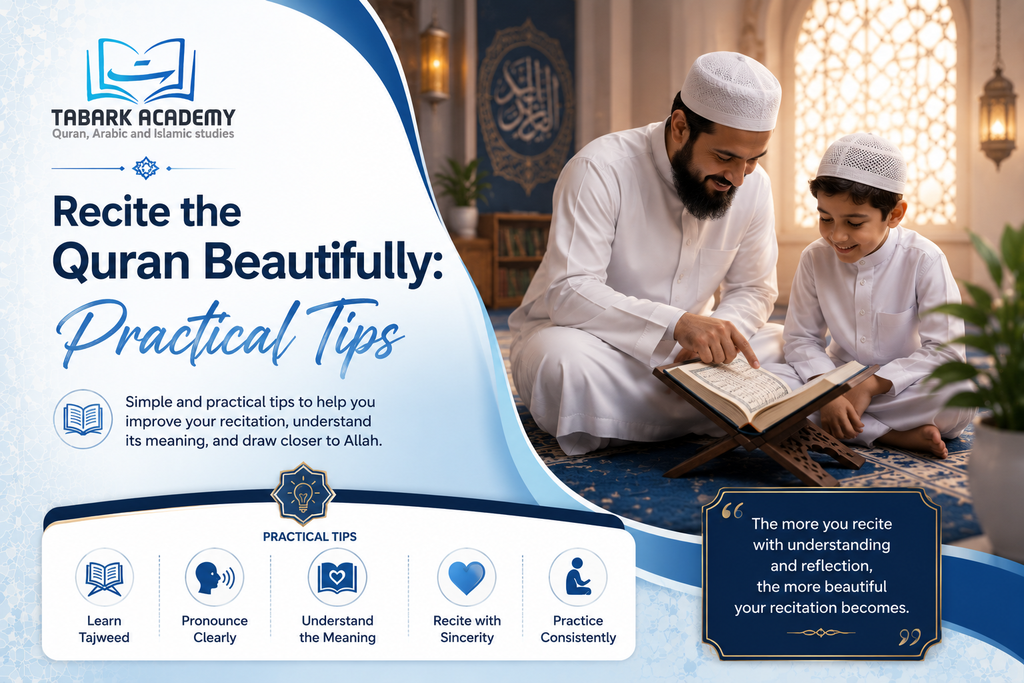
If you’re looking for practical recite the Quran beautifully tips, focus on improving your recitation gradually rather than trying to change your voice overnight. These simple habits can make a noticeable difference:
- Learn Tajweed: Start with the essential rules and practice applying them correctly.
- Improve your Makhraj: Make sure every Arabic letter comes from its correct articulation point.
- Read at a steady pace: Avoid rushing, especially when learning a new Surah.
- Practice Madd correctly: Pay attention to the required length of elongated sounds.
- Observe Waqf: Learn where to stop and continue without disrupting the meaning.
- Control your breathing: Take comfortable breaths and avoid forcing yourself to complete passages in one breath.
- Listen to skilled Qaris: Study their pronunciation, pacing, pauses, and natural vocal variation.
- Record yourself: Listen to your recitation afterward to identify unclear letters, rushed sections, or inconsistent pacing.
- Practice short Surahs repeatedly: Repetition helps you focus on improving your delivery rather than worrying about the words.
- Understand what you recite: Learning the meaning can help you approach the verses with greater attention and reflection.
- Avoid forcing your voice: Beautiful recitation does not require an artificially deep or dramatic voice.
- Get feedback: A qualified Quran teacher can identify Tajweed and pronunciation mistakes you might miss on your own.
Most importantly, consistency matters more than perfection. A short, focused practice session every day can gradually improve your pronunciation, fluency, confidence, and overall Quran recitation.
Step Inside Our Virtual Classrooms
See our engaging teaching methods in action! watch real snippets of our live classes and discover how our expert instructors make learning interactive, memorable, and inspiring for every student.
Start Improving Your Quran Recitation With Tabarak Academy
Beautiful Quran recitation is a skill that grows through correct Tajweed, consistent practice, and personalized guidance.
At Tabarak Academy, learners can develop their Quran recitation step by step with structured lessons designed to improve pronunciation, Tajweed, fluency, and confidence.
Whether you are starting from the basics or looking to refine your existing recitation, learning with a qualified teacher can help you identify mistakes, practice correctly, and make steady progress.
Watch a real life of our sessions:
Title: Surah Al-Fath Recitation | Student Test
Ready to improve your Quran recitation? Join Tabarak Academy and take the next step toward reading the Quran with greater accuracy, confidence, and beauty.
Our Quran Memorization / Hifz Courses
- Online Hifz Program
- Juz 30 Memorization
- Hifz for Kids
- Hifz for Adults
- Hifz for Sisters
- Short Surah Memorization Course
- Hifz Ijazah Course
Conclusion
Learning how to recite the Quran beautifully begins with accuracy, not simply with having a beautiful voice. Correct Tajweed, clear Makhraj, proper Waqf, controlled breathing, and a steady pace create the foundation for recitation that is both pleasant and respectful of the words of Allah.
Improvement comes gradually through consistent practice. Listen carefully to skilled Qaris, understand the meaning of what you recite, record yourself, and seek correction from a qualified teacher so that mistakes do not become habits. Even 10–15 minutes of focused daily practice can make a meaningful difference over time.
If you want structured guidance and personalized feedback, Tabarak Academy can help you strengthen your Tajweed, pronunciation, fluency, and confidence step by step. With patience and regular practice, you can develop a recitation that is clearer, more accurate, and naturally more beautiful.
Start your Quran learning journey with Tabarak Academy and take the next step toward more accurate, confident, and beautiful recitation.
FAQs
Which Quran reciter should beginners listen to?
Beginners can benefit from listening to established Qaris such as Muhammad Siddiq Al-Minshawi, Abdul Basit Abdus-Samad, Mishary Rashid Alafasy, and Maher Al-Muaiqly. Choose a recitation that is clear and comfortable to follow, then study the pronunciation, Tajweed, pacing, and pauses rather than simply copying the melody.
How long should I practice Quran recitation each day?
Even 10-15 minutes of focused practice each day can be useful. The important thing is consistency. As your skills improve, you can gradually increase your practice time and work on more advanced aspects of recitation.
Is it permissible to beautify the voice when reciting the Quran?
Beautifying one’s voice during Quran recitation is encouraged, provided that the recitation remains accurate and follows the principles of proper Quranic recitation. Vocal beauty should never lead to incorrect pronunciation, inappropriate elongation, or distortion of the words.
Can I learn beautiful Quran recitation online?
Yes. Online Quran lessons can provide structured Tajweed instruction, regular practice, and personalized feedback from a qualified teacher. This can be particularly helpful when you want someone to identify and correct pronunciation or recitation mistakes.
How can Tabarak Academy help me improve my Quran recitation?
Tabarak Academy can support learners who want to improve their Quran reading through structured guidance and personalized instruction. With consistent lessons and practice, students can work on Tajweed, pronunciation, fluency, and confidence while developing stronger Quran recitation skills.