


How Many Surahs Are In Juz Amma?
If you’ve just started teaching a child to memorize the Quran, or you’re beginning your own Hifz journey, you’ve probably been told to start with Juz Amma. Before you open the Mushaf, the first question is simple: how many surahs are in Juz Amma, and where does this section actually begin and end?
Juz Amma is the thirtieth and final part of the Quran. It’s the section most Muslims memorize first, because its surahs are short and its themes are easy to grasp even for young children. It contains 37 surahs, beginning with Surah An-Naba (chapter 78) and ending with Surah An-Nas (chapter 114).
By the end of this guide, you’ll know exactly what Juz Amma contains and how to approach memorizing it.
Where Does Juz Amma Start And End?
Juz Amma opens with Surah An-Naba النبأ, which discusses resurrection and the Day of Judgment. This juz closes with Surah An-Nas, the final chapter of the Quran, recited for protection against harm. There are 35 others between them, almost all less than a page in length.
Why Is Juz Amma Called By This Name?
Juz Amma is called by this name because it begins with Surah An-Naba. The opening words of An-Naba are عَمَّ يَتَسَاءَلُونَ (‘Amma yatasa’alun), meaning “About what are they asking one another?” The word ‘Amma became the familiar name for the 30th and final juz of the Quran, following the traditional practice of identifying Quranic sections by their opening words.
Meccan And Medinan Surahs In Juz Amma
Of the 37 surahs, there are 34 Meccan, revealed before the Prophet migrated to Medina. Only three surahs are Medinan: An-Nasr, Al-Bayyinah, and Az-Zalzalah. This is important for memorization because Meccan surahs in Juz Amma tend to focus on belief, the Day of Judgment, and short, rhythmic verses.
This is part of why they’re easier to retain than longer Medinan legislative passages found elsewhere in the Quran.
Read also: Is It Too Late to Learn to Read the Quran as an Adult? Practical Steps to Start Today
Complete List Of Juz Amma Surahs In Order
The table below lists every surah in Juz Amma in Mushaf order, with its verse count and classification. Use it as a reference while you plan a memorization schedule, since surahs with fewer verses are the natural starting point for beginners.
| # | Surah | Verses | Type |
| 1 | An-Naba | 40 | Meccan |
| 2 | An-Nazi’at | 46 | Meccan |
| 3 | Abasa | 42 | Meccan |
| 4 | At-Takwir | 29 | Meccan |
| 5 | Al-Infitar | 19 | Meccan |
| 6 | Al-Mutaffifin | 36 | Meccan |
| 7 | Al-Inshiqaq | 25 | Meccan |
| 8 | Al-Buruj | 22 | Meccan |
| 9 | At-Tariq | 17 | Meccan |
| 10 | Al-A’la | 19 | Meccan |
| 11 | Al-Ghashiyah | 26 | Meccan |
| 12 | Al-Fajr | 30 | Meccan |
| 13 | Al-Balad | 20 | Meccan |
| 14 | Ash-Shams | 15 | Meccan |
| 15 | Al-Layl | 21 | Meccan |
| 16 | Ad-Duha | 11 | Meccan |
| 17 | Ash-Sharh | 8 | Meccan |
| 18 | At-Tin | 8 | Meccan |
| 19 | Al-Alaq | 19 | Meccan |
| 20 | Al-Qadr | 5 | Meccan |
| 21 | Al-Bayyinah | 8 | Medinan |
| 22 | Az-Zalzalah | 8 | Medinan |
| 23 | Al-Adiyat | 11 | Meccan |
| 24 | Al-Qari’ah | 11 | Meccan |
| 25 | At-Takathur | 8 | Meccan |
| 26 | Al-Asr | 3 | Meccan |
| 27 | Al-Humazah | 9 | Meccan |
| 28 | Al-Fil | 5 | Meccan |
| 29 | Quraysh | 4 | Meccan |
| 30 | Al-Ma’un | 7 | Meccan |
| 31 | Al-Kawthar | 3 | Meccan |
| 32 | Al-Kafirun | 6 | Meccan |
| 33 | An-Nasr | 3 | Medinan |
| 34 | Al-Masad | 5 | Meccan |
| 35 | Al-Ikhlas | 4 | Meccan |
| 36 | Al-Falaq | 5 | Meccan |
| 37 | An-Nas | 6 | Meccan |
Notice the pattern: verse counts drop steadily as you move through the list. The first ten surahs average around 30 verses each, while the last ten average under 6.
This is why memorization teachers almost always work backward from An-Nas rather than forward from An-Naba. That is a point worth understanding before you build a study plan.
At Tabarak Academy, this exact table forms the backbone of the Juz Amma memorization track our teachers use with new students, so progress is measured surah by surah rather than by vague weekly targets.
Read also: Can I Memorize the Quran at 40? A Realistic Guide for Adult Learners
Experience Our Interactive Learning
Curious about how we teach? Watch these brief video clips from our recent live sessions to see our structured curriculum, advanced learning platform, and dynamic student-teacher interactions firsthand.
Why Is Juz Amma The Best Starting Point For Quran Memorization?
Juz Amma isn’t chosen as a starting point by accident. Its structure is built for retention, and understanding why helps you set realistic expectations before you begin.
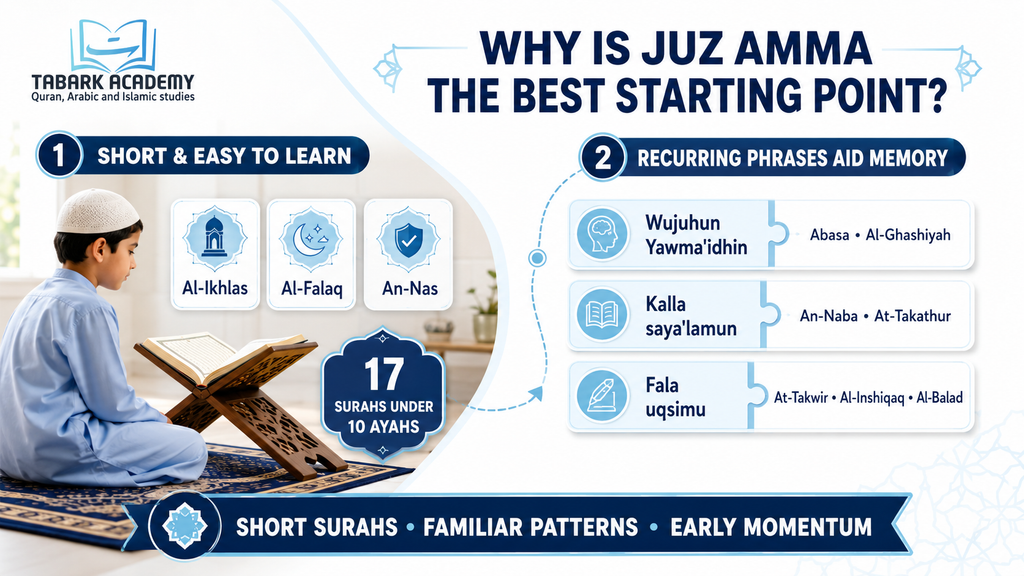
1. The Short And Easy-To-Learn Surahs In Juz Amma
Most surahs in Juz Amma are under 20 verses, and 17 of them are under 10 verses. A beginner working through Al-Ikhlas, Al-Falaq, or An-Nas can memorize a complete surah in a single sitting, which builds momentum early- something longer surahs elsewhere in the Quran don’t offer.
2. The Recurring Themes In Juz Amma Aid Understanding And Memorization
Several surahs in Juz Amma repeat the same phrases, which reinforces memory rather than adding new material to learn. For example, “Wujuhun Yawma’idhin” (faces on that Day) appears in both Abasa and Al-Ghashiyah.
Also, the phrase “Kalla saya’lamun” (No! They will come to know) appears in both An-Naba and At-Takathur. Recognizing these repeated phrases means memorizing one pattern instead of two separate ones.
| Repeated phrase | Surahs it appears in |
| Wujuhun Yawma’idhin | Abasa, Al-Ghashiyah |
| Kalla saya’lamun / sawfa ta’lamun | An-Naba, At-Takathur |
| Fala uqsimu | At-Takwir, Al-Inshiqaq, Al-Balad |
| Hal ataka hadithu | An-Nazi’at, Al-Ghashiyah, Al-Buruj |
| Ya ayyuha al-insan | Al-Infitar, Al-Inshiqaq |
A common mistake beginners make here is treating every surah as a completely fresh memorization task. Spotting these repeated phrases first, before starting to memorize, cuts real study time, because half the phrase is already familiar from another surah.
Read also: Is It Too Late to Memorize the Quran? The Honest Answer for Adult Learners
How To Memorize Juz Amma Step By Step?
There’s no single “correct” method, but the sequence below reflects how most Hifz teachers structure the first few months with a new student.
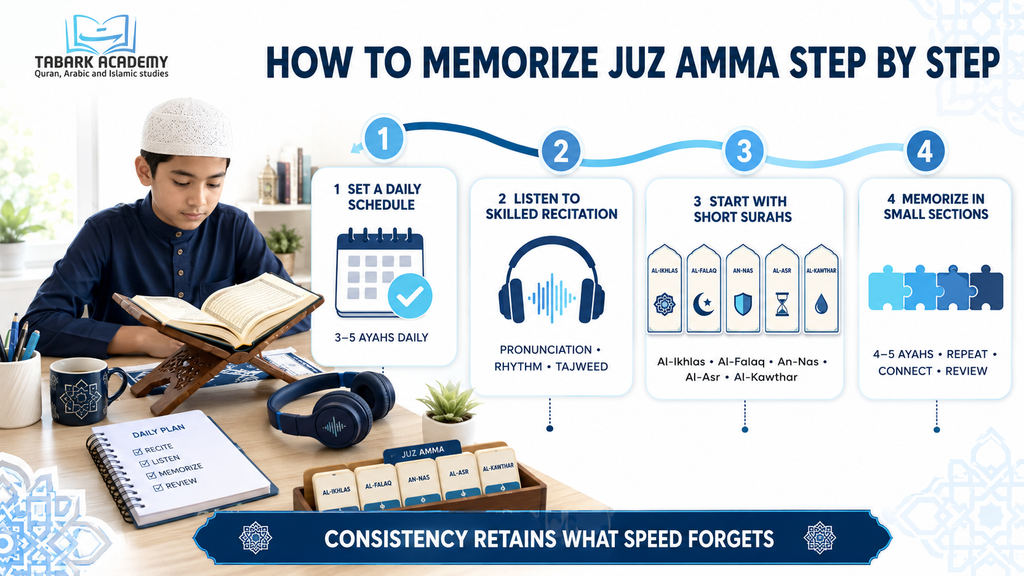
1. Set A Daily Schedule For Memorization
Decide how many verses or surahs you’ll cover each day before you start, not after. A child memorizing 3–5 short verses daily will complete the shortest ten surahs of Juz Amma within a few weeks; an adult with more study time can move faster. The schedule matters more than the pace; consistency retains what speed forgets.
2. Listen To Skilled Recitation For Juz Amma
Listening to a qualified reciter before attempting to memorize fixes pronunciation and rhythm from the start. This matters more in Juz Amma than elsewhere, because several surahs (Al-Adiyat, Al-Qari’ah, Al-Zalzalah) rely on precise Tajweed rules around stopping and starting that are easy to get wrong from text alone.
Read also: 5 Interactive Quran Games That Make Memorization Effortless for Kids
3. Start With The Shortest Surahs In Juz Amma
Begin with Al-Ikhlas, Al-Falaq, An-Nas, Al-Asr, and Al-Kawthar, five surahs under six verses each. Completing these first gives a beginner a working sense of achievement before tackling An-Naba, which, at 40 verses, is the longest surah in the entire juz.
4. Break Each Surah Of Juz Amma Into Small Sections
Divide longer surahs like An-Nazi’at (46 verses) or ‘Abasa (42 verses) into groups of 4–5 verses. Repeat each group aloud until it’s fixed, then connect it to the previous group before moving forward. Reviewing daily after prayer, rather than only when convenient, is what actually locks a surah into long-term memory.
This is the same structured approach Tabarak Academy’s certified teachers use in one-on-one online sessions, adjusting the pace to match whether the student is a young child or an adult starting Hifz for the first time.
Read also: How To Start Memorizing The Quran As A Beginner?
Step Inside Our Virtual Classrooms
See our engaging teaching methods in action! watch real snippets of our live classes and discover how our expert instructors make learning interactive, memorable, and inspiring for every student.
Key Lessons And Themes In Juz Amma
Beyond memorization, Juz Amma carries a consistent set of themes that repeat across its 37 surahs, worth understanding, since the meaning is what makes the memorized words stick.
1. Belief In God And The Day Of Judgment
The majority of Juz Amma’s surahs address resurrection and accountability directly. An-Naba opens the juz by describing the Day of Judgment in detail, and An-Nazi’at follows with the story of Musa and Pharaoh as a warning against arrogance. This isn’t incidental. The juz is structured so its opening surahs establish belief before its closing surahs turn to daily conduct and protection.
2. Reflection On Creation And Human Conduct
Surahs like At-Tin emphasize that humans were created “in the best form,” while Ash-Shams contrasts the soul’s capacity for both good and wrong.
Ad-Duha and Ash-Sharh, revealed together, address the Prophet Muhammad directly, reassuring him during a period of hardship and instructing gratitude for difficulty overcome. A theme that resonates well beyond its original context.
Read also: 10 Strategies Of How To Memorize Quran Fast And Never Forget
Start Your Juz Amma Memorization Journey With Tabarak Academy
Knowing the list is the easy part. Memorizing it with correct Tajweed and real retention takes structured guidance.
Tabarak Academy connects you or your child with certified Quran teachers for one-on-one online sessions built around exactly this kind of surah-by-surah progression, with regular review built in so nothing is forgotten once it’s learned.
Our Quran Memorization / Hifz Courses
- Online Hifz Program
- Juz 30 Memorization
- Hifz for Kids
- Hifz for Adults
- Hifz for Sisters
- Short Surah Memorization Course
- Hifz Ijazah Course
Our Quranic Arabic Courses
- Quranic Arabic Classes
- Quranic Arabic Course for Kids
- Quranic Arabic for Beginners
- Quranic Arabic Grammar Course
Conclusion
Juz Amma contains 37 surahs, from An-Naba to An-Nas, totaling 564 verses across mostly short chapters. Thirty-four of these surahs are Meccan, and three are Medinan, and the section is deliberately structured to move from longer surahs on judgment and resurrection toward the short, focused surahs recited daily in prayer.
Whether you’re memorizing it for yourself or guiding a child through it, the same principle applies: start with the shortest surahs, use the repeated phrases to your advantage, and review daily. Juz Amma is designed to be memorized. The structure does part of the work for you if you follow it in order.
Frequently Asked Questions
How Many Surahs Are In Juz Amma?
Juz Amma contains 37 surahs, starting with Surah An-Naba (chapter 78) and ending with Surah An-Nas (chapter 114). It is the thirtieth and final section of the Quran.
What Is The First Surah In Juz Amma?
The first surah in Juz Amma is An-Naba, which has 40 verses and discusses the Day of Judgment. It gives the juz its name, taken from the surah’s opening word, “Amma.”
What Is The Last Surah In Juz Amma?
The last surah in Juz Amma is An-Nas, a six-verse surah recited for protection against harm. It is also the final surah in the entire Quran.
How Many Verses Are In Juz Amma?
Juz Amma contains 564 verses spread across its 37 surahs. Verse counts range from 3 verses (Al-Asr, Al-Kawthar, An-Nasr) to 46 verses (An-Nazi’at).
Which Surahs In Juz Amma Are Medinan?
Three surahs in Juz Amma are Medinan: An-Nasr, Al-Bayyinah, and Az-Zalzalah. The remaining 34 surahs are Meccan, revealed before the migration to Medina.
Why Is Juz Amma Usually Memorized First?
Juz Amma is memorized first because most of its surahs are short. 17 of the 37 have fewer than 10 verses, and it is recited frequently in daily prayer, which naturally reinforces memorization through repetition.