


Time Management in Islam – 3 Effective Habits Backed by the Quran And Hadith
Time is free, but it’s priceless. You can’t own it, but you can use it. You can’t keep it, but you can spend it. Once you’ve lost it, you can never get it back.
Harvey Mackay
“By time, indeed, mankind is in loss, except those who believe and do righteous deeds and advise each other to truth and advise each other to patience.” Quran, 103:1-3
Islam is a complete code of life, and it has addressed many topics — manners, worshipping Allah, being a good Muslim, how to eat, drink, dress, and even how to deal with people. One of these topics is time management in Islam, and if we make good use of it, our lives could change dramatically. Time is the one thing every human being deals with daily, regardless of nationality, color, or language.
All people have 24 hours a day, so why is it that some people achieve so much more with their time than others? The answer lies in good time management. Everyone has complete freedom to use every minute of it to do their best and develop themselves. However, others may not give it a single thought and simply spend their life doing whatever comes to mind, whether or not it’s good for them.
Allah (glory be to Him) has fixed a limited lifespan for everyone on earth, and every person’s time eventually ends. Allah said: “For every nation there is a term fixed, so that when their term comes, they cannot delay a single moment, nor can they bring it forward.”
What Is Time Management in Islam?
Time management in Islam is the practice of planning and using every hour deliberately, based on the belief that time is a trust from Allah for which every person will be questioned on the Day of Judgment — not simply a resource to spend however feels convenient.
That belief is what separates this from a generic productivity method, so it’s worth looking at both halves on their own: the general concept, and what changes once it’s placed inside an Islamic framework.
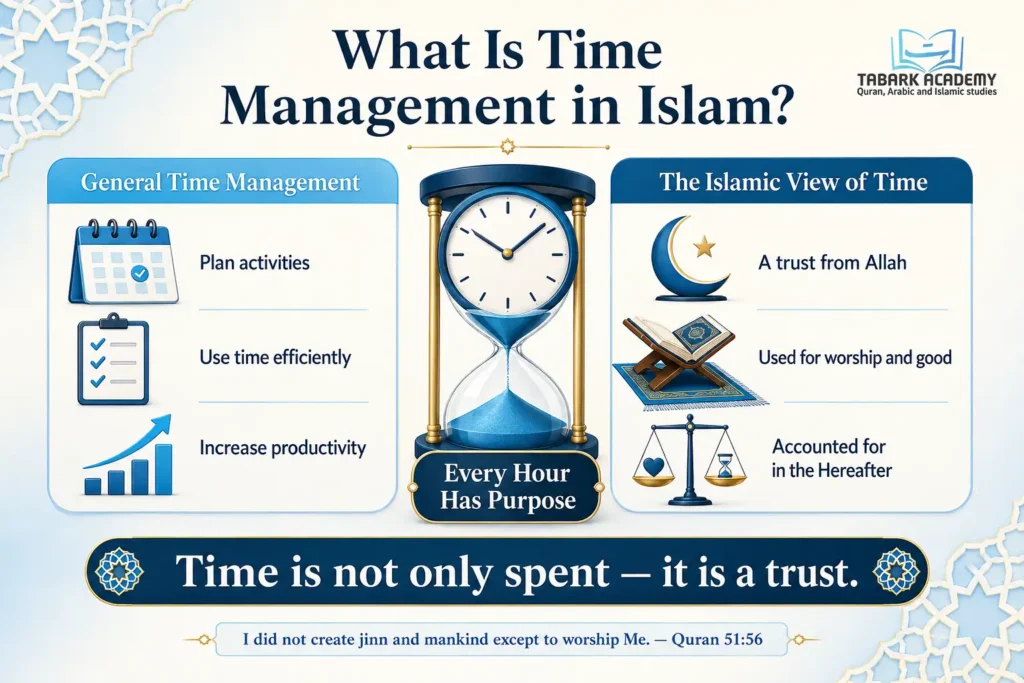
The General Concept of Time Management
Time management is the process of planning and exercising conscious control of time spent on specific activities, especially to increase effectiveness, efficiency, and productivity.
The Islamic View of Time
Time starts from the first day a person was born and ends in the last day of life. It is a gift Allah bestowed us in order to achieve our ultimate goal of life which is to worship Allah alone .Every day passes , a person becomes nearer to death and also will be asked about their lives in the day of judgment.
Allah said ;
”And I did not create the jinn and mankind except to worship Me.” (Adh-Dhariyat 51:56)
Abu Barzah Al-Aslami narrated that the Messenger of Allah (peace be upon him) said:
“The feet of the slave of Allah shall not move [on the Day of Judgment] until he is asked about five things: about his life and what he did with it, about his knowledge and what he did with it, about his wealth — how he earned it and where he spent it — and about his body and what he wore it out on.” (Jami` at-Tirmidhi 2417)
This is the belief that makes time management in Islam fundamentally different from ordinary productivity advice — it treats time as something you will answer for, not just something you spend
Read Also: How To Raise Children In Islamic Way?
Arabic Hadiths About Time Management and Productivity
The Prophet Muhammad (peace be upon him) didn’t just speak about worship in general — he addressed time directly. These hadiths are the foundation that time management in Islam is built on.
1. Take Advantage of Free Time Before Work Consumes It
This hadith lists five blessings that quietly turn into their opposite, and free time is one of them.
عَنِ ابْنِ عَبَّاسٍ: “اغْتَنِمْ خَمْسًا قَبْلَ خَمْسٍ: شَبَابَكَ قَبْلَ هَرَمِكَ، وَصِحَّتَكَ قَبْلَ سَقَمِكَ، وَغِنَاكَ قَبْلَ فَقْرِكَ، وَفَرَاغَكَ قَبْلَ شُغُلِكَ، وَحَيَاتَكَ قَبْلَ مَوْتِكَ”
“Take advantage of five before five: your youth before your old age, your health before your illness, your riches before your poverty, your free time before your work, and your life before your death.” (Narrated by Ibn Abbas, reported by Al-Hakim)
This hadith names free time specifically — not time in general. Necessities like work and prayer already claim part of the day; it’s what you do with what’s left over that this hadith is measuring.
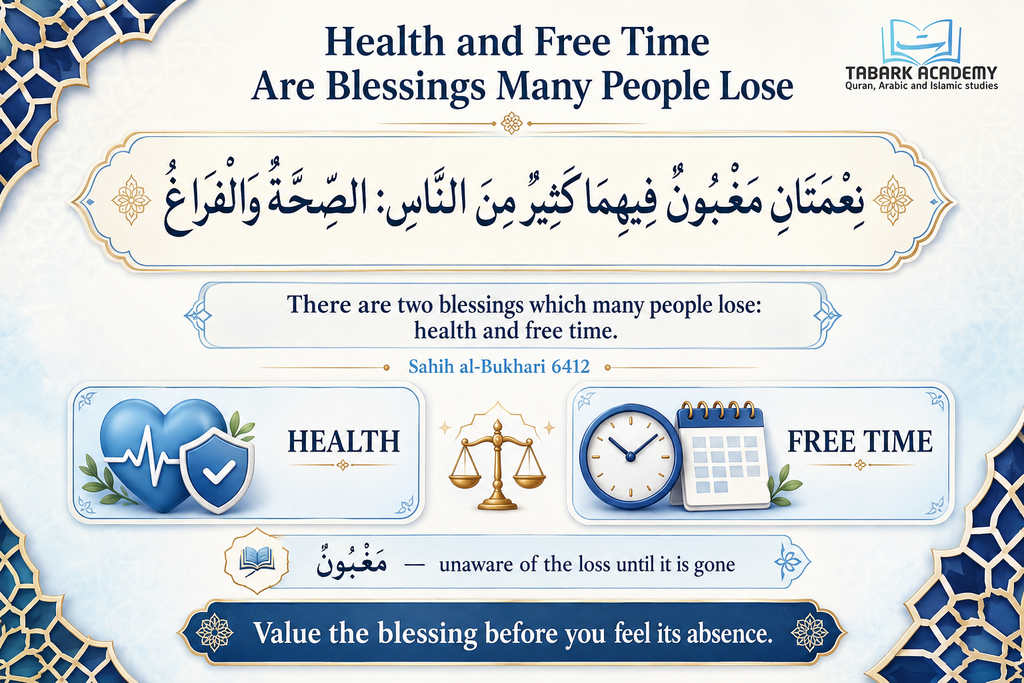
2. Health and Free Time Are Blessings Many People Lose
Here the Prophet narrows the list down to the two blessings people most often take for granted.
“نِعْمَتَانِ مَغْبُونٌ فِيهِمَا كَثِيرٌ مِنَ النَّاسِ: الصِّحَّةُ وَالْفَرَاغُ”
“There are two blessings which many people lose: health and free time.” (Sahih al-Bukhari)
The word “مغبون” — deceived, cheated — is deliberate. The Prophet is describing people who don’t realize they’re losing something valuable until it’s already gone.
3. Every Person Will Be Asked How They Spent Their Life
This hadith makes the accountability side of time explicit — it’s not a metaphor, it’s a question everyone will face.
“لَا تَزُولُ قَدَمَا عَبْدٍ يَوْمَ الْقِيَامَةِ حَتَّى يُسْأَلَ عَنْ عُمُرِهِ فِيمَا أَفْنَاهُ”
“The feet of the servant will not move on the Day of Judgment until he is asked about his life and how he spent it.” (Sunan al-Tirmidhi)
Two of the five questions asked on the Day of Judgment concern time specifically — general lifespan, and separately, the years of youth. That repetition signals how central time accountability is in Islamic belief.
4. Balance the Rights of Allah, Yourself, and Your Family
This hadith is the corrective for anyone tempted to swing too far in one direction, whether toward work or toward worship.
“لِرَبِّكَ عَلَيْكَ حَقًّا، وَلِنَفْسِكَ عَلَيْكَ حَقًّا، وَلِأَهْلِكَ عَلَيْكَ حَقًّا، فَأَعْطِ كُلَّ ذِي حَقٍّ حَقَّهُ”
“Your Lord has a right over you, your own self has a right over you, and your family has a right over you — so give each their due.” (Sahih al-Bukhari)
This is arguably the most practical hadith in this list, because it works against lopsided schedules directly — whether the imbalance comes from overwork, or from excessive worship that ends up neglecting family.
If these hadiths are new to you, Islamic Studies for Beginners covers the foundational texts they come from in more depth.
Step Inside Our Virtual Classrooms
See our engaging teaching methods in action! watch real snippets of our live classes and discover how our expert instructors make learning interactive, memorable, and inspiring for every student.
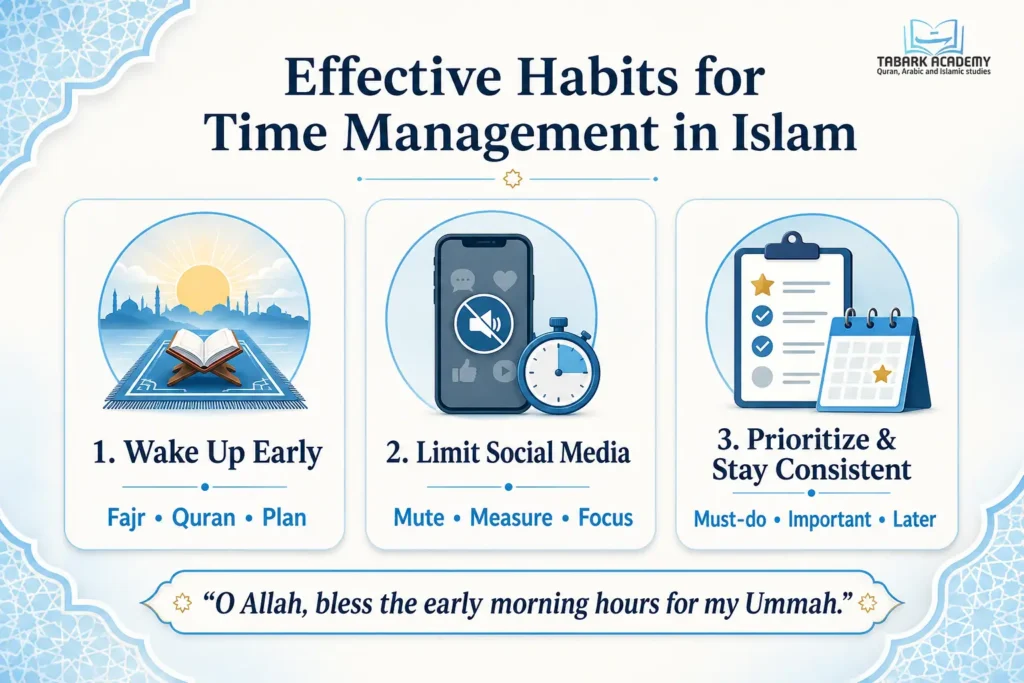
Effective Habits for Time Management in Islam
The hadiths above establish why time matters. What follows are three concrete habits that turn that belief into a daily routine — the practical side of everything covered above.
1. Wake Up Early Every Morning
Raising early has many benefits as you can have Productivity making use of the calmness The world is in the early morning. You can plan your day and achieve many goals you want.
It is very important to realizes that life is short to waste in long sleeping hours .Also, making this habit is not easy at all, so a person shall overcome and manage their day better.
”early to bed early to rise makes one healthy, wealthy and wise”
In the morning , A person can have fitness, creativity , blessing and tranquility. Prophet (may Allah’s peace and blessings be upon him) said:
“O Allah, bless the early morning hours for my Ummah.”
For example, a 5:30 a.m. wake-up for Fajr leaves roughly two uninterrupted hours before the workday starts — enough time for a short Quran portion, a plan for the day, and a task most people push to the evening when energy is already gone.
2. Minimize Social Media Time
Social media can be the tricky beast that kills and destroys you, your life, your aspirations, and your goals. A person has to be aware of how much time they’re spending on social media every day.
Look at the number of hours you spend on it without paying attention — what could you have spent those hours doing instead? You can follow a few simple steps and use apps that help you take control of your time:
- Turn off notifications of your phone
- Do not put your phone everywhere with you
- Don’t check your phone before a specific time you fix
- Focus on one thing only
- Stop the scroll
- unsubscribing to unwanted and useless channels and emails
Most phones now show a weekly screen-time report under Settings. Checking it before making any other change is usually the fastest way to see where the hours are actually going. For adults managing this alongside work, Islamic Studies for Adults is built around evening and weekend schedules specifically, so it competes with scrolling time rather than losing to it.
3. Prioritize and Be Consistent
give a priority for the things that are the most important then to the important and finally to the less important . ask yourself these questions;
- What is worth spending an hour on?
- What comes first?
- What is a must-do and what is good-to-do?
- What is urgent and what is not?
For example, what’s the real priority — teaching your kids Quran and Islamic studies, or sending them to a club to learn swimming just for fun? Getting this right is one of the clearest everyday tests of these priorities within family life.
If Quran and Islamic studies keep landing at the top of that priority list, Online Islamic Studies Classes make it easier to actually protect that time slot — structured lessons at a fixed weekly time work the same way Salah does: they anchor the schedule instead of competing with it. To find the best tutors, contact us here.
Reading about these habits is easy. Building them into a routine that sticks usually takes structure and someone checking in on your progress — which is exactly what a class provides.
Experience Our Interactive Learning
Curious about how we teach? Watch these brief video clips from our recent live sessions to see our structured curriculum, advanced learning platform, and dynamic student-teacher interactions firsthand.
Read Also: 5 Important Reasons why morals are important in Islam
Start Building Better Time Management Habits Today
At Tabarak Academy, our Islamic Studies courses give you a fixed weekly commitment built around real teachers, not just content to browse whenever you happen to find time.

Whether you’re new to structured learning or picking it back up, a class with a set schedule does more for consistency than any app or reminder — and it turns everything covered above from theory into an actual routine of time management in Islam. A class tailored to female students is also available through Islamic Studies for Ladies.
Our Islamic Studies Courses:
- Online Islamic Studies Classes
- Islamic Studies for Beginners
- Islamic Studies Classes for Kids
- Islamic Studies for Adults
- Islamic Studies for Ladies
- Islamic Studies for New Muslims
- Tafseer Al Quran Course
- Quranic Sciences (Uloom Al Quran) Course
- 5 Pillars of Islam for Kids
- Islamic Summer Camp
Conclusion
Time management in Islam isn’t a productivity hack borrowed from self-help culture — it’s a form of accountability the Prophet addressed directly, in hadiths that name free time, health, and youth as blessings people lose without noticing.
Waking early, cutting unstructured social media time, and prioritizing by what actually matters are simple habits, but they only work when practiced consistently. The Arabic hadiths above are the reminder; a daily routine — ideally one with real structure behind it — is the follow-through that makes it more than just good intentions.

Frequently Asked Questions
These are the questions readers most often ask about time management in Islam, beyond the habits already covered above.
1. What is time management in Islam?
Time management in Islam is the practice of using one’s time deliberately, based on the belief that every hour is a trust from Allah that a person will be questioned about on the Day of Judgment — not simply a resource to spend however feels convenient.
2. What is the most important hadith about time management?
The “five before five” hadith, narrated by Ibn Abbas, is considered the most comprehensive, because it pairs time with four other perishable blessings — youth, health, wealth, and life itself — and instructs the listener to use each before its opposite arrives.
3. What does Islam say about wasting time?
Islam treats wasted time as a lost blessing, not a neutral choice. The hadith “There are two blessings which many people lose: health and free time” (Sahih al-Bukhari) frames unused free time as something a person will be questioned about, not something that simply passes without consequence.
4. How can a Muslim practice better time management in Islam every day?
Anchoring the day around the five daily prayers, waking up before or at Fajr, and reducing unstructured social media use are the three most practical starting points, since each creates a fixed checkpoint the rest of the day can be planned around.
5. Does Islam allow rest and leisure time?
Yes. The same hadith that instructs giving “each their due” includes the self as one of those rights — rest and leisure aren’t opposed to this idea, only unstructured or excessive leisure that displaces prayer, family, or work obligations.
6. Why do some people achieve more in the same 24 hours?
Because the amount of time is fixed for everyone, but how deliberately it’s planned is not. New Muslims often ask exactly this question when starting to build Islamic habits — Islamic Studies for New Muslims covers it as part of building a full daily practice, not just a schedule.