


10 Strategies Of How To Memorize Quran Fast And Never Forget
Every Muslim who has sat with a Mushaf, repeated a verse until it felt solid, and then opened their mouth a week later to find nothing but silence knows exactly what this article is addressing. The question of how to memorize Quran fast and never forget is not about motivation — most students have that in abundance. It is about methods. Specifically, it is about the gap between storing something and keeping it.
The Prophet ﷺ warned his companions: “Guard this Quran carefully, for by the One in Whose Hand is my soul, it slips away faster than a camel from its tether” (Bukhari and Muslim). That hadith is not discouraging. It is a design specification. The Quran demands active custody — and a system that provides it.
The 10 strategies below are drawn from both the classical tradition of Islamic scholarship and from what practitioners observe in students who memorize successfully and hold their hifz for life. Each one addresses a specific reason why memorization breaks down. Together, they form a system.

1. Begin With Sincere To Master How To Memorize Quran Fast And Never Forget
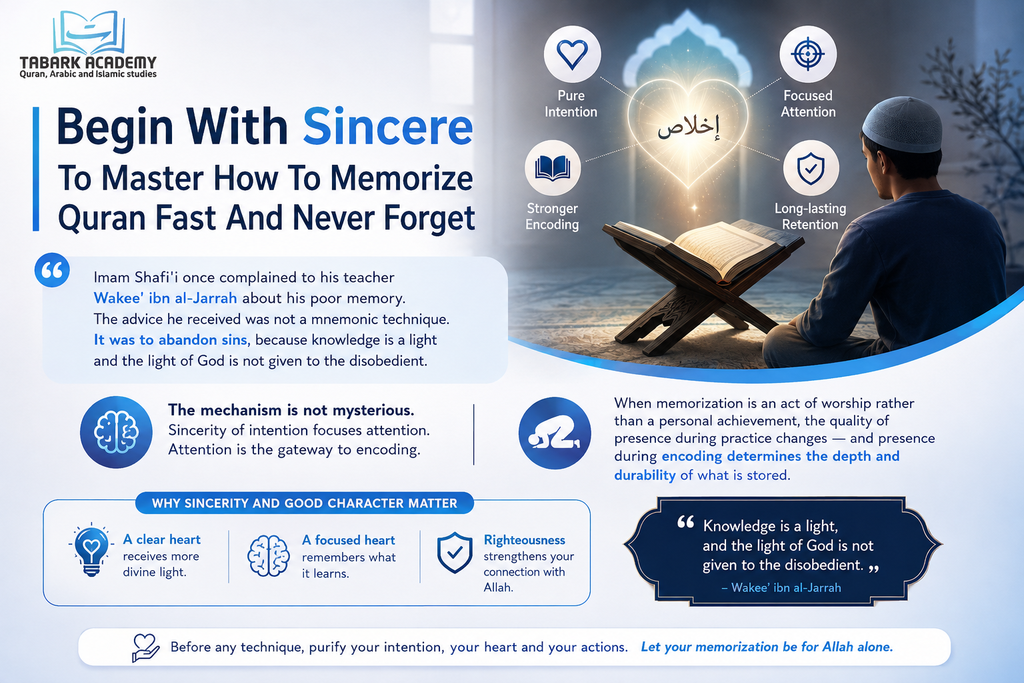
Imam Shafi’i once complained to his teacher Wakee’ ibn al-Jarrah about his poor memory. The advice he received was not a mnemonic technique. It was to abandon sins, because knowledge is a light and the light of God is not given to the disobedient. This observation has been repeated across centuries of Quran teaching because teachers kept seeing it confirmed.
The mechanism is not mysterious. Sincerity of intention focuses attention. Attention is the gateway to encoding. When memorization is an act of worship rather than a personal achievement, the quality of presence during practice changes — and presence during encoding determines the depth and durability of what is stored.
The important reasons why morals are important, especially their connection to clarity of heart and sustained attention, are worth understanding before any technique is applied.
2. Lock In One Mushaf And Never Switch
The brain stores verbal memory alongside visual memory. When you memorize a verse, you are partly encoding where that verse sits on the page — which line breaks, which word lands at the end of a row, how the text is spaced. This visual anchor is the best way to memorize Quran fast and never forget than most students realize, and it is why teachers have always insisted on a single, consistent Mushaf.
Switch to a different print layout and that visual map resets. Students who alternate between apps, printed editions, and different page sizes almost universally report weaker retention and slower recall than students who commit to one physical Mushaf from day one.
The Medina Mushaf in 15-line format is the most widely used standard, partly because its page breaks align with natural recitation units. Pick one and treat switching as non-negotiable.
Enroll in the Arabic Reading Course Today

3. Memorize After Fajr Where Your Brain Is Built For This Window
This is not folk tradition dressed in religious language. Working memory capacity and the brain’s ability to encode new information peak during the period immediately following sleep, when the mind is rested, cortisol is rising naturally, and the day’s cognitive load has not yet begun.
Early Islamic scholars identified this through decades of pedagogical observation. Neuroscience later confirmed the mechanism. The practical window is the first 30 to 45 minutes after Fajr prayer.
Environmental stillness reinforces the neurological advantage, but the deeper driver is physiological: the brain fresh from sleep consolidates material from the previous night while simultaneously being most receptive to new input.
If the Fajr window is genuinely unavailable, the next best option is any period following at least six hours of sleep, before significant cognitive demands begin.
Read also: Black Magic in Islam: Protection, Symptoms & Quranic Cure

4. Repeat Each Verse Until Your Tongue Runs On Autopilot
Twenty repetitions is a floor, not a ceiling. Sheikh Abdul Muhsin al-Qasim’s approach, 20 repetitions per individual verse, followed by 20 repetitions linking it to the verse before, produces a level of automaticity which is one of memorize quran fast and never forget tips.
The test is not “I can produce this verse when I concentrate.” The test is “I cannot say it wrong even when I am not fully attending.” Close your eyes, recite the target verse, and simultaneously think about something unrelated. If the verse comes out cleanly, it is encoded at the right depth.
If your attention must remain on the words to produce them correctly, continue repeating. The goal is not memorization. It is automaticity.
Book a free trial class in Noorani Qaida With Tabark Academy’s Tajweed Course

5. Read The Tafsir Before You Memorize The Words
Memory works by association. When a verse carries meaning, the brain links it to existing concepts, emotional responses, and prior knowledge — creating multiple retrieval pathways. When it is treated as a string of phonetically similar sounds, it exists as a single fragile connection that one moment of distraction can break.
A brief glance at a translation or simple tafsir is enough to activate the meaning layer before memorization begins. Students who explore the importance of the Arabic language often find that even a basic grasp of Quranic vocabulary transforms memorization from mechanical repetition into genuine comprehension.
For those ready to build that foundation systematically, resources to learn Arabic language make a measurable difference to memorization speed over time.
Join Tafseer Al Quran Course at Tabark Academy

Experience Our Interactive Learning
Curious about how we teach? Watch these brief video clips from our recent live sessions to see our structured curriculum, advanced learning platform, and dynamic student-teacher interactions firsthand.
6. Chain New Verses To What You Already Know By Heart
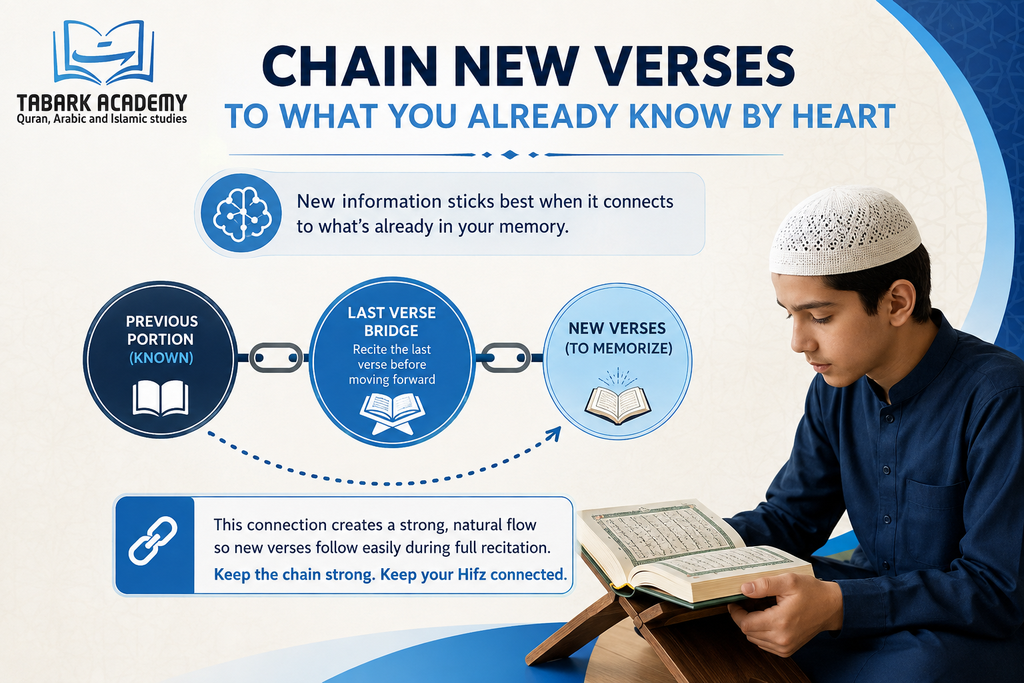
The brain is not a filing cabinet. It is a web of associations. New information sticks most reliably when it connects to existing information — which is exactly why sequential memorization, beginning from al-Fatiha and moving forward in order, outperforms jumping between surahs.
The practical application of this principle is simple: before beginning any new section, always recite the last verse of your previous portion. This creates a semantic and rhythmic bridge. When you encounter that verse during full recitation, the new material follows naturally rather than requiring a separate retrieval effort.
Students who skip this step frequently report that memorized sections feel “disconnected”, solid in isolation, unstable in sequence. Tabarak Academy‘s online Hifz program builds this chain principle directly into its curriculum structure, ensuring students never advance to new material until the connection to previous sections is fluent and reliable.
7. Turn Every Prayer Into A Review Session To Your Memorization
Each of the five daily prayers is a scheduled retrieval opportunity that most students waste by defaulting to familiar surahs. Reciting newly memorized material in salah is one of the most efficient review mechanisms available to a Muslim
The combination of physical ritual, focused spiritual presence, and verbal production creates a memory trace that outlasts desk-based review many times over.
Read also:Best Quran Hifz Schools for Online Quran Memorization
The recommended pattern is to recite the most recently memorized material in fard prayers and older portions in sunnah and nawafil. Over the course of a week, this cycles naturally through a significant volume of memorized material without requiring dedicated review sessions beyond the daily schedule.

8. Review Your Memorization In The Weekend
Weekly review is essential for turning new memorization into long-term retention. Instead of constantly adding new verses, set aside one day to strengthen what you have learned and identify any weak points before they become difficult to correct.
Read also: Can I Memorize the Quran at 40?
A. Dedicate One Day to Weekly Review
Follow six days of memorization with one day focused entirely on review. This structure reflects the principle of distributed practice and gives your mind time to consolidate the material you have learned throughout the week.
B. Recite the Week’s Memorization Without the Mushaf
On the seventh day, recite the entire week’s new memorization from beginning to end without consulting the Mushaf. Pay attention only to the places where you hesitate or make mistakes, then return to those sections and practice them until they become secure.
C. Use Review to Strengthen Long-Term Retention
Your review day is not a day off from Hifz; it is a crucial part of the memorization process. Skipping weekly review allows small mistakes to accumulate, while consistent consolidation keeps your memorization strong and manageable as you continue progressing.
Book a FREE One Trial Session in Our Juz 30 Memorization Course Now

9. Recite To A Qualified Teacher
Errors in Quran recitation are uniquely difficult to self-detect. They can be grammatically plausible, phonetically similar to the correct text, and completely wrong — embedded silently over weeks of private practice until they become deeply habituated. Without an expert ear, these errors consolidate quietly and become increasingly difficult to uproot.
The Prophet ﷺ himself reviewed the Quran with Jibreel every Ramadan. The tradition of talaqqi — oral transmission directly from teacher to student — exists precisely because self-taught recitation produces systematic errors that self-correction alone cannot catch. For students who reach the point of complete memorization and seek formal certification, understanding how to get ijazah is the natural next step.
The Ijazah tradition is also connected to the types of Qirat in the Quran — knowing which recitation style your teacher is certifying you in ensures that certification is accurate and recognized.

10. Guard Your Tawbah And Consistent Spiritual State
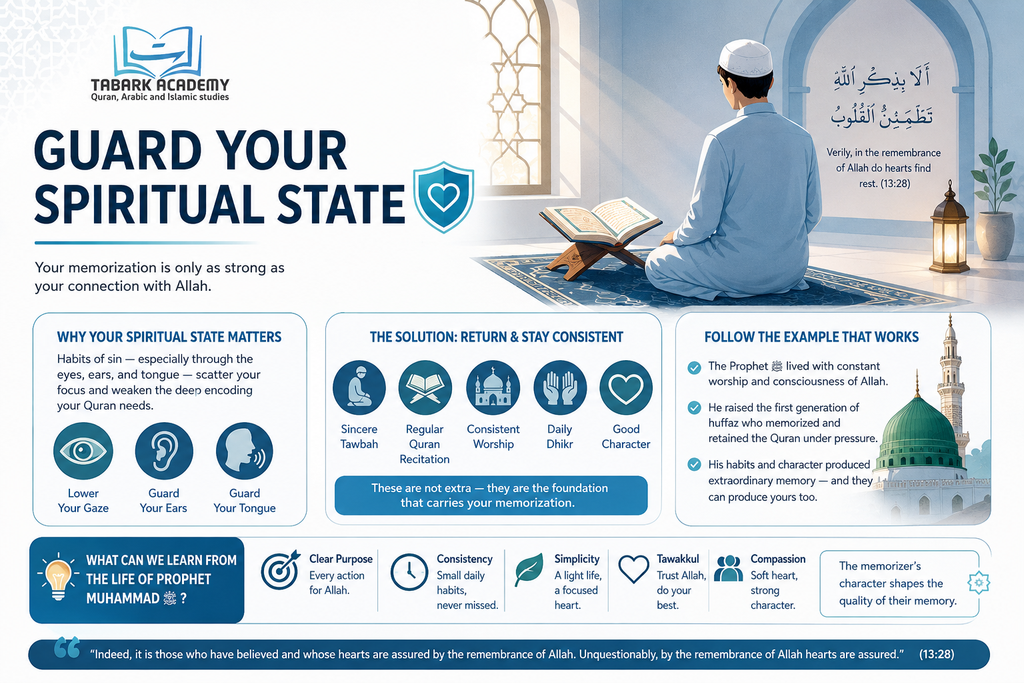
Every classical scholar who wrote substantively on Quran memorization named spiritual neglect and habitual sin as primary causes of forgetting. The mechanism is attentional rather than supernatural: habitual sin, particularly sins involving the eyes, ears, and speech, fragments the focused presence that encoding requires.
Tawbah and consistent spiritual practice are not peripheral to the memorization process. They are the substrate it runs on. The lifestyle of the Prophet ﷺ — his consistency in worship, his simplicity, his constant consciousness of God — produced the first community of huffaz, and their memorization held under conditions of enormous pressure.
Studying what can we learn from the life of prophet Muhammad reveals specific habits and character traits that correlate directly with the kind of sustained attention memorization requires. The memorizer’s character shapes the quality of their memory.
Step Inside Our Virtual Classrooms
See our engaging teaching methods in action! watch real snippets of our live classes and discover how our expert instructors make learning interactive, memorable, and inspiring for every student.
What Students Achieve At Tabark Academy?
Most students who struggle with Quran memorization have one thing in common: they are doing it alone. Progress is slow, errors embed undetected, and motivation quietly erodes as the distance between aspiration and current ability grows wider.
Tabarak Academy was built around the opposite model. Expert guidance, consistent accountability, and a structured curriculum that works whether you are beginning your first juz or rebuilding after years away. The academy’s instructors hold Ijazah in Hafs ‘an ‘Asim — the most widely taught recitation style — and bring both the formal chain of transmission and practical experience teaching diverse learners to every session.
Students report three consistent changes within the first month: sharp improvement in retention once a qualified teacher identifies and corrects errors before they habituate; a noticeably richer experience of salah as memorized material becomes genuinely recitable under pressure; and a sense that the journey, however long, is no longer uncertain.
Classes run live online with flexible scheduling designed to accommodate working adults, parents, and students across different time zones.
Our Quran Memorization / Hifz Courses
- Online Hifz Program
- Juz 30 Memorization
- Hifz for Kids
- Hifz for Adults
- Hifz for Sisters
- Short Surah Memorization Course
- Hifz Ijazah Course
Enroll At Tabark Academy Today, Don’t Walk This Road Alone
The difference between a hifz journey that succeeds and one that quietly stalls is almost never raw talent. It is structure, qualified oversight, and a teacher who hears your errors before they become habits.
Tabarak Academy pairs every student with an Ijazah-certified instructor for live sessions built around your schedule — whether you are a working professional, a parent fitting sessions around family life, or a student managing school alongside hifz.
Start Your Arabic and Quran Journey with Tabarak Academy Today

Conclusion
The question of how to memorise Quran fast and never forget has a clear answer — not a single trick, but a system. Fix one Mushaf. Guard the Fajr window. Repeat each verse until automaticity replaces effort. Prioritize review over new memorization at a ratio of at least two to one. Recite in every prayer. Protect one full day each week for consolidation. And recite regularly before a teacher who can catch what you cannot hear in yourself.
The spiritual dimension is not decorative. Sincerity, moral uprightness, and consistent tawbah are the soil the methods grow in. Students who neglect them find that even excellent technique produces fragile results. Students who tend both dimensions together find that the Quran settles into memory with a depth and durability that seems, to them, like a gift — and in the classical understanding, it is.
Start with one verse. Start correctly. Start with guidance. The 30 juz are built one ayah at a time, and every ayah you hold for life is worth every hour it costs you.
Frequently Asked Questions
How many verses should I memorize each day to never forget?
Three to five verses per day, memorized to full automaticity, produces better long-term retention than ten verses held loosely. The daily ceiling for new memorization matters far less than the daily floor for review. Always review at least twice the volume of new material before adding anything new.
What is the single best time of day to memorize the Quran?
The period immediately after Fajr prayer is consistently identified by both Islamic scholars and cognitive researchers as the strongest window for new memorization. Working memory peaks after sleep, distraction is minimal, and the session carries the practical advantage of occurring before the day’s demands begin.
Can adults memorize the Quran as effectively as children?
Adults encode more slowly per verse but forget more slowly too, provided structured review is in place. Children have the advantage of uncluttered schedules; adults have the advantage of meaning comprehension. An adult who genuinely understands what they are memorizing often outperforms a child memorizing by rote, particularly over years rather than months.
What should I do when I keep forgetting the same verse?
Isolate that verse and repeat it 30 or more times in a single session, well past the point where you feel you know it. Then identify the verse immediately before it and repeat the transition — the last few words of the preceding verse flowing into the first words of the problem verse — 20 times. Recite that specific verse in salah every day for the following week.
How long does it take to memorize the entire Quran as an adult?
With 45 minutes to one hour of focused daily practice using the methods described here, most adult students complete the Quran in three to five years. The timeline matters far less than the quality — a memorization finished in five years with strong retention is worth many times more than one rushed through in two years that continues to crumble.
Does learning Arabic genuinely help with Quran memorization?
Measurably, yes. Even passive familiarity with the 500 most frequent Quranic root words — which cover the vast majority of the text — transforms unfamiliar sounds into recognizable units and creates the meaning associations that support long-term retention.