


How To Start Memorizing The Quran As A Beginner?
Most people who want to memorize the Quran never actually begin. The intention sits quietly in the back of the mind — genuine, sincere, sometimes urgent — but the first step never arrives. They do not know where to open the mushaf, how much to take on each day, or whether their Arabic is good enough to start at all.
This guide answers those questions directly. Learning how to start memorizing the Quran as a beginner does not require extraordinary memory or years of prior study. It requires the right starting point, an honest daily commitment, and a system built around how human memory actually holds information over time.
Everything here is grounded in classical scholarship and the lived experience of teachers who have guided thousands of students — from first verse to completion.
Enroll in Tabark Academy’s Short Surah Memorization Course with a Free Trial

1. Begin With Juz’ Amma Is The Answer Of How To Start Memorizing The Quran As A Beginner
Juz’ Amma, the 30th and final part of the Quran, is the only logical starting point for a beginner. The surahs are short. Most can be memorized in a single focused session. That sense of completing something whole — of being able to recite Surah Al-Ikhlas or Surah Al-Kawthar without looking — is not a small thing.
It trains your mind to associate the memorization process with accomplishment rather than struggle, and that association is what keeps beginners in the room when the longer surahs arrive.
There is a second reason. You have been hearing Juz’ Amma in salah since childhood. Your ears already know the melody, the pauses, and the rhythm. What remains is to convert that familiarity into precision — and familiarity makes that conversion faster than starting cold from Surah Al-Baqarah.
Once Juz’ Amma is memorized with confidence, proceed to longer surahs based on your teacher’s guidance.
Explore our Online Arabic Classes at Tabark Academy

2. Listen Before You Memorize Where Your Ear Is Your First Teacher
Before attempting a single verse, listen to it. Play the passage you plan to memorize that day through a qualified reciter — Sheikh Mahmoud Khalil Al-Husary for precision in tajweed, Sheikh Mishary Rashid Al-Afasy for clarity and tone — and listen to it three to five times before you open the mushaf.
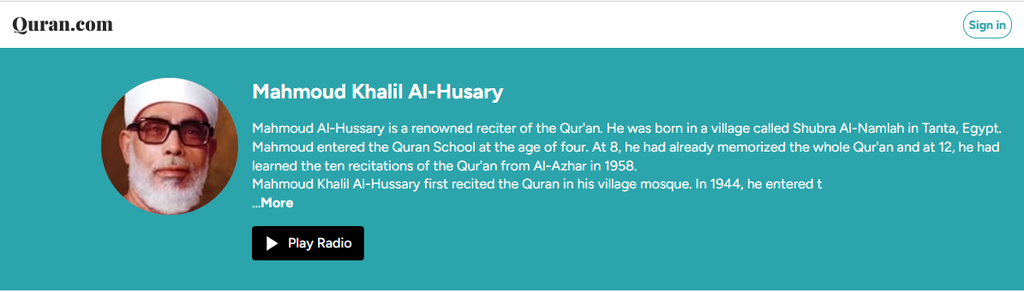
This step is not optional. Your mouth will imitate what your ear has already absorbed. Memorizing without prior listening almost always produces pronunciation errors, and the first version of any memory is the most resistant to correction.
A mispronounced letter memorized three hundred times will not correct itself automatically when someone points it out — it takes active, effortful re-learning to overwrite it.
Use the same reciter for an entire surah. Switching reciters mid-surah forces your memory to reconcile two different melodic patterns for the same text, which slows retention measurably.
Begin your reading Quran journey with our Quran Recitation Course

3. Set A Fixed Daily Time And Treat It Like A Prayer
Inconsistency is what ends most hifz journeys — not lack of ability, not difficult verses, not competing demands. Inconsistency. A student who memorizes 20 minutes every single day will, without question, outperform a student who memorizes two hours occasionally.
The time after Fajr is the best window in the day for memorization. The mind has rested, the house is quiet, and the working memory has not yet been filled with the noise of daily tasks. Scholars from across the classical tradition consistently name this slot as the most productive. After Isha is also viable for those whose mornings are unavoidably crowded.
Decide on your time, write it in your schedule, and protect it the way you protect your obligatory prayers — not as a preference, but as a commitment. This is the best way to start memorizing the Quran as a beginner.
Read also:Is It Too Late to Memorize the Quran?

4. Repeat Each Verse Out Loud Until It Flows Without Effort
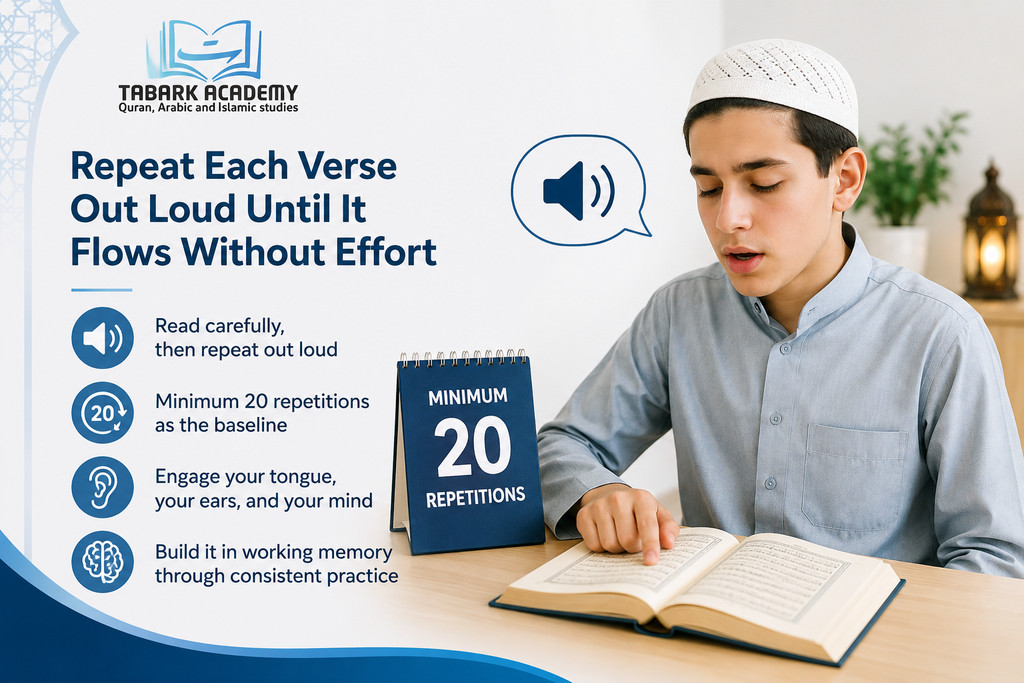
Take the first verse. Read it carefully from the page, then set the mushaf face-down and repeat that verse from memory — out loud, not in a murmur — until it emerges cleanly and without hesitation. Classical scholars recommend a minimum of 20 repetitions as the baseline.
This figure is not arbitrary; it reflects the number of repetitions typically needed to move a new item from short-term to working memory in a healthy adult learner.
Read also: How To Memorize The Quran?
Why out loud? Because raising your voice engages your tongue, your ears, and your cognition at the same time. Students who whisper or sub-vocalize while memorizing consistently report, when they first recite to a teacher, that they had been unconsciously skipping short vowels and small connecting words they never actually heard themselves say.
5. Understand What You Are Memorizing
Understanding the meaning of the verses you are memorizing is one of starting memorizing the Quran as a beginner tips and not a spiritual luxury that comes after mastery. It is a practical memory tool. When your mind grasps the concept behind a verse, you have two retrieval pathways rather than one: the phonetic sequence and the meaning. If the phonetic chain stalls, the meaning can pull it back.
Read a brief, accessible tafsir of the surahs you are working through. At the beginner stage, a clear translation alongside the Arabic is enough to activate meaning.
Some students find they can retrieve a verse they momentarily forgot by thinking “the verse about the Day of Judgment and the weighing of deeds” the meaning leads them back to the words.
Students also discover that how to start memorizing Quran as a beginner begins to reshape their relationship with the Arabic language itself. For those who want to actively develop that, resources on improving your language skills with Quran explain how recitation and language acquisition reinforce each other at the cognitive level.
Have a Look at Tabark Academy’s Certifications & Accreditations

6. Link Each New Verse To What Came Before
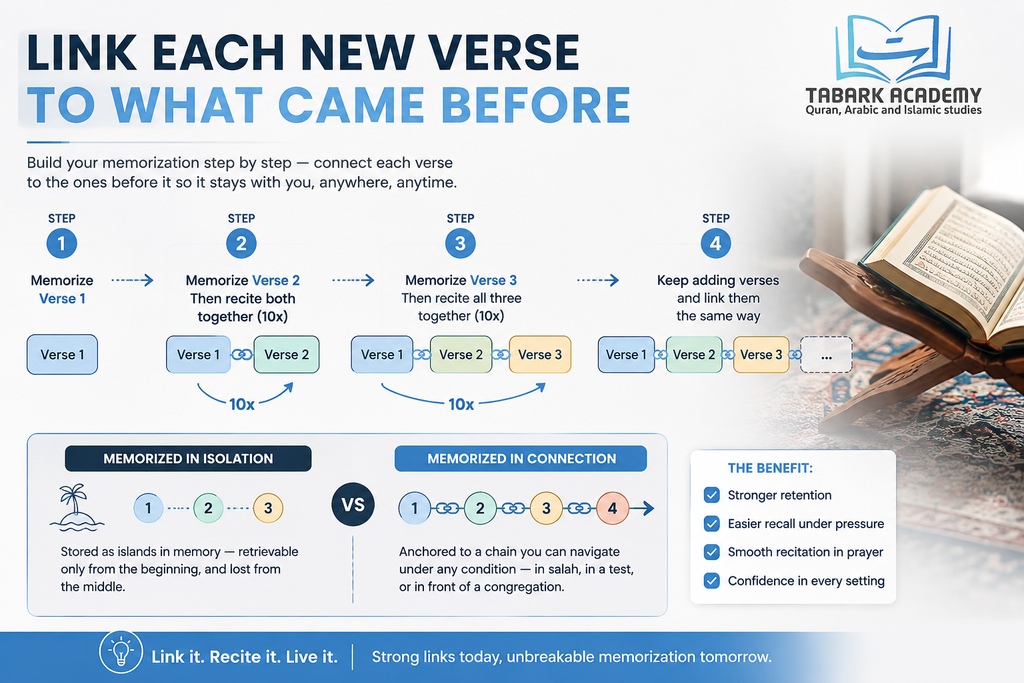
After securing verse one, memorize verse two using the same method. Then — and this is the step most beginners skip — recite both verses together, consecutively, at least ten times. Then add verse three, and recite all three together. Continue adding verses this way until you have covered your daily portion.
This linking step is what separates memorization that endures from memorization that evaporates within weeks. A verse memorized in isolation is stored as an island in memory — retrievable when approached from the beginning, but impossible to access from the middle.
A verse memorized in connection to its neighbors is anchored to a chain that the memory can navigate under any condition: during salah, in a test, in front of a congregation.
Experience Our Interactive Learning
Curious about how we teach? Watch these brief video clips from our recent live sessions to see our structured curriculum, advanced learning platform, and dynamic student-teacher interactions firsthand.
7. Always Review Yesterday’s Material Before Adding Anything New
This step runs against the natural instinct of every motivated beginner. The temptation is to push forward — more verses, more progress, the feeling that you are moving. But without consistent review, everything memorized before the most recent session begins to slip.
The rule is non-negotiable: before adding a single new verse on any given day, recite everything from your previous session from memory, without looking. Only when that review is clean should you proceed. If it reveals gaps — words that come out wrong, transitions that stall — stop there and repair those gaps first.
Experienced hifz teachers phrase it this way: the security of what you have already memorized always takes priority over the acquisition of what you have not yet memorized. This single principle, consistently applied, is what separates those who complete the Quran from those who accumulate a long list of half-remembered surahs they cannot recite in full.
Book Your Free Trial Class Now

8. Write The Verses You Are Memorizing
This practice is underused in the modern world but deeply embedded in classical Islamic pedagogy. The West African tradition of hifz — which produces some of the most precise memorizers alive today — treats writing as inseparable from the memorization process.
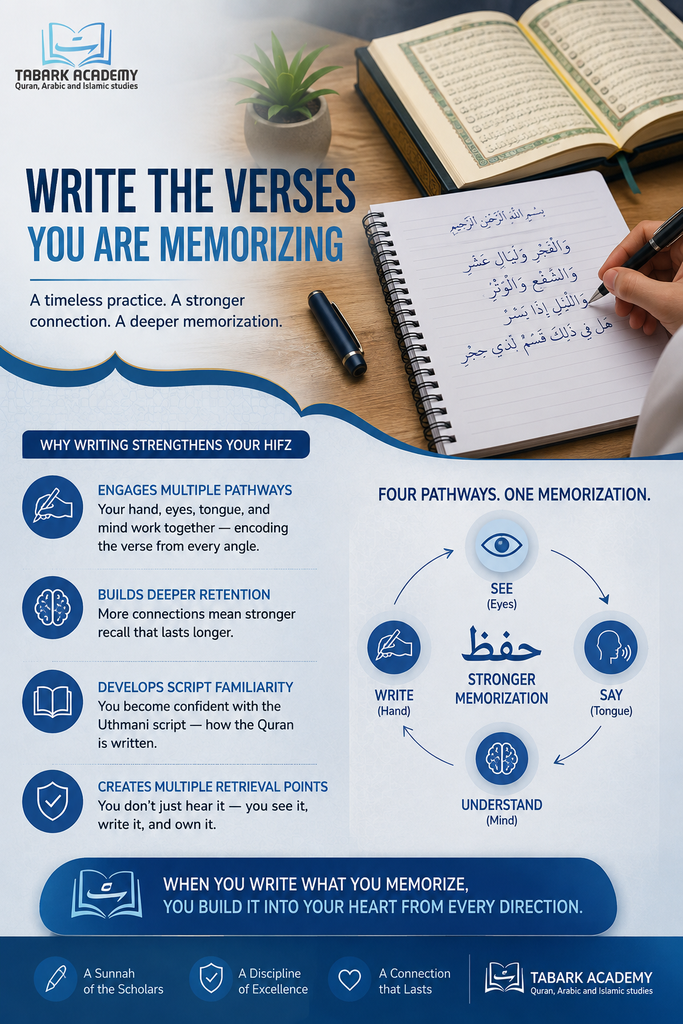
When you write a verse from memory, you engage your hand, your eyes, your tongue (reading aloud as you write), and your analytical mind (checking accuracy against what you know). Four pathways encoding the same material simultaneously. The result is a memorization that holds from multiple angles of retrieval, not just from sound.
Writing also builds familiarity with the Uthmani script, which differs meaningfully from modern Arabic orthography. A student who writes what they memorize does not just know how the words sound — they know how the words look on the page.
9. Recite Your Memorized Verses In Your Daily Prayers
Daily prayers are the most natural and sustainable review mechanism available to any memorizer. After Fajr, add two nafl raka’at and recite everything memorized in the past week. In your obligatory prayers, use your newly memorized surahs when praying alone or leading others.
Salah-based review serves two purposes simultaneously. Memories formed in emotionally and spiritually charged contexts are among the most durable that human memory research has documented — so reciting in prayer moves your memorization from the cognitive to the deeply personal.
And the structure of salah demands precision that casual revision does not: it exposes every loose word, every hesitant transition, and every verse you only think you know.
Read also: 10 Strategies Of How To Memorize Quran Fast And Never Forget
10. Recite To A Teacher — This Step Is Not Optional
Memorizing alone is possible. Completing the entire Quran alone is rare, and rarely produces reliable recitation. Every classical hifz tradition places the teacher-student relationship at the center of the process, not at its edge.
A teacher hears what you cannot hear in yourself: the slightly swallowed letter, the transposed word, the stretch of verses you rush through because the middle section is weaker than you realize.
For those whose goal extends beyond personal memorization, understanding how to get Ijazah shows clearly what the teacher relationship looks like at its highest level and what the path from memorization to certification actually involves.

What Memorizing The Quran Does To Your Arabic Learning?
A side effect of hifz that most beginners do not anticipate is what happens to their Arabic. Even without formal grammar study, regular exposure to Quranic Arabic builds an instinct for root patterns, word families, and the rhythm of classical Arabic prose. Verses that were once opaque begin to carry meaning on their own.
The importance of the Arabic language for anyone engaging with the Quran seriously is hard to overstate. It is the difference between hearing words and understanding what they mean — a difference that also directly accelerates memorization, since comprehension and retention are not separate processes.
Students who choose to learn Arabic Language alongside their memorization typically find that both advance faster than they would separately. Quranic vocabulary becomes the entry vocabulary for Arabic learning, and every memorized verse reinforces grammar patterns that a language student would otherwise encounter only in textbooks.
Students who wonder whether the learning curve will be too demanding should know that the challenge is real but manageable — 3 reasons why Arabic is difficult is a candid look at where the genuine difficulty lies and what it does and does not mean for a motivated adult learner.
Two Beginner Mistakes That Are Worth Knowing Before They Cost You Weeks
Knowing these mistakes before they arrive does not guarantee you will avoid them entirely. But it means you will recognize them faster — and faster recognition means faster correction.
Read also:Best Online Hifz Program
A. Chasing More Memorization Quantity Instead Of Consolidating What You Have
The most consistent mistake among beginners is treating memorization like a race. A student who covers a full page every day but cannot recall the page from three weeks ago has not memorized anything lasting.
They have been filling short-term memory repeatedly without converting it to long-term storage — a distinction the brain makes automatically, and one that short-term recitation success masks completely until suddenly there is nothing to show.
The Mauritanian tradition of hifz — widely regarded as producing the world’s most precise memorizers — operates on the opposite logic. Progress is intentionally slow, repetitions are extreme, and nothing new is added until the old is completely secure.
The core discipline is slowing down to consolidate rather than pushing forward to acquire. This counterintuitive instinct is the one that separates students who complete the Quran from those who accumulate a long list of half-held surahs.
Read also:Quran Memorization Centers in the USA
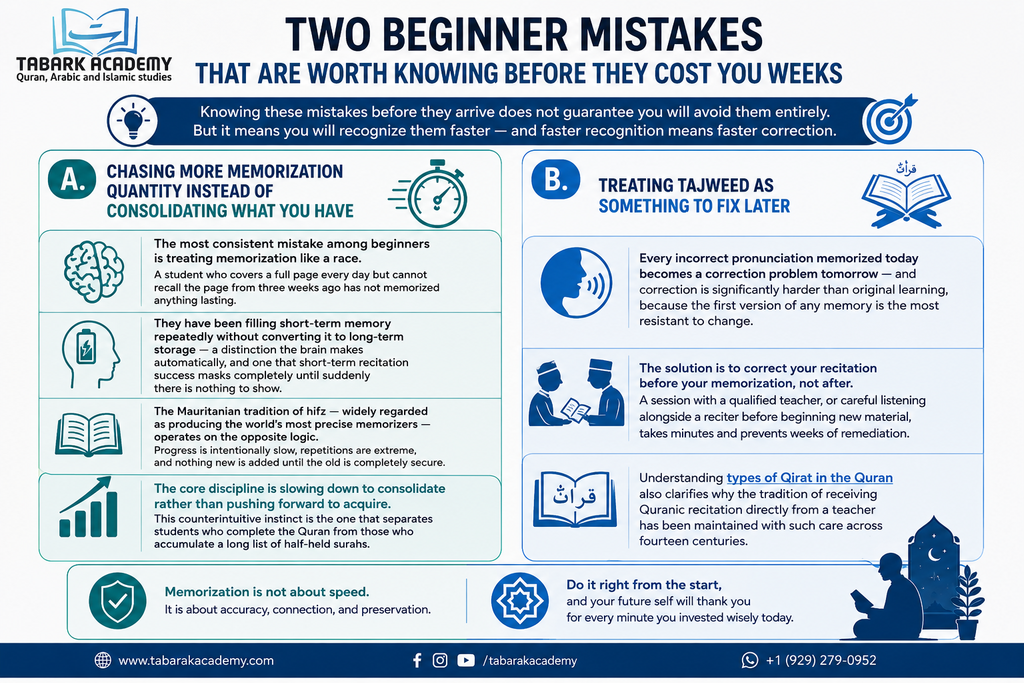
B. Treating Tajweed As Something To Fix Later
Every incorrect pronunciation memorized today becomes a correction problem tomorrow — and correction is significantly harder than original learning, because the first version of any memory is the most resistant to change.
The solution is to correct your recitation before your memorization, not after. A session with a qualified teacher, or careful listening alongside a reciter before beginning new material, takes minutes and prevents weeks of remediation.
Understanding types of Qirat in the Quran also clarifies why the tradition of receiving Quranic recitation directly from a teacher has been maintained with such care across fourteen centuries.
Step Inside Our Virtual Classrooms
See our engaging teaching methods in action! watch real snippets of our live classes and discover how our expert instructors make learning interactive, memorable, and inspiring for every student.
Begin Your Hifz Journey With Tabark Academy’s Expert Teachers
Tabark Academy has helped students across the world begin and complete their memorization journey — from the first nervous session with Juz’ Amma to full Quran completion with qualified teachers trained in the classical chain of transmission.
Every course is designed for the demands of real life: flexible scheduling, one-on-one instruction, and a curriculum built around the way memory actually works. Whether you are beginning at age 10 or age 50, there is a structured path waiting for you.
Our Quran Memorization / Hifz Courses
- Online Hifz Program
- Juz 30 Memorization
- Hifz for Kids
- Hifz for Adults
- Hifz for Sisters
- Short Surah Memorization Course
- Hifz Ijazah Course

Conclusion
Learning how to start memorising the Quran as a beginner comes down to ten decisions made every day: where to begin, when to sit down, who to listen to first, how many times to repeat, whether to link or isolate, whether to understand or just recite, whether to review before adding, whether to pick up a pen, whether to bring your memorization into salah, and whether to find a teacher.
None of these decisions is complicated. All of them compound. The student who applies all ten consistently for ninety days will look back and find, almost without noticing, that they have memorized more than they thought possible — and that the memorization has held.
The Quran was preserved in the chests of human beings long before it existed on a printed page. Every person who has ever completed it began from the same place you are standing now: with a sincere intention and a willingness to begin. The path is well-worn. All that remains is to walk it.
Frequently Asked Questions
How many verses should a beginner memorize per day?
Three to five verses is the right starting range for a beginner. The goal at this stage is not volume — it is retention and confidence. Once you can recite everything you have memorized in the past two weeks without hesitation or prompting, you can gradually increase your daily portion.
Is it better to start with Juz’ Amma or with Surah Al-Baqarah?
For most beginners, Juz’ Amma is the more sensible starting point. The surahs are short, completions come quickly, and early momentum matters more than most beginners realize. Surah Al-Baqarah is the better choice for students with a strong tajweed foundation who are ready for a slower, more demanding pace from the very beginning and who benefit from advice on the subject from a qualified teacher.
How long does it realistically take to memorize the Quran?
A student memorizing half a page per day with consistent review can complete the Quran in approximately six to seven years. A student doing a full page per day with strong reviews can finish in around three years. Both timelines are honorable.
Can I memorize the Quran without knowing Arabic?
Yes. Many thousands of non-Arab Muslims have completed hifz without formal Arabic study. Knowing the meaning of what you are memorizing does accelerate retention significantly, however — and the Quran gradually transforms a student’s relationship with Arabic regardless of whether formal study is pursued.
What should I do when I forget something I had already memorized?
Return to it immediately. Go back to your mushaf, re-read the passage carefully, identify exactly where the gap is, and apply the full repetition method as if memorizing it for the first time. Do not skip over the gap or cover it with new material.
Does memorizing the Quran change a person?
When Aisha (may Allah be pleased with her) was asked about the character of the Prophet ﷺ, she said: “His character was the Quran.” Teachers of hifz observe consistently that students who memorize with sincerity carry something different in the way they speak, decide, and endure difficulty.