

What Are The Maqamat In Quran Recitation?
You’ve probably heard the same verse recited by two qaris and felt something completely different each time. One sounds calm and reassuring, while the other seems to hold back tears.
The words and the tajweed rules are identical. What changed is the maqam, and that’s the question this guide answers: what are the maqamat in Quran recitation, and how do reciters use them?
At Tabarak Academy, students often ask about maqamat once their tajweed is solid and they want their recitation to sound as good as it is correct.
This article gives you the maqamat in Quran recitation explained from the ground up: what a maqam is, the seven classical modes, how they differ from tajweed and qiraat, and how to start practicing without straining your voice.
What you’ll learn in this article
- A one-sentence definition of a maqam and where the term comes from.
- The 7 classical maqamat, with the mood and use of each.
- How maqamat differ from tajweed and qiraat.
- A practical order for learning maqamat and the mistakes to avoid.
- How to find the maqam that suits your natural voice.
What are the maqamat in Quran recitation?
The maqamat in Quran recitation are melodic modes: set patterns of pitches, intervals, and typical phrases that a qari uses to make the voice beautiful and to carry the emotional tone of a verse.
The Arabic word maqam (مقام, plural maqamat) literally means “station” or “standing place.”
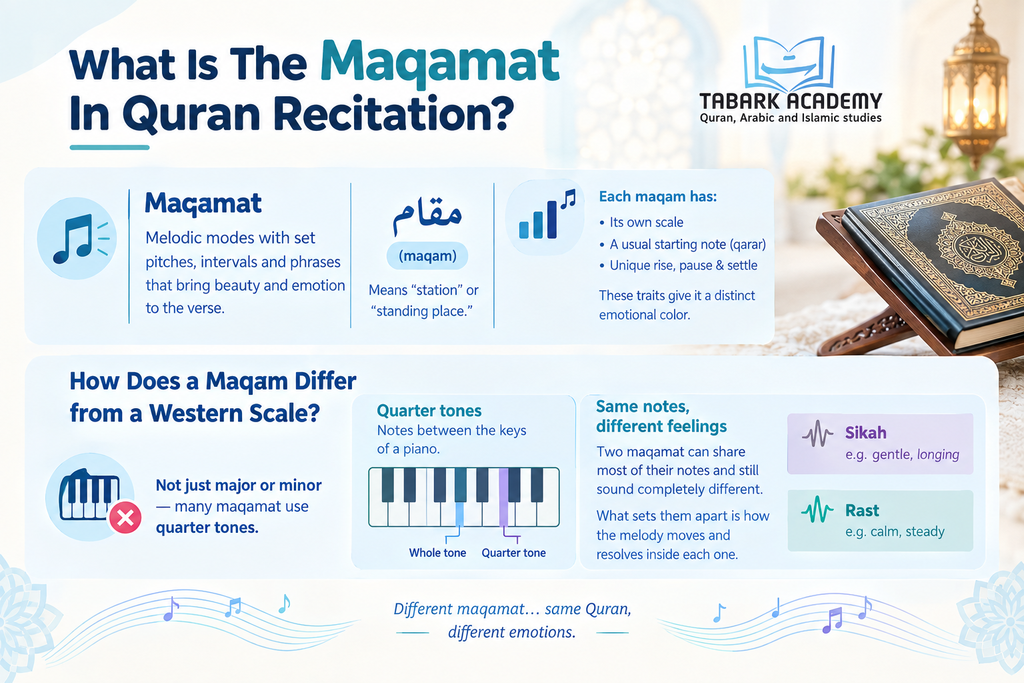
Each maqam has its own scale, a usual starting note (the qarar), and familiar ways of rising, pausing, and settling. These traits give it a recognizable emotional color. The sections below cover the idea in more detail.
How does a maqam differ from a Western scale?
A maqam isn’t just a major or minor scale. Many maqamat use quarter tones, which are notes that sit between the keys of a piano. That’s why some modes, such as Sikah or Rast, can’t be played accurately on a standard keyboard.
Two maqamat can share most of their notes and still feel completely different. What sets them apart is how the melody usually moves and resolves inside each one.
Why maqamat in recitation not music?
Using maqamat in Quran recitation isn’t singing. The qari borrows the shared melodic vocabulary of Arabic sound, but there’s no rhythm, no beat, no instruments, and no performance for entertainment.
The rule that sets the limit is simple: tajweed always governs, and the maqam only colors what tajweed has already fixed. A reciter may never lengthen a madd past its correct count, or bend a letter away from its makhraj, to make a melody work.
The Prophet ﷺ said,
“Beautify the Quran with your voices” (Sunan Abu Dawud, 1468).
He also said:
“He is not of us who does not recite the Quran in a pleasant tone” (Sahih al-Bukhari, 7527).
Scholars of recitation understood these narrations as encouragement to recite in a melodious voice, within the limits of correct pronunciation. Maqamat is the structured tradition that grew out of that encouragement.
The 7 Classical Maqamat In Quran Recitation Explained
The wider Arabic tradition has dozens of maqamat. Seven, however, form the core set used in recitation.
Many teachers remember them with the Arabic mnemonic “صنع بسحر” (Sana’a bi-Sahr), where each letter stands for one maqam: Saba, Nahawand, Ajam, Bayati, Sikah, Hijaz, Rast.
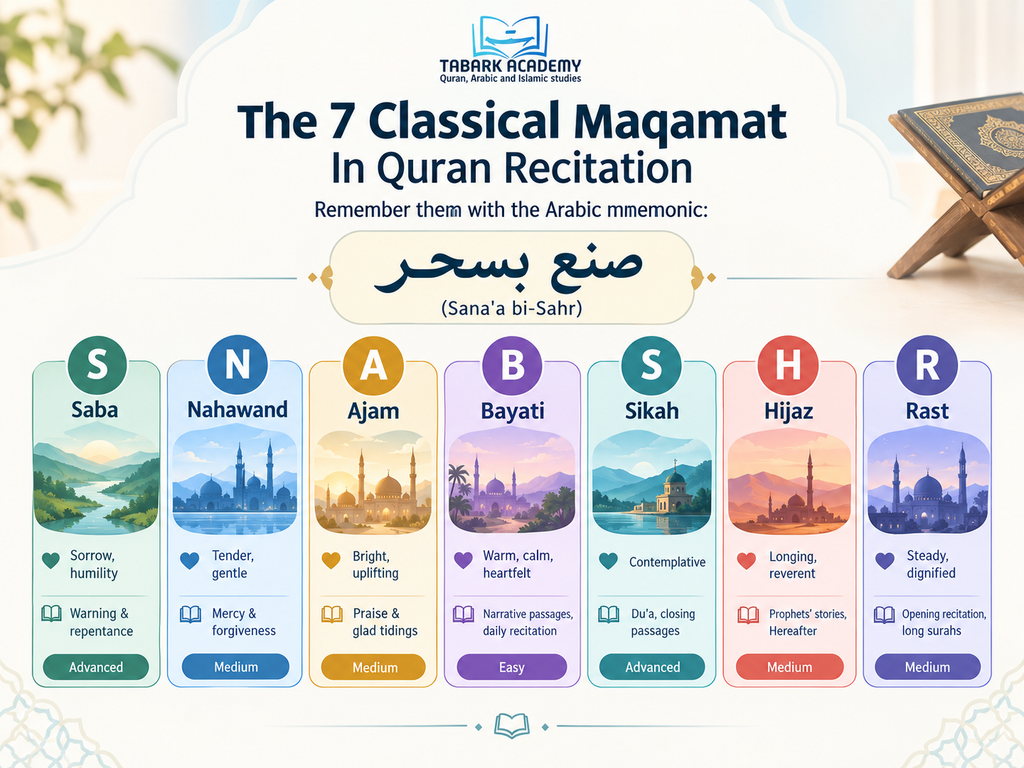
The emotional labels below are traditional tendencies, not fixed rules. A skilled qari can make any mode carry several shades of feeling.
| Maqam | Traditional mood | Common use in recitation | Beginner difficulty |
| Bayati | Warm, calm, heartfelt | Narrative passages, daily recitation | Easy |
| Rast | Steady, dignified | Opening a recitation, long surahs | Medium |
| Hijaz | Longing, reverent | Stories of the prophets, the Hereafter | Medium |
| Saba | Sorrow, humility | Verses of warning and repentance | Advanced |
| Nahawand | Tender, gentle | Verses of mercy and forgiveness | Medium |
| Sikah | Contemplative | Du’a, closing passages | Advanced |
| Ajam | Bright, uplifting | Verses of praise and glad tidings | Medium |
1. Bayati: the foundational maqam
Bayati is the most common maqam in Quran recitation and the natural starting point for learners. Its scale opens with a slightly lowered second note, which gives it a warm, grounded sound that feels close and sincere.
Reciters often begin in Bayati and come back to it after moving through other modes. If you learn to recognize only one maqam first, make it this one.
2. Rast: balance and dignity
Rast conveys steadiness and firmness, the sound of a voice declaring truth without pleading. Its third and seventh notes sit a quarter tone lower than the Western major scale, which keeps it from sounding simply “happy.” Because of that balance, Rast suits long narrative and legal passages, and many reciters use it to open a recitation.
3. Hijaz: longing and reverence
Hijaz takes its name from the region of Makkah and Madinah. It’s easy to recognize because of a wide gap, called an augmented second, between its second and third notes. That “leap” gives the mode its yearning, almost aching quality.
Reciters often turn to Hijaz for stories of the prophets and reminders of the Hereafter. Sheikh Abdul Basit Abdus-Samad is widely studied for how he handled this mode.
4. Saba: sorrow and humility
Saba is traditionally called the most “weeping” of the maqamat. Its fourth note is lowered, so the scale feels unsettled and searching, as if it never fully comes to rest.
It fits verses of warning, death, and repentance. It’s hard to control: push too much and it turns theatrical, hold back too much and it sounds flat.
5. Nahawand: tenderness and mercy
Nahawand is closest to the Western minor scale, but in recitation it sounds more compassionate than sad. The voice seems to reach toward the listener and then settle softly. Qaris often move into Nahawand for verses about Allah’s mercy, forgiveness, and blessings.
6. Sikah: contemplation
Sikah is built on a quarter-tone note as its starting point, which gives it a floating, distinctive color. That same feature makes it technically hard, because the microtonal pitch has to be exact. It’s often used for du’a, for verses of divine majesty, and for closing a recitation session.
7. Ajam: brightness and praise
Ajam is the brightest of the seven and closely matches the Western major scale. It rises and opens, and it carries no heaviness at all. Reciters use it more sparingly, mainly for passages of praise, gratitude, and glad tidings.
Some teachers add Kurd as an eighth maqam, Kurd is soft and simple, and some teachers introduce it early. Most recitation traditions, however, treat the seven maqamat in “Sana’a bi-Sahr” as the core set and teach Kurd as a related mode.
Experience Our Interactive Learning
Curious about how we teach? Watch these brief video clips from our recent live sessions to see our structured curriculum, advanced learning platform, and dynamic student-teacher interactions firsthand.
Start Your Quran Learning Journey
Join Tabark Academy today for structured online lessons with qualified tutors, customized to fit your goals.
Book Your Free Trial LessonRead Also: How To Recite Quran With Emotion Without Over Singing?
How Maqamat Differ From Tajweed And Qiraat?
Learners often confuse these three terms, but each one does a different job in Quran recitation:
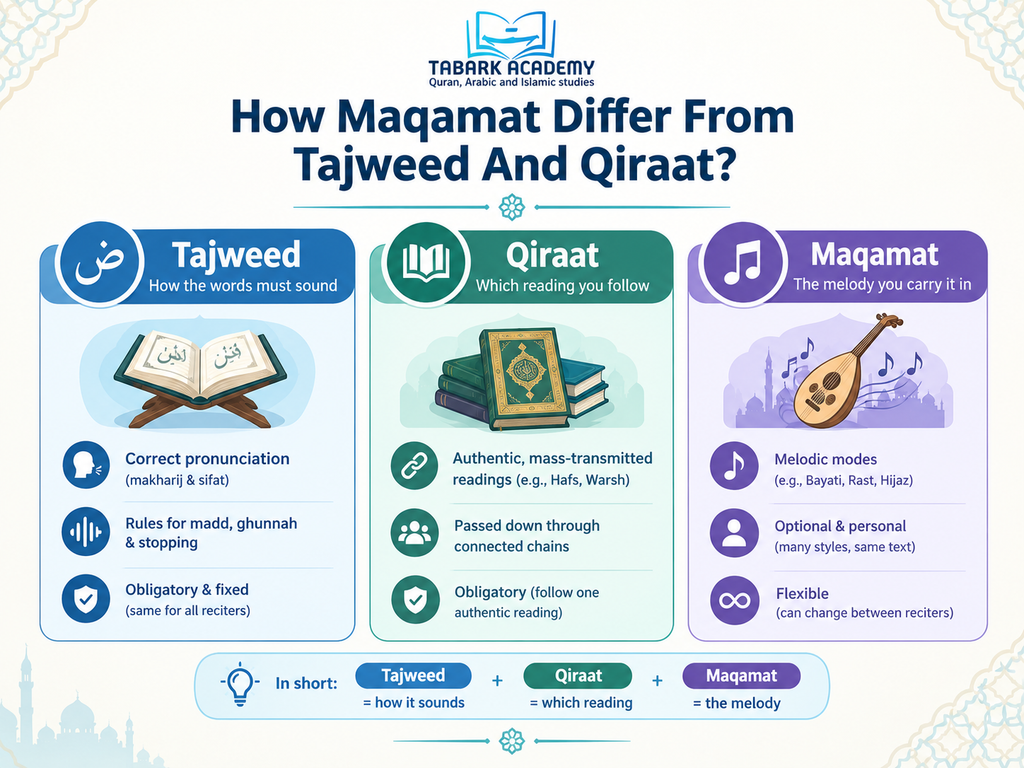
- Tajweed: is the science of pronouncing each letter correctly: makharij, sifat, madd, ghunnah, and stopping rules. It’s obligatory, and it doesn’t change from one reciter to another.
- Qiraat: are the authentic, mass-transmitted ways of reciting the Quran, such as Hafs ‘an ‘Asim or Warsh ‘an Nafi’, passed down through connected chains of teachers.
- Maqamat: are the melodic modes a reciter chooses. They’re optional, personal, and flexible.
Put simply, tajweed is how the words must sound, qiraat is which transmitted reading you follow, and maqam is the melody you carry it in.
That’s why every serious maqam teacher insists on tajweed first. Tabarak Academy’s Online Tajweed Classes build that foundation one-to-one, so the melody you add later rests on correct pronunciation.
How maqamat change between murattal and mujawwad styles?
Maqamat works very differently depending on the style of recitation.
A. Murattal: restrained melody
Murattal is the measured style used in daily reading, prayer, and memorization. The melody stays simple and repetitive on purpose, usually within one or two maqamat, so the listener stays focused on the words.
B. Mujawwad: full maqam artistry
Mujawwad is the slower, ornamented style associated with the great Egyptian reciters. Here the qari extends phrases over long breaths, moves between maqamat as the meaning of the verses shifts, and returns to the home maqam at the end.
How To Learn The Maqamat In Quran Recitation Step By Step?
The biggest gains come from learning in the right order. At Tabarak Academy, we describe that order as a four-layer ladder. Each layer has to be steady before you add the next.
The 4-layer recitation ladder:
- Correct: Get your tajweed right in a slow, murattal recitation.
- Ear: Learn to recognize maqamat by listening before you try to produce them.
- Voice: Build breath control and find your comfortable vocal range.
- Meaning: Match the maqam to what the verse says.
Beginners who skip straight to layer four usually end up with a melody that breaks tajweed rules. Fixing that habit later takes longer than learning in order would have.
1. Train your ear first
Start by listening to several recitations that stay mostly in Bayati until its settled sound feels familiar. Then listen for Hijaz, because its wide interval is the easiest contrast to pick out.
Once you can tell those two apart, play two qaris reciting the same ayah and notice where the mood changes. That change is usually a shift in maqam.
2. Find the maqam that suits your voice
To find your natural range, hold a comfortable note without straining, then test how far you can go lower and higher while your tone stays clear.
- Lower voices usually settle well into Saba and Nahawand.
- Middle voices, the most common range, handle Bayati, Rast, and Nahawand comfortably.
- Higher voices have more room for Hijaz, Ajam, and Sikah.
A practical test: record Surah Al-Fatiha in Bayati, then in Rast, then in Hijaz. Play them back and pick the one that needed the least effort and sounded steadiest in the transitions between ayat.
3. Build a short daily routine
Consistency matters more than long sessions. A focused 30-minute routine works well:
- 10 minutes listening to one maqam from a trusted qari
- 10 minutes repeating a short passage in that maqam
- 10 minutes recording yourself and checking both tajweed and pitch
Work on one maqam at a time until it feels natural before adding a second one.
Common mistakes when learning maqamat
These mistakes come up again and again with learners at every level:
- Chasing melody before tajweed. A beautiful tune with a wrong madd count or a weak makhraj is still a flawed recitation. Practice the two separately at first.
- Forcing a maqam outside your range. Copying a high Hijaz peak with a middle-range voice makes the recitation sound strained. Build range gradually.
- Switching maqamat without a reason. Changing mode every few ayat unsettles the listener. Change maqam only when the meaning changes, for example from warning to mercy.
- Imitating without understanding. Pause after each section of a recording and ask what changed in the meaning. Then note the maqam the qari moved into.
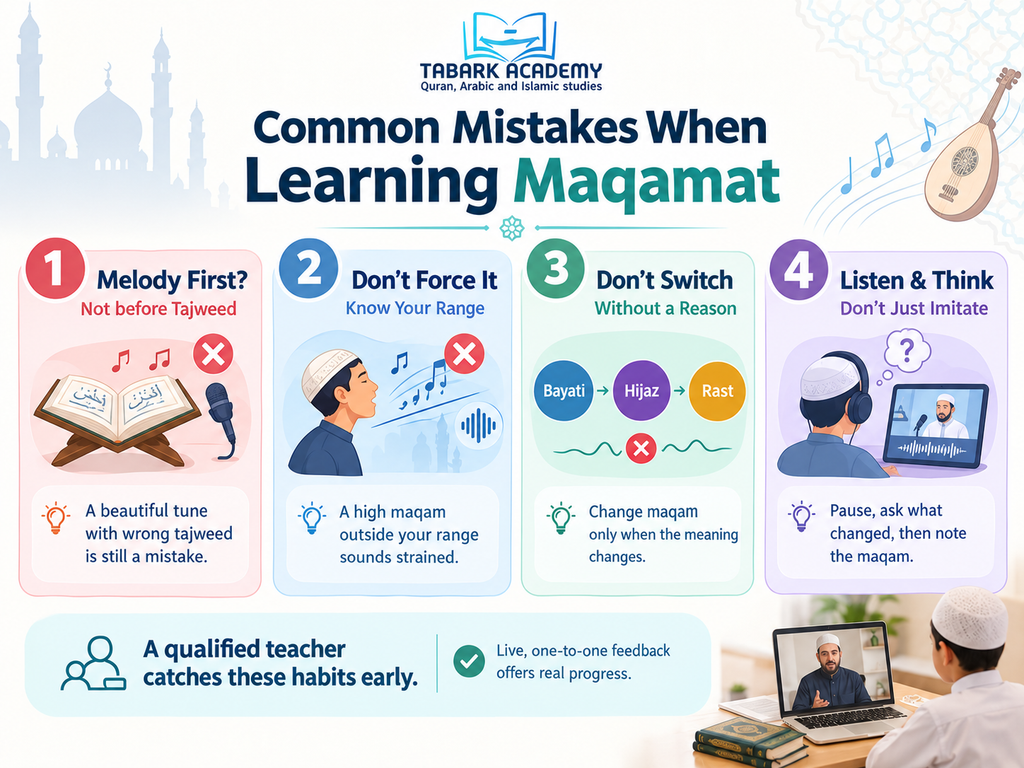
A qualified teacher catches these habits early. That’s the practical advantage of live, one-to-one feedback over learning from recordings alone.
Step Inside Our Virtual Classrooms
See our engaging teaching methods in action! watch real snippets of our live classes and discover how our expert instructors make learning interactive, memorable, and inspiring for every student.
Start Your Quran Learning Journey
Join Tabark Academy today for structured online lessons with qualified tutors, customized to fit your goals.
Book Your Free Trial LessonRead also: how to stop your voice shaking while reciting
Start perfecting your recitation with Tabarak Academy today
Beautiful recitation starts with correct recitation. Tabarak Academy pairs you with qualified teachers who first strengthen your tajweed and makharij, then guide your voice, breathing, and listening so that any melody you add stays within the rules.
You learn from home, on a schedule that fits your week, with feedback on every ayah you recite. New to the Quran? Start with Online Quran Classes for Beginners.
Our Quran Courses:
- Online Quran Classes
- Online Quran Classes for Beginners
- Online Quran Classes for Kids
- Online Quran Classes for Adults
- Online Quran Classes for Men
- Online Quran Classes for Sisters
- Quran Reading Course
- Quran Recitation Course

Conclusion
So, what are the maqamat in Quran recitation? They’re melodic modes, most commonly the seven in “Sana’a bi-Sahr”: Saba, Nahawand, Ajam, Bayati, Sikah, Hijaz, and Rast. Qaris use them to make their voices beautiful and to reflect the meaning of each verse.
They beautify recitation but never replace tajweed. Learn in order: correct pronunciation, then ear training, then voice control, then matching maqam to meaning.
With patient practice and a good teacher, such as the tutors at Tabarak Academy, your recitation can become both correct and moving.

FAQs About The Maqamat In Quran Recitation
These are the questions learners ask most often about maqamat, answered briefly so you can find what you need quickly.
1. How many maqamat are there in Quran recitation?
There are seven core maqamat in Quran recitation: Bayati, Rast, Hijaz, Saba, Nahawand, Sikah, and Ajam. Some teachers add Kurd as an eighth. The wider Arabic tradition has dozens more, but these seven are the ones reciters use most.
2. Which maqam should a beginner learn first?
Bayati is the best first maqam for beginners. It’s the most common and most versatile mode, it sits comfortably in a middle voice, and it gives you a reference point for recognizing the other maqamat.
3. Do I need to learn tajweed before maqamat?
Yes, tajweed comes before maqamat. Tajweed is required for correct recitation, while maqamat is an optional way to beautify it. Learning melody before your makharij and madd rules are solid tends to lock in mistakes.
4. Is it permissible to use maqamat when reciting the Quran?
Yes. Most scholars allow maqamat in Quran recitation as long as tajweed is fully observed and no letter or madd is distorted to fit the melody. What they warn against is turning recitation into performance or entertainment.
5. What is the difference between maqam and tajweed?
Tajweed is the fixed set of rules for pronouncing each letter correctly, and it’s the same for every reciter. A maqam is the melodic mode a reciter chooses, and it varies from qari to qari. Tajweed decides what the words must sound like; the maqam decides the melody.
6. Can I learn the maqamat in Quran recitation online?
Yes. You can learn maqamat online with a qualified teacher who listens live and corrects both your tajweed and your pitch. Online one-to-one classes, like those at Tabarak Academy, let you practice at home with feedback on every recitation.