


Is It Wrong To Read The Quran From Transliteration?
If you’re a new Muslim or an adult who never learned the Arabic alphabet, you’ve probably wondered: is it wrong to read the Quran from transliteration?
Reading “Bismillahir-Rahmanir-Raheem” in English letters feels like the fastest way to start reciting, especially when prayer can’t wait.
The short answer from major fatwa bodies is that reciting the Quran from Latin-letter transliteration is not an acceptable long-term way to read the Book of Allah. English letters can’t carry Arabic sounds accurately, and a changed sound can change the meaning.
This article from Tabarak Academy covers the scholarly ruling, the language reasons behind it, and a practical plan to move from transliteration to reading the real Arabic text.
What you’ll learn in this article:
- The scholarly ruling on writing and reading the Quran in non-Arabic letters
- Why English letters can’t capture key Arabic sounds, with examples of meaning changes
- What to do if you need to pray today and can’t read Arabic yet
- A three-stage plan to move from transliteration to the Arabic Mushaf
- Common transliteration mistakes that change the words of the Quran
Is It Wrong To Read The Quran From Transliteration? The Scholarly Ruling
Quran transliteration means writing the Arabic words of the Quran in another alphabet, usually Latin letters, so a non-Arabic reader can sound them out.
It is different from a translation, which conveys the meaning in another language. Scholars have ruled on both writing the Quran this way and reciting from it.
What Major Fatwa Councils Say About Writing The Quran In Latin Letters?
The Council of Senior Scholars in Saudi Arabia agreed unanimously, in its fourteenth session in Ta’if (Shawwal 1399 AH), that writing the Quran in Latin script or any non-Arabic alphabet is prohibited. Shaykh ‘Abd al-‘Azeez ibn Baaz passed on the ruling as Secretary-General of the Academic Research Council.
The Council gave five reasons:
- The Quran was revealed “in the plain Arabic language” (ash-Shu’ara’ 26:195), in both its letters and its meanings.
- The Companions wrote and compiled it in Arabic letters, and the Muslim community has kept to this for more than fourteen centuries, including non-Arab Muslims.
- Other alphabets change over time, so recitation based on them would drift too.
- Allowing it would let everyone write the Quran in their own alphabet, which leads to confusion and variant texts.
- It would discourage Muslims from learning Arabic, the language they worship in.
Why Does Reciting From Transliteration Take The Same Ruling?
Scholars reason that if writing the Quran in non-Arabic letters is not allowed, reciting from that writing isn’t allowed either. Some scholars state that a Muslim who can’t pronounce Arabic letters must learn to recite in Arabic, because non-Arabic letters change the form of words or corrupt their meaning. That applies whether you recite aloud or silently.
The classical schools reached the same point through the Uthmani script. Ibn Hajar al-Haytami reports that Imam Malik was asked whether the Mushaf could be written in a newer style of writing, and he answered:
“No, only in the original way,” meaning the script of the ‘Uthmani Mushaf. Scholars of recitation added that this is the position of all four imams. If the Quran can’t be written in a different Arabic style, it can’t be written in a foreign alphabet.
Shaykh Ibn ‘Uthaymeen explained that reciting the Quran incorrectly amounts to altering the words of Allah, and that is forbidden.
He said a person should take five minutes, or even fifteen, over a single word until they pronounce it correctly, rather than recite it wrongly. The Quran isn’t human speech that you can report by its general meaning. Every letter counts.
Read Also: Is It Too Late to Learn to Read the Quran as an Adult?
Why Can’t English Letters Carry The Sounds Of The Quran?
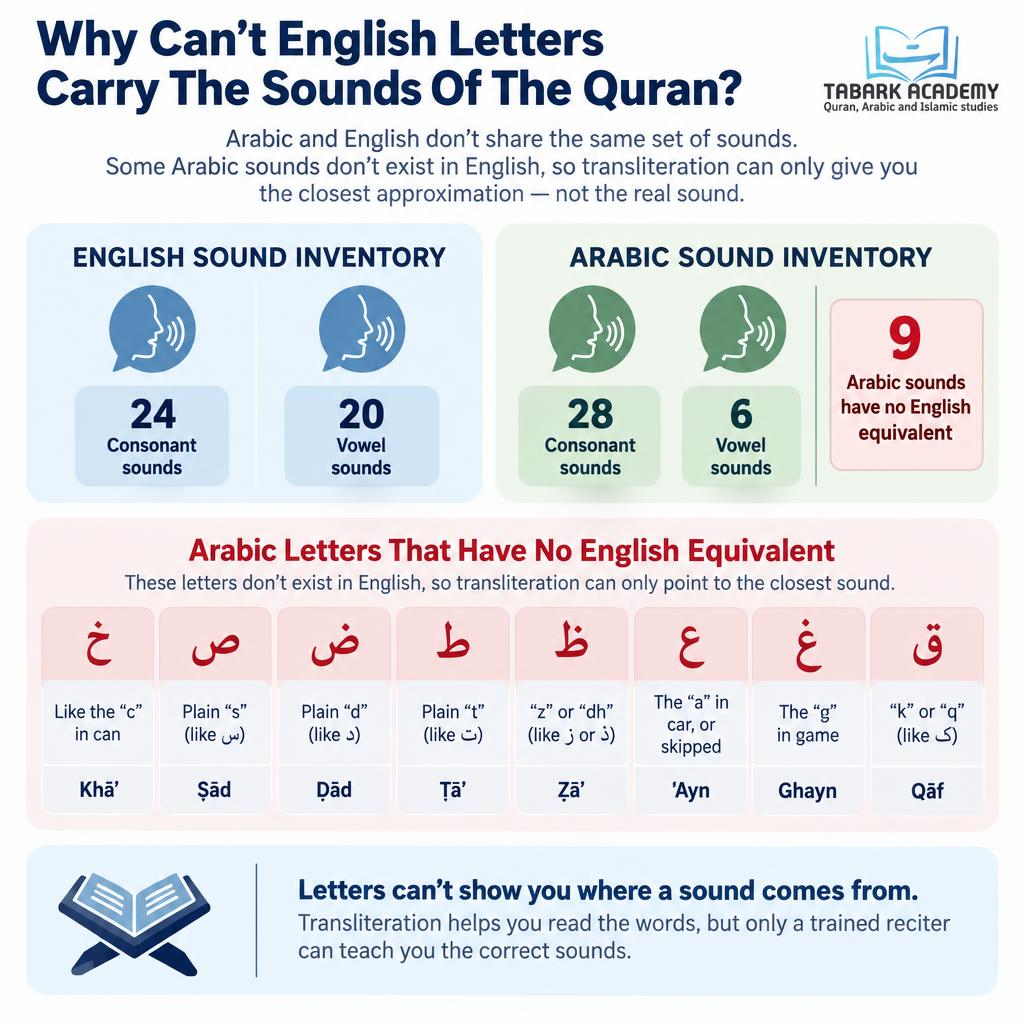
The ruling rests on a linguistic fact: Arabic and English don’t share the same set of sounds. This is the practical reason why reading the Quran from transliteration goes wrong, even when the reader means well.
1. Phonemes: The Sounds Your Ear Can And Can’t Hear
A phoneme is the smallest unit of speech sound that separates one word from another. /b/ and /p/, for example, are separate phonemes in English. Speakers of one language are partly “phoneme-deaf” to other languages: when they hear a sound their language lacks, the brain quietly swaps in the nearest familiar sound.
Arabic has no “p,” so an Arabic speaker hears “pun” as “bun.” The same thing happens in reverse. An English reader who sees “q” or “s” on a transliteration sheet produces an English sound, not the Arabic one.
Commonly cited counts give Arabic about 28 consonants and 6 vowels, and English about 24 consonants and 20 vowels. Around nine Arabic phonemes have no English equivalent.
2. Arabic letters that transliteration gets wrong
Some Arabic letters have no English equivalent, so a transliteration sheet points you to the closest English sound instead. The table below lists the eight letters English speakers most often mispronounce, the sound they usually end up making, and the academic transliteration for each letter.
| Arabic letter | How English readers usually say it | Academic transliteration |
| خ | Like the “c” in “can” | Khā’ |
| ص | Plain “s” (like س) | Ṣād |
| ض | Plain “d” (like د) | Ḍād |
| ط | Plain “t” (like ت) | Ṭā’ |
| ظ | “z” or “dh” (like ز or ذ) | Ẓā’ |
| ع | The “a” in “car,” or skipped | ‘Ayn |
| غ | The “g” in “game” | Ghayn |
| ق | “k” or “q” (like ك) | Qāf |
Take the qāf. English “q” in “queen” is really a “k” sound, but the Arabic qāf starts deeper in the throat, from a different makhraj (point of articulation). Transliteration can’t show you where a sound comes from. Only a trained reciter can.
How does one wrong sound change the meaning?
These pairs show what happens when a transliterated sound slides to its nearest English match:
| Correct word | Meaning | Mispronounced as | Meaning |
| قلب (qalb) | Heart | كلب (kalb) | Dog |
| ضلّ (ḍalla) | Went astray | دلّ (dalla) | Guided |
| صَلْب (ṣalb) | Crucifixion | سَلْب (salb) | Theft |
| ساء (sā’a) | Was evil | صاع (ṣā’) | A unit of measure |
On a transliteration sheet, both words in each pair can look almost the same. In the Quran, the difference can flip a meaning completely. The ḍalla/dalla pair, for example, turns “went astray” into “guided,” its opposite.
If you want to find out where your own pronunciation slips, the teachers in Tabarak Academy’s Online Quran Classes correct each letter live, one-to-one, so mistakes don’t turn into habits.
What To Do If You Can’t Read Arabic Yet?
Scholars don’t ask a new Muslim to wait years before praying. They point to other ways to learn that avoid transliteration. The main ones are learning by ear, reading from the Arabic Mushaf, and building up gradually.
1. Learn Al-Fatihah by listening first
Some scholars advise learning Al-Fatihah correctly in Arabic by listening to people who recite it well, and note that this is easier than it sounds.
Repeat after a qualified reciter, verse by verse, until your pronunciation matches. Then do the same with a few short surahs for your prayers.
2. Reading from a Mushaf in prayer is allowed when needed
Scholars allow reciting in prayer from a Mushaf, or from a paper with verses written on it, if you need it because you can’t recite from memory yet. That permission covers the Arabic text, not a Latin-letter version.
3. Use translation for meaning, not for recitation
A translation of the meanings is valuable for understanding the Quran, and scholars allow quoting translated meanings in books written in other languages. It just isn’t the Quran itself, and you shouldn’t read it as recitation or worship.
Experience Our Interactive Learning
Curious about how we teach? Watch these brief video clips from our recent live sessions to see our structured curriculum, advanced learning platform, and dynamic student-teacher interactions firsthand.
Start Your Quran Learning Journey
Join Tabark Academy today for structured online lessons with qualified tutors, customized to fit your goals.
Book Your Free Trial LessonRead Also: What Are The Maqamat In Quran Recitation?
The Ear-First Transition Plan: moving from transliteration to Arabic
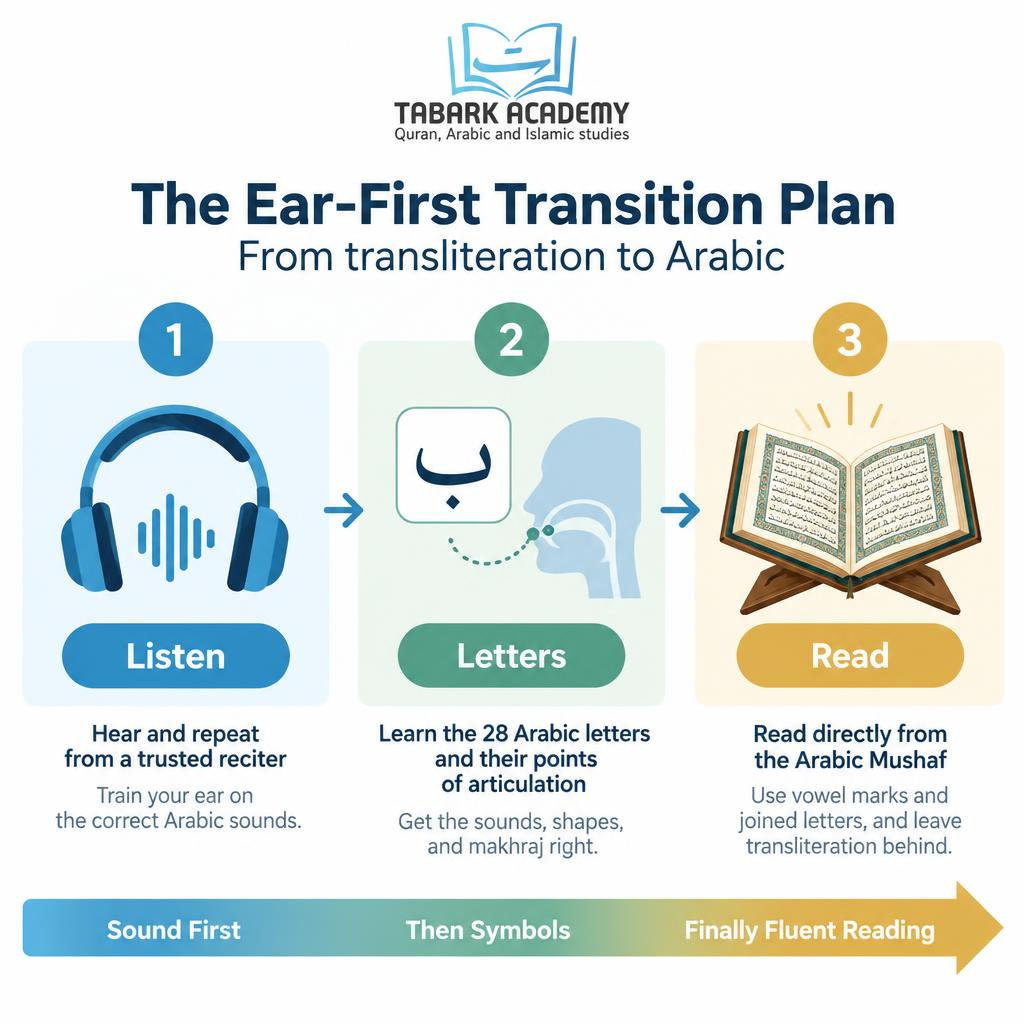
Learners who make the switch successfully usually go in the same order: sound first, then symbols, then fluent reading. Tabarak Academy calls this the Ear-First Transition Plan.
Stage 1: Listen and repeat
Build correct sounds before you look at any written form. Listen to a trusted reciter and repeat Al-Fatihah and your prayer surahs. This way your ear is trained on Arabic, not on English approximations.
Stage 2: Learn the letters and their points of articulation
Learn the 28 Arabic letters, their shapes, and the makhraj of each one, paying special attention to the eight letters in the table above. This is where a teacher matters most, because you can’t correct a sound you can’t hear yet.
Stage 3: Read the Arabic text and drop transliteration
Move on to vowel marks, joining letters, and reading whole words straight from the Mushaf. Take transliteration away completely at this stage, even for verses you already know. If you keep it “just in case,” your eyes will keep going back to it.
A structured course speeds up this transition. Tabarak Academy’s Quran Reading Course follows this order, from letters to fluent reading, with a teacher correcting you at every step.
Common Mistakes When Reading The Quran From Transliteration
Apart from the missing letters, transliteration causes predictable errors that learners often don’t notice.
A. Inconsistent spelling systems
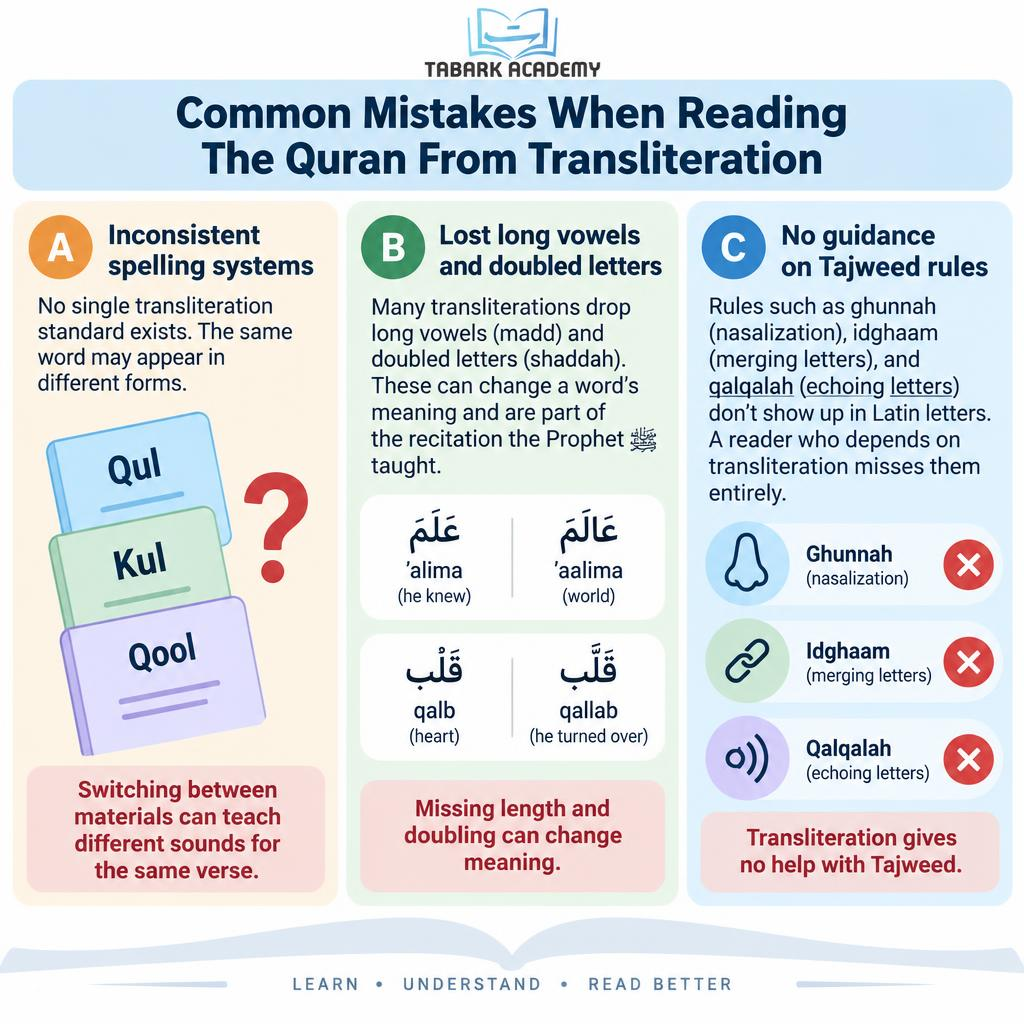
No single transliteration standard exists. The same word may appear as “Qul,” “Kul,” or “Qool” in different booklets. If you switch between apps or printed sheets, you learn different sounds for the same verse.
B. Lost long vowels and doubled letters
Arabic separates short vowels from long ones (madd) and marks doubled letters with a shaddah. Many transliterations drop these marks. The length of a vowel and a doubled consonant can change a word’s meaning, and they are part of the recitation the Prophet ﷺ taught.
C. No guidance on Tajweed rules
Rules such as ghunnah (nasalization), idghaam (merging letters), and qalqalah (echoing letters) don’t show up in Latin letters at all. A reader who depends on transliteration misses them entirely, even with perfect intentions.
Step Inside Our Virtual Classrooms
See our engaging teaching methods in action! watch real snippets of our live classes and discover how our expert instructors make learning interactive, memorable, and inspiring for every student
Start Your Quran Learning Journey
Join Tabark Academy today for structured online lessons with qualified tutors, customized to fit your goals.
Book Your Free Trial LessonStart Reading The Quran In Arabic With Tabarak Academy Today
Don’t let transliteration become a lifelong crutch. At Tabarak Academy, qualified teachers take you from your first Arabic letter to reading the Mushaf on your own, in live online lessons scheduled around your week.
Learn at home, at your own pace, with a teacher who hears every letter you say. You can also add Online Islamic Studies Classes to understand what you recite.
Our Quran Courses:
- Online Quran Classes
- Online Quran Classes for Beginners
- Online Quran Classes for Kids
- Online Quran Classes for Adults
- Online Quran Classes for Men
- Online Quran Classes for Sisters
- Quran Reading Course
- Quran Recitation Course
- Online Ijazah Course
- Online Qirat Course
- Quran for Toddlers / Young Children

Conclusion
So, is it wrong to read the Quran from transliteration? According to the Council of Senior Scholars, other contemporary scholars, and the classical position linked to the four imams, the Quran should be written and recited in Arabic letters only. Latin letters distort its sounds, and distorted sounds can distort its meaning.
This isn’t about making things hard. Arabic has letters English doesn’t have, and the Quran deserves to be recited the way the Prophet ﷺ taught it. Start by ear, learn the letters, and move to the Mushaf. Tabarak Academy is ready to guide you through each stage.

FAQs About Reading The Quran From Transliteration
Here are short, direct answers to the questions learners ask most often about Quran transliteration, reciting in prayer, and learning to read Arabic.
1. Is it wrong to read the Quran from transliteration if I am a new Muslim?
Yes. Scholars advise against reciting the Quran from transliteration even for new Muslims, because English letters change its sounds. Learn Al-Fatihah by listening to a qualified reciter and repeating, and move to the Arabic text as soon as you can.
2. Can I read the Quran from my phone or a paper in prayer?
Yes, if you need to. Scholars allow reciting from a Mushaf, a phone, or a written paper in prayer when you can’t recite from memory, as long as the text is in Arabic.
3. How long does it take to stop relying on transliteration?
It depends on how often you practice and whether you have a teacher. Most of the progress comes in the letters-and-makhraj stage. A one-to-one teacher, like those at Tabarak Academy, helps you get through it faster by correcting sounds you can’t hear yourself yet.
4. Do I get rewarded for reading the Quran in transliteration?
Scholars state that the reward promised for each letter of the Quran applies to reading it in Arabic, as Allah revealed it. Reading it in another alphabet isn’t the prescribed recitation, even though your effort to learn is still valued.
5. Is reading a Quran translation the same as reading the Quran?
No, a translation gives the meaning of the Quran in another language, but it isn’t the Quran itself. Use it to understand the text, and recite the Quran only in Arabic.