


How to Get Ijazah? A Complete Step-by-Step Guide
As Muslims, we all want to learn our beautiful religion. The number one source to learn Islam is the Holy Book of Allah, which is the source of all guidance. Many of us set different goals in terms of our learning of the Quran and Islam in general.
Many Muslims have the ambition to become an expert in reciting the Quran with proper Tajweed rules as well as memorize the Glorious Quran as much as possible.
If you’re wondering how to get ijazah in the Quran — whether in recitation or memorization — this guide covers every step from building your Tajweed foundation to receiving your sanad certificate. A simple way to achieve these goals is to get an Ijazah in Quran memorization or recitation as per your preference.
1. Understand What Ijazah Means in Arabic
The ijazah meaning in Arabic comes from the root أجاز, which literally translates to “authorization” or “permission”. The word ijazah (إجازة) carries a sense of granting someone the right to act on your behalf — in this case, the right to transmit the Quran exactly as it was received.
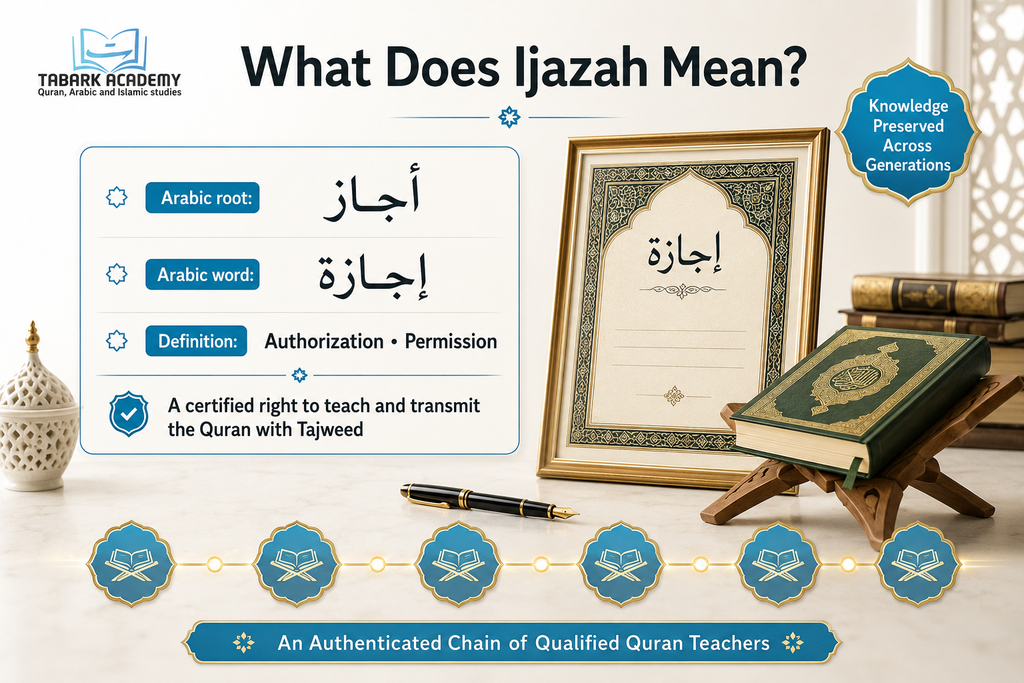
Technically, it refers to a certificate that gives its holder authorization to teach and transmit the Holy Quran with Tajweed. This certificate or license can only be awarded by a person who already has ijazah certification.
Simply put, Ijazah is a permit used mainly by Sunni Muslims to specify that an individual has been sanctioned by a scholar who already possesses Ijazah to transmit the Holy Quran. Its purpose is to set up the account of the Quran via a series of approved transmitters reverting to the Prophet (PBUH) then to the angel Jibril (peace be upon him) and then to the Almighty Allah.
Why Is Ijazah Important in Islam?
Ijazah provides its holder the right and entitlement to verify others with the matching authority as well. Thus, creating an infinite chain of qualified Quran narrators.
Ijazah signifies great honor and integrity in Islam since the initial times of Islam. People used to come from faraway places to become a student of an Imam/Sheikh and stay with him for some 8 to 10 years. They either study Quran reading with Tajweed or Quran memorization.
Meanwhile, the teacher keeps testing the student for Quran recitation/memorization, and correcting him, until the Imam becomes completely sure that this person has mastered his knowledge, then he issues him his Ijazah.
This tradition of scholarly authorization is deeply connected to the broader Islamic Studies framework that preserves authentic knowledge across generations.
2. Know the Types of Ijazah Before You Choose Your Path
Students pursuing Quran certification generally follow one of two distinct paths, each with its own requirements and scope of authorization. Understanding the difference before you begin saves time and ensures you prepare correctly.
1. Quran Recitation Ijazah
An ijazah in Quran recitation is an authorization that permits its owner to teach Quran recitation. This Ijazah certificate can only be issued by an Imam/scholar who already holds this certificate; hence it creates an endless chain.
The learner acquires this permit after reciting the Holy Book from beginning to the end with Tajweed rules in front of an Ijazah holder. The recitation must demonstrate consistent, error-free application of every Tajweed rule — not just theoretical knowledge, but practical mastery that holds up across all 30 Juz.
2. Quran Memorization (Hifz) Ijazah
Ijazah in Quran Memorization is a certificate that permits teaching Quran Memorization to the person who receives it. This Ijazah certificate can only be issued by an Imam/scholar who already holds a Quran memorization certificate; hence it creates an endless chain.
The student gains this authorization after memorizing all of the Quran very well from beginning till the end and reading it by heart in front of the certified tutor. This path requires dedicated daily revision and consistent practice over an extended period.
Tabarak Academy’s Online Quran Memorization Course provides structured Hifz programs with certified scholars who guide students through the memorization and retention process leading up to ijazah.
3. Tajweed Ijazah
While recitation ijazah certifies that you can recite the Quran correctly with Tajweed, an ijazah in Tajweed goes further — it specifically authorizes you to teach the science of Tajweed itself.
This means you are not only a proficient reciter but a qualified instructor who can explain the rules, correct students, and transmit the methodology of Tajweed to others. If you’re wondering how to get ijazah in Tajweed specifically, section 5 below covers the complete process.
How to Get Ijazah: Subtypes of Quran Recitation Ijazah
The Ijazah that is granted to students who learn Quran recitation with Tajweed, can be categorized into four subtypes.
Most students worldwide pursue the first type — Hafs ‘an ‘Asim — which is the narration used in the vast majority of printed Mushafs and Quran apps. The remaining three are typically pursued by advanced scholars and Qira’at specialists.
- Ijazah teaches Tajweed with one narration, like the Ijaza certificate with the account of Hafs ‘an ‘Asim.
- Ijazah teaches Tajweed with seven methods of recitation of ash-Shatibiyyah.
- Quran Ijazah with 3 methods of recitation of Durrat Al-Maa’nia.
- Ijazah with 10 methods of recitation of Tayyibat An-Nashr.
Read Also: 7 Types of Qirat in the Quran
3. Build Your Tajweed Foundation Before Anything Else
Many students rush into ijazah preparation before their foundation is ready — and this is the single most common reason for delays. Before enrolling in any ijazah program, you need to meet certain Tajweed and recitation benchmarks that your examining sheikh will expect from the very first session.
Learning How to Get Ijazah begins with an honest assessment of these foundations because strong Tajweed skills make the certification process smoother and more efficient.
Precise pronunciation of Arabic letters from their correct articulation points (Makharij) and understanding each letter’s characteristics (Sifaat) is the number-one gatekeeper for ijazah certification. Non-Arabic speakers particularly struggle with letters like ع، ح، خ، غ، ق، and ض — and even small errors in Makharij can change the meaning of a word entirely.
The following table summarizes the Tajweed categories you must master consistently before your sheikh will consider granting ijazah:
| Tajweed Category | Rules Required |
|---|---|
| Noon Sakinah & Tanwin | Idhhar, Idgham, Iqlab, Ikhfa |
| Meem Sakinah | Ikhfa Shafawi, Idgham Shafawi, Idhhar Shafawi |
| Madd Rules | Madd Asli, Madd Far’i (all six types) |
| Lam Rules | Tafkhim and Tarqiq of Lam in Allah’s name |
| Ra Rules | Tafkhim and Tarqiq conditions for Ra |
| Qalqalah | Five letters (ق ط ب ج د), three levels of echo |
| Waqf & Ibtida | Rules of stopping and resuming correctly |
If you’re still building your Tajweed foundation, a structured Tajweed course with certified instructors is the most efficient way to reach ijazah-readiness — it ensures every rule is corrected in real-time before habits form.
A common misconception is that you must memorize the entire Quran to get ijazah. This is only true for memorization (Hifz) ijazah. For ijazah in Quran recitation, you may recite from the Mushaf during your sessions with the sheikh.
However, your reading fluency must be at a level where you can recite any portion of the Quran smoothly, without hesitation, with correct Tajweed applied automatically throughout.
You must be able to read any Surah or page with proper Tajweed on first exposure, apply all rules without consciously thinking through each one, maintain consistent recitation across long sessions, and correct yourself immediately when the sheikh stops you — understanding which rule was violated.
4. Find A Qualified Sheikh with An Authentic Sanad
The most critical decision in your ijazah path is choosing your sheikh. The entire validity of your ijazah depends on your teacher holding a verified, unbroken sanad themselves. A certificate issued by someone without an authentic chain carries no scholarly weight.
A qualified ijazah sheikh must hold their own ijazah with a documented, traceable sanad, be recognized within established Islamic scholarly circles, have experience examining students for ijazah, and teach the specific riwayah you are seeking (Hafs ‘an ‘Asim, or others).
A common practitioner observation: students who attempt to find ijazah sheikhs independently without institutional vetting often encounter delays, unverifiable credentials, or instructors whose own preparation was incomplete.
Working through an established academy that verifies its scholars’ credentials eliminates this risk entirely.
Experience Our Interactive Learning
Curious about how we teach? Watch these brief video clips from our recent live sessions to see our structured curriculum, advanced learning platform, and dynamic student-teacher interactions firsthand.
5. Enroll in A Structured Ijazah Program Online
Many institutions provide Ijazah Course Online. You need to find one with highly-qualified teachers bearing Ijazah who teach the matching Ijazah course via one-to-one online sessions.
For students researching How to Get Ijazah online, a structured program offers a clear study plan, regular correction, and direct access to a qualified teacher with an authentic sanad.
Many of them offer both types of Ijaza i.e., Quran recitation ijazah and Quran memorization Ijaza. The process involves an assessment of the aspiring student by an Ijazah holder teacher to check the current status of the aspiring individual in their desired field.
Based on this assessment, the required course, the number of classes, and the method of education are determined.
The teacher usually begins by describing the purpose and meaning of “Ijazah” to the student. Afterward, the student will read a part of the Quran to the teacher, following the predefined plan, and then, the tutor will deliver the required supervision accordingly.
Tabarak Academy’s Online Ijazah Course connects students with Ijazah-certified Al-Azhar instructors through personalized one-to-one sessions — giving you the same quality of direct teacher supervision that traditional in-person ijazah programs provide.
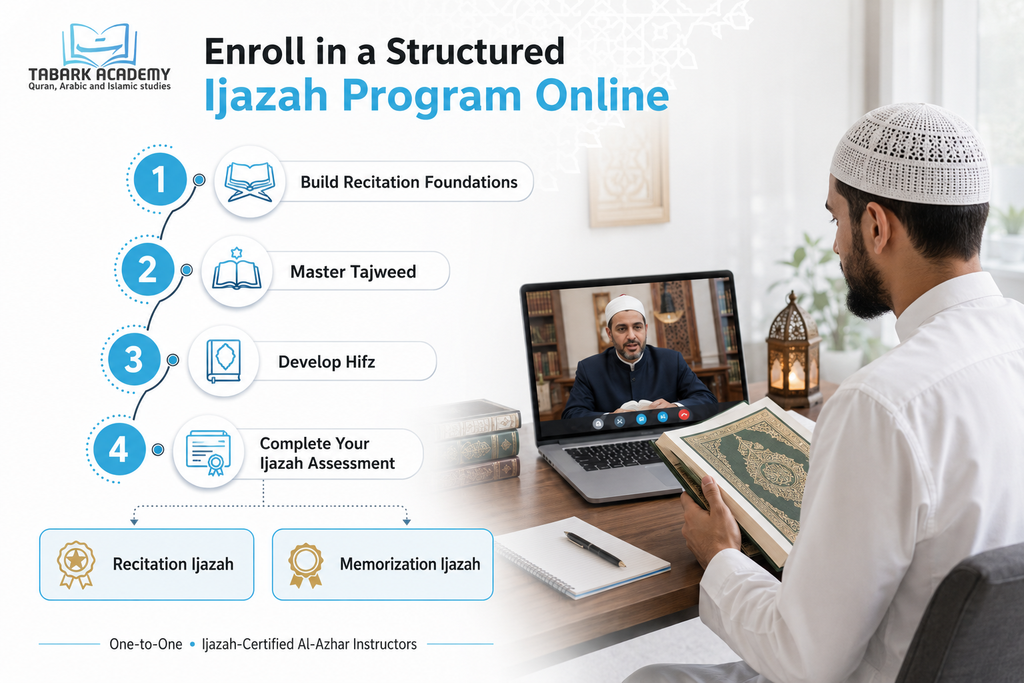
Steps to Get Your Ijazah Online
Follow these steps to get Ijazah online conveniently:
- Get enrolled in an online Quran recitation program to learn how to recite Quran properly. If you are starting from scratch, Tabarak Academy’s Foundation course builds this base efficiently.
- The next step is to perfect the Quran recitation without mistakes or errors by mastering Tajweed rules.
- Start taking a Quran Hifz/memorization course at an institute that has qualified Quran scholars on board.
- The last step is signing up for an authenticated Ijazah Program and demonstrating your recitation to the Ijazah holder tutors so that they award you an Ijazah in your desired domain.
Upon completion of the program, the student has to read the Quran with Tajweed rules correctly in front of the teacher to get an Ijazah in Quran Recitation with proper rules of Tajweed.
While the student has to recite all of the Quran from memory in front of the tutor to get an Ijazah in Quran Memorization.
When a student completes the learn Quran online course and passes the test, they will be awarded an Ijazah certificate in the corresponding program. This certificate bestows the student with the permission to teach others and delivers an Ijazah as well.
6. Pass the Formal Ijazah Examination
The formal examination is the most rigorous stage of the entire process. Understanding what to expect helps you prepare mentally and reduces unnecessary anxiety during your sessions.
You will recite directly to your sheikh — either the full Quran or agreed-upon sections — with all Tajweed rules applied correctly and consistently throughout.
The sheikh will stop you at every error, require you to self-correct, identify which rule was violated, and in some cases ask you to repeat entire sections. This is not meant to discourage you — it is the process by which the integrity of the Quran’s oral transmission has been protected for over 1,400 years.
What Does the Sheikh Evaluate?
The examination covers several criteria simultaneously. Your sheikh evaluates correct makharij for every letter, consistent application of all Tajweed rules without reminders, proper waqf (stopping) and ibtida (resuming), accurate ghunnah duration, madd lengths held correctly, and the complete absence of lahn jali (major recitation errors that change the meaning).
A common practitioner observation: students who rush through the recitation phase accumulate small errors that compound across longer sections. The sheikh’s corrections may feel repetitive, but each one is reinforcing precision that must become second nature. Many students need two to three rounds on certain sections before the sheikh is fully satisfied — and this is entirely normal.
7. Receive Your Sanad and Ijazah Certificate
Upon successfully passing the examination, your sheikh issues you a formal ijazah certificate. This document includes your name, the riwayah you have been certified in, and the full chain of transmission (sanad) from you through your sheikh, back through generations of scholars, to the Prophet Muhammad ﷺ.
The sanad is what distinguishes a Quran ijazah from any other recitation diploma or completion acknowledgment. Some sanads are shorter — meaning fewer generations between you and the Prophet ﷺ — which is considered an elevated honor in Islamic scholarship, known as ‘Uluw al-Isnad.
The following table summarizes the rights ijazah grants its holder:
| Right Granted | Meaning |
|---|---|
| Right to Transmit | You may teach Quran recitation with scholarly authority |
| Right to Grant Ijazah | You may examine and certify qualified students yourself |
| Scholarly Recognition | Your recitation is recognized within the Islamic scholarly tradition |
With ijazah, you do not merely know Quran recitation — you are now a link in the preserved chain of transmission that has protected the Quran since the time of the Prophet ﷺ.
8. Maintain Continuous Practice After Certification
Ijazah is not the end of the journey — maintaining your recitation quality is an ongoing responsibility. Many scholars emphasize that the true weight of ijazah lies in what you do with it after receiving it.
Here are practical habits to maintain your certification standard:
- Daily review of previously recited or memorized portions — even 15 to 20 minutes preserves fluency.
- Teach small groups or individual students regularly — teaching reinforces your own mastery and keeps Tajweed rules actively applied.
- Attend refresher sessions or advanced Tajweed circles with other scholars to stay sharp and learn from different recitation styles.
- Listen regularly to proficient reciters to reinforce correct Makharij and identify any subtle drift in your own recitation over time.
Continuous practice ensures your recitation stays at ijazah standard, and teaching helps preserve the authenticity of the chain you now carry.
Practical Tips to Make Your Ijazah Journey Smoother
Fourteen and a half centuries have passed since the time of Prophet Muhammad (Peace be upon him). This is the era of advanced technology and the internet which has made it easy to obtain an Ijazah from a certified tutor sitting miles away from you.
These tips apply whether you are pursuing ijazah in recitation, memorization, or Tajweed:
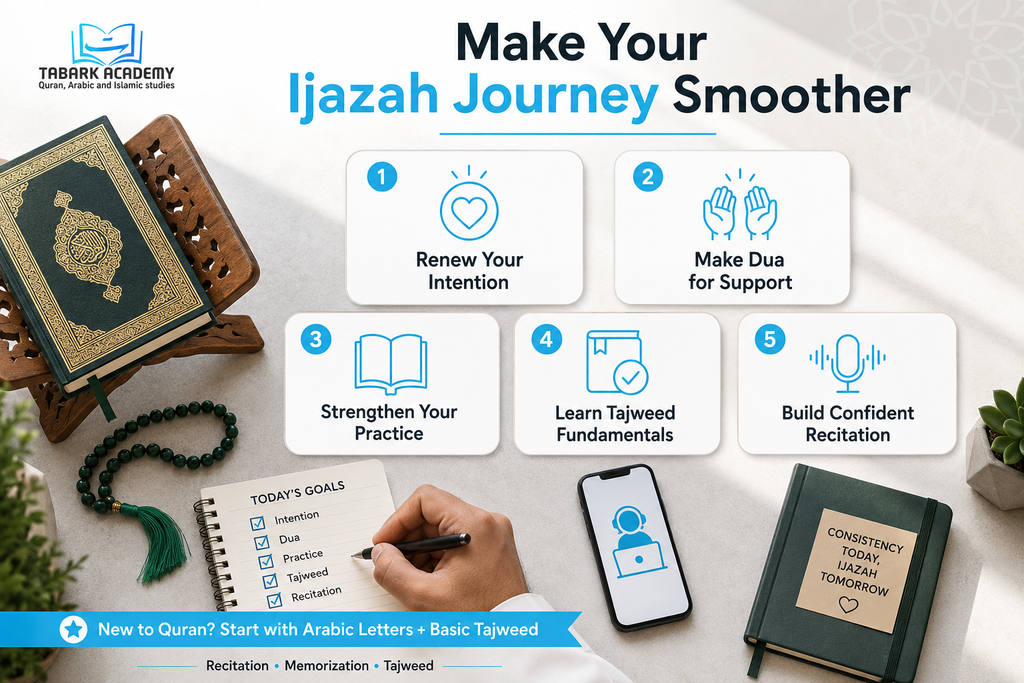
- Keep renewing your intent to learn the Quran to stay motivated.
- Make dua to Allah the Almighty for means and support to continue.
- Try to be a good Muslim so that you become eligible to get this honor
- While you are seeking means to get Ijazah certified, learn the fundamentals of Tajweed rules so that your Ijazah journey can become easier when you start
- Have a decent grasp on recitation and reading of the Quran (intermediate level).
Don’t fret if you are a newbie. Begin learning Arabic letters, basic Tajweed through a Quran and Arabic foundation program, and within two or three months, you can begin a journey of Ijazah.
Read Also: Is Arabic a Difficult Language to Learn?
How Long Does It Take to Get Ijazah?
students ask about the total timeline. Understanding how to get ijazah also means setting a realistic timeline based on your current recitation level and the type of certification you intend to pursue.
The exact duration varies significantly depending on your starting level, how many hours you dedicate each week, and the quality of your teacher’s corrections.
The following table provides realistic estimates for both types of Ijazah:
| Starting Level | Recitation Ijazah | Memorization Ijazah |
|---|---|---|
| Beginner (learning Arabic basics) | 1.5–2 years | 3–5 years |
| Intermediate (basic Tajweed in place) | 8–12 months | 1.5–3 years |
| Advanced (fluent recitation) | 4–6 months | 6–12 months |
The key factor that accelerates or delays the process is Tajweed accuracy — not reading speed. Students who invest time perfecting their Tajweed before entering the ijazah program consistently finish faster because fewer sessions are spent on correction and repetition.
Step Inside Our Virtual Classrooms
See our engaging teaching methods in action! watch real snippets of our live classes and discover how our expert instructors make learning interactive, memorable, and inspiring for every student.
Start Your Ijazah Journey with Tabarak Academy Today
Take the first step toward earning your certified Ijazah with Tabarak Academy’s expert instructors. Our Online Ijazah Course pairs you with Ijazah-certified Al-Azhar scholars in personalized one-to-one sessions — built around your schedule, your current level, and your specific ijazah goals.
Whether you are preparing for recitation, memorization, or Tajweed certification, our instructors guide you through every stage from foundation to final examination.
Our Courses:
- Online Quran & Arabic Classes | Foundation
- Online Quran Memorization Course
- Modern Standard Arabic Online Course (Fusha)
- Online Ijazah Course
- Recitation Of Quran with Tajweed Course
- Islamic Studies Course Online

Conclusion
Getting ijazah is a structured process that follows clear steps: understanding what ijazah means, choosing between recitation and memorization paths, building your Tajweed and Makharij foundation, finding a qualified sheikh with a verified sanad, completing systematic recitation under direct supervision, passing the formal oral examination, and receiving your certificate with the chain of transmission.
The ijazah is not simply a certificate of completion — it is a living scholarly tradition that connects you directly to the Prophet Muhammad ﷺ through an unbroken chain of qualified transmitters. Every link in that chain carried the same responsibility you now hold: to preserve the Quran’s exact recitation and pass it forward with precision.
Whether you pursue ijazah in Quran recitation, memorization, or Tajweed, the path requires patience, consistent practice, and sincere intention. The reward is not only scholarly recognition but a profound spiritual connection to the Book of Allah that shapes every recitation you make from that point forward.

Frequently Asked Questions
Here are the most common questions students ask before starting their ijazah journey — with direct, clear answers to help you plan your path confidently.
1. How long does it take to get ijazah in Tajweed?
It depends on your starting level. Beginners typically need 1.5 to 2 years to build Tajweed mastery and complete the full Quran recitation to a sheikh. Students with intermediate Tajweed knowledge can achieve it in 8 to 12 months, while advanced reciters who already apply most rules correctly may finish in 4 to 6 months.
2. Can anyone with ijazah give ijazah?
Holding ijazah grants you the right to examine and certify students, but exercising that right responsibly requires more than the certificate itself. A sheikh granting ijazah must have a verified, traceable sanad, sufficient teaching experience to evaluate recitation accurately, and the scholarly competence to identify and correct subtle errors. Simply holding the certificate without the ability to assess students properly does not fulfill the scholarly trust that ijazah represents.
3. Do I need to memorize the entire Quran to get ijazah?
No — not for recitation ijazah. You may recite from the Mushaf (physical copy of the Quran) during your examination sessions. Full memorization is only required for Hifz (memorization) ijazah, where you must recite the entire Quran by heart without looking.
4. What is the difference between ijazah in recitation and ijazah in Tajweed?
Ijazah in recitation certifies that you can recite the Quran correctly with all Tajweed rules applied. Ijazah in Tajweed goes a step further — it authorizes you to teach the science of Tajweed itself, meaning you can explain the rules, correct students’ articulation, and transmit the methodology to others.
5. Can I get ijazah online?
Yes. Online ijazah follows the same scholarly standards as in-person certification. You work with a qualified, Ijazah-certified sheikh through live one-to-one video sessions, reciting directly to them while they correct and evaluate your recitation in real time. Tabarak Academy’s Online Ijazah Course provides exactly this structure with Al-Azhar-trained scholars.
6. What is the ijazah meaning in Arabic?
The word ijazah (إجازة) comes from the Arabic root أجاز, meaning “to authorize” or “to permit.” In Quranic scholarship, it refers specifically to the formal permission a qualified sheikh grants a student — certifying that their recitation meets the standards of authentic transmission and authorizing them to teach and certify others.