2 Important Reasons why morals are important in Islam
Morals in Islam — known in Arabic as أخلاق (akhlaq) or خُلُق (khuluq) — are not a cultural add-on to the religion. They are its practical expression. Islam is unique in that its moral system is not locally or socially conditioned; it is revealed, consistent, and unchanging. The Quran and the Sunnah are the two sources from which every Islamic moral principle is drawn.
For Muslims, Islamic morals are the rules that govern life and personal conduct. Without them, our social relationships and personal behavior lose their compass.
These morals are not determined randomly — they come directly from the Holy Quran and the Sunnah (the traditions and teachings of the Prophet Muhammad ﷺ). In this article, we explain why morals are important and what good morals in Islam look like in practice.
What you’ll learn in this article:
- What “morals” means in Arabic and how Islam defines them
- Why good morals in Islam are inseparable from faith (iman)
- The two core reasons morals are important for every Muslim
- Practical examples of Islamic moral qualities (akhlaq)
- How to build good morals in yourself and your children
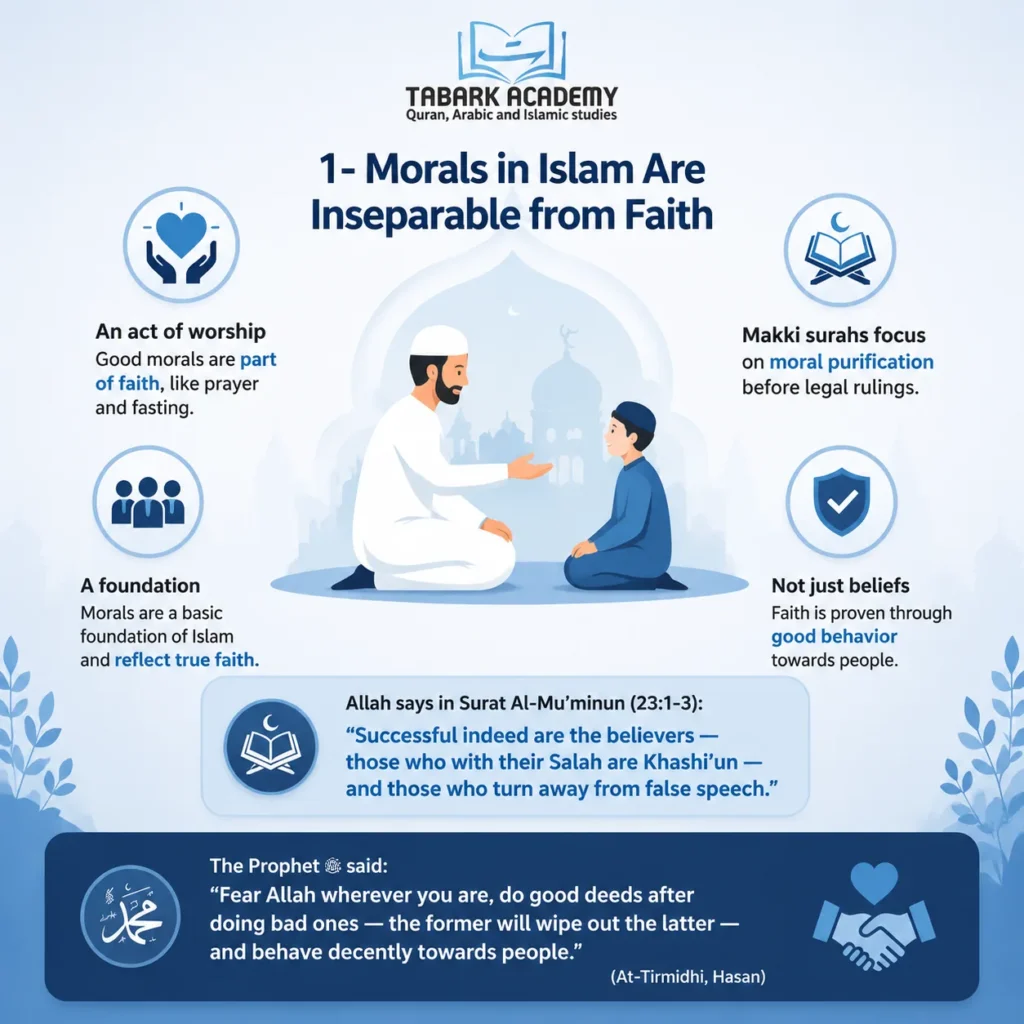
1- Morals in Islam Are Inseparable from Faith
Good morals in Islam are not a personality trait — they are an act of worship. Scholars of Islam categorize akhlaq (moral character) as a practical pillar of the religion, alongside prayer and fasting. The Makki surahs — the earliest chapters revealed — focus almost entirely on moral purification before moving to legal rulings.
Whoever ponders the Holy Quran, especially the Makki surahs, will find that they call and encourage people to have good morals and to purify their souls from anything that blocks the way to Allah.
Morals are not a minor thing in this religion — they are one of its basic foundations and the practical translation of correct beliefs. Iman (faith) is not only a feeling hidden in the heart; it is a clear behavior. If morals are not reflected in how we treat people, what is the value of faith?
The Quran connects morals to faith always. As Allah says in Surat Al-Mu’minun:
“Successful indeed are the believers — those who with their Salah are Khashi’un — and those who turn away from false speech.” (Quran 23:1–3)
Ethics are one of the four fundamentals Islam is based on, and the most visible one. It is not sufficient to have correct beliefs without performing deeds that reflect those beliefs. The Prophet ﷺ said:
“Fear Allah wherever you are, do good deeds after doing bad ones — the former will wipe out the latter — and behave decently towards people.” (At-Tirmidhi, Hasan)
2- Having good morals is a way to call people to Allah;
Dawah is calling people to Allah and telling them about Islam .It has many ways like using emotions, reasons, experiment and all of the above.
The shortest way to win people hearts is good morals as Some people revert to Islam when they find the good morals of Muslims and others form a negative view about Islam because of the bad and terrible manners of Muslim. So, as a Muslim you call to Islam directly or indirectly and the best way to call to Islam is having good manners.
In Quran Allah talks to prophet Muhammad and informs him that if the he has bad manners and harsh heart, people would have dispersed from around him .But all of the sweetness of the heart and tongue of prophet Muhammad are from Allah ,The Giver, the One who gives anyone whatever He wants by His favor and permission.
To have good manners , we should never lose our temper in difficult situation ,say bad words that hurt people, We should not talk loudly to anyone and we should not be rude or harsh in our words or body language. On the other hand, a person shall be honest, compassionate ,gentle and soft spoken, helpful, genuine and Be loving and caring.
The Prophet ﷺ said
“Whoever believes in Allah and the Last Day, let him speak good things or remain silent.” (Saheeh Muslim)
“Do not lose your temper.” *repeated three times as advice (Saheeh Bukhari)
“None of you will have faith until he loves for his brother what he loves for himself.” (Saheeh Bukhari)
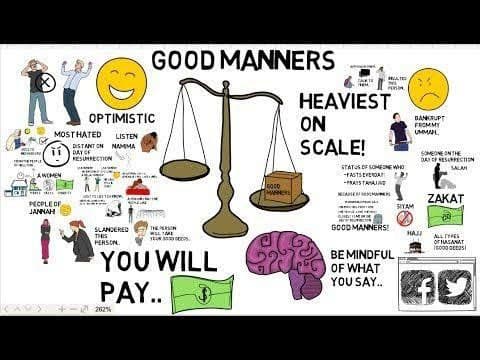
The messenger (peace be upon him) said, “Nothing is heavier on the Scale of Deeds than one’s good manners.” (Saheeh Al-Bukhari)
To avoid bad manners, a Muslim should never lose their temper in difficult situations, never say words that hurt people, and never be rude or harsh in speech or body language. On the other hand, a person of good character is honest, compassionate, gentle, soft-spoken, helpful, and caring.
Experience Our Interactive Learning
Curious about how we teach? Watch these brief video clips from our recent live sessions to see our structured curriculum, advanced learning platform, and dynamic student-teacher interactions firsthand.
Core Examples of Good Morals in Islam
Understanding what good morals in Islam look like in practice helps move them from abstract to actionable. Islamic scholars have identified several core moral qualities — each grounded in the Quran and Sunnah — that every Muslim is called to embody.
1. Sidq — Truthfulness
Truthfulness (sidq) is one of the highest moral virtues in Islam. The Prophet ﷺ said: “Truthfulness leads to righteousness and righteousness leads to Paradise.” (Sahih al-Bukhari).
A Muslim is truthful in speech, in trade, and in representing others — even when the truth is difficult.
2. Sabr — Patience
Patience (sabr) is mentioned over 90 times in the Quran — more than almost any other moral quality. It applies in hardship, in moments of anger, and in waiting for what is right. Sabr is not passive resignation; it is an active moral choice to hold to what is good under pressure.
3. Hilm — Gentleness and Restraint
The Prophet ﷺ said to Ashaj Abd al-Qays: “You have two qualities that Allah loves: gentleness (hilm) and deliberateness (ana’ah).” (Sahih Muslim).
Hilm is the quality that keeps a Muslim calm when provoked — the opposite of impulsiveness and anger.
4. Amanah — Trustworthiness
Amanah means fulfilling what has been entrusted to you — whether a secret, a responsibility, or a financial obligation. The Prophet ﷺ was known among the Quraysh as Al-Amin (the Trustworthy) before the revelation came, because his morals were visible to everyone around him.
If you want your child to internalize these qualities, the most direct path is through the Quran — because the Quran is where these moral teachings originate.
Tabarak Academy’s Islamic Studies Course Online connects children with qualified teachers who build Quran knowledge and Islamic character together. Explore the Islamic Studies Course
How to Teach Morals to Your Children in Islam
The most effective way to raise a child with good morals is to immerse them in the Quran — the primary source of Islamic values — and to model good character at home every day. The following practical steps, drawn from Islamic tradition, give parents a clear starting point.
Here are the most effective ways to build good morals in children:
- Take care of what they read or watch: The content children consume shapes their sense of what is normal. Monitor it intentionally.
- Take an action for any immoral behavior or if you discovered them doing or watching any inappropriate content. Delayed correction sends the message that the behavior is acceptable.
- Give your child love and kindness: A child who feels secure is far more receptive to moral guidance than one who is disciplined through fear.
- Tell them stories and be selective: Stories are the oldest moral education tool. The life of the Prophet ﷺ is full of concrete moral lessons that children remember: how he treated orphans, how he responded to those who harmed him, how he fulfilled promises.
Teaching your child the Quran is teaching them the source of Islamic morals directly. Tabarak Academy offers Online Quran Classes for Kids with certified teachers — structured, flexible, and accessible from home. Start your child’s Quran journey
Step Inside Our Virtual Classrooms
See our engaging teaching methods in action! watch real snippets of our live classes and discover how our expert instructors make learning interactive, memorable, and inspiring for every student.
Start Building Stronger Islamic Character Today
The fastest path to good morals in Islam is connecting with the Quran — the book that shaped the Prophet’s character and continues to shape every sincere student. Tabarak Academy pairs your child with qualified, patient teachers for Quran, Tajweed, Arabic, and Islamic Studies — all online, at a time that fits your family.
Our Courses:
- Online Quran & Arabic Classes | Foundation
- Online Quran Memorization Course
- Modern Standard Arabic Online Course (Fusha)
- Online Ijazah Course
- Recitation Of Quran with Tajweed Course
- Islamic Studies Course Online
Conclusion
Morals in Islam — expressed in Arabic as أخلاق (akhlaq) — are not optional refinements. They are the visible proof of faith, the most effective form of dawah, and the primary gift a Muslim parent can pass to their child.
Whether the quality is truthfulness (sidq), patience (sabr), or trustworthiness (amanah), each traces back to one source: the Quran and the example of the Prophet Muhammad ﷺ. The closer a person is to that source, the stronger their character becomes.
The Prophet ﷺ said: “I was only sent to perfect good character.” (Al-Hakim, authenticated). This single statement defines the relationship between Islam and morality. Good morals in Islam are not a branch of the religion — they are at its heart.
Frequently Asked Questions
Good morals in Islam raise questions — about their meaning in Arabic, their connection to faith, and how to build them in the next generation. The answers below address the questions readers ask most about akhlaq in Islam.
What is the word for morals in Arabic?
The Arabic word for morals is أخلاق (akhlaq), the plural of خُلُق (khuluq). It refers to a person’s character, ethical behavior, and the qualities that govern how they treat others. In Islamic tradition, akhlaq is considered a core component of the religion itself — not a secondary matter.
Why are morals important in Islam?
Morals are important in Islam for two main reasons: they are the practical expression of faith (iman), and they are the most effective form of dawah. The Prophet ﷺ said that nothing is heavier on the Scale of Deeds than good manners (Sahih al-Bukhari), placing morals at the center of a Muslim’s religious life.
What are examples of good morals in Islam?
Core examples of good morals in Islam include truthfulness (sidq), patience (sabr), trustworthiness (amanah), and gentleness (hilm). Each is grounded in specific Quranic verses and authentic hadiths. The Prophet ﷺ embodied all of these qualities and is the primary model for Muslims to follow.
How do I teach morals to my child in Islam?
The most effective approach is to teach children the Quran — the primary source of Islamic moral values — and to model good character at home. Age-appropriate stories from the life of the Prophet ﷺ are also a proven way to make moral lessons concrete and memorable.
Is having good morals enough in Islam without acts of worship?
No. Good morals are a required dimension of the religion, but they complement — not replace — acts of worship like prayer and fasting. Islam sees morals and worship as inseparable: throughout the Makki surahs, the Quran connects correct belief (iman) with ethical behavior in the same passages.
What did the Prophet Muhammad ﷺ say about good morals?
The Prophet ﷺ said: “I was only sent to perfect good character” (Al-Hakim). He also said: “Nothing is heavier on the Scale of Deeds than one’s good manners” (Sahih al-Bukhari). These statements show that morals are not peripheral to Islam — they are among its highest objectives.