


How to Stay Consistent With Quran Memorization?
Most people who start memorizing the Quran don’t quit because the verses are too hard. They quit because the daily habit collapses after a few strong weeks. If you’re looking for how to stay consistent with Quran memorization, the real problem usually isn’t your memory, it’s the system holding your memory up.
Consistency comes down to four habits working together:
- A daily portion small enough to survive a bad week.
- Review that outweighs new memorization.
- Understanding that anchors the words to meaning.
- Sincerity, avoiding what clouds your focus, and habits that protect your heart from what makes verses slip away.
This guide walks through each one, plus a daily structure built for your specific situation, and what to do if you’ve already fallen behind.

1- Take A Small, Unbroken Quran Wird Beating A Large, Broken One
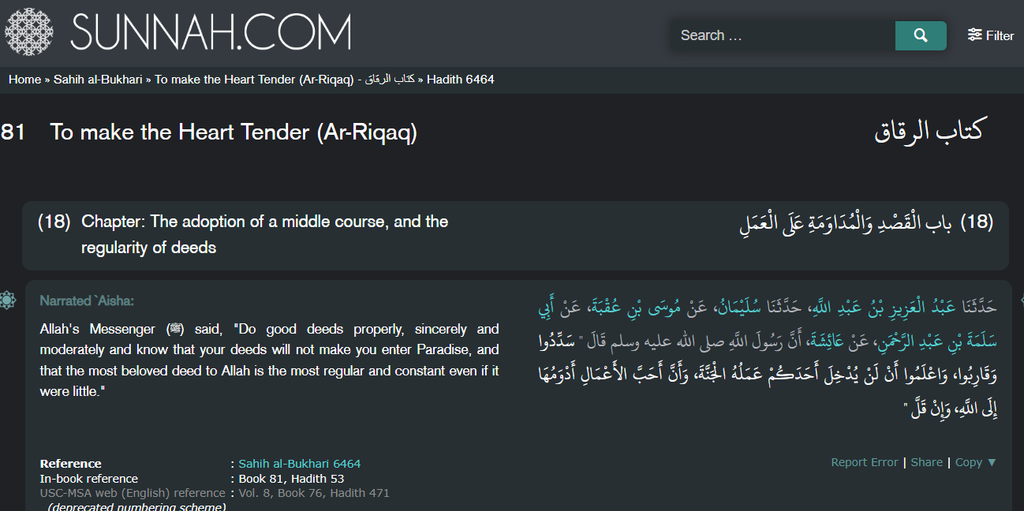
The Prophet ﷺ said the most beloved deed to Allah is the most regular and constant even if were little (reported in Sahih al-Bukhari and Sahih Muslim). The same logic applies to memorization. A quarter-page memorized every single day for a year carries you further than two pages memorized in bursts, with two-week gaps in between.
Gaps don’t just pause your progress. They force you to re-learn material that was already loosening in your memory, which is slower than learning it the first time.
How to size your starting portion:
A common, sustainable plan among memorization teachers is half a page a day, six days a week, resting on Friday. At that pace, a student completes the entire Quran in roughly four years. That’s a realistic timeline you can plan a life around, not an all-or-nothing sprint that burns out by month two.
If half a page still feels heavy in your first month, drop to a quarter-page. A portion you finish every day beats a target you abandon by week three.
2. Make Review More Important Than New Memorization
Muraja’ah is the deliberate re-reading and re-reciting of everything you have already memorized, on a schedule separate from learning new verses. Most students who “lose” their memorization didn’t fail at memorizing, they simply never built a review system.
This section answers one question: how do you structure review so it actually protects what you’ve memorized?
3. Adapt The Five Fortresses Framework For Quran Hifz Review
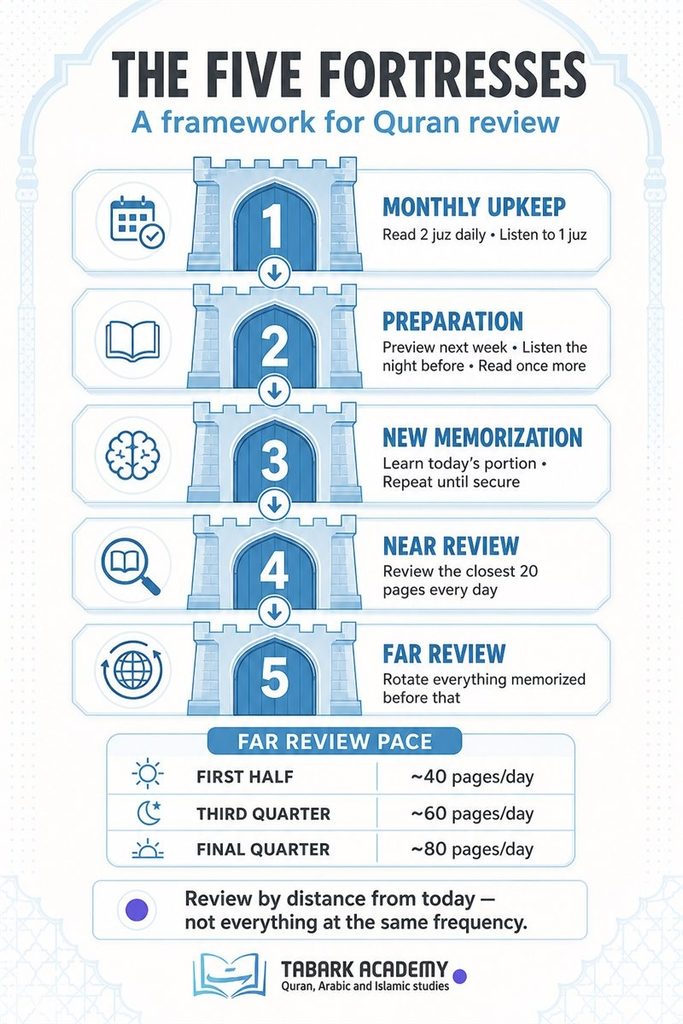
A structure known among Quran teachers as the Five Fortresses breaks the daily session into five layers instead of one:
- Monthly upkeep: read about two juz a day and listen to one juz of recitation, so the whole Quran stays familiar.
- Preparation: read next week’s material in advance, listen to it the night before, then read it once more right before memorizing.
- New memorization: learn today’s portion and repeat it until it’s secure.
- Near review: the twenty pages closest to what you just memorized, reviewed daily.
- Far review: everything memorized before that, on a rotating schedule that grows with your memorization.
| Stage of memorization | Far review pace |
| First half of the Quran | ~40 pages a day |
| Third quarter | ~60 pages a day |
| Final quarter | ~80 pages a day |
The mechanism is simple: older material needs less frequent contact to stay fixed than what you memorized yesterday. Grouping review by distance from today, not treating everything the same, is what keeps six months of work from evaporating in six weeks.
Signs You Should Increase Quran Review and Reduce New Memorization
If you notice yourself hesitating on pages you memorized weeks ago, that’s the signal to act, not to feel discouraged. Cut your new memorization in half and double your near review until the shaky pages feel solid again.
This isn’t a step backward. Review carries the same reward as reciting the Quran. Islamic scholarship treats it as part of your daily wird, not a lesser substitute for it. A working parent or professional who spends most of a session reviewing is still fully engaged in Quran memorization that day.
This kind of adjustment is hard to judge on your own but straightforward with a teacher watching your recitation session by

4. Use a Short Tafsir to Understand Each Verse Before Memorizing
Repetition builds the wording into your tongue. Understanding builds a second, independent path back to it when your memory blanks mid-recitation.
This section answers one question: how does understanding the text make memorization more durable?
Read a short tafsir before you memorize the verse
Reading a brief explanation of the verse before memorizing it gives you a mental hook beyond the sequence of words. A concise tafsir works better here than a lengthy commentary.
When you know why a verse says what it says, a forgotten word is easier to recover. You can reason your way back to the meaning instead of guessing at sounds.
Understanding should support repetition, not replace it. Relying on meaning alone tends to produce students who paraphrase the Quran under pressure instead of reciting it exactly.
Read also :90-Day Hifz Comeback Plan After a 5-Year Break
5. Avoid Quietly Break Your Hifz Habit
Small, seemingly harmless habits can quietly weaken your Hifz over time and make long-term retention harder:
- Switching mushaf editions mid-memorization resets the visual position memory you’ve built for each ayah’s place on the page.
- Moving to a new page before the last one is fully secure lets small errors compound over weeks.
- Treating memorization as separate from prayer wastes a natural reinforcement opportunity.
- Starting with an ambitious daily target, then abandoning it once it’s unsustainable — the most common failure pattern of all.
Using one fixed mushaf edition throughout your memorization; same page layout, same line breaks, is a small decision most beginners overlook. It measurably reduces confusion later.
6. Protect Your Quran Memorization Habit With Prayer
A habit this long-running needs support outside the study session itself. Two supports matter most: how you use your prayers, and who you recite to.
Reciting the verses you just memorized during voluntary prayers, and during the silent portions of obligatory prayers, locks them into long-term memory. It costs no additional time. Early scholars relied on this deliberately rather than treating prayer and memorization as separate activities.
If you memorize a page a day, try reciting that page in your Duha or night prayer the same evening. By the time you review it formally the next day, it will already feel familiar.
7. Find a teacher or study partner to recite to regularly
Tasmi’ means reciting your memorization aloud to someone else who follows along with the mushaf. It catches errors you can’t hear in your own recitation.
A word swapped for a similar-sounding one, a skipped ayah and a mixed-up order between two similar verses, these surface only when another set of ears is listening.
A consistent listener does something a solo habit can’t. It creates a standing appointment you don’t want to miss. That single appointment is often the difference between a habit that lasts a year and one that quietly stops after a month.
Tabarak Academy‘s Ijazah-certified instructors listen to your recitation in private sessions, not group classes. Every missed word gets caught and corrected the same day. Your review plan adjusts to how your memory is actually behaving that week.
Experience Our Interactive Learning
Curious about how we teach? Watch these brief video clips from our recent live sessions to see our structured curriculum, advanced learning platform, and dynamic student-teacher interactions firstha
Have a look at our Quran Courses

8. Guard your memorization with sincerity and by avoiding what weakens it
Sincerity in memorization means returning to the Quran because you want closeness to Allah — not recognition, not completion for its own sake. Scholars of Hifz consistently note that students who memorize for an audience struggle with retention in ways that students who memorize privately do not.
The second part is avoidance, Classical scholars identified specific behaviors that weaken memorization: habitual sin, excessive distraction, and time spent in environments that dull the heart.
Ibn al-Jawzi and others wrote that the Quran “withdraws” from a heart that is not kept ready to receive it — not as punishment, but as a natural consequence of where attention and intention are directed.

a. Renew your intention for Allah
Niyyah is the intention behind an act of worship. Here, It is memorizing the Quran for Allah’s sake rather than for recognition or comparison with others. When memorization feels heavy, renewing this intention resets your motivation to something durable.
A goal tied to comparison fades the moment no one is watching your progress. A goal tied to sincerity survives the quiet weeks between milestones, which is exactly when most people quit.
b. Avoiding sin protects your memory, not just your reward
Traditional Quran teachers treat this as cause and effect, not metaphor: guard the five daily prayers, limit idle talk and backbiting, and protect your memorization session from anything that clouds your focus. The link between the two isn’t mystical.
Mental clutter from an unsettled conscience is one of the most common things students report as breaking their concentration mid-session. Removing the clutter is often what fixes the concentration.
c. What to do when you feel like quitting
Waswasa is the term for the intrusive doubt or discouragement that surfaces when you’re trying to build a good habit. Islamic scholarship treats it as something to expect, not a sign that you’re failing.
The scholar Ibn Taymiyyah described this directly: these doubts approach everyone who turns toward Allah, and the response is to stay firm, keep to your prayer and remembrance, and not let irritation push you to stop. In practice, the day you feel like quitting isn’t the day to renegotiate your whole plan. But, it’s the day to do the smallest version of it and move on.
Read also: Overcoming Hifz Burnout: A Comprehensive Guide
9. Build A Daily Schedule And Habit Structure That Matches Your Situation
The habits above work the same for everyone. The time slots and portion sizes don’t. Here’s how to apply this framework if you’re a student, managing a home, working full-time, or getting back on track after a break.
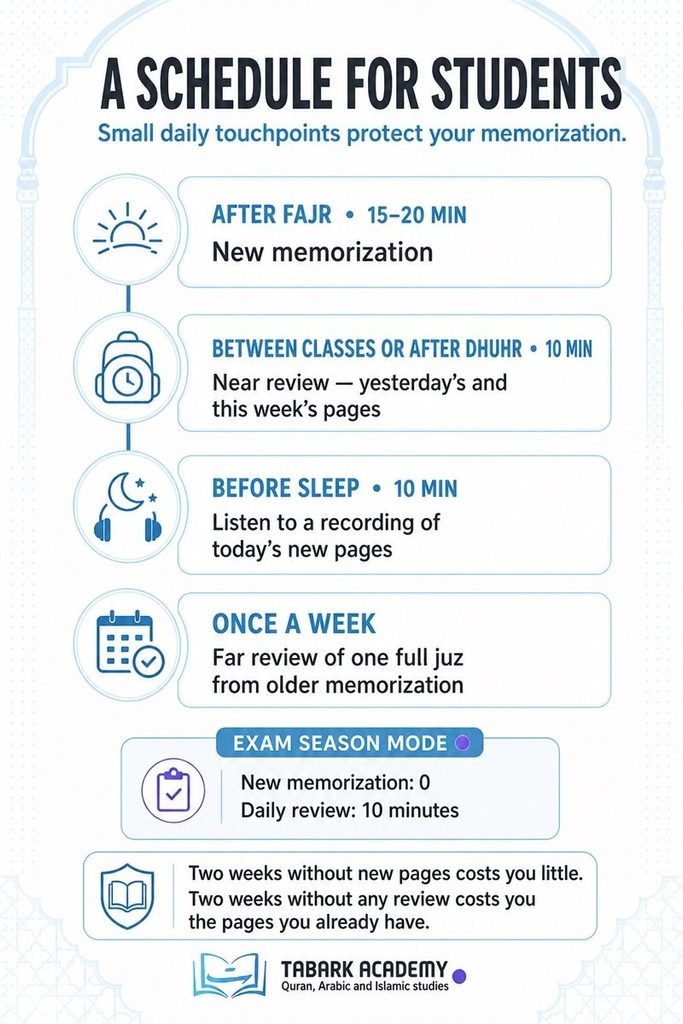
a. A schedule for students
A student’s biggest risk isn’t a lack of time; it’s exam season wiping out weeks of review in one stretch.
| Time | Activity |
| After Fajr (15–20 min) | New memorization |
| Between classes or after Dhuhr (10 min) | Near review — yesterday’s and this week’s pages |
| Before sleep (10 min) | Listen to a recording of today’s new pages |
| Once a week | Far review of one full juz from older memorization |
During exams, cut new memorization to zero and hold a 10-minute daily review only. Two weeks without new pages costs you little. Two weeks without any review costs you the pages you already have.
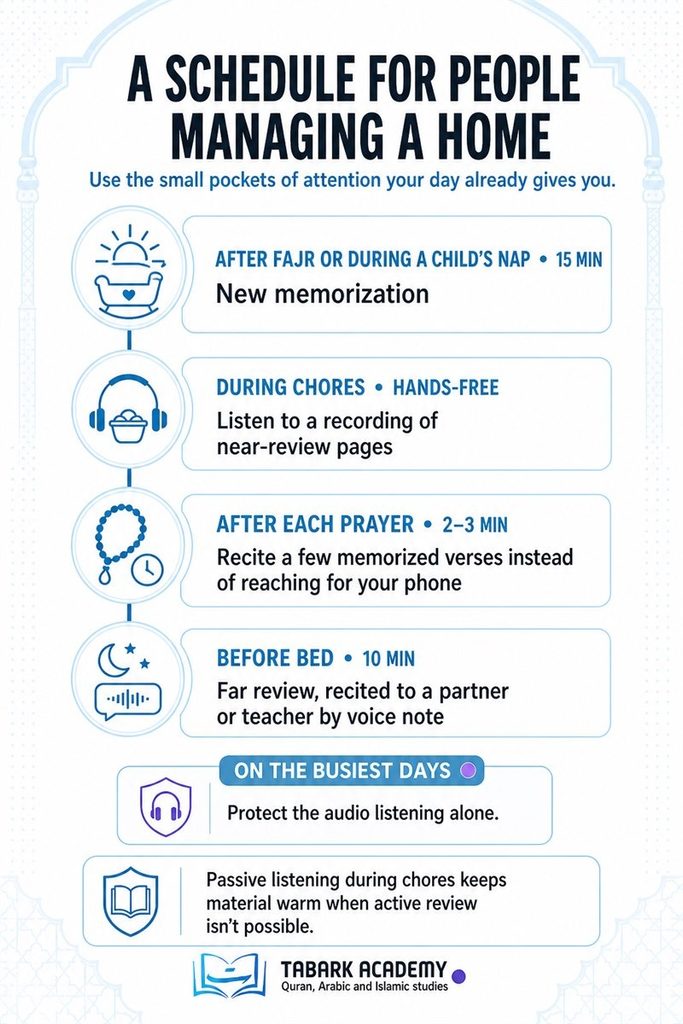
b. A schedule for people managing a home
The challenge here isn’t total time; it’s that attention comes in short, interrupted bursts around children and chores.
| Time | Activity |
| After Fajr or during a child’s nap (15 min) | New memorization |
| During chores, hands-free | Listen to a recording of near-review pages |
| After each prayer (2–3 min) | Recite a few memorized verses instead of reaching for your phone |
| Before bed (10 min) | Far review, recited to a partner or teacher by voice note |
On days when even 15 minutes doesn’t happen, protect the audio listening alone. Passive listening during chores keeps material warm even when active review isn’t possible.
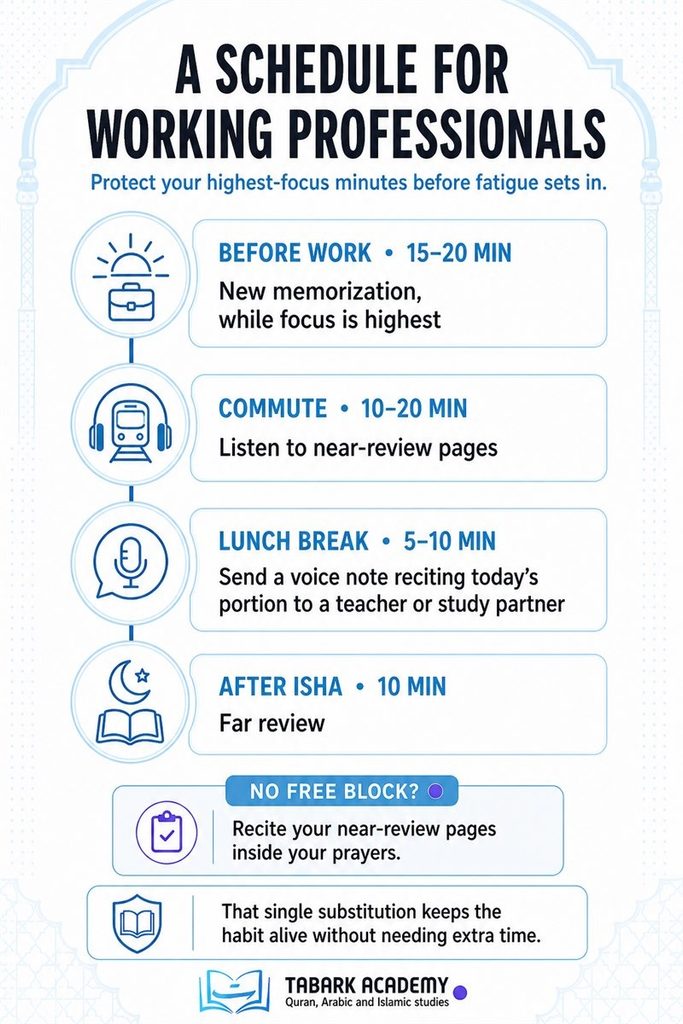
c. A schedule for working professionals
The constraint here is usually mental fatigue by evening, not the clock itself.
| Time | Activity |
| Before work (15–20 min) | New memorization, while focus is highest |
| Commute (10–20 min) | Listen to near-review pages |
| Lunch break (5–10 min) | Send a voice note reciting today’s portion to a teacher or study partner |
| After Isha (10 min) | Far review |
On a day with no free block at all, recite your near-review pages inside your prayers instead of adding a separate session. That single substitution keeps the habit alive without needing extra time.
If you’ve already fallen off track
Falling off track means a gap in your daily habit long enough that you can feel older material slipping. Most people respond by trying to make up every missed day at once; memorizing double and cramming review. However, the result will be quitting again within a week.
The better approach: spend your first week back on review only, starting from the pages right before the break, with no new memorization at all. Resume new memorization at half your previous pace for the following two weeks, then return to your normal rate once review feels stable again.
Whichever pattern matches your situation, Tabarak Academy‘s live one-on-one sessions run morning, afternoon, evening, and weekend slots. So, your schedule doesn’t have to bend around a fixed class time. The class bends around you.

Step Inside Our Virtual Classrooms
See our engaging teaching methods in action! watch real snippets of our live classes and discover how our expert instructors make learning interactive, memorable, and inspiring for every student.
Start Your Hifz Journey With A Teacher Who Reviews With You
Consistency is easier to sustain when someone qualified is tracking your review, not just your new pages.
Tabarak Academy pairs you with an Al-Azhar Ijazah-certified teacher for private, one-on-one Hifz classes with Tajweed. Sessions are built around your schedule, your pace, and a review plan that adjusts as you grow.
Tabarak Academy has 25 years of experience and more than 6,800 students across 15+ countries. The review systems this article describes are already built into how its Hifz teachers teach. Female tutors are available at no extra cost for sisters and families who prefer them.
Read: Why Is It Vital To Recite Quran With Tajweed?

Have a look at our Courses and Book Your Trial
- Online Quran & Arabic Classes | Foundation
- Recitation Of Quran with Tajweed Course
- Islamic Studies Course Online
- Arabic Alphabet Learning Course
- Noorani Qaida Course for Adults
- Quranic Arabic Course for Kids
- Arabic and Quran Classes for Kindergarten
- Islamic Summer Camp
- Hifz for Kids Course
- Hifz Course for Sisters
- Hifz for Adults Course
- Online Hifz Program
- Noor Al-Bayan Course
Conclusion
Staying consistent with Quran memorization comes down to four habits. Protect a daily portion small enough to survive a bad week. Give review more weight than new memorization.
Anchor the words in understanding. Guard the habit with sincerity, avoiding sin, and a regular listener.
None of this requires unusual memory or unlimited free time. Whether you’re a student working around exams, managing a home around a toddler’s schedule, fitting memorization around a job, or starting again after a break, you can do it. It requires a system that survives your worst weeks, not just your best ones.
Build that system, protect it the way you’d protect any other daily worship, and the pages accumulate on their own.
Frequently asked questions about staying consistent with Quran memorization
What’s the best daily amount to memorize, and how long will the whole Quran take?
Half a page a day, six days a week, is a realistic target for most beginners. At that pace, most students complete the Quran in roughly four years. A quarter-page you finish every day still beats a full page you abandon after two weeks.
Should review or new memorization come first in my session?
Review your near pages before you start new memorization, since your recall is freshest at the start of a session. If you’re short on time, protecting review takes priority over adding new material.
What if I don’t have enough time some days?
Cut your new memorization rather than skipping your session entirely. A short review of what you already know still counts as engaging with the Quran and carries the same reward as recitation.
Does switching between different Quran editions hurt memorization?
Yes, in practice it does. Memorizers rely on remembering where an ayah sits on the page; near the top, mid-page, next to a line break. Changing editions disrupts that visual anchor and slows recall.
Is the daily schedule different for students, homemakers, and working professionals?
Yes. The four core habits stay the same, but the timing changes. Students protect review hardest during exams, homemakers anchor sessions around nap time or chores, and working professionals often fold review into commutes or prayers instead of a separate block.
How do I restart if I’ve already stopped for weeks or months?
Spend your first week back on review only, with no new memorization, starting from the pages right before you stopped. Resume new memorization at half your old pace for two weeks before returning to your normal rate.