


The best age to start Quran memorization for a child
Most parents ask this question the moment their toddler starts repeating words back to them: Is my child too young to begin, or have we already waited too long? If you’re searching for the best age to start Quran memorization for a child, here’s the honest answer: no single birthday marks the starting line. Readiness matters more than a number on a calendar.
That said, there is a clear pattern. Children move through three distinct stages before formal memorization takes hold, and knowing which stage your child is in tells you far more than their age alone.
But what are those stages? And how do you know your child is ready? Keep reading for the signs that actually matter, a weekly rhythm young memorizers can sustain, and the mistakes that quietly undo weeks of work.

What you’ll learn
- The three stages every child passes through before memorization becomes formal.
- The specific, observable signs that show your child is ready to begin.
- An age-by-age roadmap from birth through structured Hifz.
- A weekly rhythm you can start using immediately.
- The most common mistakes that stall a child’s progress.
Quran Memorization for A Child
Hifz is the Arabic word for memorization. Here, it means memorizing the Quran by heart, verse by verse, with a teacher checking accuracy along the way. Most families conflate “starting Hifz” with “starting to hear the Quran,” and that is why we are here discussing this.
Why One Age Doesn’t Fit Every Child?
A four-year-old who can sit still, repeat phrases accurately, and speak in full sentences is ready for far more than a same-age child still forming basic words.
Islamic teaching has never tied memorization to a fixed birthday. It ties it to a child’s demonstrated readiness, which parents and teachers assess together.
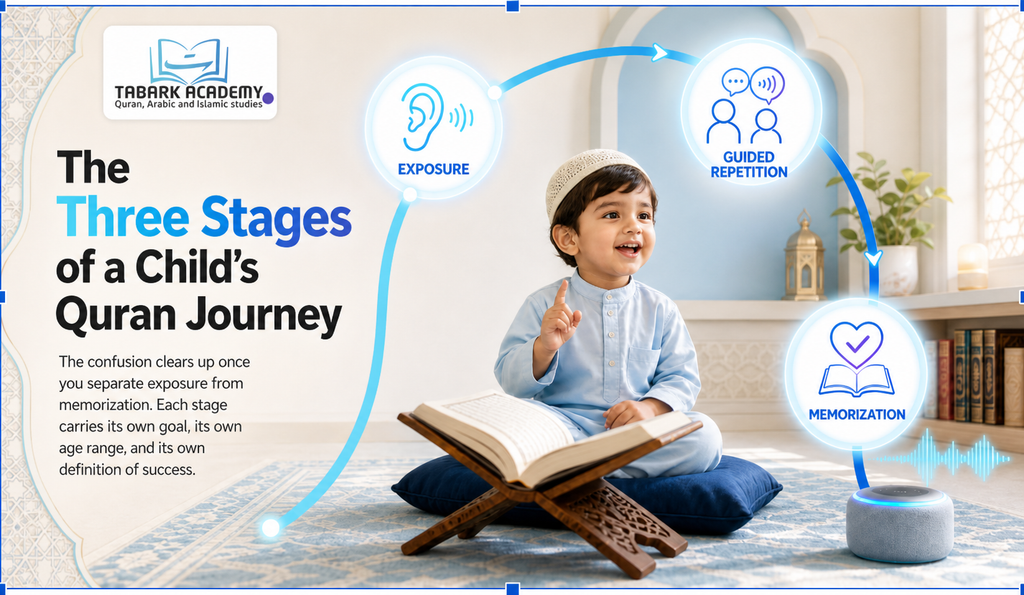
The Three Stages Of A Child’s Quran Journey
The confusion clears up once you separate exposure from memorization. Each stage below carries its own goal, its own age range, and its own definition of success.
1. Listening Exposure (Before Birth To Age Two)
Listening exposure can start before birth and continues through infancy, with no expectation of retention. The goal is familiarity, not memorization — recitation played during feeding, sleep, or quiet play.
Many parents skip straight to asking “when do we start memorizing,” without realizing their child has already been in this stage for years. That’s not wasted time; it’s the groundwork that makes every later stage faster.
2. Foundational Repetition (Ages Three To Five)
Foundational repetition typically begins between ages three and five, through short surahs, simple duas, and playful sound imitation.
Children at this stage repeat what they hear before they understand it, the same way they pick up their first spoken words. There’s no formal teacher yet and no pressure to get it right — just consistent, low-stakes exposure that turns unfamiliar sounds into familiar ones.
3. Structured, Accountable Memorization (Age Five And Up)
Structured, accountable memorization is different: a teacher hears recitation and corrects it verse by verse, generally starting between ages five and seven. This is where a trained tutor makes the real difference — the gap between a child who associates the Quran with pressure and one who associates it with warmth.
Tabarak Academy‘s live, private sessions are built around exactly this handoff, matched to each child’s pace rather than a fixed date.
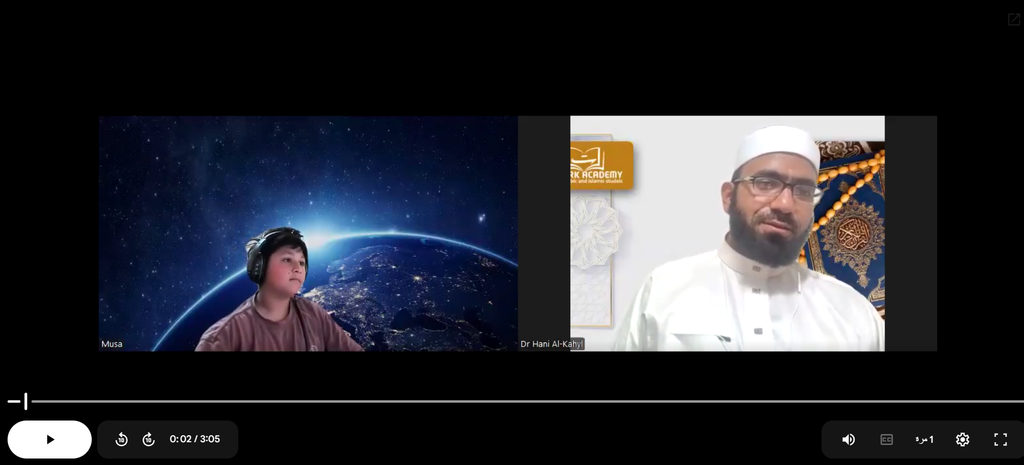
Watch Tabarak Academ in classes with young learners in action
But, what you will do if your child ready to start his Quarn memorization journey?
Experience Our Interactive Learning
Curious about how we teach? Watch these brief video clips from our recent live sessions to see our structured curriculum, advanced learning platform, and dynamic student-teacher interactions firsthand.
How To Tell If Your Child Is Ready To Start
Age gives you a rough window, but three concrete signs tell you whether your specific child is ready today. Watch for these before committing to a formal memorization schedule.
The Readiness Triangle – Speech, Sit, Repeat
Look for three things together, not just one.
- Speech: your child speaks in clear, complete phrases that a stranger could understand.
- Sit: your child can remain focused with a teacher or parent for five to ten uninterrupted minutes.
- Repeat: your child spontaneously echoes verses or duas they’ve heard, without being asked to.
When all three signs show up together, formal memorization sessions tend to go smoothly. When only one or two are present, more listening-stage exposure usually closes the gap faster than pushing ahead. However, what does happen when memorization starts early?
Starting Memorization Too Early
Starting before a child can sit or speak clearly doesn’t damage anything permanently. But it usually produces frustration on both sides: a parent repeating corrections a toddler isn’t developmentally able to apply yet, and a child who begins associating Quran time with failure rather than comfort.
The fix isn’t waiting indefinitely; it’s shifting back to listening and repetition until the three signs align.
Read also: Teaching the Quran to a 4-Year-Old: A Step-by-Step Guide
The Age-By-Age Roadmap For Quran Memorization
With the readiness signs in mind, here’s how the three stages typically map onto age, based on how most Hifz programs structure early learning.

a- Birth To Age Two – Building The Quranic Ear
There’s no instruction here, only ambient sound. Playing recitation during feeding, sleep, or quiet play lets an infant’s ear absorb rhythm and pronunciation long before language production begins.
Scholars who address this stage consistently note that Islamic teaching places no formal requirement here. It’s entirely about creating a home environment where Quranic sound is normal, not novel.
b- Ages Three To Five – The Golden Window For Gentle Repetition
This is where most children start actively echoing what they hear. Short, high-repetition surahs work best here — Al-Ikhlas and Al-Kawthar are common starting points because of their length and rhythm.
Keep sessions under ten minutes and frame them as play, not lessons. Praise for effort, not accuracy, keeps the child engaged through the inevitable mispronunciations.
Because attention spans at this age are genuinely short and unpredictable, flexible scheduling matters more here than at any other stage.
This is one reason Tabarak Academy runs every kids’ session one-on-one rather than in groups. A five-year-old having an off day needs a session that adapts in real time — not a group lesson that moves on without them.
Check our hifz courses for kids

c- Age Six And Beyond – Structured, Independent Hifz
Once a child can sit for fifteen to twenty minutes and take correction without losing motivation, memorization becomes accountable.
A teacher listens to recitation every day or week, checks progress, and adds Tajweed; the rules for correct pronunciation, alongside new verses. The child can start learning the Noorani Qaida and Arabic letters by sight while keeping the memorization by ear.
Read also:Coping with Hifz Burnout: The Ultimate Guide
A Simple Weekly Rhythm For Young Memorizers
A steady rhythm avoids the two biggest problems: burnout from too much new material, and getting stuck from too much repeating. A five-and-two plan works well for most beginners; five short sessions to learn or repeat one new verse, and two sessions just for review of everything learned that week.
Ten to fifteen minutes per session is enough at this early stage. Making sessions longer to “cover more ground” almost always backfires with young children; it leads to fidgeting, not better memory.
Staying consistent matters more than pushing hard. A tutor who hears the same child recite every week — instead of a rotating group of teachers — spots memory gaps early and slows down before the child gets frustrated.
That’s part of why Tabarak Academy gives each child one dedicated, Ijazah-certified tutor for the whole course, instead of changing teachers from session to session.
Take a tour of Tabarak Academy and pick the right teacher for your child.

Common Mistakes That Slow Down Early Quran Memorization
Even well-intentioned parents fall into patterns that work against a child’s natural pace. These three come up most often.

a- Forcing Memorization Before Speech Is Clear
Pushing a child to memorize verses before they can pronounce the underlying sounds clearly teaches mispronunciation alongside memorization.
Mispronunciations learned early are notoriously hard to correct later. Waiting for clear speech isn’t lost time, it prevents having to unlearn bad habits afterward.
b- Treating Every Missed Day As Failure
A missed session or a week of shaky recall doesn’t mean your child “isn’t good at this.” Memory settles unevenly at this age — some weeks stick, some don’t. One rough week tells you very little about the years ahead.
Parents who expect these dips keep their children going; parents who read them as failure often watch that interest disappear
Read also:How To Make Quran Memorization Fun For Kids?
c- Skipping Review To Chase New Verses
New hifz feels like progress, but without regular review, earlier surahs fade just as fast as they were learned. The five-and-two rhythm above exists specifically to prevent this. Review isn’t a pause in progress — it’s what makes progress permanent.
Step Inside Our Virtual Classrooms
See our engaging teaching methods in action! watch real snippets of our live classes and discover how our expert instructors make learning interactive, memorable, and inspiring for every student.
Book your child’s free trial class with Tabarak Academy TODAY
Give your child a Quran teacher who adjusts to them, not the other way around. Tabarak Academy has spent 25 years building private, one-on-one Hifz programs for children. Every tutor carries a verified Al-Azhar Ijazah, and more than 6,800 students have been taught across 15+ countries.
Book a completely free trial class — no payment, no pressure, no obligation — and see how your child responds to a session built entirely around their pace.

Our Courses
- Online Quran & Arabic Classes | Foundation
- Recitation Of Quran with Tajweed Course
- Islamic Studies Course Online
- Arabic Alphabet Learning Course
- Noorani Qaida Course for Adults
- Quranic Arabic Course for Kids
- Arabic and Quran Classes for Kindergarten
- Islamic Summer Camp
- Hifz for Kids Course
- Hifz Course for Sisters
- Hifz for Adults Course
- Online Hifz Program
- Noor Al-Bayan Course
Conclusion
There’s no single best age to start Quran memorization for a child — there’s a best stage, and every child reaches it on their own timeline. Listening exposure can start at birth.
Gentle repetition usually clicks between three and five, and structured, accountable memorization generally begins between five and seven, once a child can sit, speak clearly, and repeat spontaneously.
The parents who see the smoothest progress aren’t the ones who started earliest. They’re the ones who matched their approach to their child’s actual readiness at each stage, kept sessions short and consistent, and treated the inevitable plateaus as normal rather than alarming.
Watch the three readiness signs, keep the rhythm consistent, and the age question mostly answers itself.
Frequently asked questions
What is the best age to start Quran memorization for a child?
Most children are ready for structured memorization between ages five and seven, though gentle listening and repetition can begin as early as age three. The right age for your child depends more on speech clarity and attention span than on a fixed birthday.
Can a two-year-old start learning the Quran?
A two-year-old can begin the listening stage, absorbing rhythm and pronunciation through daily exposure at home. Formal memorization isn’t developmentally appropriate yet. This exposure period is genuinely valuable groundwork, not something to rush past.
What are the clearest signs a child is ready to begin memorizing?
The clearest signs are clear speech in full phrases, the ability to sit focused for five to ten minutes, and spontaneous repetition of verses they’ve heard. When these three signs appear together, formal sessions tend to go smoothly.
Is there an ideal time of day for a child to memorize Quran?
There’s no single ideal time. What matters is picking a slot when your child is naturally calm and alert — shortly after waking, before bedtime, or right after school. Consistency in timing matters more than the specific hour chosen.
How long does it typically take a child to memorize the Quran?
Timelines vary widely based on starting age, session consistency, and the child’s individual pace, so there’s no universal number. Children who start with strong listening exposure and stick to a steady weekly review rhythm generally progress faster than those who start memorization cold.
What should I do if my child seems bored or resistant during sessions?
Shorten the session and shift back toward listening and playful repetition rather than pushing through resistance. Boredom or resistance is usually a signal that the pace or format needs adjusting, not that the child is unsuited to memorization.