


Hifz Burnout – A Full Guide
Hifz burnout, for me, looked like reciting ten juz a day for weeks before every Quran competition. Then, after the competition, not even a single ayah could be revised. The energy was just gone.
Underneath the exhaustion sat a guilt I didn’t know how to shake, because I was certain everything I had worked so hard to memorize was about to slip away. However, I failed to drag myself to revise even an ayah.
That cycle repeated for years before I found a way out of it. If you recognize any of that, the crash after the push, the guilt that follows and the fear that you’re losing what you built, you’re in the right place.
Let me guide you through the exact recovery plan that finally broke the cycle for me: how to recover from hifz burnout with a phased plan, not just another list of motivational tips.

What You’ll Learn
- How to tell normal tiredness apart from a short slump and true hifz burnout.
- Whether forgetting memorized Quran is actually a sin.
- The Reset, Rebuild, Sustain protocol for recovering in stages.
- A decision framework for whether to pause, reduce, or step back from hifz.
- How burnout looks different for students, working adults, parents, and anxious perfectionists.
What Hifz Burnout Really Is?
Hifz burnout is mental and physical depletion from sustained Quran memorization. New verses stop sticking, older memorization feels shaky, and the session itself starts to feel like a burden instead of worship.
It is a system problem, not a character flaw. It usually means your pace has been heavier than your life could carry, not that Allah is displeased with you or that you lack sincerity.
That distinction matters. Shame is what turns a short recovery into a permanent stop. Before you treat burnout, it helps to know which of three states you’re actually in, since each one calls for a different response.
Normal Fatigue, a Short Slump, or True Hifz Burnout
- Normal fatigue is a heavy feeling after one hard day that clears with a night’s sleep.
- A short slump is a week or two of slower progress that resolves on its own if you keep showing up.
- True hifz burnout is different. It lasts for weeks or months, brings resentment or dread toward sessions, and comes with a felt loss of connection to the Quran itself.

If you recognize yourself having a true burnout, don’t worry. Let’s fix it together.
Experience Our Interactive Learning
Curious about how we teach? Watch these brief video clips from our recent live sessions to see our structured curriculum, advanced learning platform, and dynamic student-teacher interactions firsthand.
How to Apply the Reset, Rebuild, Sustain Recovery Plan
Recovering from hifz burnout works better as a sequence than as a single decision to “push through” or “take a break.” Three phases move you from stabilization to a pace you can actually keep for years: Reset, Rebuild, and Sustain.
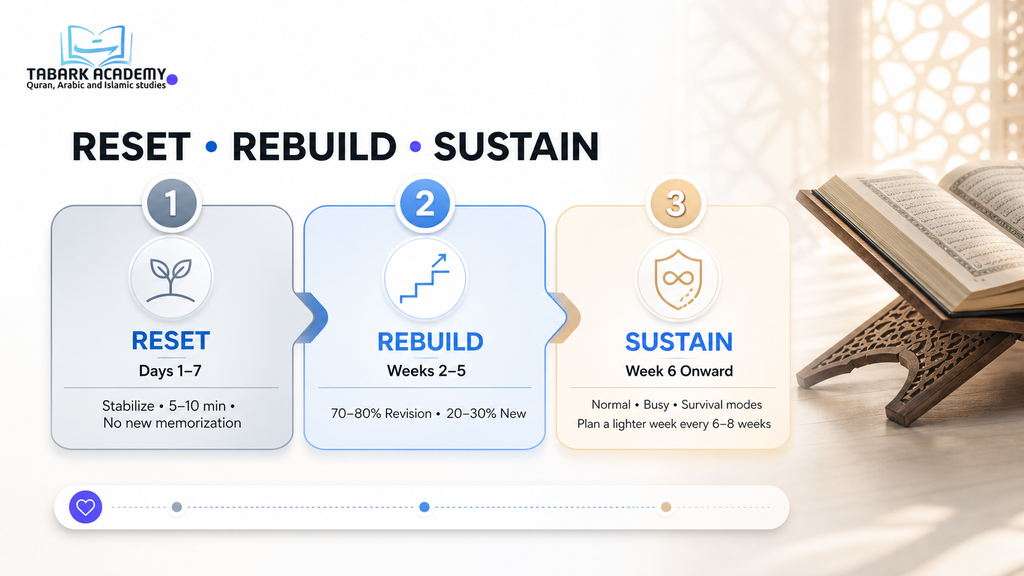
1. Reset (Days 1–7)
The goal of the Reset week is stabilization, not progress. Pause new memorization completely for seven days. Keep your Quran time to a minimum viable routine of five to ten minutes, limited to revising one or two short surahs you already know well. There is no teacher testing and no new sabaq this week.
Total silence from the Quran, however, isn’t the goal either. The Prophet ﷺ compared the believer who reads Quran to a citron, pleasant in both scent and taste, and the believer who doesn’t read it to a date, sweet but without fragrance. That’s why the Reset week keeps one light, non-demanding habit going.
Listen to a reciter you love for a few minutes, or read a short tafsir note on a familiar ayah, anything except reciting from memory under pressure.
If sadness or grief is tangled into the burnout, add the du’a of Abdullah ibn Mas’ud to this week specifically:
اللَّهُمَّ إِنِّي عَبْدُكَ، ابْنُ عَبْدِكَ، ابْنُ أَمَتِكَ… أَسْأَلُكَ أَنْ تَجْعَلَ الْقُرْآنَ رَبِيعَ قَلْبِي، وَنُورَ صَدْرِي، وَجِلَاءَ حُزْنِي، وَذَهَابَ هَمِّي
“O Allah, I am Your servant… I ask You to make the Quran the spring of my heart, the light of my chest, the departure of my sadness, and the removal of my worry.”

Your only job this week is stabilization. Nothing measured this week counts as failure.
2. Rebuild (Weeks 2–5)
Once the Reset week ends, reintroduce structure slowly. Add back one to three new ayat, or a quarter to half a page, four to five days a week.
Keep revision at roughly seventy to eighty percent of the session. New memorization stays at only twenty to thirty percent. Fix the whole session to fifteen to twenty-five minutes right after a specific prayer, so it doesn’t expand and recreate the pressure that caused burnout in the first place.
Add one weekly check-in during this phase, with a teacher, a hifz partner or just yourself in a notebook. Build it around three short questions: did I feel dread or calm this week, was the routine actually sustainable, and what one thing should change next week. Answering honestly tells you whether to hold the current portion or reduce it further.
A Quran teacher who hears your recitation directly, rather than relying only on your own self-assessment, makes it easier to catch when a portion is still too heavy.
Tabarak Academy‘s Hifz tutors are Al-Azhar Ijazah-certified and work with students one-on-one, so the pace adjusts to the individual instead of a fixed class schedule.
Have a look at our Hifz Tutors in Tabarak Academy and their Certifications & Accreditations

3. Sustain (Week 6 Onward)
By week six, the goal shifts from recovering to building a routine that survives real life. Define three modes in advance. A normal-mode routine for typical weeks. A busy-mode routine for exams or travel. A survival-mode minimum, as small as three ayat or five minutes, for the worst days.
Deciding these in advance, before you’re overwhelmed, prevents the same crash that caused the original burnout. Schedule a planned lighter week every six to eight weeks, even when things feel fine.
It’s the detail most students skip because it feels unnecessary in the moment. However, a scheduled light week costs far less than the unscheduled multi-week collapse it prevents.
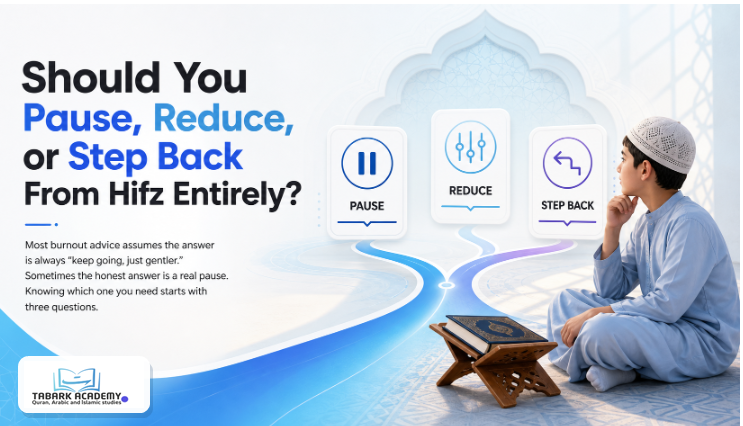
Should You Pause, Reduce, or Step Back From Hifz Entirely
Yes, you may need to pause, reduce, or step back from Hifz, depending on the severity of your burnout. If a lighter memorization schedule restores consistency, reduce your pace; if exhaustion continues even with smaller goals, taking a genuine pause can be better than forcing yourself forward.
a- Is the Problem Your Routine, or the Quran Itself?
If what you dread is the pressure, the teacher relationship, or the pace; not the Quran itself, the fix is adjusting that setup, not stepping away from hifz.
If the aversion is toward recitation itself, that’s a different signal. It usually calls for prioritizing spiritual reconnection over memorization targets for a while.
b- Would You Still Want to Stop your hifz if All Outside Pressure Disappeared?
If parental expectations, a teacher’s deadline, or social comparison vanished tomorrow and you’d still want to keep going, you most likely need load reduction, not an exit.
If the honest answer is that you’d still want to stop, a formal, planned pause is more truthful than forcing continuation.
c- Can You Picture Returning to Hifz in Six to Twelve Months?
If you can imagine coming back with a lighter, gentler plan, frame the current break as a planned pause, not a failure. Set a maintenance-mode routine of roughly one page of revision a week, with no new memorization, until you resume.
If you can’t picture returning at all right now, shift focus to tilawah, tafsir, and salah without the hifz target, and revisit the question later.
Burnout Looks Different Depending On Your Situation
The right adjustment depends heavily on what’s actually driving the exhaustion. A student under exam pressure needs a different fix than an adult juggling a full-time job.

a- If You’re a Student Balancing Hifz and Exams
The signs here are constant rushing, dreading your teacher’s session, and having no real time left for revision once schoolwork is done. The practical fix is negotiating a reduced daily new portion during exam weeks.
Protect your sabqi (new lesson) and manzil (older, previously memorized review) portions, and use weekends to catch up gradually, not all at once.
If you need to raise this with a teacher, a direct script helps: “I need to pause new memorization for a few weeks and focus on revision and rest so I don’t lose what I’ve already built.”
b- If You’re an Adult having Work and Family
The signs are missed days, guilt about being “too old” to be struggling with this, and a memorization window that keeps shrinking to late at night.
The fix is accepting a smaller, steadier daily portion. Shift new memorization to a rested part of the day, and use commute time for audio repetition of what’s already memorized.
Fitting the Rebuild phase’s short daily session around a full-time job is easier when class times flex around your schedule. Tabarak Academy’s private sessions run in 30, 45, or 60-minute slots across morning, afternoon, evening, and weekend times, which makes it realistic to protect a fixed short session even during a demanding work week.
At Tabarak Academy, you can find your perfect teacher who suits your needs entirely. Have a look at our teachers.

b- If You’re a Parent Guiding a Burned-Out Child
The signs are resistance, tears before sessions, or open frustration with hifz time. Moreover, the instinct to push harder usually backfires.
The fix is reducing the daily target and reconsidering the teaching method or teacher fit if the relationship feels harsh. Involve the child directly in setting the next goal so the plan feels less imposed.
A short script for talking to your own child works the same way it works with a teacher: “We’re not stopping the Quran. We’re changing how we’re doing it so it stops feeling this heavy.”
Step Inside Our Virtual Classrooms
See our engaging teaching methods in action! watch real snippets of our live classes and discover how our expert instructors make learning interactive, memorable, and inspiring for every student.
Book Your Free Trial and Start Recovering at Your Own Pace
A recovery plan works better with someone tracking it alongside you. A teacher can adjust your portion, listen for the difference between ordinary forgetting and real strain, and catch a relapse into the “catch-up” trap before it restarts the cycle.
Tabarak Academy has spent over 25 years teaching Quran and Hifz to students worldwide. Its Al-Azhar Ijazah-certified tutors deliver private, one-on-one sessions shaped around each student’s real pace, not a fixed group schedule.
More than 6,800 students across 15+ countries have used this individualized structure to rebuild a hifz routine that survives burnout instead of ending with it. Female tutors are available at no extra cost, and every plan includes monthly progress reports, so recovery is something you can actually see.
Have a look at our hifz coursesl

Our Courses
- Online Quran & Arabic Classes | Foundation
- Recitation Of Quran with Tajweed Course
- Islamic Studies Course Online
- Arabic Alphabet Learning Course
- Noorani Qaida Course for Adults
- Quranic Arabic Course for Kids
- Arabic and Quran Classes for Kindergarten
- Islamic Summer Camp
- Hifz for Kids Course
- Hifz Course for Sisters
- Hifz for Adults Course
- Online Hifz Program
- Noor Al-Bayan Course
Conclusion
Hifz burnout is a recoverable state with a structure behind it, not a verdict on your sincerity or your ability to finish memorizing the Quran. Working through Reset, Rebuild, and Sustain replaces guilt-driven guessing with an actual plan.
It works best paired with honesty about whether you need to pause, reduce, or step back for a season. I didn’t recover from my own cycle by pushing harder. I recovered by finally treating the exhaustion as something to manage deliberately, one stage at a time.
If hifz burnout has you stuck right now, the next right step isn’t a bigger effort tomorrow. It’s a genuine Reset week, followed by a slow Rebuild, followed by a Sustain routine built for real life, not for your best day.
Frequently Asked Questions About Hifz Burnout Recovery
How long does hifz burnout usually take to recover from?
Most students move through the full Reset, Rebuild, and Sustain protocol in five to six weeks. The Reset week alone often brings noticeable relief within days. Burnout left unaddressed, by contrast, tends to drag on for months and raises the risk of quitting hifz altogether.
Should I tell my teacher or parents that I need to pause?
Yes. Naming the pause directly, rather than quietly falling behind, keeps the people supporting your hifz working with you instead of assuming you’ve lost interest. A simple script works well: “I need to pause new memorization for a few weeks and focus on revision and rest.”
Does listening to Quran count as maintaining my connection during recovery?
Yes. Listening to a reciter you love during a recovery week is a legitimate way to stay connected without the pressure of active memorization or testing.
The Prophet ﷺ described the believer who engages with the Quran as carrying a pleasant fragrance alongside its sweetness, unlike one who doesn’t engage with it at all.
Is forgetting the Quran I already memorized a sin?
No. Forgetting is only sinful when it comes from neglect and abandoning review entirely, not from a weak memory or genuine life pressure. As long as you keep tending to your memorization in some form, occasional forgetting is not held against you.
Can I recover from hifz burnout after being away for years, not just weeks?
Yes. The same Reset, Rebuild, Sustain sequence applies after a multi-year gap, though the Rebuild phase should move more slowly, and the Reset phase may need to last closer to two weeks. Shame about the length of the gap is common — but it doesn’t erase what you already built.
How do I know if I should reduce my portion instead of quitting completely?
If you’d still want to continue hifz once you removed outside pressure — a teacher’s deadline, family expectations — that’s a sign you need a smaller, more sustainable portion rather than an exit. Reducing to a genuinely comfortable amount for a few weeks, then reassessing, is almost always the better first move.