


Ijazah In Hafs An Asim Explained – Meaning, Sanad, Requirements, And How To Earn It
Reading the Quran according to Hafs ‘an ‘Asim and holding an Ijazah in that recitation are not the same thing. That distinction is the most important place to begin when looking for ijazah in hafs an asim explained clearly.
An Ijazah represents direct verification by an authorized Quran teacher, while Hafs ‘an ‘Asim identifies a particular transmitted reading of the Quran. Understanding how those two ideas connect makes the entire Ijazah process much easier to follow.
At Tabarak Academy, students can strengthen their Quran recitation, Tajweed, Makharij, and memorization before progressing toward advanced Ijazah study with qualified teachers.
This guide explains what the qualification means, how its sanad works, and what students should expect before pursuing it.
What You Will Learn In This Article:
- What an Ijazah in Hafs ‘an ‘Asim means.
- How Hafs and ‘Asim are connected.
- Why sanad and direct recitation matter.
- What students need before pursuing Ijazah.
- How to prepare for advanced Ijazah study.
Ijazah In Hafs An Asim Explained – What Does It Actually Mean?
In simple terms, an Ijazah in Hafs ‘an ‘Asim is an authorization in Quranic recitation granted after a qualified teacher has personally verified a student’s recitation according to this particular transmitted reading.
Understanding ijazah in hafs an asim explained properly therefore requires separating three ideas: the Ijazah itself, the qira’ah associated with ‘Asim, and its transmission through Hafs.
1. The Meaning Of Ijazah In Quran Recitation
An Ijazah is not simply proof that someone attended Quran lessons. In the context of Quranic recitation, it records authorization from a qualified teacher after the student has demonstrated the required level of accuracy.
The process traditionally depends on direct recitation. A teacher listens closely to pronunciation, Tajweed application, elongations, stops, starts, and other details rather than relying on a written examination alone.
That makes an Ijazah fundamentally different from an ordinary participation or completion certificate. What matters is not merely how many lessons the learner attended, but what the teacher personally heard and verified.
2. The Meaning Of Hafs ‘An ‘Asim
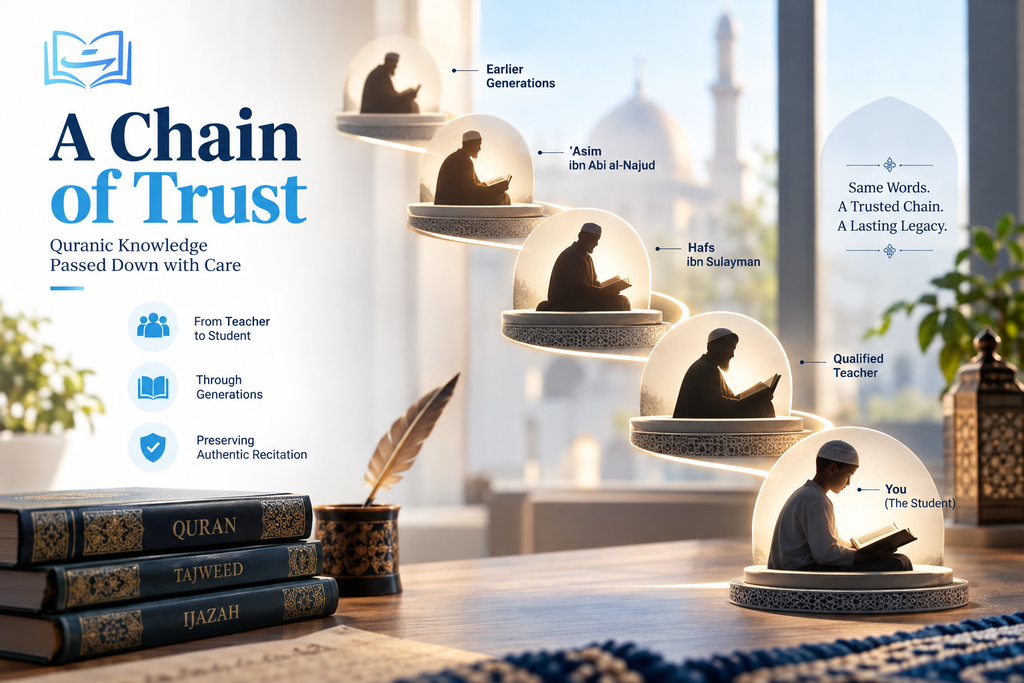
‘Asim ibn Abi al-Najud was an important early Quran reciter associated with Kufa. Hafs ibn Sulayman transmitted one of the recognized narrations of ‘Asim’s recitation, hence the expression Hafs ‘an ‘Asim, meaning Hafs transmitting from ‘Asim.
The terminology becomes easier when separated into levels. Qira’ah refers to the reading associated with a recognized recitation imam, while riwayah identifies a transmission from that imam through a particular transmitter.
Hafs ‘an ‘Asim eventually became the most widely used Quranic recitation tradition across much of the Muslim world, while other recognized qira’at and riwayat continue to be studied and recited in different regions.
For more background on its transmission and widespread use, refer to the English Wikipedia overview of Hafs.
3. The Difference Between Reading Hafs ‘An ‘Asim And Holding An Ijazah
Someone may have read a Hafs mushaf throughout their life and learned standard Tajweed without holding an Ijazah. Using this riwayah does not itself constitute authorization.
An Ijazah involves individual assessment. The teacher needs to determine that the learner can maintain the required recitation standard rather than applying Tajweed accurately only to familiar passages.
If you need to strengthen that practical foundation first, Tabarak Academy’s Quran Recitation Course develops Tarteel, applied Tajweed, Makharij, Waqf, and systematic error correction through private instruction.

How The Sanad Of An Ijazah In Hafs ‘An ‘Asim Works
A complete ijazah in hafs an asim explained guide also needs to explain sanad. Without this concept, an Ijazah can easily be misunderstood as merely an advanced Quran certificate.
Sanad places the student within a tradition of receiving recitation from a teacher who received it through teachers before them.
1. The Meaning Of Sanad In Quran Recitation
Sanad is the chain through which Quranic recitation is transmitted from teacher to student. In Ijazah study, the identity and authorization of the teacher therefore matter greatly.
The principle is practical as well as historical. Students do not simply read Tajweed rules and declare themselves proficient; their actual recitation is heard, corrected, and eventually approved by someone qualified to transmit it.
The transmission of Hafs ‘an ‘Asim reflects the teacher-to-student tradition that characterizes the recognized Qira’at. Hafs ibn Sulayman received and transmitted the recitation of his teacher, ‘Asim ibn Abi al-Najud.
For more background on this relationship and the recognized chains of Quranic readings, refer to the English Wikipedia overview of Qira’at.
2. The Place Of Hafs And ‘Asim In The Chain Of Transmission
‘Asim ibn Abi al-Najud studied Quranic recitation under earlier teachers, including Abu ‘Abd al-Rahman al-Sulami, who was a prominent Quran reciter and teacher in Kufa.
This teacher-to-student relationship forms an important part of understanding the transmission associated with ‘Asim’s recitation.
For additional historical background, refer to the English Wikipedia overview of ‘Asim ibn Abi al-Najud.
A student’s written sanad may naturally contain many later teachers between the modern authorizing teacher and these early figures. Therefore, the exact sanad attached to a particular Ijazah should be read from that teacher’s documented chain rather than reconstructed from a simplified online diagram.
Experience Our Interactive Learning
Curious about how we teach? Watch these brief video clips from our recent live sessions to see our structured curriculum, advanced learning platform, and dynamic student-teacher interactions firsthand.
3. The Importance Of Direct Recitation To A Qualified Teacher
Some Quranic mistakes are easy to see on a page. Others become apparent only when somebody listens: an articulation point may be slightly misplaced, a Madd may be inconsistent, or Ghunnah may be too short or exaggerated.
Direct listening also allows a teacher to assess whether correct Tajweed remains stable across long passages. That is considerably more demanding than reciting a handful of familiar surahs accurately.
For that reason, recordings, apps, books, and independent practice can be valuable supporting tools, but they cannot perform the personal verification that sits at the heart of an Ijazah.
Related read: How to Get Ijazah? A Complete Step-by-Step Guide
What Are The Requirements For An Ijazah In Hafs ‘An ‘Asim?
When ijazah in hafs an asim explained is reduced to “recite and receive a certificate,” an important part of the process disappears: readiness.
An Ijazah is generally an advanced Quranic goal. Exact requirements can vary by teacher and type of Ijazah, but strong recitation and consistent practical Tajweed are central.
1. Strong And Consistent Tajweed Application
A learner should ideally enter dedicated Ijazah study with a strong command of Makharij, Sifaat, Madd, Ghunnah, Noon and Meem Sakinah rules, Tafkheem and Tarqeeq, and appropriate stopping and starting.
More importantly, these rules should appear naturally during recitation. Knowing that a particular rule exists is different from applying it immediately while reading an unfamiliar page.
A pre-Ijazah assessment is therefore valuable. It can reveal whether you are ready for a complete presentation or would benefit more from concentrated Tajweed correction first.
Students who already recite fluently but still have advanced pronunciation or rule-application weaknesses can refine these areas through Tabarak Academy’s Advanced Tajweed Course.
The course is particularly relevant before Ijazah study because it focuses on the level of precision experienced Quran students, Huffaz, and aspiring teachers need before moving toward advanced recitation assessment.
Read also: Why You Need a Female Ijazah Certified Teacher

2. Complete Quran Recitation Under Teacher Supervision
A full Quran presentation is a core feature of traditional Ijazah assessment. The teacher needs to hear the learner across the Quran rather than judging ability from selected passages.
This matters because different passages expose different challenges. A student who sounds highly polished in frequently recited surahs may still have recurring Makharij, Madd, Waqf, or fluency issues elsewhere.
Corrections during this process should not be viewed simply as obstacles delaying certification. They are part of the purpose of studying with an authorizing teacher: identifying weaknesses that the learner may no longer notice independently.
3. Quran Memorization Based On The Type Of Ijazah
Not every form of Quran recitation Ijazah necessarily requires the student to present the Quran entirely from memory. A distinction should therefore be made between authorization involving recitation and a route requiring complete presentation from memory.
For Huffaz seeking the memorization route, Tabarak Academy’s Hifz Ijazah Course includes complete recitation from memory, advanced Tajweed verification, Makharij correction, and sanad documentation.
Students should confirm the exact requirements of the Ijazah they intend to pursue before beginning. This prevents confusion between memorization certificates, course certificates, recitation proficiency, and formal Ijazah authorization.
How To Prepare For An Ijazah In Hafs ‘An ‘Asim
The practical side of ijazah in hafs an asim explained is straightforward: do not rush toward certification while foundational errors remain unresolved.
Preparation should progressively move from correcting individual errors to sustaining accurate recitation across longer and increasingly unfamiliar passages.
1. Strengthen Makharij And Tajweed Before The Ijazah Track
Start by identifying recurring errors rather than reviewing every Tajweed rule equally. One student may struggle with letter articulation, while another understands Makharij but repeatedly miscalculates Madd.
Keep an error record during lessons. Categorizing mistakes allows you to discover patterns that can otherwise remain hidden when every correction is treated as an isolated incident.
The aim is automatic application. Before advanced assessment, you should increasingly be able to concentrate on the flow and meaning of recitation without consciously rebuilding every basic Tajweed rule.
Read also: What Is Sanad in Hifz? Meaning, Requirements & Steps
2. Build Consistency Across Long Quran Passages
Practice from different sections of the Quran instead of repeatedly polishing your strongest surahs. Unfamiliar passages give a much more realistic picture of your recitation.
Longer practice also exposes Waqf and Ibtida problems, breath-management weaknesses, loss of concentration, and Tajweed rules that disappear when the student becomes tired.
Record yourself occasionally and compare recurring errors across several weeks. The most useful sign of progress is not simply sounding better once; it is seeing the same category of error occur less frequently.
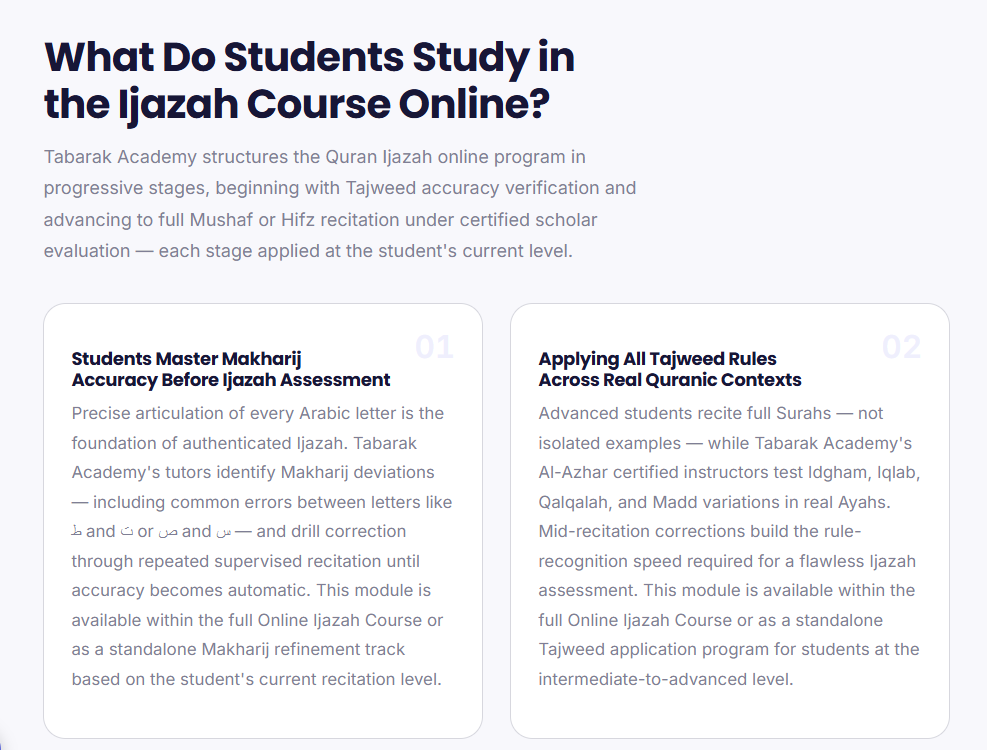
Once your recitation reaches the required level, Tabarak Academy’s Online Ijazah Course provides a structured route into formal Ijazah study.
Students progress through advanced Tajweed verification, complete Quran recitation, Sanad validation, and formal assessment under qualified teachers rather than treating Ijazah as a standalone certificate.
3. Study With An Authorized Teacher Who Can Correct You Directly
Talaqqi makes Quran learning interactive. The teacher hears the student, corrects the recitation, and asks for repetition until the sound or rule is performed correctly.
For ijazah in hafs an asim explained in practical terms, this relationship is essential. Ijazah is ultimately based on demonstrated recitation rather than self-assessed proficiency.
Through private Quran instruction and flexible lesson frequencies, learners can spend more time addressing individual weaknesses instead of moving through a fixed group-class pace. This personalized approach can also help prepare students for the level of consistency expected in later Ijazah coursework.

Discover more here: How To Memorize The Quran?
Tabarak Academy Helps You Build Your Ijazah Path
Reaching Ijazah level is less about rushing through pages and more about making your recitation consistently reliable.
Tabarak Academy gives learners a one-to-one environment where a teacher can hear the details that independent practice often misses: recurring Makharij problems, inconsistent Madd, weak stopping choices, or rules that disappear when the passage becomes difficult.
That individual attention is particularly useful for an Ijazah goal because two students rarely need exactly the same preparation.
One may already be a Hafiz who needs precision work, while another may need months of Tajweed refinement before attempting a complete presentation.
Tabarak Academy also offers flexible online learning for students across different countries and time zones, with qualified tutors and a free first class.
That allows you to begin with an assessment, understand your current recitation level, and work toward the appropriate next stage rather than treating the certificate itself as the starting point.
Step Inside Our Virtual Classrooms
See our engaging teaching methods in action! watch real snippets of our live classes and discover how our expert instructors make learning interactive, memorable, and inspiring for every student.
Turn Accurate Recitation Into Recognized Ijazah With Tabarak Academy!
If your goal is an authentic Ijazah rather than simply another completion certificate, begin by finding out exactly where your recitation stands. A detailed teacher assessment can show whether you are ready for advanced presentation or which Tajweed skills need strengthening first.
With Tabarak Academy, you can study one-to-one with qualified Quran teachers, receive direct correction, and follow a pathway suited to your current level instead of forcing your recitation into a generic timetable.
Book a free trial class with Tabarak Academy today and take the first practical step toward accurate, confident, teacher-verified Quran recitation and your longer-term Ijazah goal.
Our Quran Courses
- Online Quran Classes
- Online Quran Classes for Beginners
- Online Quran Classes for Kids
- Online Quran Classes for Adults
- Online Quran Classes for Men
- Online Quran Classes for Sisters
- Quran Reading Course
- Quran Recitation Course
- Online Ijazah Course
- Online Qirat Course
- Quran for Toddlers / Young Children
- Weekend Quran Classes
- Intensive Quran Course
- Al-Azhar Quran Course
- Zoom Quran Classes
- Noor Al-Bayan Course

Conclusion
With ijazah in hafs an asim explained clearly, the concept becomes much simpler: Hafs ‘an ‘Asim identifies a transmitted Quranic reading, while an Ijazah represents authorization received after qualified teacher verification.
Sanad connects that authorization to a wider teacher-to-student transmission tradition, while full recitation, accurate Tajweed, Makharij, and consistent performance help demonstrate that the student is ready.
The key takeaway is therefore not to chase the document before developing the recitation it represents. Build accuracy first, receive direct correction, and approach Ijazah as the culmination of careful Quran study rather than a shortcut to certification.
Frequently Asked Questions
What Is The Meaning Of Ijazah In The Quran?
An Ijazah is an authorization granted by a qualified Quran teacher after a student demonstrates the required standard of recitation or memorization. It may also document the student’s connection to an established chain of transmission, depending on the type and scope of the Ijazah.
Does Ijazah Mean Degree?
No. An Ijazah is not the same as a modern academic degree; traditionally, it refers to authorization to transmit or teach specific knowledge. In Quran studies, its meaning depends on what the teacher has assessed and explicitly authorized the student to transmit.
What Is A Certificate Of Ijazah?
An Ijazah certificate documents the authorization a student has received from a qualified teacher and typically identifies its specific scope. At Tabarak Academy, students can work toward Quran Ijazah through structured study, direct recitation, correction, and teacher assessment.
Are Hafs And Warsh The Same Quran?
Hafs and Warsh are recognized transmission traditions of Quranic recitation, not different Qurans, and they share the same Quranic revelation. They preserve recognized differences in aspects of recitation, pronunciation, vowels, and other transmitted reading details.
How To Get An Ijazah In The Quran?
A student typically studies with an authorized teacher, develops accurate Tajweed, recites as required, receives corrections, and completes the teacher’s assessment. Tabarak Academy offers online Ijazah study for learners ready to develop and demonstrate the accuracy required for formal authorization.
What Does “Ijazah” Mean In English?
“Ijazah” is commonly translated as authorization, permission, or license, although its precise meaning depends on the scholarly context. For Quran recitation, it generally refers to a teacher’s authorization confirming that the student has met specified recitation requirements.