


How Many Pages A Day To Finish Hifz In 3 Years? 7 Structured Steps
Three years is a proven, achievable timeline for completing the entire Quran. But knowing how many pages a day to finish hifz in 3 years, and building a real system around that number, are two entirely different things.
The Quran contains 604 pages. Three years gives you 1,095 days. That produces one daily target you can measure, plan around, and hit consistently from week one.
This listicle gives you 7 structured steps: the exact numbers, the right memorization sequence, a working revision system, and the Arabic language strategy that makes the entire plan faster and more durable.
1. Know Exactly How Many Pages A Day To Finish Hifz In 3 Years
This is the number every student should start with: 604 divided by 1,095 equals approximately 0.55 pages per day on a 7-day memorization schedule.
If you choose to memorize 5 days per week, with 2 days reserved for review, your daily target rounds to half a page, roughly 10 to 12 lines per session. Your weekly target in both cases stays fixed at 4 pages.
Sustained across 156 weeks, those 4 pages per week cover the entire Quran. The arithmetic is simple; the discipline is the variable.

A. Breaking Down The Monthly And Yearly Targets
Four pages per week produces roughly 16 to 17 pages per month, equal to about 0.8 of one juz’. You complete nearly one full juz’ each month and approximately 9 to 10 juz’ per year.
Year 1 covers Juz’ 30 through Juz’ 22, around 180 pages of shorter surahs. Year 2 covers Juz’ 21 through Juz’ 12, about 200 pages of increasing density.
Year 3 covers Juz’ 11 through Juz’ 1, approximately 224 pages; this is the hardest stage, including Al-Baqarah, Al-Imran, and An-Nisa, the three longest surahs in the Quran.
B. Mastering Arabic Accelerates Your Daily Memorization Rate
When you memorize a page without knowing Arabic, your brain encodes only sounds. When you understand the words, your brain builds meaning-based anchors that are far more durable.
Semantic encoding, memory tied to meaning rather than sound, consistently outperforms phonetic repetition in retention studies across language learning research. Even basic Quranic vocabulary makes a measurable difference.
If you want to How To Memorize The Quran? at a consistently faster pace, learning Quranic Arabic is the single highest-leverage tool available to you. It does not replace discipline; it multiplies its results.
Explore How Do Kids Progress Through Hifz for Kids Course?

2. Confirm Your Tajweed Foundation Before You Begin Any Memorization Schedule
Memorizing with incorrect pronunciation creates a problem that compounds daily. Every page you lock in with an error becomes a page you will eventually need to re-memorize from scratch.
Tajweed Rules for Beginners reach a functional level in 4 to 6 weeks. That early investment costs far less than correcting deeply embedded errors one year into your plan.
The most common Tajweed errors among non-Arabic speakers involve the letters qaf (ق), ‘ain (ع), and ghayn (غ), all of which require Arabic articulation points not found in English, French, or Urdu phonology. Address these before your first memorization session.
Experience Our Interactive Learning
Curious about how we teach? Watch these brief video clips from our recent live sessions to see our structured curriculum, advanced learning platform, and dynamic student-teacher interactions firsthand.
Start Your Quran Learning Journey
Join Tabark Academy today for structured online lessons with qualified tutors, customized to fit your goals.
Book Your Free Trial Lesson3. Begin with Juz’ 30 and Build Real Momentum Through the Short Surahs
Juz’ 30 contains 20 pages and 37 surahs, from An-Naba (surah 78) to An-Nas (surah 114). It is the universal recommended starting point because the surahs are short, rhythmic, and fast to memorize.
Starting here gives you your first completed surah within days, your first completed juz’ within five weeks, and your first concrete proof that your plan is working. That early confidence carries you through the harder years ahead.
Most structured hifz programs allocate the first 3 months to Juz’ 30, with revision time built in. The goal is not just memorization; it is to arrive at Juz’ 29 with a clean, fully retained Juz’ 30.

A. Calibrate Your Realistic Daily Capacity During the First Month
Track how long it takes you to memorize 5 lines, to review yesterday’s portion, and to recite last week’s pages without error. That data, collected in month one, tells you whether a 5-day or 7-day schedule is genuinely sustainable for you.
Adjust the plan in month one, not month twelve. Many students set an unsustainable pace in their first week. Juz’ 30 is your opportunity to discover your real daily capacity before it costs you momentum.
B. Connect Every Surah to Its Meaning from the Very First Session
The short surahs of Juz’ 30 are ideal for building the habit of reading the translation before memorizing. Al-Ikhlas teaches that Allah is One; Al-Falaq teaches seeking protection from harm.
When you memorize these surahs with their meanings, you are not memorizing syllables; you are memorizing declarations of belief. This shift, from phonetic repetition to meaning-grounded retention, is the foundation of Arabic-enhanced hifz.
At Tabarak Academy, students pair their first memorization steps with focused Quranic vocabulary study, so that Juz’ 30 becomes the starting point for both hifz and Arabic comprehension. This approach reduces the review time needed in later years significantly.
Discover Why Tabarak Academy Leads in Quranic Arabic Beginner Courses

4. Use Meaning-Grounded Techniques Designed Specifically for Non-Arabic Speakers
Memorizing the Quran without Arabic fluency is harder; it is not impossible. The techniques below reduce the gap between phonetic memorization and meaning-based retention, which is the most effective form of long-term memory.
Start Memorizing The Quran As A Beginner guides consistently recommend one foundational habit: read the translation of each ayah once before you begin memorizing it. You do not need full fluency; you need enough meaning to create a mental anchor.
Technique 1: Line-by-Line Repetition with Cumulative Review
Memorize one line, repeat it 10 times. Add the second line, repeat both lines from the beginning. Continue until the full page is complete, then recite the entire page without looking.
This method forces cumulative repetition at every step and prevents the common mistake of memorizing individual lines that cannot be recited in sequence.
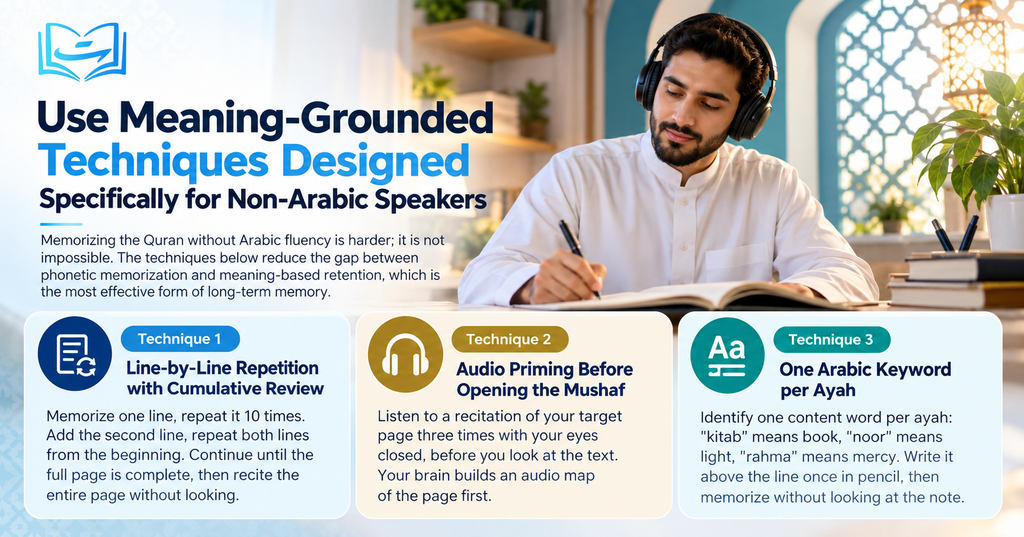
Technique 2: Audio Priming Before Opening the Mushaf
Listen to a recitation of your target page three times with your eyes closed, before you look at the text. Your brain builds an audio map of the page first.
When you begin repetition, you reinforce a structure already partially encoded. This technique works especially well for learners with stronger auditory than visual memory.
Technique 3: One Arabic Keyword per Ayah
Identify one content word per ayah: “kitab” means book, “noor” means light, “rahma” means mercy. Write it above the line once in pencil, then memorize without looking at the note.
Practiced consistently over 6 months, this habit builds a working Quranic vocabulary. In Year 3, where root words repeat across hundreds of ayaat in Al-Baqarah and Al-Imran, that vocabulary pays compound dividends.
Meet Our Qualified Quran & Islamic Studies Instructors

5. Recognize Hifz Plateaus Early and Reset Before They Derail Your Timeline
Every hifz student hits a plateau; usually between months 4 and 7, and again at the start of Year 3 when the longest surahs begin. A plateau is not a failure signal; it is a predictable phase in the brain’s consolidation cycle.
The signs are consistent: new memorization feels slower than before, murajaah errors increase on previously solid pages, and forward progress seems to disappear. Students who treat this as a personal failure often stop. Students who treat it as a scheduled maintenance phase move through it.
Hifz Burnout a Full Guide outlines the evidence-based protocol: reduce new memorization to two or three lines per day for 2 to 3 weeks, double your murajaah time, and focus your Arabic study on the vocabulary of the juz’ you are currently reviewing.
This restores consolidation balance without pausing your 3-year plan.
Read also: How To Memorize One Page Of Quran A Day
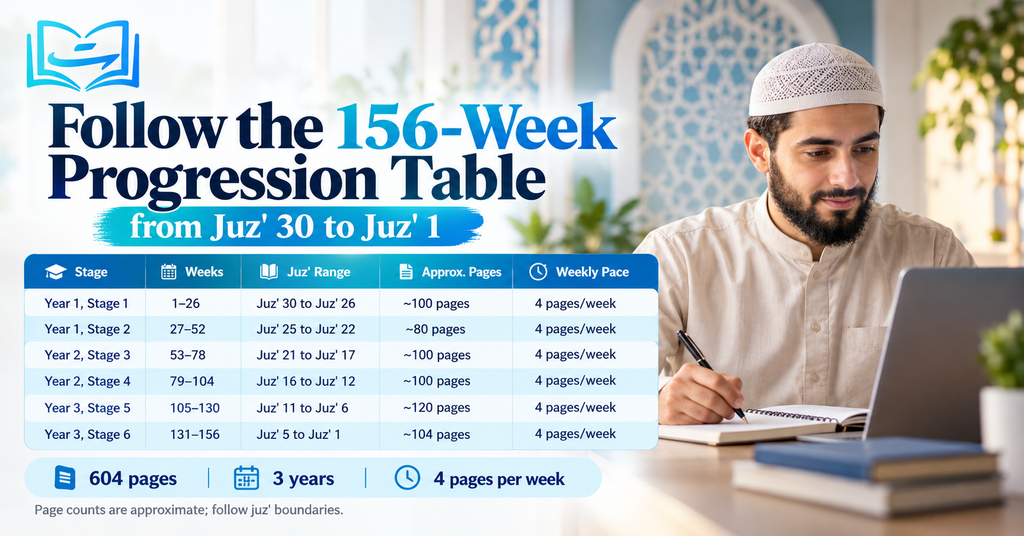
6. Follow the 156-Week Progression Table from Juz’ 30 to Juz’ 1
The 156-week structure organizes the Quran’s 604 pages across three years at a consistent pace of 4 pages per week. The table below shows the full plan divided into 6 stages.
Note that page counts are approximate; your mushaf edition may vary slightly from these numbers. Use the juz’ boundaries as your primary guide.
| Stage | Weeks | Juz’ Range | Approx. Pages | Weekly Pace |
| Year 1, Stage 1 | 1 to 26 | Juz’ 30 to Juz’ 26 | ~100 pages | 4 pages/week |
| Year 1, Stage 2 | 27 to 52 | Juz’ 25 to Juz’ 22 | ~80 pages | 4 pages/week |
| Year 2, Stage 3 | 53 to 78 | Juz’ 21 to Juz’ 17 | ~100 pages | 4 pages/week |
| Year 2, Stage 4 | 79 to 104 | Juz’ 16 to Juz’ 12 | ~100 pages | 4 pages/week |
| Year 3, Stage 5 | 105 to 130 | Juz’ 11 to Juz’ 6 | ~120 pages | 4 pages/week |
| Year 3, Stage 6 | 131 to 156 | Juz’ 5 to Juz’ 1 | ~104 pages | 4 pages/week |
Year 3 is where students who lack Arabic comprehension consistently slow down. Al-Baqarah alone spans 2.5 juz’.
Students who have built working Quranic Arabic vocabulary by this stage decode the text rather than sounding out syllables, maintaining their pace into the final stretch.
The importance of the Arabic language to hifz becomes undeniable in Year 3. When you can read the Quran and track its subject shifts, its narrative arcs, and its repeated arguments, revision becomes active engagement rather than mechanical repetition.
7. Build a Non-Negotiable Tiered Murajaah System from Day One
Murajaah is the revision practice that separates students who complete hifz from those who restart it repeatedly. Without structured review, you will re-memorize the same pages every few months instead of advancing.
A working murajaah system has three tiers: daily review, weekly review, and cumulative monthly review. Each tier serves a distinct role in the memory consolidation cycle, and all three must run simultaneously.
The rule that governs all three tiers is fixed: never advance to a new page until the previous page passes three consecutive reviews on separate days without error.

A. Structure Your Daily, Weekly, and Monthly Review Tiers Precisely
Your daily tier covers the current page and yesterday’s page, recited before any new memorization begins. Your weekly tier covers all pages memorized in the past 7 days, recited in order from memory.
Your monthly tier covers the entire juz’ in progress, recited start to finish. This cumulative pass builds the ability to recite large sections fluidly, which is what hifz ultimately requires.
The Daily Murajaah Plan For Hifz Students approach works for students in the USA, UK, UAE, Canada, Malaysia, and across the Gulf; it is time-based, not location-based. Thirty consistent daily minutes produces better results than two-hour weekend sessions.
B. Log Every Session to Catch Weak Pages Before They Compound
Use a written tracker or phone note: date, pages reviewed, smooth or needs correction. A page that “needs correction” two sessions in a row is a signal that it requires focused attention before your weekly review.
Why Do I Forget What I Memorize Of The Quran is the most common hifz complaint. In most cases, the cause is insufficient murajaah in weeks 2 and 3 after initial memorization. Logging makes weak pages visible early, when correction is easy.
Arabic comprehension also improves your murajaah efficiency directly. When you understand the meaning of what you are reciting, your brain self-corrects errors because a wrong word breaks the semantic flow you have internalized.
Step Inside Our Virtual Classrooms
See our engaging teaching methods in action! watch real snippets of our live classes and discover how our expert instructors make learning interactive, memorable, and inspiring for every student.
Start Your Quran Learning Journey
Join Tabark Academy today for structured online lessons with qualified tutors, customized to fit your goals.
Book Your Free Trial LessonStart Your Quran Learning Journey Today
Students at Tabarak Academy from the UK, USA, UAE, Malaysia, and the Gulf region have completed both 3-year and 5-year hifz programs with personalized revision plans built around their actual daily availability.
Whether you want to learn Quran reading, improve your Tajweed, or memorize the Quran with guidance, Tabarak Academy provides personalized online classes with qualified teachers.
Join us and learn at your own pace with lessons designed for children and adults.
Our Quran Courses:
- Quranic Arabic Classes
- Tafseer al Quran Course
- Hifz Course for Sisters
- Advanced Tajweed Course
- Hifz Ijazah Course
- Hifz for Adults Course
- Online Hifz Program
- Zoom Quran Classes
Start your Quran hifz journey today and take the next step toward reading and memorizing the Quran with confidence.

Conclusion
Three years to complete the entire Quran is not a dream; it is a mathematical plan built on 4 pages per week, 156 consecutive weeks, and a murajaah system that protects every page you earn.
The seven steps in this article give you the number (0.55 pages per day), the sequence (Juz’ 30 first, then backward to Juz’ 1), the revision structure (daily, weekly, monthly tiers), and the techniques that work specifically for non-Arabic speakers.
The single factor that elevates every part of this plan is learning Quranic Arabic. Understanding what you memorize is not a bonus add-on; it is the mechanism that converts short-term phonetic repetition into long-term retention.
Students who invest in Arabic comprehension move through Year 3 at the same pace as Year 1, while students relying on sound alone consistently slow down.
Whether you are based in the US, UK, Canada, Germany, the UAE, or across the Gulf, your 3-year plan starts with one consistent daily session, one strong murajaah system, and one commitment to understanding the words you are carrying.
Frequently Asked Questions
How Many Pages a Day Do I Need to Memorize to Finish Hifz in 3 Years?
You need approximately 0.55 pages per day on a 7-day schedule, or 0.5 pages per day on a 5-day schedule with 2 days reserved for review. Both approaches produce the same weekly total of 4 pages.
Can a Non-Arabic Speaker Complete Hifz in 3 Years?
Yes. Non-Arabic speakers complete hifz in 3 years regularly, provided they invest in Tajweed before starting and use meaning-grounded memorization techniques.
Learning Quranic Arabic vocabulary alongside hifz accelerates retention and reduces the time lost to re-memorization.
What Happens If I Fall Behind My 3-Year Schedule?
Do not skip murajaah to catch up on new memorization. Falling behind on revision creates far more damage than falling behind on new pages.
Reduce your new daily target by half for 2 weeks, maintain your murajaah fully, then gradually return to your original pace.
Is Juz’ 30 the Best Place to Start Hifz?
Yes, for nearly all students. Juz’ 30 contains the shortest surahs, the most rhythmic ayaat, and the highest density of vocabulary that repeats across the rest of the Quran.
How Does Learning Arabic Make Hifz Easier?
Learning Arabic transitions memorization from phonetic encoding, which is fragile, to semantic encoding, which is durable.
When you know that an ayah means “And We have certainly made the Quran easy to remember,” your brain stores it as a statement, not a sound sequence.