

Have you watched a seven-year-old recite a full page after a few repetitions, then struggled to hold three verses yourself? Many adults who start memorizing the Book of Allah ask the same thing: is adult memorization slower than childhood memorization, and did I miss my chance?
The short answer is yes, for the exact, word-for-word memorization that hifz needs. But the Quran wasn’t revealed only to children. Most of the Companions memorized it as adults, and the Prophet ﷺ promised a double reward to the one who recites with difficulty.
This article explains how memorizing the Quran differs between childhood and adulthood, what the Sunnah and the example of the Companions teach about learning later in life, and how to start with sincerity and a clear plan.
At Tabarak Academy, we teach children and adults, and the approach is different for each.
What you’ll learn in this article
- Whether adult memorization is slower than childhood memorization, and why.
- How the Companions memorized the Quran as adults.
- Realistic hifz timelines for children and adults.
- The “Sound + Meaning” method that helps adults close the gap.
- The spiritual keys to memorization: intention, du’a, and avoiding sins.
Is adult memorization slower than childhood memorization?
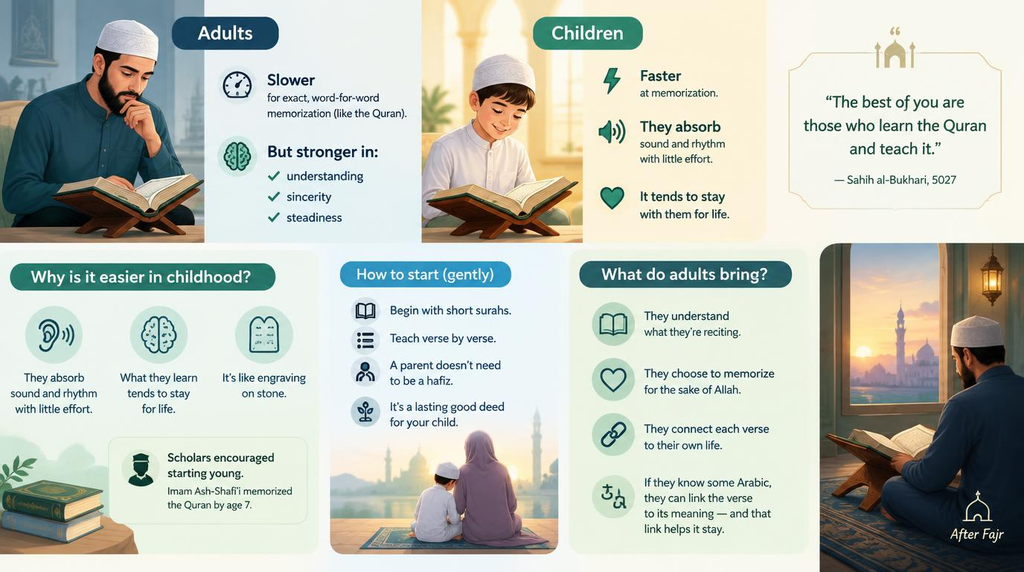
Adult memorization is slower than childhood memorization for verbatim text like the Quran, where every letter, vowel, and ending must be exact.
But it isn’t weaker in every way. What children gain in speed, adults often gain in understanding, sincerity, and steadiness.
Why is memorizing in childhood easier?
Children absorb sound and rhythm with little effort, and what they memorize tends to stay with them for life. That’s why the scholars encouraged starting young, and why an old saying among them compares learning in childhood to engraving on stone. Imam Ash-Shafi’i, for example, is reported to have memorized the Quran by the age of seven.
The scholars also advised parents to begin gently: start with the short surahs and teach them verse by verse. A parent doesn’t need to be a hafiz to do this. Teaching your child the Quran early is a lasting good deed, and the Prophet ﷺ said:
“The best of you are those who learn the Quran and teach it” (Sahih al-Bukhari, 5027).
What do adults bring to the Quran?
Adults come to the Quran with something children usually lack: they understand what they’re reciting, they choose to memorize for the sake of Allah, and they can connect each verse to their own life. An adult who knows some Arabic can link a verse to its meaning, and that link helps the verse stay.
How did the Companions memorize the Quran as adults?
Most of the Companions memorized the Quran as adults, slowly and with understanding, and they’re the best example for any adult learner. They didn’t treat late learning as a loss. They treated it as a responsibility to learn the Quran properly.
A. Ten verses at a time
It’s reported from Ibn Mas’ud (may Allah be pleased with him) that the Companions would learn ten verses and not move past them until they had learned the knowledge and practice they contained.
This is close to what works best for working adults today: a small daily portion, understood and applied, then revised.
B. Years on a single surah
Imam Malik reports in al-Muwatta that Abdullah ibn Umar spent eight years learning Surah Al-Baqarah. He wasn’t slow.
He was learning its meaning and rulings along with its words. Ibn Mas’ud himself said he learned more than seventy surahs directly from the Prophet ﷺ (Sahih al-Bukhari, 5000).
The lesson for adults is clear: slow memorization done with understanding is part of how the Quran has been learned from the beginning.
Read also: Hifz For Adults Over 40 Realistic Plan
Experience Our Interactive Learning
Curious about how we teach? Watch these brief video clips from our recent live sessions to see our structured curriculum, advanced learning platform, and dynamic student-teacher interactions firsthand.
Adult Vs Childhood Memorization: A Side-By-Side Comparison
The difference between adult and childhood memorization is mostly about how each group takes in new material, not how much each can learn.
Children memorize by sound and visual detail. Adults memorize by meaning and category. If you’re asking whether adult memorisation is slower than childhood memorisation, the table below shows where the difference is real and where adults are ahead.
| Factor | Childhood memorization | Adult memorization |
| Speed for word-for-word text | Faster. High language plasticity under about age 12 | Slower. Needs more repetitions to hold exact wording |
| How new material is processed | By similarity, sound and surface detail | By meaning and category; small details get filtered out |
| Working memory | Still developing. Roughly doubles between ages 5 and 10 (about 4 to 6 digits) | Peaks in the early-to-mid twenties, then declines slowly |
| Understanding of meaning | Limited, especially in young children | Strong. Can link verses to context, themes and grammar |
| Accuracy with similar verses (mutashabihat) | Usually higher, because exact sounds are absorbed | Lower, because similar verses get stored under one idea |
| Memory strategies | Must be taught. Children don’t use them automatically | Uses organization, linking and self-testing on purpose |
| Ideal session length | Short: about 10–20 minutes, repeated daily | Longer: 30–60 minutes, split between new material and revision |
| Typical daily amount | Part of a page to a page (in full-time programs) | About 3–5 verses for a working adult |
| Main risk | Losing motivation if pushed too hard, or treated as punishment | Revision debt and quitting after unrealistic expectations |
| Best teaching approach | Listening, repeating after the teacher, short surahs first | Sound + Meaning method: listen, understand, then check exact words with a teacher |
What does the comparison mean in practice?
Neither group is at a disadvantage overall. Each has a different weak point. Children need structure, patience and short sessions so they keep loving the Quran. Adults need to bring back the attention to detail that understanding tends to push aside.
That’s why Tabarak Academy doesn’t use one method for every age. Children get listening-based lessons in short sessions. Adults get a plan that combines meaning, exact recitation and daily revision.
Start Your Quran Learning Journey
Join Tabark Academy today for structured online lessons with qualified tutors, customized to fit your goals.
Book Your Free Trial LessonHow Long Does Quran Memorization Take For Children Vs Adults?
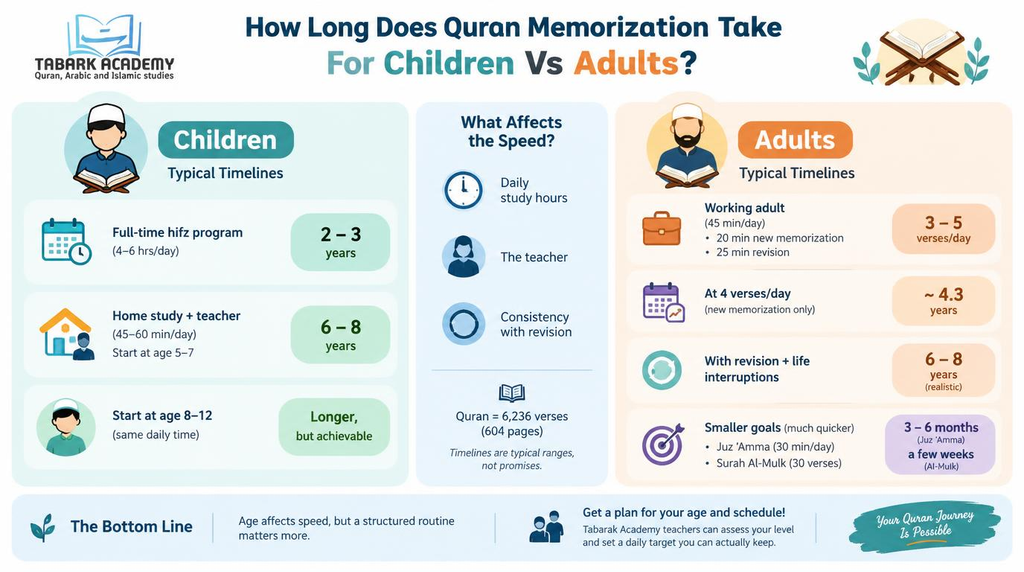
Timelines are where the question “is adult memorization slower than childhood memorization?” matters most in practice. The time it takes depends mainly on daily hours, the teacher, and how consistently you revise.
Age affects speed, but a structured routine matters more. The Quran has 6,236 verses across 604 pages, so these timelines are typical ranges, not promises.
Typical timelines for children:
- Full-time hifz programs (4–6 hours a day): often around 2–3 years
- Home study with a teacher (45–60 minutes a day), starting at age 5–7: often several years, commonly around 6–8
- Starting at age 8–12 with the same daily time: a longer road, but very achievable, and older children often understand more of what they memorize
Typical timelines for adults:
A working adult who can give 45 minutes a day (about 20 minutes of new memorization and 25 of revision) usually adds 3–5 verses a day.
At 4 verses a day, new memorization alone takes about 4.3 years. Once you add revision cycles and the interruptions of normal life, 6–8 years is a realistic estimate for strong, full retention.
Smaller goals are much quicker. Most adult beginners can memorize Juz ‘Amma in 3–6 months at 30 minutes a day, and Surah Al-Mulk (30 verses) in a few weeks.
If you want a clear plan for your age and schedule, Tabarak Academy teachers can assess your starting level and set a daily target you can actually keep.
Step Inside Our Virtual Classrooms
See our engaging teaching methods in action! watch real snippets of our live classes and discover how our expert instructors make learning interactive, memorable, and inspiring for every student.
How Can Adults Memorize The Quran Faster?
Adults memorize faster when they deliberately add back the attention to detail that children have naturally. We call this the Sound + Meaning method: children memorize mostly by sound, adults mostly by meaning, and adults get the best results by using both on purpose.
Step 1: Listen before you read
Play the verse from one skilled reciter 10–15 times before you look at the Mushaf. Stay with the same reciter for weeks so your ear has one consistent model. Switching reciters every week mixes up the sound pattern you’re building.
Step 2: Understand, then check the exact words
Read the meaning so the verse has a “place” in your mind. Then, like the children in the study, look for the specific details: the exact ending, the particle that differs from a similar verse, and where the verse sits on the page. Even basic Arabic grammar helps here, because knowing why a word ends the way it does makes it easier to remember.
Step 3: Recite to a teacher, not only to yourself
Errors memorized early are hard to undo. A qualified teacher, ideally one with an ijazah, catches mistakes in tajweed and wording right away, before they settle in your memory.
Step 4: Build revision in from day one
The Prophet ﷺ said:
“Keep refreshing your knowledge of the Quran, for… it is more prone to slipping away than camels from their tying ropes” (Sahih al-Bukhari, 5033).
Use three layers: new memorization, daily revision of recent pages, and a rotating weekly cycle for older sections.
The adult-friendly structure in Tabarak Academy‘s online classes follows this approach: one-on-one sessions, a fixed reciter model, and revision built into every lesson instead of left as homework.
Common Mistakes That Slow Adult Learners Down
Most adults who quit don’t lack ability. They lack a realistic plan. These are the patterns teachers see most often:
- Trying to match a child’s daily amount: Start with 3–5 verses and protect your revision time.
- Building up revision debt: Many adults move quickly, then stall around Juz 5–7 because older pages have faded.
- Memorizing only by meaning: This is the main cause of confusing similar verses.
- Studying only when life allows: A short, fixed daily slot beats a long session once a week.
- Comparing yourself to children or hafiz prodigies: Their conditions aren’t yours.
Is It Too Late For An Adult To Memorize The Quran?
It’s never too late to memorize the Quran. Even if adult memorization is slower than childhood memorization for exact wording, adults learn differently from children, not worse.
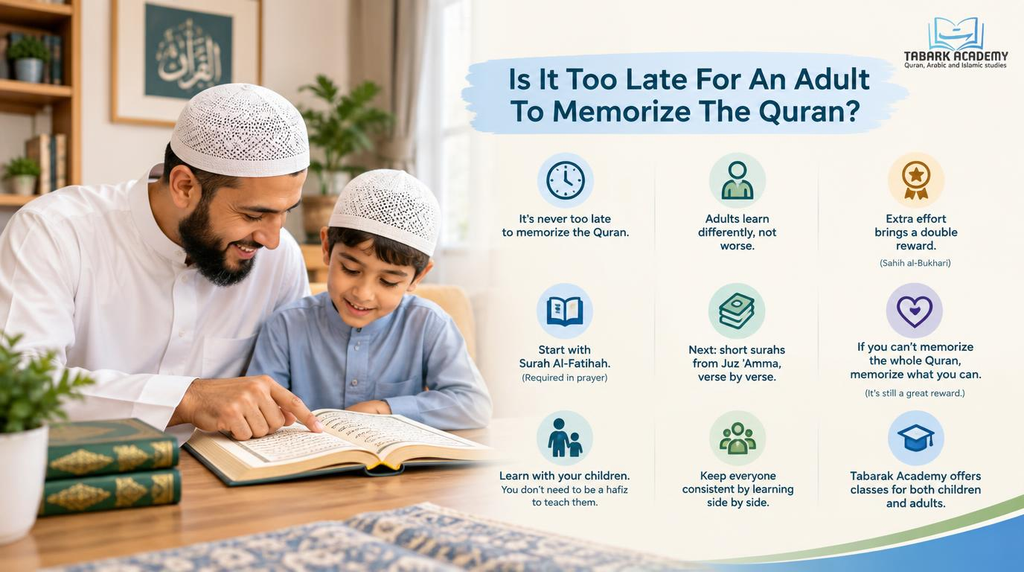
The one who recites the Quran with difficulty has a double reward, as the Prophet ﷺ said (Sahih al-Bukhari), so the extra effort is itself a reward.
Allah says:
“And We have certainly made the Quran easy to remember. So is there anyone who will be mindful?” (Al-Qamar 54:17).
This verse appears four times in that surah.
What every adult should memorize first
The only portion every Muslim is required to memorize is Surah Al-Fatihah, because prayer isn’t valid without it. Anything beyond that is extra virtue.
A sensible next step is the short surahs from Juz ‘Amma, memorized gradually, verse by verse. If you can’t memorize the whole Quran, memorize as much as you can. The Prophet ﷺ compared a person with no Quran inside them to a ruined house.
Learning alongside your children
Parents don’t need to be hafiz to teach their children. You can start your child with the short surahs while you memorize your own portion. Many families find that learning side by side keeps everyone consistent.
Tabarak Academy offers classes for both children and adults, so the whole family can follow the same plan.
Read also: Is It Too Late to Memorize the Quran?
Start Your Quran Learning Journey
Join Tabark Academy today for structured online lessons with qualified tutors, customized to fit your goals.
Book Your Free Trial LessonStart your Quran memorization with Tabarak Academy today
Whether you’re 8 or 48, the right method matters more than your age. At Tabarak Academy, qualified teachers work with you one-on-one, correct your recitation live, and build a revision plan that fits your schedule.
Children learn in a way suited to their age, and adults get a structure that turns understanding into lasting memory. Book your first session today and memorize with a plan you can stick to.
Our Quran Memorization / Hifz Courses:
- Online Hifz Program
- Juz 30 Memorization Course
- Hifz for Kids Course
- Hifz for Adults Course
- Hifz for Sisters Course
- Short Surah Memorization Course
- Hifz Ijazah Course

Conclusion
So, is adult memorization slower than childhood memorization? For exact, word-for-word text like the Quran, usually yes. Children absorb sound and detail with less effort, and research by Sloutsky and Fisher shows that adults’ knowledge can make them skip the very details they need to remember.
The comparison also shows where adults are ahead: understanding, discipline, memory strategies and longer focused sessions. Children win on speed and sound accuracy. Adults win on meaning and structure. The weakness of each group is the strength of the other.
The key message: don’t try to memorize like a child, and don’t rely on meaning alone. Use the Sound + Meaning method, recite to a qualified teacher, and revise every day. Whatever your age, Tabarak Academy can build a memorization plan that suits how you actually learn.
Frequently asked questions
These are the questions adult learners and parents ask us most often about the difference between adult and childhood memorization, and what it means for Quran memorization.
1. Is adult memorisation slower than childhood memorisation?
Yes, adult memorisation is usually slower than childhood memorisation for verbatim text such as the Quran. Children absorb sound patterns more easily. Adults, however, remember better when the material has meaning and structure.
2. At what age is memory strongest?
Working memory and processing speed peak in the early-to-mid twenties. Knowledge-based (semantic) memory keeps growing and may peak in your fifties. For effortless memorization by sound, early childhood is the strongest window.
3. How many verses a day should an adult memorize?
Most working adults do well with 3–5 verses a day, plus at least as much time for revision. Consistency matters more than daily quantity. Tabarak Academy teachers adjust this target to your level.
4. What is the best age for a child to start memorizing the Quran?
Many teachers see ages 5–8 as an ideal starting window, beginning with listening and short surahs. Starting at 10 or 12 isn’t too late. It’s a different path that often comes with stronger understanding.
5. Why do adults confuse similar verses in the Quran?
Adults tend to store a verse by its meaning and filter out small differences in wording. Comparing similar verses side by side, and reciting them to a teacher, fixes this.
6. Can adults memorize the Quran online?
Yes. Live one-on-one online classes with a qualified teacher work well for adults, because the teacher corrects mistakes in real time and keeps your revision on track.


0 Comments