

Most beginners can read the letters of the Quran correctly but still sound unnatural when two words meet. The reason is almost always the same rule: idgham.
If you have ever wondered what is idgham in tajweed, it is the rule that tells you when a Noon Saakin or Tanween disappears into the letter that follows it instead of being pronounced on its own.
Idgham is one of the four rules of Noon Saakin and Tanween, alongside Izhar, Iqlab, and Ikhfa. It affects some of the most frequently recited phrases in the Quran — غَفُورٌ رَّحِيمٌ, مِن رَّبِّهِمْ, هُدًى لِّلْمُتَّقِينَ — which means a single misapplied idgham repeats itself across hundreds of verses.
This guide explains idgham in tajweed meaning, its six letters, both main types, the exception that stops the rule from applying, and the mistakes that teachers at Tabarak Academy correct most often.
What you’ll learn in this article
- The definition of idgham in tajweed and the condition that triggers it.
- The six idgham letters and the two memory words used to retain them.
- Idgham with ghunnah vs. idgham without ghunnah, with Quran examples.
- The one case where idgham letters appear but the rule does not apply.
- A practical check you can run on any verse in under five seconds.
Experience Our Interactive Learning
Curious about how we teach? Watch these brief video clips from our recent live sessions to see our structured curriculum, advanced learning platform, and dynamic student-teacher interactions firsthand.
What is idgham in tajweed?
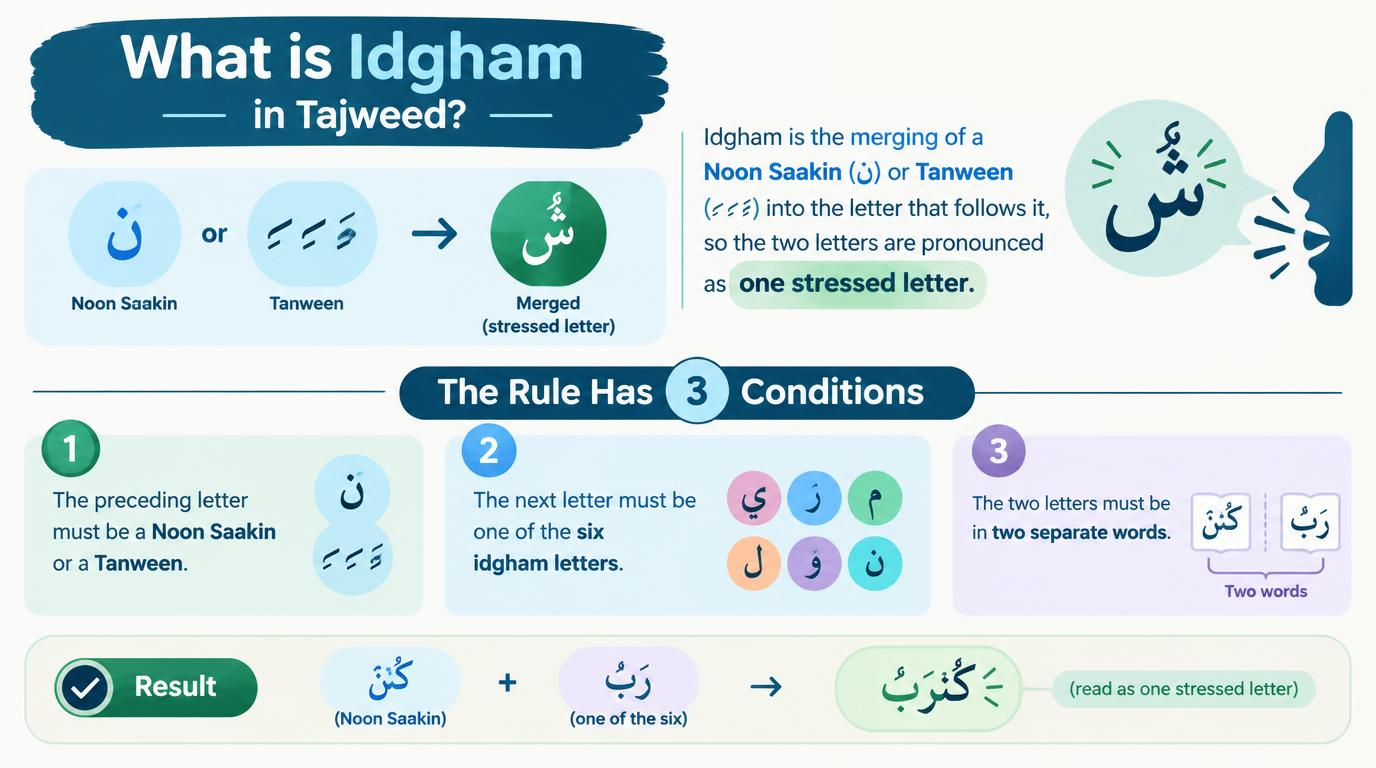
Idgham in tajweed is the merging of a Noon Saakin (نْ) or Tanween (ً ٍ ٌ) into the letter that follows it, so the two letters are pronounced as one stressed letter.
The word idgham in Arabic means inserting or merging one thing into another, and that is exactly what happens to the sound.
The rule has three conditions, and all three must be present. First, the preceding letter must be a Noon Saakin or a Tanween. Second, the next letter must be one of the six idgham letters. Third — and this is the condition most learners skip — the two letters must be in two separate words.
When those conditions are met, the Noon sound is no longer pronounced independently. Instead, the following letter is read with a shaddah, and your voice stresses that letter.
The six letters of idgham
There are six idgham letters: ي ر م ل و ن. Two memory words are used for them. The classical one is يَرْمَلُون (yarmaloon), which gathers all six.
Many teachers prefer splitting them instead: ينمو (yanmoo) for the four letters that carry ghunnah, and لر for the two that do not. The second method is more useful in practice, because it encodes the type along with the letter.
How idgham changes what you actually say?
Idgham in tajweed explained at the level of sound: the Noon is not softened or shortened — it is removed and replaced by a doubling of the next letter.
Take مِنْ رَّبِّهِمْ (Al-Baqarah 2:5). The written form shows Noon Saakin followed by Raa. The recited form is mir-rabbihim, not min rabbihim. Likewise مَنْ لَا (Al-Ahqaf 46:5) is recited mal-laa, not man-laa.
If you can still hear a distinct “n” in these words, idgham has not been applied.
Merging rules are far easier to fix by ear than by reading. A short correction from a qualified tutor in a live session saves weeks of self-correction — which is why Tabarak Academy builds its tajweed lessons around recitation and immediate feedback rather than theory alone.
Read also: What Is Izhar In Tajweed?
Types Of Idgham In Tajweed
Once you can answer what is idgham in tajweed, the next step is knowing which of its two forms applies in front of you. Idgham is divided by one question: does the nasal sound (ghunnah) remain, or not? Ghunnah is the sound that resonates through the nose, and it is an inherent quality of the letters م and ن.
The type is decided entirely by which of the six letters follows the Noon Saakin or Tanween.
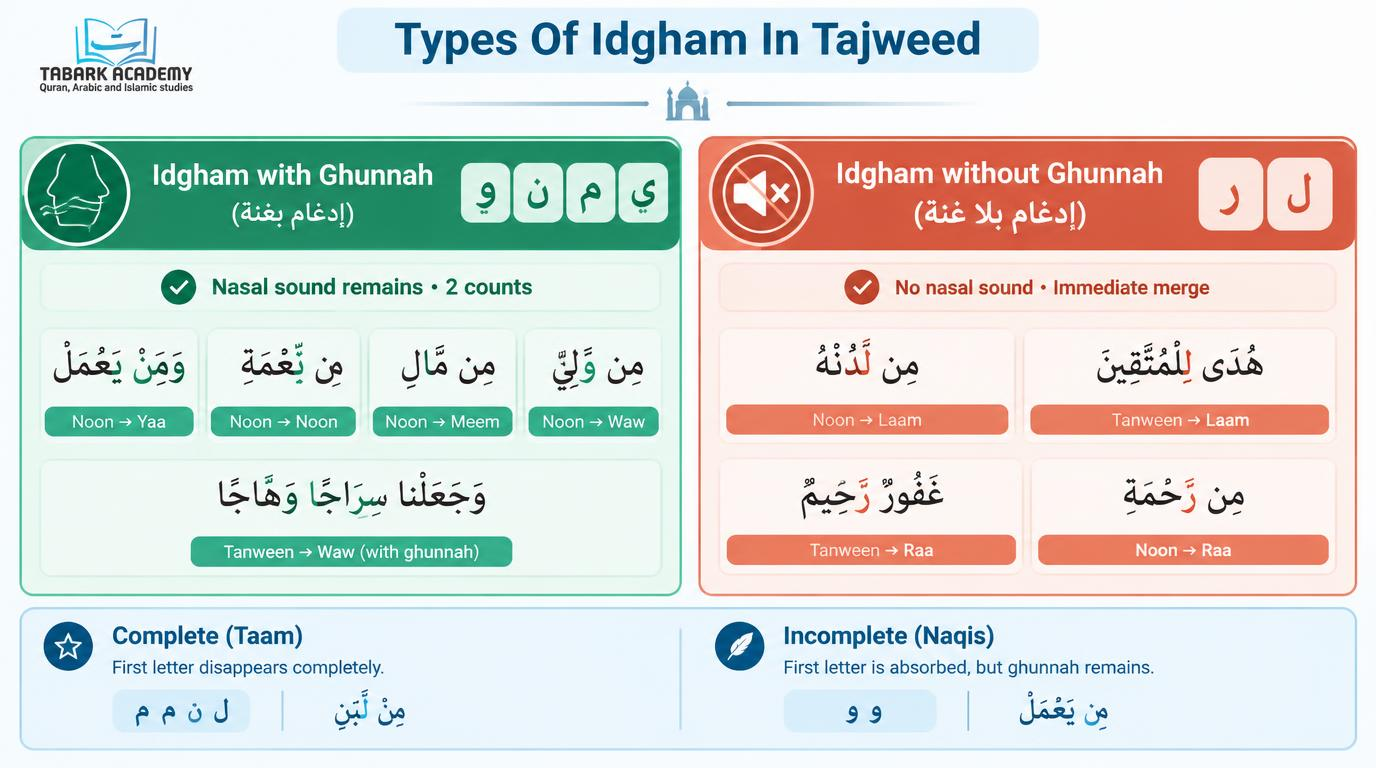
1. Idgham with ghunnah (إدغام بغنة)
Idgham with ghunnah occurs when Noon Saakin or Tanween is followed by one of four letters: ي ن م و (gathered in ينمو). The Noon merges into the following letter, and the nasal sound is held for approximately two counts.
Quran examples:
- وَمَن يَعْمَلْ : Noon Saakin into Yaa.
- مِن نِّعْمَةٍ : Noon Saakin into Noon.
- مِن مَّالٍ : Noon Saakin into Meem.
- مِن وَلِيٍّ : Noon Saakin into Waw.
The same applies to Tanween: in وَجَعَلْنَا سِرَاجًا وَهَّاجًا (An-Naba 78:13), the Tanween on سِرَاجًا merges into the Waw of وَهَّاجًا with ghunnah held.
2. Idgham without ghunnah (إدغام بلا غنة)
Idgham without ghunnah occurs when Noon Saakin or Tanween is followed by ل or ر. The merge is complete and immediate, with no nasal resonance at all.
Quran examples:
- مِن لَّدُنْهُ — Noon Saakin into Laam.
- هُدًى لِّلْمُتَّقِينَ — Tanween into Laam.
- غَفُورٌ رَّحِيمٌ — Tanween into Raa.
- مِن رَّحْمَةٍ — Noon Saakin into Raa.
A useful contrast: غَفُورٌ رَّحِيمٌ is read ghafoorur-raheem with no nasal hold, while عَلِيمٌ يَقُولُ keeps a clear two-count hum. Same rule family, opposite sound.
3. Complete (Taam) and incomplete (Naqis) idgham
Beyond the ghunnah division, scholars classify idgham by how much of the first letter survives.
- Idgham Taam (complete) means the first letter vanishes entirely and only the stressed second letter remains. This applies with ل، ر، ن، م — as in مِّن لَّبَنٍ, where nothing of the Noon is left.
- Idgham Naqis (incomplete) means the first letter is absorbed but one of its qualities survives — specifically the ghunnah. This is what happens with ي and و: the Noon itself is gone, yet the nasal sound it carried remains.
This distinction explains why ghunnah persists in some merges and not others, rather than asking you to memorise two unrelated lists.
Start Your Quran Learning Journey
Join Tabark Academy today for structured online lessons with qualified tutors, customized to fit your goals.
Book Your Free Trial LessonWhen idgham does not apply: the same-word exception
Idgham requires the Noon Saakin and the idgham letter to be in two different words. When both appear inside a single word, the rule reverts to Izhar — clear, separated pronunciation.
There are four well-known words in the Quran where this happens:
- دُنْيَا (Al-Baqarah 2:85).
- بُنْيَانٌ (As-Saff 61:4).
- قِنْوَانٌ (Al-An’am 6:99).
- صِنْوَانٌ (Ar-Ra’d 13:4).
In each, Noon Saakin sits directly before ي or و, yet the Noon is pronounced clearly. The reason is practical: merging inside a single word would blur the root letters and change the word’s recognisable shape.
Memorising these four words is one of the fastest wins in tajweed, because they are the only places the exception appears.
Read also: 10 Benefits of Tajweed
Step Inside Our Virtual Classrooms
See our engaging teaching methods in action! watch real snippets of our live classes and discover how our expert instructors make learning interactive, memorable, and inspiring for every student.
The five-second idgham check
The quickest way to turn what is idgham in tajweed from theory into reading habit is a fixed decision sequence you run while reciting:
- Is there a Noon Saakin or Tanween? No → no idgham.
- Is the next letter one of ي ر م ل و ن? No → check Izhar, Iqlab, or Ikhfa instead.
- Are the two letters in separate words? No → apply Izhar (the four exception words).
- Is the letter ل or ر? Yes → merge with no ghunnah. Otherwise → merge and hold ghunnah for two counts.
Running these four questions in order prevents the most common error pattern we see in tajweed classes: students who know the letters perfectly but apply ghunnah to ل and ر out of habit.
Three mistakes that persist longest
The first is holding ghunnah too long — stretching it to three or four counts turns a correct rule into an obvious error. Two counts is roughly the length of saying “one, two” at recitation pace.
The second is leaving a trace of the Noon. Saying min-rrabbihim instead of mir-rabbihim is incomplete merging, and it is audible to any trained listener.
The third is applying idgham across a stop. If you pause (waqf) on the word ending in Noon Saakin or Tanween, the merge does not happen — the rule only operates when the two words are joined in continuous recitation.
Correcting these three habits is standard early work in the tajweed and Quran recitation programmes at Tabarak Academy, where learners read aloud and are stopped at the point of error rather than after the session.
Start Your Quran Learning Journey
Join Tabark Academy today for structured online lessons with qualified tutors, customized to fit your goals.
Book Your Free Trial LessonStart Applying Idgham Correctly With Tabarak Academy
Knowing what is idgham in tajweed gets you the rule. Reciting it under correction gets you the habit — and only the habit shows up in your salah.
Tabarak Academy offers live, one-to-one tajweed lessons with qualified tutors who listen to your recitation, identify exactly which merges you are missing, and build your practice around the verses you actually read.
Flexible scheduling, structured levels from beginner to advanced, and a free trial session so you can hear the difference before committing.
Our Tajweed Courses:
- Online Tajweed Classes
- Tajweed Course for Beginners
- Tajweed Course for Kids
- Tajweed Course for Adults
- Tajweed Course for Sisters
- Advanced Tajweed Course
- Amali (Practical) Tajweed Course
- Learn Quran with Tajweed
- Learn Quran with Tajweed for Kids
- Learn Quran with Tajweed for Sisters

Conclusion
Idgham in tajweed is the merging of Noon Saakin or Tanween into one of six following letters — ي ر م ل و ن — across two separate words.
Four of those letters (ينمو) keep the nasal ghunnah for two counts; the remaining two (ل، ر) merge cleanly with no nasal sound at all. When the Noon and the idgham letter sit inside the same word, as in دُنْيَا and بُنْيَانٌ, the rule gives way to Izhar.
The single takeaway for anyone asking what is idgham in tajweed: it is not about softening the Noon, it is about removing it.
Once your ear expects mir-rabbihim rather than min rabbihim, the rule stops being something you calculate and becomes how you read — and Tabarak Academy’s tutors can get you there faster than self-study.

Frequently Asked questions about idgham in tajweed
These are the questions learners ask most often once they move past the definition of what is idgham in tajweed and start applying it to full verses rather than isolated examples.
1. How many letters does idgham have?
Idgham has six letters: ي، ر، م، ل، و، ن. They are gathered in the word يَرْمَلُون, or split into ينمو (four letters with ghunnah) and لر (two letters without ghunnah).
2. What is the difference between idgham with ghunnah and without ghunnah?
Idgham with ghunnah applies to ي، ن، م، و and keeps a nasal sound held for about two counts. Idgham without ghunnah applies only to ل and ر, where the Noon merges completely with no nasal resonance.
3. Does idgham apply within a single word?
No. Idgham requires the Noon Saakin and the idgham letter to be in two separate words. Inside one word — as in دُنْيَا، بُنْيَانٌ، قِنْوَانٌ، صِنْوَانٌ — the rule becomes Izhar and the Noon is pronounced clearly.
4. How long should the ghunnah be held?
The ghunnah in idgham is held for approximately two counts, measured at your normal recitation pace. Holding it longer is a common beginner error and is immediately noticeable to a trained listener.
5. What is Idgham Naqis?
Idgham Naqis is an incomplete merging, where the first letter is absorbed but its ghunnah remains. It occurs with ي and و, which is why those merges still carry a nasal sound even though the Noon itself is gone.
6. How can I learn idgham correctly?
Idgham is best learned by reciting aloud with a qualified tutor who corrects errors in real time. Reading explanations builds understanding, but only guided recitation — such as the live tajweed lessons at Tabarak Academy — builds the automatic habit needed during salah.




0 Comments