
Learning how to memorize Surah Al Fatiha correctly is an essential step for every Muslim. As the opening chapter of the Quran, Surah Al Fatiha is recited in every rak’ah of prayer.
Memorizing it correctly involves more than remembering its seven verses. It also requires accurate pronunciation, correct vowels (harakat), and proper articulation points (makharij).
This guide provides a simple step-by-step memorization method, a 7-day plan, common pronunciation mistakes, and a fun picture-card activity for kids.
1. Listen To A Skilled Reciter Before You Start
Listening is the first step in memorizing Surah Al Fatiha correctly. Quran learning traditionally relies on hearing and repeating (talaqqi), which helps learners recognize correct pronunciation before practicing themselves.
Choose a slow, clear recitation, such as the Murattal recitation of Sheikh Mahmoud Khalil Al-Husary, whose precise pronunciation makes letters, vowels, and elongations (madd) easy to follow.
You can also listen to Sheikh Mohamed Siddiq Al-Minshawi, especially his teaching-style recording with children repeating after him. Listen five to ten times while following the Mushaf before memorizing.
2. Understand The Meaning Of Each Verse
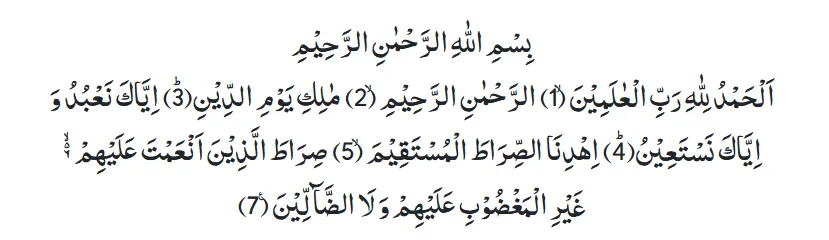
Understanding the meaning of Surah Al Fatiha makes memorization easier and turns recitation into real worship. When a learner knows that the verses move from praising Allah to asking Him for guidance, the order of the verses becomes logical and much harder to forget.
The table below explains the key Arabic words of Surah Al Fatiha with their transliteration and English meaning:
| Arabic Word | Transliteration | English Meaning |
|---|---|---|
| بِسْمِ اللَّهِ | Bismillah | In the name of Allah |
| الْحَمْدُ | Al-Hamdu | All praise and thanks |
| رَبِّ الْعَالَمِينَ | Rabbil-‘Alamin | Lord of all the worlds |
| الرَّحْمَٰنِ الرَّحِيمِ | Ar-Rahman Ar-Rahim | The Entirely Merciful, the Especially Merciful |
| مَالِكِ يَوْمِ الدِّينِ | Maliki Yawmid-Din | Sovereign of the Day of Recompense |
| إِيَّاكَ نَعْبُدُ | Iyyaka Na’budu | You alone we worship |
| نَسْتَعِينُ | Nasta’in | We ask for help |
| اهْدِنَا | Ihdina | Guide us |
| الصِّرَاطَ الْمُسْتَقِيمَ | As-Siratal-Mustaqim | The straight path |
| الْمَغْضُوبِ عَلَيْهِمْ | Al-Maghdubi ‘Alayhim | Those who earned [Allah’s] anger |
| الضَّالِّينَ | Ad-Dallin | Those who went astray |
3. Memorizing One Verse At A Time
Breaking the surah into single verses is the core of any method for how to memorise Surah Al Fatiha correctly. Instead of trying to hold all seven verses at once, the learner focuses on one short verse until it is firmly memorized with correct pronunciation.
To memorize a verse of Surah Al Fatiha, read it while looking at the Mushaf, then repeat it aloud about ten times. Close the Mushaf and recite it from memory. If you hesitate or make a mistake, look again and repeat until you can recite it smoothly three times in a row.
The ideal number of repetitions depends on the learner’s age and memory. To find the right amount for you or your child, read this guide on how many times you should repeat a verse to memorize it.
Experience Our Interactive Learning
Curious about how we teach? Watch these brief video clips from our recent live sessions to see our structured curriculum, advanced learning platform, and dynamic student-teacher interactions firsthand.
Start Your Quran Learning Journey
Join Tabark Academy today for structured online lessons with qualified tutors, customized to fit your goals.
Book Your Free Trial Lesson4. Connecting Each New Verse To The Previous One
Connecting verses (rabt) is the step most beginners skip, and it is the main reason people forget the order of a surah. After memorizing the second verse of Surah Al Fatiha, recite verses one and two together several times so the tongue moves between them without stopping to think.
Continue the same pattern throughout the surah: memorize the new verse alone, then join it to everything you memorized before it.
Once you finish, recite all seven verses together several times to strengthen the connection between them and memorize the surah as one complete passage.
Parents who want a teacher to guide their child through this stage can explore the online Quran course for kids
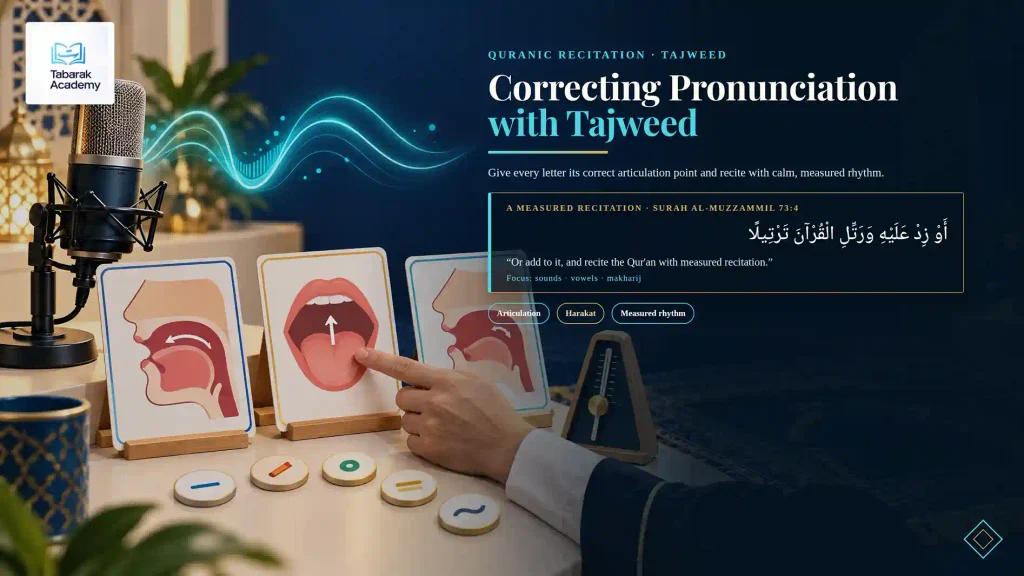
5. Correcting Pronunciation With The Rules Of Tajweed
Tajweed is the science of reciting the Quran by giving every letter its correct articulation point and characteristics. Applying Tajweed is essential when memorizing Surah Al Fatiha, and Allah commands calm, measured recitation of the Quran in this verse:
أَوْ زِدْ عَلَيْهِ وَرَتِّلِ الْقُرْآنَ تَرْتِيلًا
“Or add to it, and recite the Qur’an with measured recitation.”
The best way to memorize surah al fatiha correctly is to focus on a few specific sounds. The sections below explain the letters and vowels that beginners, especially non-Arabic speakers and children, most often get wrong when reciting Surah Al Fatiha.
a. Pronouncing the Letter Dad in Al-Maghdubi and Ad-Dallin
The letter Dad (ض) appears in Al-Maghdubi and Ad-Dallin in the last verse of Surah Al-Fatiha. It is pronounced by bringing one or both sides of the tongue against the upper molars, producing a heavy, full sound.
Beginners often confuse it with Dal (د) or Dha (ظ), so practicing with a qualified Quran teacher helps develop the correct articulation point (makhraj).
b. Pronouncing the Letter Sad in As-Sirat
The letter Sad (ص) in As-Sirat and Sirat is a heavy letter with a distinctive whistling quality. In the Hafs recitation, it is pronounced clearly with a full, heavy sound.
Beginners should avoid softening it into Seen (س), as this changes its characteristic sound. Repeated listening and guided practice can help learners maintain the correct pronunciation.
Read also: 9 Signs Of How To Know If Your Hifz Is Strong
c. Distinguishing the Throat Letter Ha (ح) From the Soft Ha (ه)
The words Al-Hamdu, Ar-Rahman, and Ar-Rahim in Surah Al-Fatiha contain the letter Ha (ح), which originates from the middle of the throat. English speakers may confuse it with the softer Ha (ه) or omit it entirely.
To pronounce it correctly, produce a gentle breathy sound from the throat without turning it into an ordinary English H. Listening to a skilled reciter and repeating after them helps build accuracy.
d. Pronouncing the Letter ‘Ayn (ع)
The letter ‘Ayn (ع) appears in Al-‘Alamin, Na’budu, Nasta’in, and An’amta. It originates from the middle of the throat and requires controlled articulation. Beginners often replace it with Hamza (ء) or a simple vowel, losing its distinctive Arabic sound.
Practice it slowly within individual words before reciting the complete verses, and ask a qualified teacher to correct your pronunciation.
e. Keeping The Shadda And The Vowels Accurate
The shadda on the Ya in Iyyaka must be pronounced clearly because dropping it changes the word’s meaning. The same attention is needed for the shadda in Allah, Ar-Rahman, and Ad-Dallin.
Short vowels also affect meaning. In An’amta, the letter Ta carries a fatha, meaning “You bestowed favor.” Changing it to a damma (An’amtu) changes the meaning to “I bestowed favor,” making correct vowel pronunciation essential.
f. Lengthening The Madd In Ad-Dallin
The word Ad-Dallin at the end of Surah Al Fatiha contains a necessary prolongation (madd lazim), because the Alif is followed by a doubled Lam.
In the Hafs recitation, it is lengthened for six counts. Shortening it is a common mistake when beginners rush through the final verse.
The Tajweed with Quran course for kids teaches correct pronunciation step by step, with tutors who listen carefully and correct each letter.

6. Reciting Surah Al Fatiha To A Qualified Teacher
Reciting to a qualified teacher (ard) is an essential part of how to memorise Surah Al Fatiha correctly. Learners cannot always hear their own mistakes, especially in letters that do not exist in their native language. A teacher catches these errors before they become lifelong habits.
Learning the Quran from a teacher and then teaching it to others is a source of great reward for both. The Prophet Muhammad ﷺ said:
خَيْرُكُمْ مَنْ تَعَلَّمَ الْقُرْآنَ وَعَلَّمَهُ
“The best among you (Muslims) are those who learn the Qur’an and teach it.”
You can compare available options in this overview of Hifz academies in Egypt.
7. Reviewing Daily And Reciting Surah Al Fatiha In Prayer
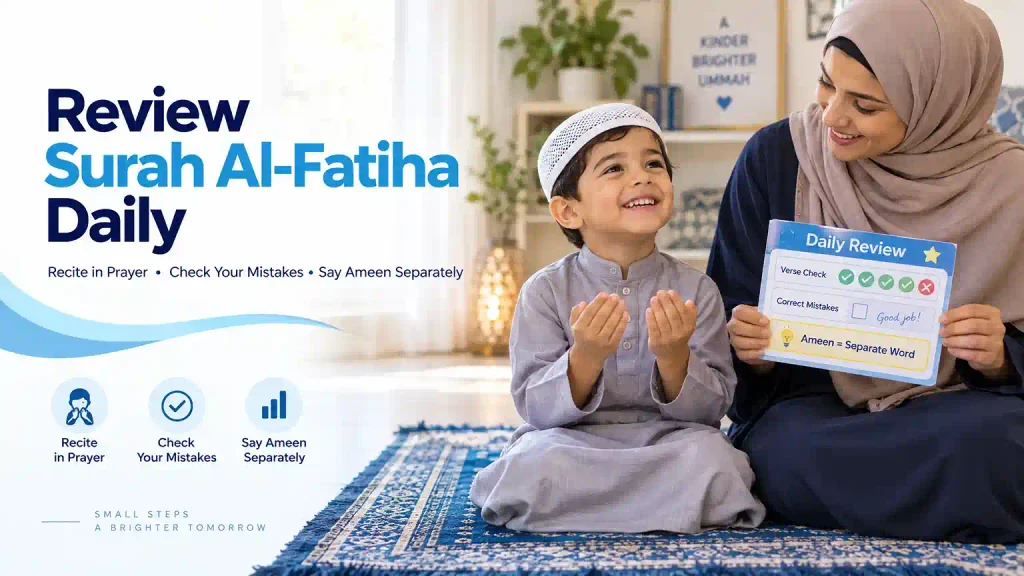
Daily review (muraja’ah) keeps Surah Al Fatiha firm in memory. The easiest review is the prayer itself: once the surah is memorized, recite it in every obligatory and voluntary prayer, and read it aloud at least once a day outside prayer to check for mistakes.
Keeping a simple record of memorized verses and corrected mistakes helps learners notice weak spots early.
The word “Ameen” said after Surah Al Fatiha is not part of the surah. It is a supplication meaning “O Allah, answer,” so children should learn it as a separate word that comes after finishing the final verse.
Read this guide on how to track Quran memorization progress.
A 7-Day Plan To Memorize Surah Al Fatiha Correctly
This 7-day plan offers a simple and practical way to memorize Surah Al-Fatiha correctly, especially for busy beginners and children. It focuses on learning one verse each day without rushing, allowing enough time to practice pronunciation and remember each verse.
Recite every new verse aloud ten times, and always review the previously memorized verses before moving on to the next one.
Children who need a guided routine with a qualified teacher can join the Hifz program for kids, which follows the same principle of small daily portions and regular review.

Day 1 – Memorizing The Basmala (Verse 1)
Day 1 focus: Pay special attention to pronouncing the shadda on the Lam in Allah and the throat letter Ha (ح) in Ar-Rahman and Ar-Rahim.
Listen to a slow, clear recitation, then repeat the verse aloud ten times while following the Mushaf. Focus on producing each letter correctly rather than memorizing the words quickly.
بِسْمِ اللَّهِ الرَّحْمَٰنِ الرَّحِيمِ
“In the name of Allah, the Entirely Merciful, the Especially Merciful.”
Day 2 – Memorizing Verse 2
Day 2 focus: Pay attention to pronouncing the throat letter Ha (ح) in Al-Hamdu and the ‘Ayn (ع) in Al-‘Alamin.
Before memorizing the new verse, review verse 1 several times, then connect verses 1 and 2 together. Repeat both verses aloud ten times to strengthen your pronunciation and help you remember their correct order.
الْحَمْدُ لِلَّهِ رَبِّ الْعَالَمِينَ
“[All] praise is [due] to Allah, Lord of the worlds.”
Day 3 – Memorizing Verse 3
Day 3 focus: This day is usually easier because the two names of Allah, Ar-Rahman and Ar-Rahim, have already appeared in the Basmala. Listen to the verse carefully, then repeat it aloud ten times while focusing on clear pronunciation.
الرَّحْمَٰنِ الرَّحِيمِ
“The Entirely Merciful, the Especially Merciful.”
Day 4 – Memorizing Verse 4
Day 4 focus: Practice the long vowel in Maliki according to the Hafs recitation, and the shadda on the Dal in Ad-Din. Pay attention to the correct length of the vowel and give the doubled Dal its full emphasis.
Then recite verses 1–4 together several times to reinforce accurate pronunciation and improve the flow between the words.
مَالِكِ يَوْمِ الدِّينِ
“Sovereign of the Day of Recompense.”
Day 5 – Memorizing Verse 5
Day 5 focus: Practice the shadda on the Ya in both occurrences of Iyyaka, and focus on pronouncing the letter ‘Ayn clearly in Na’budu and Nasta’in. Pay attention to the doubled Ya and the correct articulation of the throat letter.
This verse is the turning point of the surah, as it shifts from praising Allah to directly worshipping Him and seeking His help.
إِيَّاكَ نَعْبُدُ وَإِيَّاكَ نَسْتَعِينُ
“It is You we worship and You we ask for help.”
Day 6 – Memorizing Verse 6
Day 6 focus: Practice the heavy Sad (ص) in As-Sirat and the deep Qaf (ق) in Al-Mustaqim. Make sure to pronounce both letters from their correct articulation points without softening their sounds. Then recite verses 1–6 from memory without looking at the Mushaf to strengthen recall and build confidence in your recitation.
اهْدِنَا الصِّرَاطَ الْمُسْتَقِيمَ
“Guide us to the straight path.”
Day 7 – Memorizing Verse 7
Day 7 has the longest verse, so split it into three parts: Sirat alladhina an’amta ‘alayhim, then ghayril-maghdubi ‘alayhim, then wa lad-dallin. Focus on the fatha in An’amta, the Dad (ض), and the six-count madd.
صِرَاطَ الَّذِينَ أَنْعَمْتَ عَلَيْهِمْ غَيْرِ الْمَغْضُوبِ عَلَيْهِمْ وَلَا الضَّالِّينَ
“The path of those upon whom You have bestowed favor, not of those who have evoked [Your] anger or of those who are astray.”
Step Inside Our Virtual Classrooms
See our engaging teaching methods in action! watch real snippets of our live classes and discover how our expert instructors make learning interactive, memorable, and inspiring for every student.
Start Your Quran Learning Journey
Join Tabark Academy today for structured online lessons with qualified tutors, customized to fit your goals.
Book Your Free Trial LessonMemorize Surah Al Fatiha Correctly Tips For Kids – Picture Cards Activity
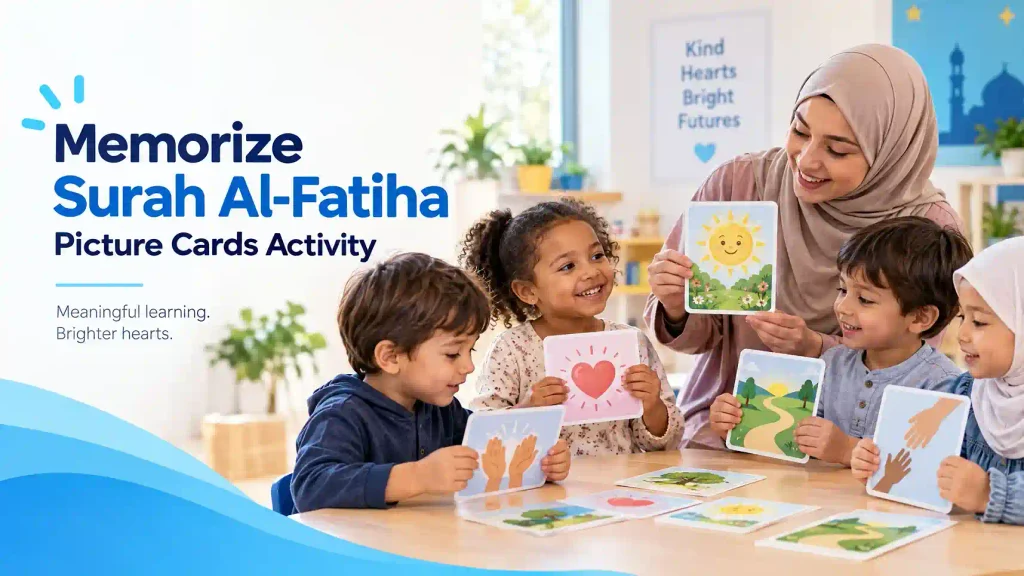
Young children learn best through a combination of sight, sound, and play. The picture card activity uses this natural learning style to help children aged 4 to 6 memorize Surah Al-Fatiha in an enjoyable and interactive way. Each verse is connected to a simple picture card that children can see, hold, and repeat as they learn.
This visual connection helps them associate the verses with familiar images, making memorization easier, more engaging, and easier to recall later.
Parents can also use the cards to ask simple questions and encourage children to remember each verse independently.
Read also: How To Teach Quran To A Child Who Does Not Speak Arabic
Goals Of The Picture Cards Activity
The picture card activity is designed to help each child achieve four clear and age-appropriate learning goals while memorizing Surah Al-Fatiha, making the process easier, more engaging, and enjoyable:
- Listening to Surah Al Fatiha recited correctly and clearly.
- Repeating each verse separately while holding its card.
- Linking each verse to its picture to remember the order of the surah.
- Reciting the complete surah in the correct sequence.
How To Prepare The Picture Cards
Prepare seven cards, one for each verse of Surah Al Fatiha. Write the verse in large, clear Arabic letters with full vowel marks, and add a simple picture that reminds the child of its meaning. Use images from nature and daily life, and never draw or depict Allah in any form.
| Verse | Suggested Picture Idea |
|---|---|
| 1 – Bismillah Ar-Rahman Ar-Rahim | A child saying Bismillah before eating or opening a book |
| 2 – Al-Hamdu Lillahi Rabbil-‘Alamin | The sun, the earth, trees, and animals (all the worlds) |
| 3 – Ar-Rahman Ar-Rahim | Rain falling on green plants as a sign of Allah’s mercy |
| 4 – Maliki Yawmid-Din | A balance scale as a reminder of the Day of Judgment |
| 5 – Iyyaka Na’budu wa Iyyaka Nasta’in | A child praying on a prayer mat |
| 6 – Ihdinas-Siratal-Mustaqim | A straight, clear road |
| 7 – Siratal-ladhina An’amta ‘Alayhim… | A straight road with a signpost pointing forward |
Steps To Do The Picture Cards Activity
To start the picture cards activity, prepare simple, colorful cards that represent the main ideas of each verse in Surah Al-Fatiha.
Show your child one card at a time, recite the corresponding verse clearly, and encourage them to repeat it several times. Let your child look at the picture, say the verse aloud, and match each card to its verse.
- Starting with calm: Gather the children, ask them to sit quietly, and open with: “Let’s listen to the surah we read in every prayer.”
- Listening first: Play a clear recording of Surah Al Fatiha or recite it yourself slowly and clearly.
- Showing the first card: Hold up the Basmala card, recite it clearly, and ask the children to repeat after you two or three times.
- Linking the picture to the meaning: Explain the card in one simple sentence, such as “We say Bismillah before every good thing we do.”
- Adding cards gradually: Introduce one or two new cards per session, and always review the earlier cards first.
- Playing the ordering game: Mix the cards and ask each child to arrange them in order while reciting each verse.
- Celebrating progress: Praise every effort and reward the child with a star or sticker when they recite a new verse correctly.
Common Mistakes To Avoid When Memorizing Surah Al Fatiha
Avoiding common mistakes from the beginning helps children and beginners develop correct recitation habits and saves them from spending weeks correcting repeated errors later.
Some pronunciation and memorization mistakes can become difficult to change if they are practiced regularly. Here are the mistakes teachers most often notice when children and beginners memorize Surah Al-Fatiha.
Recognizing these errors early makes it easier for parents and teachers to correct them through patient guidance and regular practice.
The short surahs memorization course helps learners memorize Surah Al-Fatiha with correct Tajweed and regular review.
1. Rushing Because The Surah Is Short
Many learners rush through Surah Al-Fatiha because it has only seven verses. However, reciting too quickly can hide mistakes in letters, vowels, and pronunciation, causing learners to repeat the same errors every time they recite it in prayer.
Encourage children to recite slowly and carefully, making sure each word is pronounced clearly before increasing their speed.
2. Ignoring The Rhythm Of The Verse Endings
The verses of Surah Al-Fatiha end with matching sounds (fawasil), such as Ar-Rahim, Al-‘Alamin, and Nasta’in. These endings create a natural rhythm that supports memorization and helps learners remember the correct order of the verses.
Following the steady rhythm of a skilled reciter makes the verses flow smoothly and easier to recall.
3. Memorizing Silently
Silent reading alone is not enough to memorize Surah Al-Fatiha correctly. Reciting aloud engages the eyes, tongue, and ears together, helping learners remember the words and recognize their pronunciation.
Children, especially, should practice reciting out loud in front of someone who can guide them and provide immediate feedback.
4. Relying Only On Transliteration
Transliteration, which represents Arabic sounds using English letters, can be helpful during the first few days of learning. However, it cannot accurately represent Arabic letters such as ض, ص, ح, and ع, because some of their sounds have no exact English equivalent.
Relying on transliteration for too long may lead to incorrect pronunciation and difficulty recognizing Arabic letters.
Start Your Quran Learning Journey
Join Tabark Academy today for structured online lessons with qualified tutors, customized to fit your goals.
Book Your Free Trial LessonStart Memorizing The Quran Correctly With Tabarak Academy
Memorizing Surah Al Fatiha correctly is the first step in a lifelong relationship with the Quran. Tabarak Academy offers one-to-one online classes for kids and adults, with qualified tutors who teach correct pronunciation, guide memorization, and follow every student’s progress.
Choose a schedule that fits your family, learn from home, and receive personal feedback in every lesson. Book your free trial lesson today and let your child recite Surah Al Fatiha with confidence and correct Tajweed.

Our Quran Memorization / Hifz Courses
- Online Hifz Program
- Juz 30 Memorization
- Hifz for Kids
- Hifz for Adults
- Hifz for Sisters
- Short Surah Memorization Course
- Hifz Ijazah Course
Conclusion
Learning how to memorize Surah Al-Fatiha correctly means combining memorization with accurate pronunciation and a clear understanding of its meaning. Surah Al-Fatiha is recited in every rak’ah, and the Prophet ﷺ taught that the prayer is not valid without it, so every letter deserves care and attention.
Learning it properly from the beginning helps children and beginners build confidence and develop correct recitation habits that they can maintain throughout their lives.
The method is clear: listen to a skilled reciter, understand the meaning, memorize one verse at a time, connect the verses, correct your Tajweed, recite to a teacher, and review daily in prayer.
Frequently Asked Questions About Memorizing Surah Al Fatiha
How Long Does It Take To Memorize Surah Al Fatiha Correctly?
Most beginners can memorize Surah Al Fatiha in about one week by learning one verse per day. Mastering correct pronunciation may take longer, especially for non-Arabic speakers, so regular correction from a qualified teacher is important.
What Is The Best Way To Memorize Surah Al Fatiha Correctly For Kids?
The best way to memorize Surah Al Fatiha correctly for kids is listening and repeating. Children should hear a clear recitation, repeat one verse at a time aloud, and use visual aids like picture cards, with a parent or teacher correcting them.
How Many Times Should A Child Repeat Each Verse Of Al Fatiha?
There is no fixed number, but repeating each verse of Al Fatiha about ten times aloud is a practical starting point. Younger children may need more repetitions spread across the day in short, enjoyable sessions.
Can I Learn Surah Al Fatiha Using Transliteration Only?
Transliteration can help at the very beginning, but it is not enough for correct recitation of Surah Al Fatiha. English letters cannot represent sounds like ض, ص, ح, and ع accurately, so learners should move to the Arabic text with a teacher.
Is The Basmala A Verse Of Surah Al Fatiha?
In the standard Mushaf following the Kufan count, the Basmala is the first verse of Surah Al Fatiha. Scholars have differed on this question, and the schools of Islamic jurisprudence hold different views about reciting it aloud in prayer.
Is “Ameen” Part Of Surah Al Fatiha?
No, “Ameen” is not part of Surah Al Fatiha and is not written in the Mushaf. It is a supplication meaning “O Allah, answer,” said after finishing the final verse of the surah.



0 Comments