


Tajweed Rules for Beginners – A Complete Guide to Reciting the Quran Correctly
Have you ever listened to a Quran reciter and wondered how every letter sounds so clear, so precise, and so beautiful? That clarity comes from Tajweed, the science that governs how each letter of the Quran should be pronounced.
Learning tajweed rules for beginners is the first real step toward reciting the Quran the way it was revealed and transmitted by the Prophet Muhammad ﷺ.
This guide walks you through the foundational tajweed rules every new learner needs: what tajweed means, why it matters, and how letters, nasal sounds, and elongations are pronounced correctly. Whether you are a non-Arabic speaker starting from zero or someone refreshing the basics, these rules will give you a clear, structured starting point.
What You Will Learn
- What tajweed means and why every Muslim is encouraged to learn it.
- The correct way to perform Isti’adhah and Basmalah before reciting.
- The four rules of Noon Sakinah and Tanween, and the three rules of Meem Sakinah.
- The basics of Madd (elongation) and where letters are articulated (Makharij al-Huruf).
- Practical steps for learning tajweed correctly as a beginner.
Tajweed Rules for Beginners
Tajweed is the Islamic science that defines how each letter of the Quran must be pronounced, giving every letter its correct articulation point, characteristics, and vowel sound, without exaggeration or carelessness.
The word tajweed itself means “improvement” or “mastery” in Arabic. In practice, it is the set of rules that protects the tongue from mistakes while reciting the words of Allah.
For a non-Arabic speaker, tajweed rules for beginners can feel technical at first. The good news is that these rules follow a logical structure: once you learn the categories below, you can apply them to any page of the Quran.
Read more about: Understanding Tajweed: Meaning, Rules, and Importance
Is Learning Tajweed Obligatory?
Yes, Every Muslim who recites the Quran is required to recite it correctly enough to avoid clear pronunciation errors that can alter its letters or meaning. This means learning and applying the essential Tajweed needed for correct recitation is an individual responsibility.
However, mastering the complete theoretical science of Tajweed—including its detailed terminology, classifications, and finer rules—is not required from every Muslim. Traditionally, preserving and teaching this deeper knowledge is treated as a communal responsibility (Fard Kifayah).
In practical terms, you do not need to become a Tajweed scholar, but you should learn enough to pronounce the Quran’s letters correctly, distinguish similar sounds, and avoid significant recitation errors.
Read more about: Is Learning Tajweed Mandatory in Islam?
How Is Tajweed Traditionally Learned?
Tajweed is traditionally learned through direct listening and correction from a qualified teacher, not from books alone. A learner either listens carefully to a teacher’s recitation and imitates it, or recites in front of the teacher and receives live correction, and the strongest method combines both.
This is one reason structured, teacher-led programs matter so much for beginners. Guided correction catches mistakes that self-study simply cannot, which is exactly the gap that live, one-on-one Quran classes are designed to close.

Rules of Isti’adhah and Basmalah
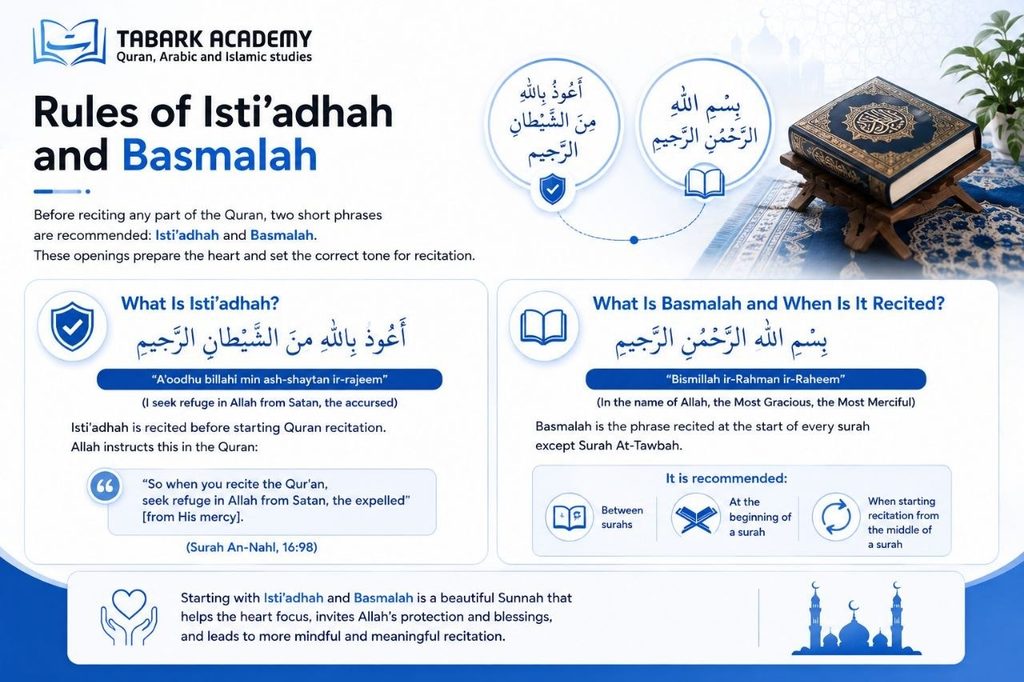
Before reciting any part of the Quran, two short phrases are recommended: Isti’adhah and Basmalah. These openings prepare the heart and set the correct tone for recitation.
What Is Isti’adhah?
Isti’adhah is the phrase “A’oodhu billahi min ash-shaytan ir-rajeem” (I seek refuge in Allah from Satan, the accursed), recited before starting Quran recitation. Allah instructs this in the Quran:
فَإِذَا قَرَأْتَ الْقُرْآنَ فَاسْتَعِذْ بِاللَّهِ مِنَ الشَّيْطَانِ الرَّجِيمِ
“So when you recite the Qur’an, seek refuge in Allah from Satan, the expelled [from His mercy]”
What Is Basmalah and When Is It Recited?
Basmalah is the phrase “Bismillah ir-Rahman ir-Raheem” (In the name of Allah, the Most Gracious, the Most Merciful), recited at the start of every surah except Surah At-Tawbah.
It is recommended between surahs, at the beginning of a surah, and when starting recitation from the middle of a surah.
Experience Our Interactive Learning
Curious about how we teach? Watch these brief video clips from our recent live sessions to see our structured curriculum, advanced learning platform, and dynamic student-teacher interactions firsthand.
Rules of Noon Sakinah and Tanween
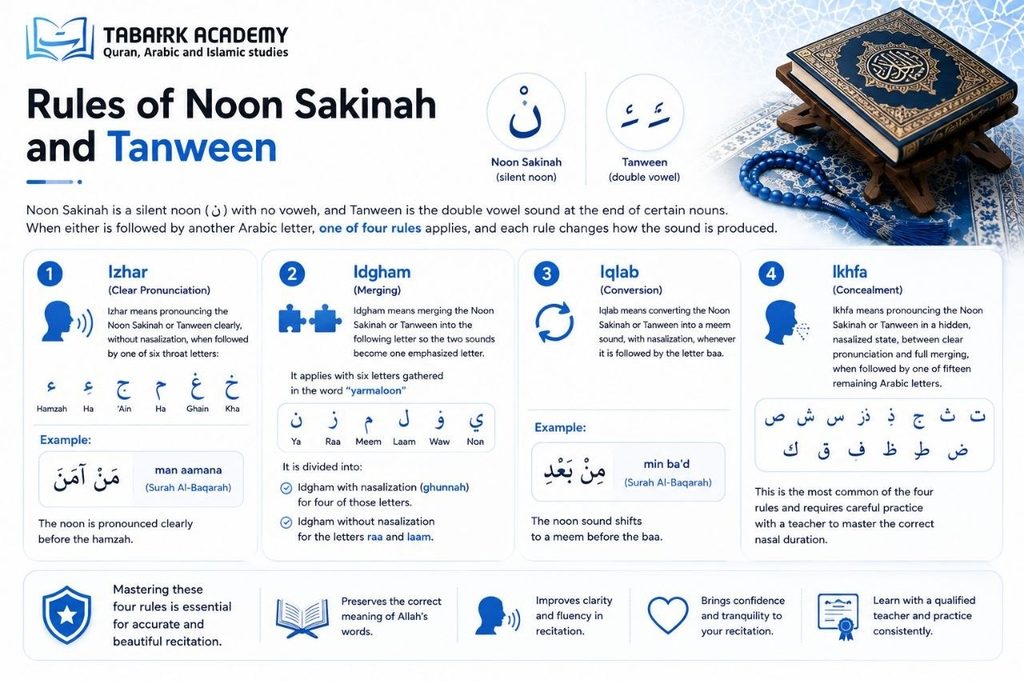
Noon Sakinah is a silent noon (ن) with no vowel, and Tanween is the double vowel sound at the end of certain nouns. When either is followed by another Arabic letter, one of four rules applies, and each rule changes how the sound is produced.
1. Izhar (Clear Pronunciation)
Izhar means pronouncing the Noon Sakinah or Tanween clearly, without nasalization, when followed by one of six throat letters: hamzah, ha, ‘ain, ha (خ), ghain, or kha.
An example is the phrase “man aamana” (Surah Al-Baqarah), where the noon is pronounced clearly before the hamzah.
Read also: Mastering the Letter Ain (ع): Pronunciation & Tajweed Tips
2. Idgham (Merging)
Idgham means merging the Noon Sakinah or Tanween into the following letter so the two sounds become one emphasized letter.
It applies with six letters gathered in the word “yarmaloon” (ي ر م ل و ن), and is divided into idgham with nasalization (ghunnah) for four of those letters, and idgham without nasalization for the letters raa and laam.
3. Iqlab (Conversion)
Iqlab means converting the Noon Sakinah or Tanween into a meem sound, with nasalization, whenever it is followed by the letter baa.
An example is the phrase “min ba’d” (Surah Al-Baqarah), where the noon sound shifts to a meem before the baa.
4. Ikhfa (Concealment)
Ikhfa means pronouncing the Noon Sakinah or Tanween in a hidden, nasalized state, between clear pronunciation and full merging, when followed by one of fifteen remaining Arabic letters. This is the most common of the four rules and requires careful practice with a teacher to master the correct nasal duration.
Read also :Where to Begin and How to Progress Through Tajweed Rules
Rules of Meem Sakinah
Meem Sakinah is a silent meem (م) with no vowel. When another Arabic letter follows it, three rules apply, based entirely on which letter comes next.
1. Izhar Shafawi (Clear Labial Pronunciation)
Izhar Shafawi means pronouncing the silent meem clearly, without nasalization, whenever it is followed by any letter other than baa or meem. This is the most frequent of the three Meem Sakinah rules across the Quran.
2. Idgham Shafawi (Labial Merging)
Idgham Shafawi means merging a silent meem into a following moving meem so they become one emphasized letter with nasalization. This rule only occurs across two separate words, never within a single word.
3. Ikhfa Shafawi (Labial Concealment)
Ikhfa Shafawi means concealing the silent meem with nasalization whenever it is followed by the letter baa. It is called “labial” because both meem and baa are articulated from the lips.
Read also: What Are Lahn Jali and Lahn Khafi in Recitation
Rules of Madd (Elongation)
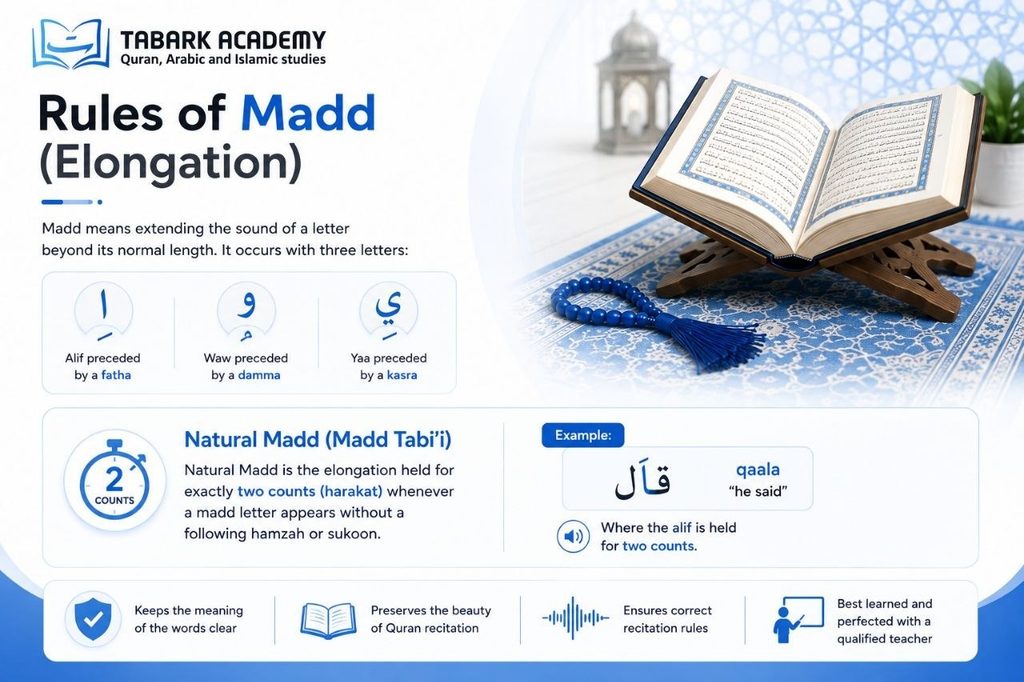
Madd means extending the sound of a letter beyond its normal length. It occurs with three letters: alif preceded by a fatha, waw preceded by a damma, and yaa preceded by a kasra.
1. Natural Madd (Madd Tabi’i)
Natural Madd is the elongation held for exactly two counts (harakat) whenever a madd letter appears without a following hamzah or sukoon. An example is the word “qaala” (قَالَ), where the alif is held for two counts.
2. Branching Madd (Madd Far’i)
Branching Madd is any elongation caused by a hamzah or a sukoon following the madd letter, and its length ranges from four to six counts depending on the specific type.
Common types include Madd Muttasil (connected, within one word), Madd Munfasil (separated, across two words), and Madd ‘Aarid lis-Sukoon (occurring at a pause).
3. Makharij al-Huruf: Where Each Letter Is Articulated
Makharij al-Huruf is the study of the exact point in the mouth or throat where each Arabic letter originates. There are five main articulation areas: the throat, the tongue, the lips, the nasal cavity, and the open space of the mouth and throat (al-jawf).
Mastering these articulation points is what separates correct tajweed from approximate pronunciation.
This is precisely the kind of detail that is very difficult to self-correct from a book, since two letters can sound almost identical to an untrained ear until a teacher demonstrates the difference live.
Read more about: Complete Guide to the 17 Makharij of the Arabic Alphabet
Sifaat al-Huruf – Characteristics of the Letters
Sifaat al-Huruf refers to the qualities that describe how a letter behaves when pronounced, such as heaviness or lightness, and whether the breath flows or is withheld.
Examples include tafkheem (heavy pronunciation), tarqeeq (light pronunciation), qalqalah (a slight bounce on certain letters when they carry no vowel), and safeer (a whistling sound on specific letters).
These characteristics are what give Quranic recitation its distinctive, consistent sound across different reciters and regions.
How to Learn Tajweed Rules Effectively as a Beginner
Learning tajweed well as a beginner depends on consistent practice and correction, not memorizing rules in isolation. The following steps build a solid foundation over time.
- Set a fixed, regular study schedule, starting with articulation points before moving to rules like madd, noon sakinah, and idgham.
- Apply every rule you learn directly to Quranic verses, since repeated practice on real text is what makes a rule stick.
- Join a study circle or recite with others, ideally under the guidance of a qualified teacher who can correct you in real time.
- Record your own recitation and listen back to it, so you can catch mistakes yourself between sessions.
- Listen regularly to reciters known for precise tajweed, such as Sheikh Mahmoud Khalil Al-Husary, and imitate their style.
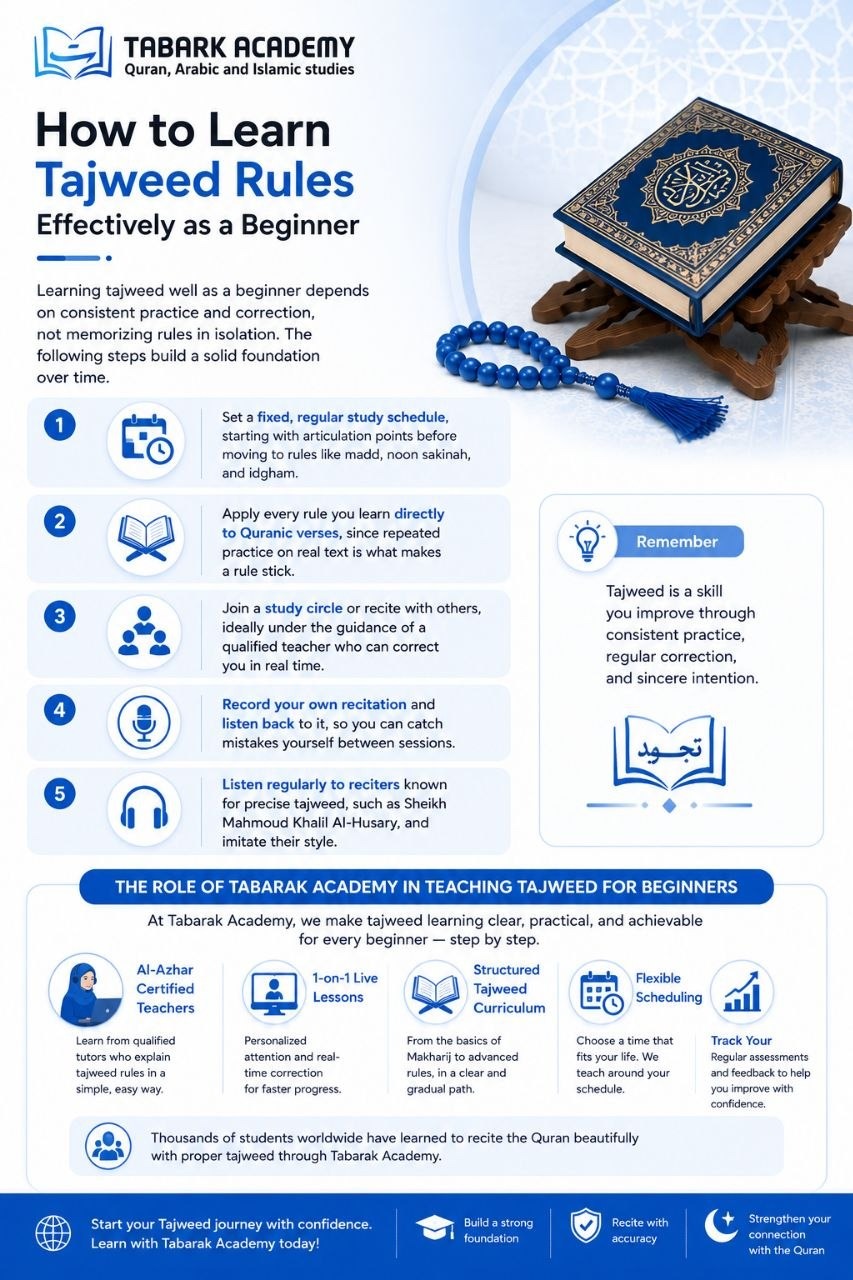
At Tabarak Academy, we make tajweed learning clear, practical, and achievable for every beginner step by step.

Because tajweed is fundamentally a spoken skill passed from teacher to student, no combination of books or apps fully replaces live correction.
This is exactly why structured, one-on-one online classes have become such a popular option for learners around the world who do not have access to a local teacher.
Step Inside Our Virtual Classrooms
See our engaging teaching methods in action! watch real snippets of our live classes and discover how our expert instructors make learning interactive, memorable, and inspiring for every student.
Start Reciting the Quran with Confidence Today
Tabarak Academy offers structured, one-on-one online Quran and tajweed classes for children, adults, and families worldwide, led by certified teachers who correct your recitation in real time.
If you are ready to move from learning tajweed rules for beginners in theory to applying them correctly with expert guidance, book a class and start your journey toward confident, accurate Quran recitation.
Watch a real life at our academy:
Full TAJWEED Course | Rules of Mudood- Maad Muttasil
Our Tajweed Courses
- Online Tajweed Classes
- Tajweed Course for Beginners
- Tajweed Course for Kids
- Tajweed Course for Adults
- Tajweed Course for Sisters
- Advanced Tajweed Course
- Amali (Practical) Tajweed Course
- Learn Quran with Tajweed
- Learn Quran with Tajweed for Kids
- Learn Quran with Tajweed for Sisters
Tajweed rules for beginners cover a clear, learnable structure: the meaning and ruling of tajweed, the etiquette of Isti’adhah and Basmalah, the four rules of Noon Sakinah and Tanween, the three rules of Meem Sakinah, the categories of Madd, and the articulation points and characteristics of each letter.

The key takeaway is that tajweed is best learned gradually, through daily practice, self-recording, and above all, correction from a qualified teacher who can hear and fix mistakes that are invisible on the page. With consistency and the right guidance, any beginner can progress from basic rules to confident, correct recitation.
Your Quran journey starts with one click. Book your free trial now no cost, no risk, just real progress.
[Claim Your Free Trial Lesson →]

FAQs About Tajweed Rules for Beginners
What is tajweed in simple terms?
Tajweed is the set of rules that govern the correct pronunciation of every letter in the Quran, covering articulation points, letter characteristics, and vowel length. It ensures the Quran is recited the way it was transmitted from the Prophet Muhammad ﷺ, without errors or careless pronunciation.
Is it a sin not to recite with tajweed?
Applying the basic tajweed rules that prevent clear mispronunciation is obligatory on every reciting Muslim, according to the majority of tajweed scholars.
Mastering the finer, detailed rules, however, is a communal obligation, meaning the wider community is responsible for preserving and teaching them.
Can I learn tajweed on my own from books or apps?
Books and apps can help you understand the theory behind tajweed rules, but tajweed is fundamentally a spoken skill that requires listening and live correction.
Most tajweed scholars recommend learning directly from a qualified teacher, since some pronunciation details cannot be captured accurately in writing.
How long does it take to learn tajweed as a beginner?
The time it takes depends on prior familiarity with Arabic letters, how often you practice, and whether you study with a teacher
Beginners who practice consistently with a teacher’s correction typically grasp the core rules, such as noon sakinah, meem sakinah, and basic madd, within a few months of regular sessions.