

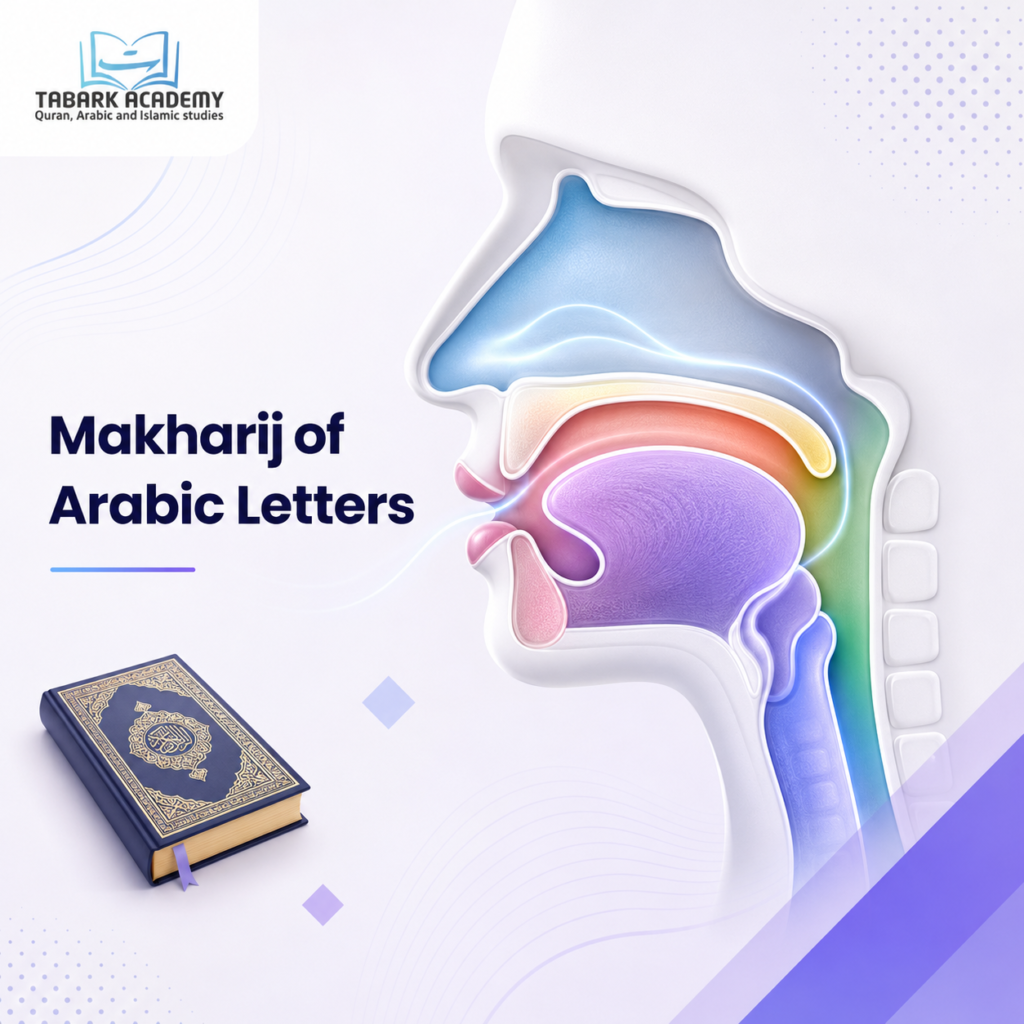
17 Makharij of Arabic Letters – Complete Chart, Diagram, and Pronunciation Guide
Have you ever recited a Quranic word correctly in your mind, only to hear a teacher tell you that one letter came from the wrong place?
This is exactly what Makharij al-Huruf (مخارج الحروف) helps you correct.
Makharij are the specific articulation points from which Arabic letters emerge. In the classification followed by many Tajweed scholars, including Ibn al-Jazari, the Arabic sounds are organized into 17 specific Makharij distributed across 5 general articulation zones: Al-Jawf, Al-Halq, Al-Lisan, Ash-Shafatan, and Al-Khaishum.
Learning the 17 Makharij is not simply about memorizing a chart. Each point tells you where a sound begins, which part of the mouth or throat should move, and which letters are likely to become confused when the articulation is incorrect.
This guide explains all 17 points individually, with their Arabic names, letters, physical articulation, and practical pronunciation guidance.
The 17 Makharij of Arabic Letters at a Glance
Before studying each Makhraj individually, it helps to understand how the 17 points fit inside the five broader articulation zones.
| # | Specific Makhraj | General Zone | Letters / Sound |
| 1 | Al-Jawf | Oral-throat cavity | Madd ا، و، ي |
| 2 | Aqsa Al-Halq | Deep throat | ء، هـ |
| 3 | Wasat Al-Halq | Middle throat | ع، ح |
| 4 | Adna Al-Halq | Upper throat | غ، خ |
| 5 | Back of tongue for Qaf | Tongue | ق |
| 6 | Back of tongue for Kaf | Tongue | ك |
| 7 | Middle of tongue | Tongue | ج، ش، ي |
| 8 | Side of tongue | Tongue | ض |
| 9 | Front edge of tongue | Tongue | ل |
| 10 | Tip of tongue for Nun | Tongue | ن |
| 11 | Tip of tongue for Ra | Tongue | ر |
| 12 | Tip of tongue with upper tooth roots | Tongue | ط، د، ت |
| 13 | Tip of tongue with upper incisors | Tongue | ظ، ذ، ث |
| 14 | Tip of tongue near lower incisors | Tongue | ص، ز، س |
| 15 | Lower lip with upper incisors | Lips | ف |
| 16 | Both lips | Lips | ب، م، و |
| 17 | Al-Khaishum | Nasal cavity | Ghunnah of ن and م |
That mental path turns the chart into a map rather than an isolated list. Tabarak Academy sequences the Amali Tajweed Course across six applied practice modules, each targeting a distinct recitation skill that theory alone cannot build.
Read also: How Many Total Makharij Are Recognized in Tajweed?

1. Al-Jawf – The Oral Cavity and the Three Vowel Letters
Al-jawf is the empty cavity formed by the mouth and throat combined. It has no fixed point of contact the way the tongue or lips do, which is why scholars call it a muqaddar (estimated) makhraj rather than a muhaqqaq (defined) one.
It produces the three madd (elongation) letters: the sakin alif preceded by a fatha, the sakin waw preceded by a damma, and the sakin ya preceded by a kasra.
These three letters are called “jawfiyyah” letters because the sound simply flows through the open cavity without the tongue, lips, or throat narrowing at any single spot.
Here is a Quranic example of a madd letter produced from this makhraj:
وَإِذْ قَالَ رَبُّكَ لِلْمَلَائِكَةِ إِنِّي جَاعِلٌ فِي الْأَرْضِ خَلِيفَةً
“And [mention] when your Lord said to the angels, ‘Indeed, I will make upon the earth a successive authority.'”
2. Aqsa al-Halq (Farthest Part of the Throat)
Aqsa al-halq, the part of the throat closest to the chest, produces hamza (ء) and hā’ (هـ). This is the deepest of the three throat points, near the larynx, and both letters are formed with a light, breathy release rather than any pressure from the tongue.
The hamza is a sudden glottal stop, while the hā’ is a soft, continuous exhale, so although they share the same location their sound quality is very different.
Here is a Quranic example of a throat letter, found in the opening chapter:
اهْدِنَا الصِّرَاطَ الْمُسْتَقِيمَ
“Guide us to the straight path.”
Experience Our Interactive Learning
Curious about how we teach? Watch these brief video clips from our recent live sessions to see our structured curriculum, advanced learning platform, and dynamic student-teacher interactions firsthand.
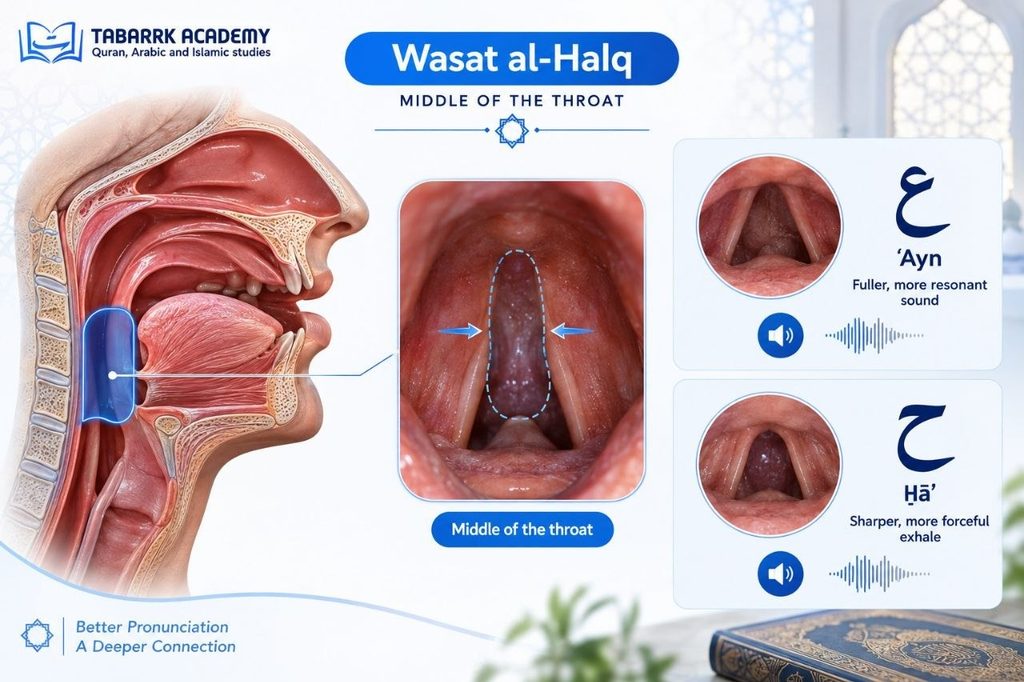
3. Wasat al-Halq (Middle of the Throat)
Wasat al-halq produces ‘ayn (ع) and ḥā’ (ح). Both letters are pharyngeal, meaning they are produced by constricting the middle of the throat, and they have no direct equivalent in most non-Arabic languages, which is why many learners need repeated practice to isolate this exact spot.
The ‘ayn carries a fuller, more resonant sound, while the ḥā’ is a sharper, more forceful exhale from the same narrow point.
4. Adna al-Halq (Nearest Part of the Throat)
Adna al-halq, the part of the throat closest to the mouth, produces ghayn (غ) and khā’ (خ). These two letters are produced further forward than ‘ayn and ḥā’, close to where the throat meets the back of the mouth, and both carry a raspy, guttural quality caused by air passing through a narrowed passage.
The ghayn is voiced, with a low rumble similar to a gargling sound, while the khā’ is unvoiced and closer to a harsh clearing of the throat.
5. Aqsa al-Lisan — Qaf Point
The back of the tongue rising to touch the soft palate produces qāf (ق). The very back of the tongue rises to touch the soft palate (the fleshy rear portion of the roof of the mouth), fully blocking the airflow before releasing it in a deep, heavy burst.
This is one of the seven letters classified as heavy (mufakhkham) in every position, so the qāf should never be flattened or softened toward a kāf sound.
6. Aqsa al-Lisan — Kaf Point
Slightly forward of the qāf point, the back of the tongue meets the boundary between the soft and hard palate to produce kāf (ك).
Unlike the qāf, the kāf is a light (muraqqaq) letter, so learners are often taught to say qāf and kāf back to back to feel the small but important shift in tongue position and heaviness between the two.
Read also: How to Breathe Correctly During Quran Recitation
7. Wasat al-Lisan (Middle of the Tongue)
Wasat al-lisan, the middle of the tongue against the hard palate, produces jīm (ج), shīn (ش), and the non-elongated yā’ (ي). These three letters are known as the “shajariyyah” letters because they emerge from the middle, arched part of the tongue meeting the hard palate.
The jīm is a full stop released sharply, the shīn is a continuous hissing airflow, and the yā’ is a soft glide, so despite sharing one exit point their manner of release is completely different.
Here is a Quranic example of a letter produced from the tip of the tongue:
مِنَ الْجِنَّةِ وَالنَّاسِ
“From among the jinn and mankind.”

8. Edge of the Tongue — Dad Point
The edge of the tongue against the upper molars produces ḍād (ض). This makhraj can be on either the right or left edge of the tongue, or both together, pressed firmly against the upper back molars.
The ḍād is widely considered the most difficult Arabic letter for non-native speakers to master, since it combines heaviness, elongation of contact, and a lateral release that has no close match in most other languages.
9. Edge of the Tongue — Lam Point
Moving forward from the ḍād point, the edge of the tongue closer to its tip touches the gum ridge just behind the upper front teeth to produce lām (ل).
The airflow is released along both sides of the tongue, giving the lām its characteristic light, flowing quality, which is why it blends smoothly into surrounding vowels.
10. Tip of the Tongue — Nun Point
The very tip of the tongue touches the gum ridge in a position close to the lām, but slightly further back, to produce nūn (ن).
The sound is released partly through the mouth and partly through the nose, and because of this dual release, the nūn is always accompanied by ghunnah, the nasal resonance described in point 17.
11. Tip of the Tongue — Ra Point
Just behind the nūn point, on the back of the tongue’s tip rather than its very edge, the tongue produces rā’ (ر) with a slight vibration or flap against the gum ridge.
This repeated, light trilling motion (takrīr) is a defining feature of the rā’ and must be controlled carefully so it is neither over-rolled nor flattened.
12. Tip of the Tongue — Ta, Dal, and Ta (Nit’iyyah Letters)
The tip of the tongue striking the base of the upper front teeth produces ṭā’ (ط), dāl (د), and tā’ (ت). Known as the “nit’iyyah” (dental-plosive) letters, all three fully stop the airflow before releasing it.
The ṭā’ is heavy and forceful, the dāl is voiced and moderate, and the tā’ is unvoiced and light, so the three letters share a location but differ sharply in weight and vibration.
13. Tip of the Tongue — Za, Dhal, and Tha (Lathawiyyah Letters)
The tip of the tongue lightly touching the edges, rather than the base, of the upper front teeth produces ẓā’ (ظ), dhāl (ذ), and thā’ (ث). These “lathawiyyah” (interdental) letters allow a continuous airflow rather than a full stop.
The ẓā’ is heavy, while the dhāl and thā’ are light, and all three require the tongue tip to be visible slightly between the teeth for a clear, correct sound.
14. Tip of the Tongue — Sad, Zay, and Sin (Whistling Letters)
The tongue tip held close to, but not touching, the point between the upper and lower front teeth produces ṣād (ص), zāy (ز), and sīn (س). Also called the “ḥurūf al-ṣafīr” (whistling letters), these three force air through a narrow channel that produces a distinctive whistling or hissing sound. The ṣād is heavy while the zāy and sīn are light, giving all three a shared airstream but a different resonance.
15. Inner Part of the Lower Lip — Fa Point
The soft inner edge of the lower lip brought lightly against the tips of the upper front teeth produces fā’ (ف), allowing air to escape in a steady, unvoiced stream.
This is the only Arabic letter produced by a lip meeting the teeth rather than the two lips meeting each other.
16. Both Lips Meeting
Both lips meeting produces bā’ (ب), the non-madd wāw (و), and mīm (م). All three letters share the point where the upper and lower lips come together, but each uses a different lip shape and release: the bā’ is a firm, full closure released sharply, the wāw is formed with the lips rounded and only slightly parted, and the mīm is closed like the bā’ but released partly through the nose, carrying its own ghunnah.
17. Al-Khaishum – The Nasal Cavity and the Ghunnah
Al-khaishum, the nasal cavity, produces the ghunnah that accompanies nūn and mīm in every one of their grammatical states, whether the letter is voweled, sakin, doubled with a shaddah, or hidden inside a Tajweed rule such as idghām, ikhfa, or iqlab.
Ghunnah itself is a nasal resonance with no tongue movement involved, and its duration is measured in counted beats (harakat) that lengthen or shorten depending on which Tajweed rule is being applied.
A Mental Map of the 17 Makharij Across the Five Main Articulation Areas
Picture a side-view cross-section of the head, moving from the chest upward: the trachea leads into the throat (al-halq), which opens into the mouth cavity where the tongue meets the palate and teeth, before the air finally exits through the lips or is redirected through the nose.
Tracing this path from the throat to the lips is exactly how a makharij chart with diagram visually orders the seventeen points, which is why teachers recommend studying the chart alongside a real diagram of the vocal tract rather than memorizing the list alone.
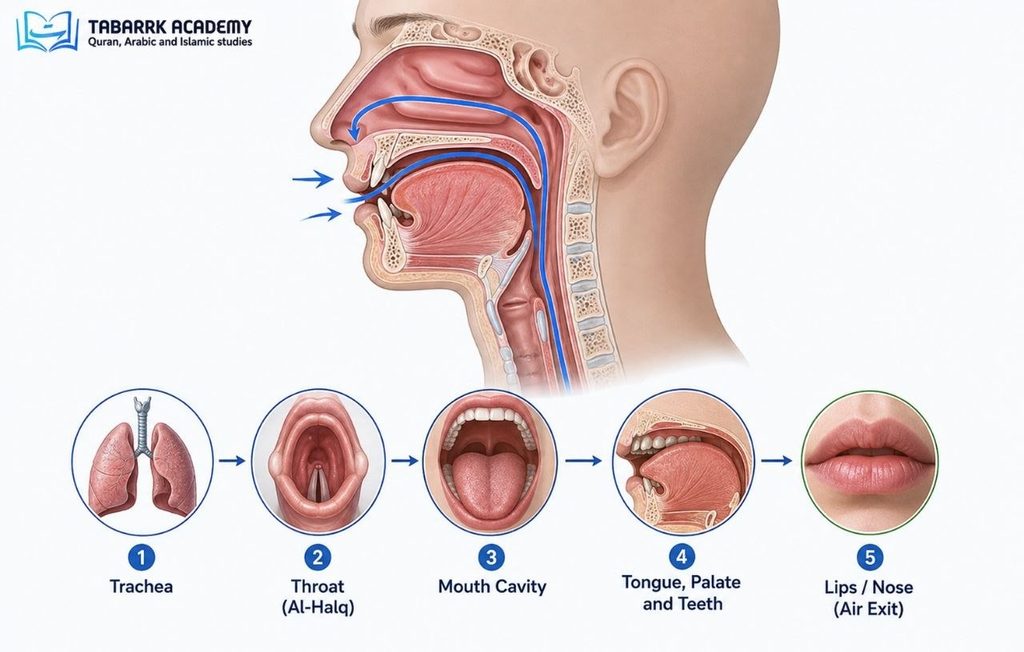
Many learners find it easier to internalize this diagram with live feedback from a qualified teacher Tabarak Academy’s certified Tajweed instructors guide students through each makhraj individually until the correct exit point becomes automatic.

Why Visualizing the 17 Makharij Makes Arabic Letter Articulation Easier to Understand
A chart alone lists where letters are produced, but a diagram adds the spatial picture that makes the information stick, because learners retain a cross-section image of the vocal tract far longer than a text description.
Combining both formats also helps international learners encountering Arabic phonetics for the first time, since their native languages often have no equivalent sound for letters such as ḍād or ‘ayn.
For that reason, most structured Tajweed courses pair a printed or digital makharij chart with diagram alongside live audio correction, since a chart shows the letter’s location while a teacher confirms that the sound produced actually matches it.
Read also: What Are the Makharij of the Arabic Letters?
Tabarak Academy builds this pairing into its curriculum, giving learners both the visual reference and a certified instructor who listens and corrects pronunciation letter by letter.
Step Inside Our Virtual Classrooms
See our engaging teaching methods in action! watch real snippets of our live classes and discover how our expert instructors make learning interactive, memorable, and inspiring for every student.

Start Correcting Your Makharij with a Certified Tajweed Teacher
A chart shows you where each letter should be produced, but only consistent, corrected practice turns that knowledge into accurate recitation.
Tabarak Academy offers live, one-on-one online Quran and Tajweed classes for children, adults, and families worldwide, pairing every student with a certified teacher who listens to their recitation and corrects makharij and sifaat in real time.
Book a class Today and start replacing guesswork with guided, accurate pronunciation.
Our Tajweed Courses
- Online Tajweed Classes
- Tajweed Course for Beginners
- Tajweed Course for Kids
- Tajweed Course for Adults
- Tajweed Course for Sisters
- Advanced Tajweed Course
- Amali (Practical) Tajweed Course
- Learn Quran with Tajweed
- Learn Quran with Tajweed for Kids
- Learn Quran with Tajweed for Sisters

Conclusion
A complete makharij chart with diagram breaks Arabic pronunciation down into five general zones al-jawf, al-halq, al-lisan, ash-shafatan, and al-khaishum and seventeen specific exit points beneath them, with al-lisan alone accounting for eighteen letters across ten locations.
Understanding these points is not a memorization exercise for its own sake; it is the foundation that determines whether a recitation is accurate or whether a small shift in the tongue or lips changes a letter’s sound and meaning.
The take-away message is straightforward: pair the chart with a mental or printed diagram, practice each zone letter by letter, and seek correction from a qualified teacher whenever a sound feels uncertain, because a makharij chart with diagram works best as a guide alongside guided practice rather than a replacement for it.

Frequently Asked Questions
What is a makharij chart with diagram?
A makharij chart with diagram is a visual and tabular reference that shows the seventeen specific points inside the mouth, throat, and nasal cavity where each of the 28 Arabic letters is produced.
It combines a table of the letters grouped by zone with a cross-section illustration of the vocal tract, helping learners see rather than only read where each sound originates.
How many makharij are there in Arabic?
There are seventeen specific makharij according to the view held by the majority of Tajweed scholars, including Ibn al-Jazari, grouped under five general zones: al-jawf, al-halq, al-lisan, ash-shafatan, and al-khaishum.
Some scholars, such as Sibawayh and Ash-Shatibi, count sixteen by distributing the madd letters among the tongue and lips instead of assigning them to a separate jawf category.
Why is al-jawf called an “estimated” makhraj?
Al-jawf is called muqaddar (estimated) because it is empty space rather than a fixed point of contact, unlike the tongue or lips, which physically touch another part of the vocal tract to produce a sound.
The three madd letters produced there rely on the shape of the oral-throat cavity itself rather than on any specific muscle contact.
What is the difference between makharij and sifaat?
Makharij refers to where a letter is produced, while sifaat refers to how it is produced, including qualities such as heaviness (tafkhim), lightness (tarqiq), or the presence of vibration (jahr) versus airflow (hams). Two letters can share the same makhraj, such as tā’ and dāl, yet sound distinct because their sifaat differ.
Can I learn correct makharij without a teacher?
A chart or diagram can teach the theory of where each letter is produced, but confirming that your own pronunciation matches that location usually requires a teacher’s ear, since some sounds cannot be self-corrected from a mirror or a book alone.
Structured programs such as Tabarak Academy’s online Tajweed classes pair the visual chart with live correction so learners hear the difference between the correct and incorrect exit point.
Where can I find a printable makharij chart with diagram?
A printable chart typically groups the seventeen makharij into a table by general zone (al-jawf, al-halq, al-lisan, ash-shafatan, al-khaishum) alongside a labeled cross-section diagram of the head, and Tajweed textbooks and reputable Quran-education platforms are the most common sources for one.
Confirm any chart against a certified Tajweed teacher before relying on it for self-study, since diagrams vary slightly between the different counting methods (17, 16, or 14 makharij).