


The Chunking Method For Quran Memorization
The chunking method for Quran memorization gives a practical structure to every hafiz who has ever completed the Quran. They stopped treating memorization as a single overwhelming task and started treating it as a sequence of deliberate, achievable steps.
You divide Quranic text into compact, defined units, master each one fully, then chain them together into a continuous and living memory.
This guide covers a total of 9 field-tested strategies, from foundational verse segmentation to meaning-driven techniques that use Arabic comprehension to build retention that genuinely lasts.
What You Will Learn In This Article:
- What the chunking method for Quran memorization means and why the brain responds to it.
- The critical difference between semantic chunking and mechanical chunking.
- 3 Strategy phases organized from foundational, intermediate to advanced each one phase has 3 strategies.
- How Tajweed knowledge identifies natural chunk boundaries.
- Why Arabic understanding adds a dimension to memorization that repetition alone cannot provide.

What The Chunking Method For Quran Memorization Really Means
The chunking method for Quran memorization is a structured cognitive approach built around how human working memory processes language. Working memory handles roughly 4 to 7 distinct units at once; well-defined chunks fit directly within that capacity.
Three chunking types apply to Quranic memorization: phonological (by sound pattern), visual (by page layout), and semantic (by meaning).
Most students use the first two without realizing the third exists, and that gap is where the most significant retention gains remain untapped.
Understanding what those verses mean in Arabic is not supplementary work; it activates semantic chunking and shifts retention from fragile to genuinely durable.
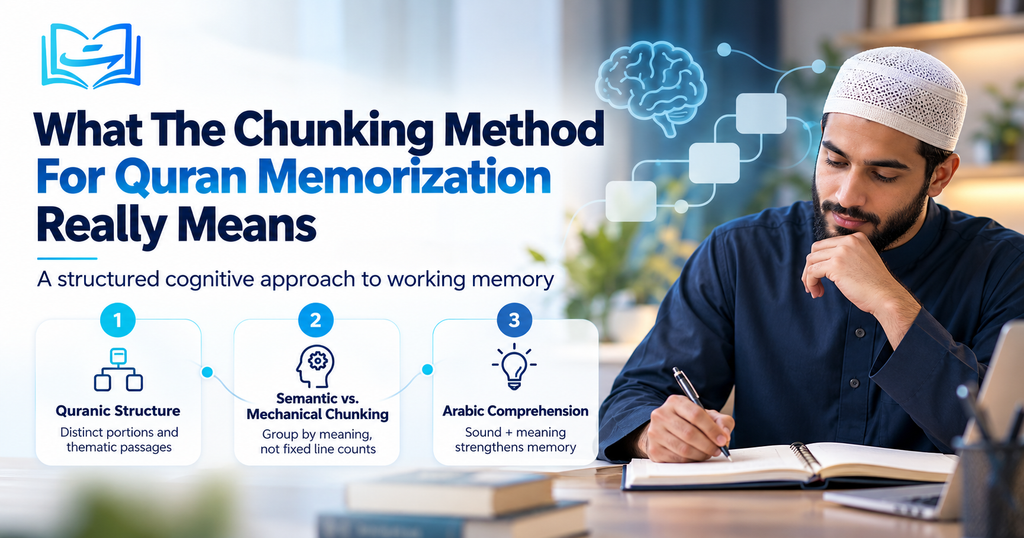
1. How Chunking Aligns With Quranic Structure
The Quran was revealed in distinct portions over 23 years, not delivered all at once. Scholars of Quranic sciences note that this gradual revelation, known as tadarruj, follows a natural chunking logic: themes open, develop, and conclude within discrete passages.
Surah Al-Baqarah, for example, groups legal rulings, historical narratives, and creedal statements into separate thematic blocks. A memorizer who understands this structure can use those seams as chunk boundaries, converting divine literary design into a practical memory framework.
Studying Quranic Arabic Classes alongside memorization gives students direct access to this structural layer of the Quran, one that remains invisible to those relying on translation alone.
2. Semantic Chunking Vs. Mechanical Chunking
Mechanical chunking divides text by fixed line counts regardless of meaning. A student using this approach memorizes two lines, then two more; with no attention to where one idea concludes and another begins.
Semantic chunking divides at meaning boundaries: the end of a narrative scene, the conclusion of a legal ruling, the close of a du’a passage. Because the brain stores meaning alongside sound, semantic chunks are retrieved far more reliably under pressure.
Students who chunk mechanically often find verses merge in memory, creating sequence confusion during salah. Students who chunk semantically report clear mental anchors at each theme’s opening, making long passages far easier to navigate with confidence.
3. Arabic Comprehension Opens A New Dimension In Chunking
When you understand what a verse means, your memory encodes two simultaneous signals: the phonological form (how it sounds) and the semantic form (what it means).
This dual encoding is substantially more resistant to forgetting than sound alone. Understanding the importance of the Arabic language for Quran memorization is not theoretical; it produces a measurable difference in every single memorization session you complete.
A student who knows that “وَإِذَا مَرِضْتُ فَهُوَ يَشْفِينِ” means “and when I am ill, it is He who cures me” chunks that verse as one complete emotional unit, not a sequence of unfamiliar syllables to be rehearsed mechanically.
Explore Why Families Choose Tabarak Academy’s Short Surahs Memorization Course

The Foundation Strategies Of Chunking Methods
These three strategies form the base of any effective Quran memorization practice. Every beginner and experienced memorizer should have them fully in place before layering more advanced techniques on top.
They are particularly practical for students in the USA, UK, Canada, Australia, and across the Gulf region who are memorizing around demanding daily schedules, since they are designed for clarity and immediate implementation.
1. Divide Each Verse Into Its Smallest Meaningful Units
Read a single ayah aloud three times from the mushaf. Identify the natural pause points within the verse, places where meaning momentarily completes, and treat those as internal chunk boundaries for that specific ayah.
For longer verses, segment the ayah into two or three parts at those pause points. Memorize each segment to fluency, then link them in sequence, reciting all segments without interruption between them.
This approach prevents the most common beginner failure: memorizing a verse as one unbroken string that collapses entirely when a single word is forgotten.
For a broader starting framework, start memorizing the Quran as a beginner provides the foundational context that makes this technique most effective from day one.
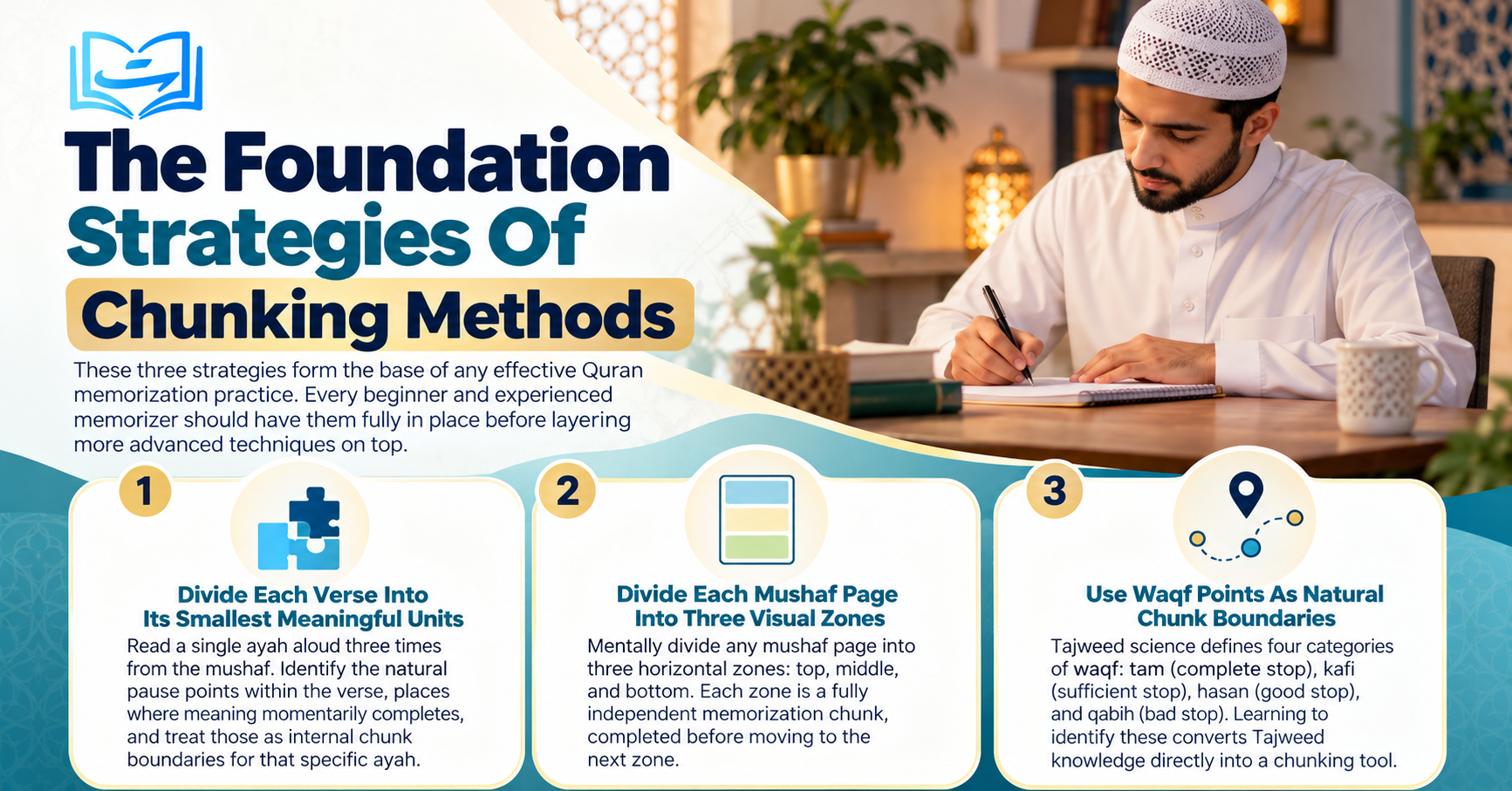
2. Divide Each Mushaf Page Into Three Visual Zones
Mentally divide any mushaf page into three horizontal zones: top, middle, and bottom. Each zone is a fully independent memorization chunk, completed before moving to the next zone.
This visual chunking strategy uses spatial memory alongside linguistic memory. When recalling a verse later, the brain retrieves both the sound and the approximate visual position on the page, giving you two retrieval pathways instead of one.
Use the same physical mushaf throughout your entire hifz journey. The visual anchor only builds reliable retrieval when the page layout is identical every session.
3. Use Waqf Points As Natural Chunk Boundaries
Tajweed science defines four categories of waqf: tam (complete stop), kafi (sufficient stop), hasan (good stop), and qabih (bad stop). Learning to identify these converts Tajweed knowledge directly into a chunking tool.
Chunk boundaries should fall at waqf tam or waqf kafi points, never mid-phrase.
A chunk ending at a qabih point disconnects the memorized unit from its logical continuation, registering as incomplete in memory and making later recall significantly harder.
Students who have covered Tajweed Rules for Beginners will recognize this connection immediately: correct pause points define where meaning concludes, which is precisely where every chunk boundary belongs.
Experience Our Interactive Learning
Curious about how we teach? Watch these brief video clips from our recent live sessions to see our structured curriculum, advanced learning platform, and dynamic student-teacher interactions firsthand.
Start Your Quran Learning Journey
Join Tabark Academy today for structured online lessons with qualified tutors, customized to fit your goals.
Book Your Free Trial LessonThe Intermediate Techniques Of Chunking Methods
Once the foundation is solid, these three methods add both depth and speed to the memorization process. They work best after a consistent daily routine with the first three strategies is already firmly established.
Students who have been memorizing for some time but find their retention unstable will benefit most here. These techniques address the root cause of fragile memory in ways that increased repetition alone cannot resolve.
1. Apply The Thematic Block Method For Narrative Passages
Group consecutive ayahs sharing a single thematic thread into one memorization block. In Surah Al-Kahf, the story of the People of the Cave runs from ayah 9 to ayah 26; memorize that narrative arc as a unified story, not 18 isolated verses.
This works because narrative structure provides built-in sequential cues. Once you know what happens next in the story, you know which ayah follows; content-based retrieval is far more stable than sequence-based retrieval alone.
Understanding thematic shifts in the Quran becomes significantly clearer with foundational Arabic, since transition phrases signaling a new theme are visible only in the original text and lost entirely in translation.
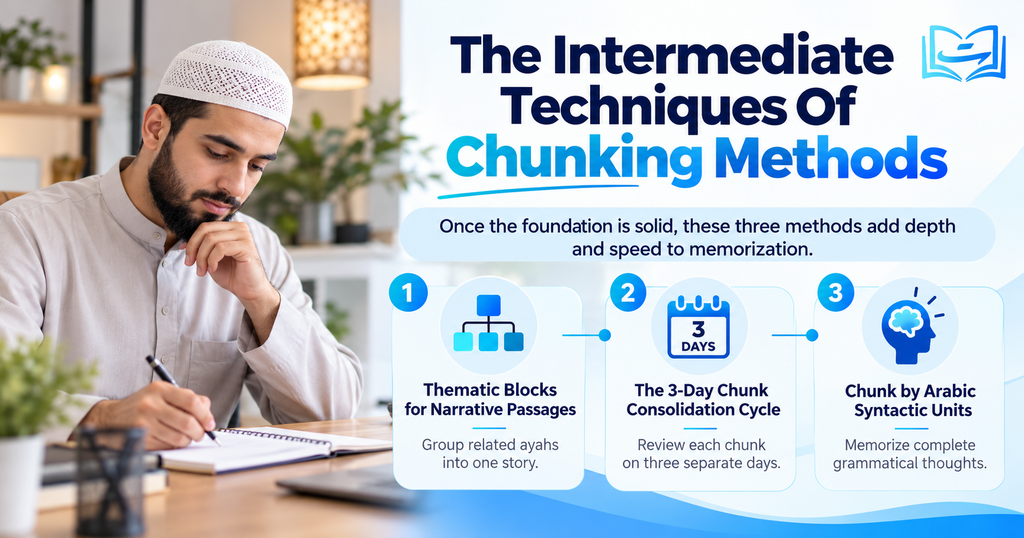
2. Implement The 3-Day Quran Chunk Consolidation Cycle
New memorization is most vulnerable during the first 72 hours. This cycle treats each chunk as unconfirmed until it has been reviewed successfully on three separate days, with at least one night’s sleep between each review.
Day 1: memorize to fluency. Day 2: recite cold at the very start of your session before reviewing anything else. Day 3: recite cold again, then integrate it with the chunks immediately before and after.
Most students who feel they forget quickly are simply advancing before Day 3 review is complete.
For a parallel revision framework, strategies to revise memorized Quran helps sustain both old and new material simultaneously without doubling session length.
3. Chunk By Arabic Syntactic Units For Grammatical Precision
Every Arabic sentence in the Quran is built from a mubtada (subject) and khabar (predicate), or a fi’l (verb) and its fa’il (doer). These complete syntactic units make ideal chunk boundaries because they align exactly with complete thoughts.
“إِنَّ الْمُتَّقِينَ فِي جَنَّاتٍ وَنَهَرٍ” (Al-Qamar, 54:54), meaning “Indeed, the righteous will be in gardens and rivers,” is a single mubtada-khabar structure; one grammatical chunk, one complete unit of meaning.
Even foundational Arabic study pays direct dividends here. Students who invest in learning the Learn Arabic Language path and apply grammar awareness to their memorization sessions consistently report that individual verses become logical units rather than arbitrary sequences of sound.
Tabarak Academy integrates this Arabic-to-memorization connection across its hifz programs, giving students the language comprehension and the Quranic application together in one structured curriculum.
Begin Your Hifz for Sisters Journey With Tabarak Academy Now

The Long-Term Retention System Of Chunking Methods
The final three strategies convert chunked memorization from short-term fluency into permanent, retrievable hifz. These are what separate students who complete their memorization from those who plateau halfway through.
Students in Malaysia, Bahrain, Egypt, Germany, and across the broader Muslim diaspora who manage hifz alongside work, university, or family responsibilities will find these strategies especially practical for building systems that actually hold over years.
1. Build A Three-Pool Chunk Review Timetable
Divide all memorized material into three review pools: fresh (memorized within the last 2 weeks), consolidating (2 to 6 weeks old), and secured (older than 6 weeks). Each pool follows a distinct review cadence; daily, every 3 days, and weekly respectively.
Review fresh chunks at the start of every session before new memorization begins. Move a chunk to “consolidating” only after it passes without hesitation across three consecutive sessions.
A well-structured best revision schedule for hifz makes this three-pool timetable sustainable without significantly increasing total daily practice time.
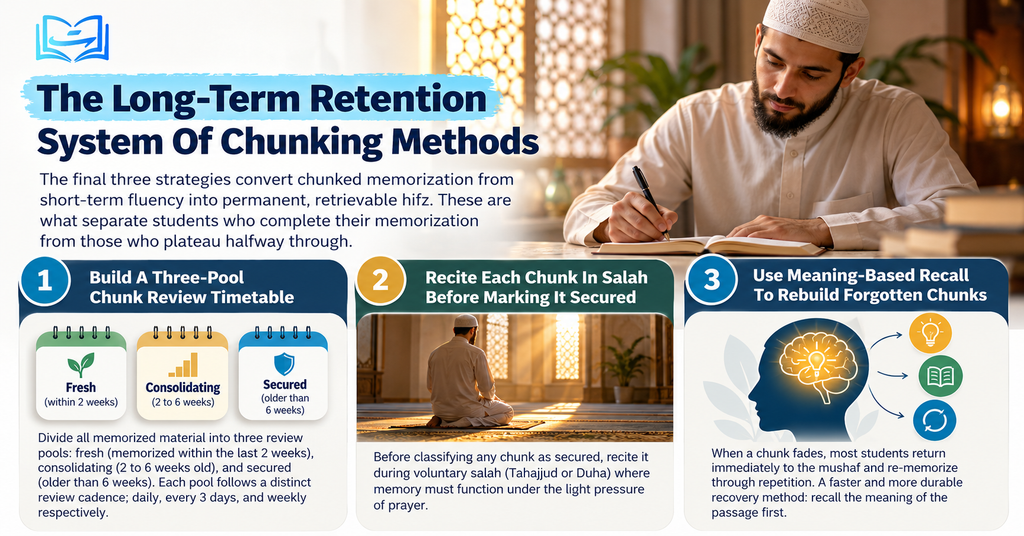
2. Recite Each Chunk In Salah Before Marking It Secured
Before classifying any chunk as secured, recite it during voluntary salah (Tahajjud or Duha) where memory must function under the light pressure of prayer. This stress-test reveals genuine retention, distinct from the assisted recall of a structured review session.
If you hesitate or substitute a word, return that chunk to the fresh pool immediately. If it flows with full confidence through three separate prayer sessions, classify it as consolidating and proceed.
For sisters seeking structured support for this approach, Quran Hifz Classes for Sisters provide both the systematic method and the long-term accountability that makes this practice truly sustainable.
3. Use Meaning-Based Recall To Rebuild Forgotten Chunks
When a chunk fades, most students return immediately to the mushaf and re-memorize through repetition. A faster and more durable recovery method: recall the meaning of the passage first.
Ask yourself what the passage is about, what scene it describes, and what Allah addresses in those specific ayahs. Once the meaning is active in your mind, the Arabic text often follows; the semantic pathway retrieves the phonological form without forcing it.
This is the clearest practical demonstration of why Arabic comprehension fundamentally changes the nature of hifz. If you frequently lose previously secured sections, reading about why do I forget what I memorize of the Quran helps identify whether the root cause is method, review schedule, or something else entirely.
Step Inside Our Virtual Classrooms
See our engaging teaching methods in action! watch real snippets of our live classes and discover how our expert instructors make learning interactive, memorable, and inspiring for every student.
Start Your Quran Learning Journey
Join Tabark Academy today for structured online lessons with qualified tutors, customized to fit your goals.
Book Your Free Trial LessonStart Your Hifz Journey With A Method That Actually Holds
Hifz built on the chunking method is hifz that lasts. Every strategy in this guide is designed not just to help you memorize faster but to help you remember longer, with less revision effort and greater confidence in salah.
Tabarak Academy brings these principles into structured, live one-on-one sessions with certified instructors, combining personalized chunking plans, Tajweed correction, and Arabic comprehension in one complete curriculum.
Explore Tabarak Academy’s Courses:
- Hifz for Kids Course
- Arabic Reading Course
- Hifz Ijazah Course
- Hifz for Adults Course
- Online Hifz Program
- Quran Recitation Course
- Weekend Quran Classes
- Zoom Quran Classes
Book Your Free Trial Class Today and Learn How Structure Transforms Every Repetition

Conclusion
The chunking method for Quran memorization is not a shortcut; it is a smarter application of how memory actually works. By dividing Quranic text into deliberate, meaning-anchored units, mastering each one completely, and chaining them through regular review, students build a hifz that holds under the real pressures of daily life and prayer.
The Arabic comprehension thread running through these 9 strategies is not coincidental. When you understand what you memorize, you encode it on two levels simultaneously, making each chunk not just a sound pattern to rehearse but a living meaning to carry.
That shift, from reciting to understanding, is where hifz becomes something you own rather than something you borrow until the next forgetting.
Whether you are beginning your first juz or rebuilding after a long break, the chunking method for Quran memorisation offers a systematic and proven path forward.
Begin with precision, build with consistency, and let understanding do what repetition alone never can.
Frequently Asked Questions
What Is The Chunking Method For Quran Memorization?
The chunking method for Quran memorization is a structured approach that divides Quranic text into small, defined units, each mastered before moving to the next.
It works because human working memory processes compact, meaningful units more efficiently than long, unbroken sequences of text.
How Many Verses Should I Include In Each Chunk?
The ideal chunk size depends on verse length and your daily capacity. For shorter verses, 2 to 5 ayahs per chunk is a practical starting range.
For longer verses, dividing a single ayah into 2 to 3 segments at natural pause points is far more effective than forcing multiple long verses together.
Can The Chunking Method For Quran Memorisation Work For Adults With No Prior Experience?
Yes. The chunking method for Quran memorisation works particularly well for adult beginners because it removes the pressure of open-ended memorization and replaces it with a clear, achievable daily target.
Starting small and building progressively is the method’s core design, and that suits adult learners especially well.
Does Learning Arabic Genuinely Improve Quran Memorization?
Learning Arabic activates semantic chunking, meaning your memory encodes both the sound and the meaning of what you memorize at the same time.
Students with Arabic comprehension self-recover from forgotten chunks faster, identify natural chunk boundaries more accurately, and retain material under pressure far more reliably than those relying on sound alone.
How Long Does It Take To Memorize One Juz Using The Chunking Method?
Timeline depends on daily session length and review consistency. At 2 to 5 ayahs per day with diligent three-pool review, one juz typically takes 3 to 6 months.
Increasing daily output to a full page with consistent review can reduce this to 6 to 10 weeks without sacrificing retention quality.
What Should I Do When I Forget A Chunk I Already Secured?
Before returning to the mushaf, try to recall the meaning of the passage first. Ask yourself what the verses describe or what they address.
Because meaning retrieval often unlocks phonological memory, this method frequently restores the chunk faster than visual re-reading.