


Difference Between Ijazah And Sanad – A Clear Guide For Quran Students
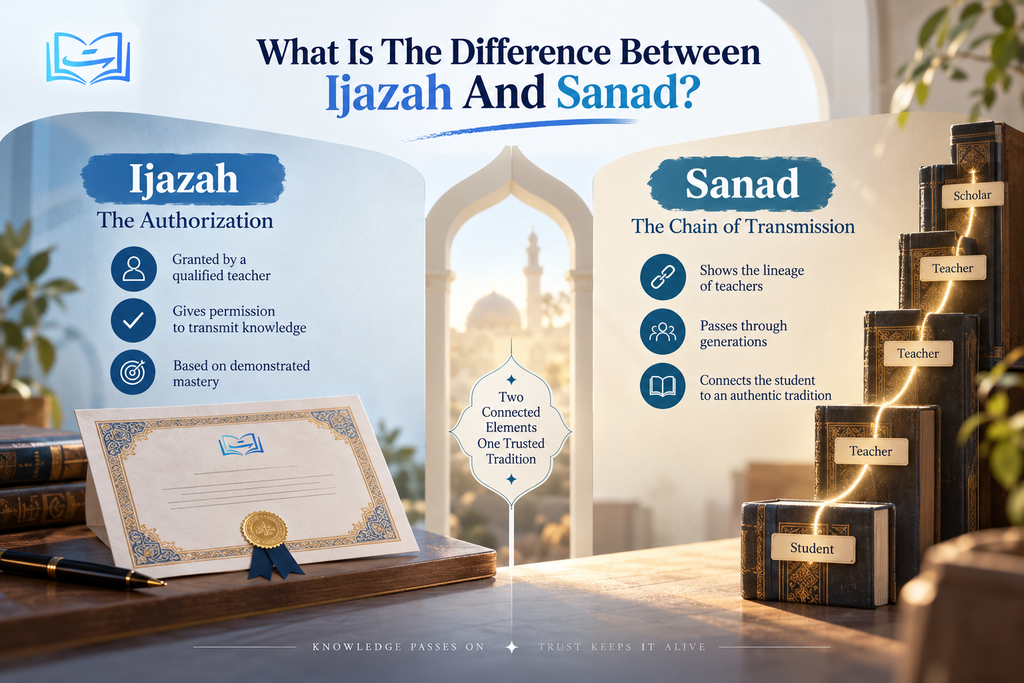
The main difference between Ijazah and Sanad is that an Ijazah is the authorization a qualified teacher grants to a student, while a Sanad is the chain of transmission associated with the knowledge or recitation being transmitted.
The two terms frequently appear together in Quran education, which is why students can easily assume they mean the same thing. In reality, each describes a different part of the traditional process of learning and transmitting Quran recitation.
For students considering advanced Quran study with Tabarak Academy, understanding this distinction is particularly useful before pursuing an Ijazah pathway. It helps you know what you are studying toward, what your teacher is assessing, and what the final authorization represents.
By the end of this guide, you will understand not only the terminology but also how Ijazah and Sanad work together in practical Quran learning.
What You Will Learn In This Article:
- Ijazah means authorization or permission.
- Sanad refers to a chain of transmission.
- The two concepts are connected but not interchangeable.
- An Ijazah should have a clearly defined scope.
- Students should verify both the teacher and authorization pathway.
What Is The Difference Between Ijazah And Sanad?
The difference between Ijazah and Sanad becomes much easier to understand when you separate permission from transmission. An Ijazah concerns authorization; a Sanad identifies the transmission chain behind the knowledge being passed on.
Ijazah Is The Authorization
An Ijazah (إجازة) is, broadly, an authorization or permission granted by someone qualified to transmit the relevant knowledge. In Quranic study, it is associated with a teacher authorizing a student after the student has demonstrated the required standard of recitation or memorization.
It should therefore not be understood merely as a decorative certificate received after attending classes. The important element is the teacher’s authorization and the defined material, recitation, or pathway for which that authorization has been given.
Academic research into Quranic Ijazah traditions similarly distinguishes authorization from the chain attached to transmission.
Sanad Is The Chain Of Transmission
A Sanad (سند) is the transmission chain. Rather than describing the permission itself, it identifies the sequence through which transmitted knowledge has passed from teacher to student across generations.
In the context of Quran recitation, this means the student does not view learning as an isolated achievement. Their teacher learned through teachers before them, creating a traceable scholarly lineage of transmission.
This is a central part of the difference between Ijazah and Sanad: one concerns authorization, while the other concerns lineage.
In Quranic transmission, the Sanad provides a documented chain connecting a student to their teacher and, through successive generations of teachers, to the established tradition of Quran recitation.
For a clear academic perspective on the transmission lineage, you can review Britannica’s entry on isnad.
Ijazah And Sanad Compared Side By Side
Because the terms are so closely connected, people sometimes use phrases such as “Ijazah with Sanad.” That wording helps illustrate the relationship: the student receives authorization while the Sanad documents the transmission lineage associated with it.
The distinction matters especially when evaluating a Quran program. Asking only whether you will receive “a certificate” does not tell you enough about the qualification, its scope, the teacher granting it, or the chain it represents.
Here is the difference between Ijazah and Sanad at a glance:
| Point | Ijazah | Sanad |
| Basic Meaning | Authorization or permission | Chain of transmission |
| Main Purpose | Authorizes transmission within a defined scope | Documents the transmission lineage |
| Connected to a Teacher | Yes | Yes |
| Focus | Permission and demonstrated mastery | Teacher-to-teacher transmission |
| Ordinary Course Certificate? | No | No |
| Relationship | Can be granted with a documented Sanad | Supports the transmission behind the Ijazah |
Read also: How to Get Ijazah? A Complete Step-by-Step Guide
Experience Our Interactive Learning
Curious about how we teach? Watch these brief video clips from our recent live sessions to see our structured curriculum, advanced learning platform, and dynamic student-teacher interactions firsthand.
How Ijazah And Sanad Work Together In Quran Learning
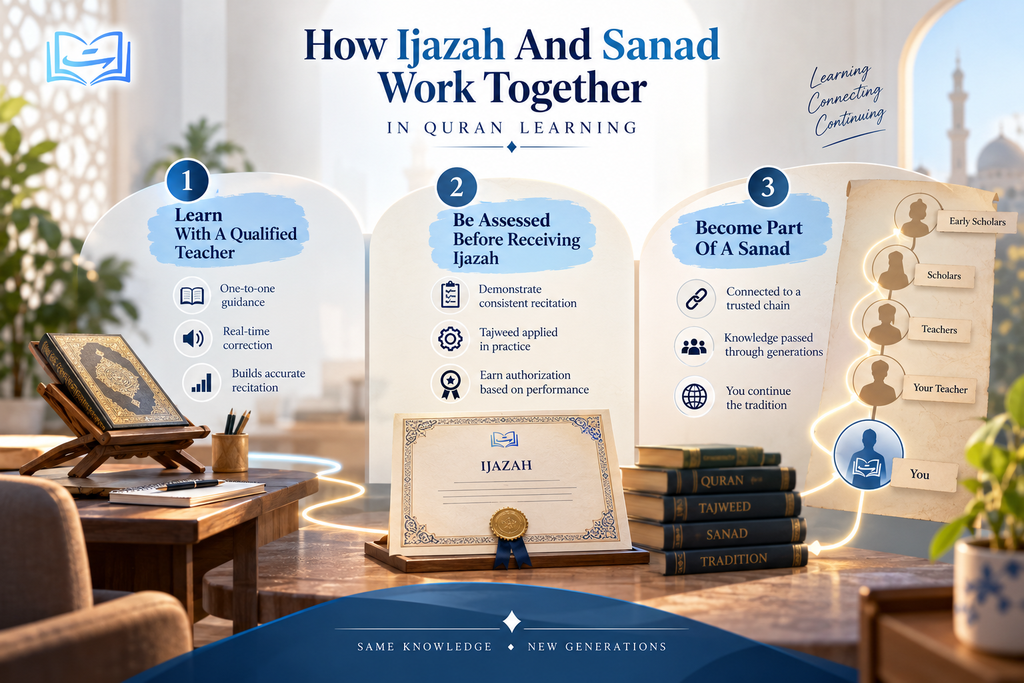
Knowing the definitions is useful, but understanding the learning process makes the difference between Ijazah and Sanad much clearer. Traditional Quran authorization is fundamentally connected with direct learning, correction, assessment, and transmission.
1. The Student Learns Directly From An Authorized Teacher
Quran recitation is an applied skill. A learner may understand Tajweed terminology perfectly yet still pronounce a letter incorrectly, shorten a Madd, mishandle Ghunnah, or make subtle mistakes during continuous recitation.
Direct instruction allows the teacher to hear these details and correct them as they occur. This teacher-student interaction is especially important at Ijazah level, where the objective goes beyond becoming a generally competent reader.
For learners who are ready to pursue formal authorization, Tabarak Academy’s Online Ijazah Course provides a dedicated pathway that includes advanced Tajweed correction, complete Quran recitation, assessment, and Sanad documentation.
This makes it especially relevant for students who already have a strong recitation foundation and want to progress toward Ijazah rather than begin Quran study from scratch.

2. The Teacher Assesses The Student Before Granting Ijazah
An Ijazah is not supposed to result automatically from attending a predetermined number of lessons. The teacher must determine whether the learner has reached the required standard for the specific authorization being pursued.
Assessment may therefore involve sustained recitation and detailed correction rather than a simple written examination. Tajweed needs to be demonstrated consistently in actual recitation rather than merely explained theoretically.
This distinction protects the meaning of Ijazah. The authorization reflects demonstrated performance assessed by an appropriately authorized teacher, rather than simply confirming participation in a course.
3. The Student Becomes Connected To A Sanad
Once the appropriate requirements are successfully fulfilled and the teacher grants authorization with a connected chain, the learner becomes part of that documented transmission lineage.
This illustrates why asking about the difference between Ijazah and Sanad should not lead students to think they must choose between them. They perform different but complementary functions within the same broader tradition.
The Ijazah tells you about the authorization being granted. The Sanad tells you about the chain through which the relevant transmission reaches the student.
Recommended reading: What To Do When You Feel Like Giving Up Hifz?
What Does A Quran Ijazah Actually Certify?
Not every Quran Ijazah necessarily describes the same accomplishment. Before pursuing one, students should understand exactly what is being authorized and what they are expected to demonstrate.
1. Ijazah In Quran Recitation
An Ijazah in recitation focuses on the student’s ability to recite accurately according to the requirements of the particular recitation pathway. Correct pronunciation and practical Tajweed application are central to this process.
The teacher listens carefully over an extended period, correcting weaknesses that may have remained unnoticed during ordinary study. Small recurring errors matter because the goal is consistent precision.
The particular Riwayah or recitation covered should also be clear. Students should never assume that one authorization automatically encompasses every form of Quranic recitation.
Students who are interested in Ijazah but still need to refine recurring Tajweed or pronunciation errors may benefit from preparing at an advanced level first.
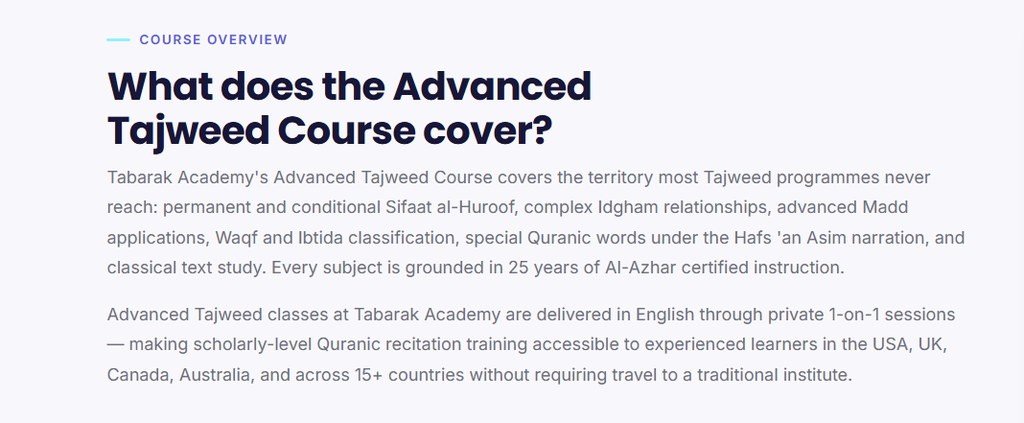
Tabarak Academy’s Advanced Tajweed Course is designed for experienced Quran readers, Huffaz, and learners who already recite fluently but need greater precision before progressing toward higher-level Quran certification.
Read also: Ijazah in Hafs ‘an ‘Asim: Requirements & How to Earn
2. Ijazah In Quran Memorization
A memorization Ijazah involves demonstrating accurate Quran recitation from memory according to the requirements established by the authorizing teacher.
This makes strong Muraja’ah essential. Memorizing the complete Quran is a major achievement, but an Ijazah pathway requires the learner to demonstrate reliable retention alongside accurate recitation.
Tabarak Academy’s Ijazah pathway distinguishes between recitation and Hifz preparation, allowing advanced learners to work toward the authorization appropriate to their Quran background and goals.
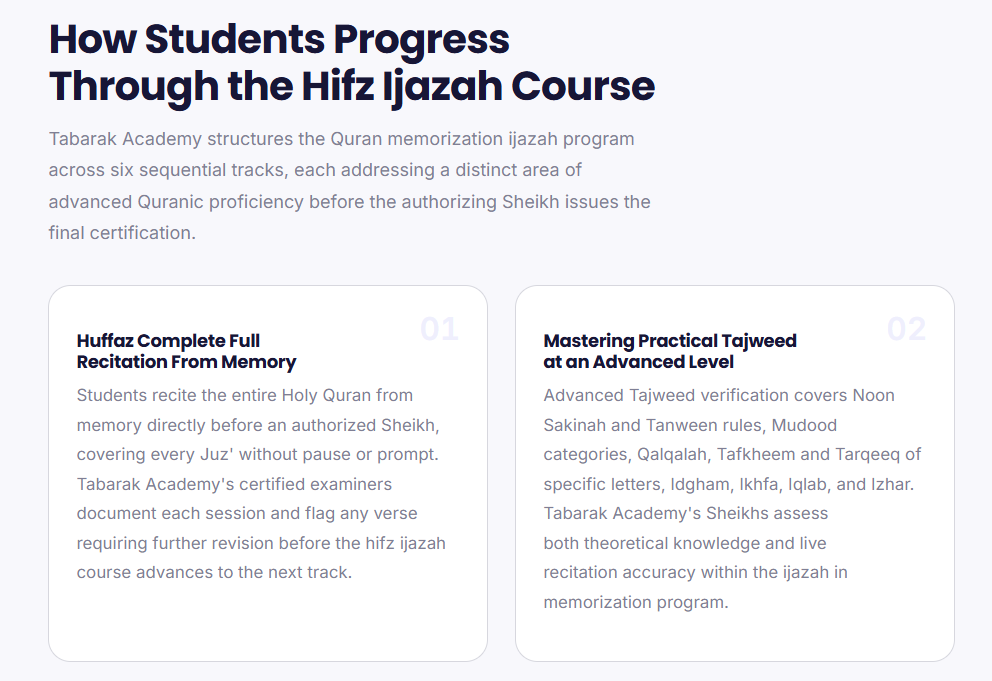
For Huffaz who have already memorized the complete Quran, Tabarak Academy’s Hifz Ijazah Course provides a dedicated route toward certification in memorization.
Students recite the Quran from memory before authorized teachers while their Tajweed, Makharij, memorization accuracy, and consistency are carefully assessed before the final Ijazah and documented Sanad are granted.
Read also: Understanding Sanad in Hifz: Meaning and Requirements
3. Ijazah Is Different From A General Course Certificate
A completion certificate can confirm that someone finished a program. An Ijazah represents a different concept because it involves authorization from a qualified teacher within a defined scholarly transmission framework.
Students should therefore avoid treating terms such as “certificate,” “Ijazah,” and “Sanad” as interchangeable marketing labels. Ask exactly what document is being issued and what it signifies.
Understanding this distinction is one of the most practical benefits of learning the difference between Ijazah and Sanad before choosing an advanced Quran program.
If you are still building the recitation skills required before advanced certification, there is no need to rush toward Ijazah.
Tabarak Academy’s Learn Quran with Tajweed Course helps learners strengthen Makharij, foundational Tajweed rules, and practical Quran recitation first, creating a stronger foundation before they consider progressing toward an Ijazah-level assessment.

How To Check An Ijazah And Sanad Before Enrolling
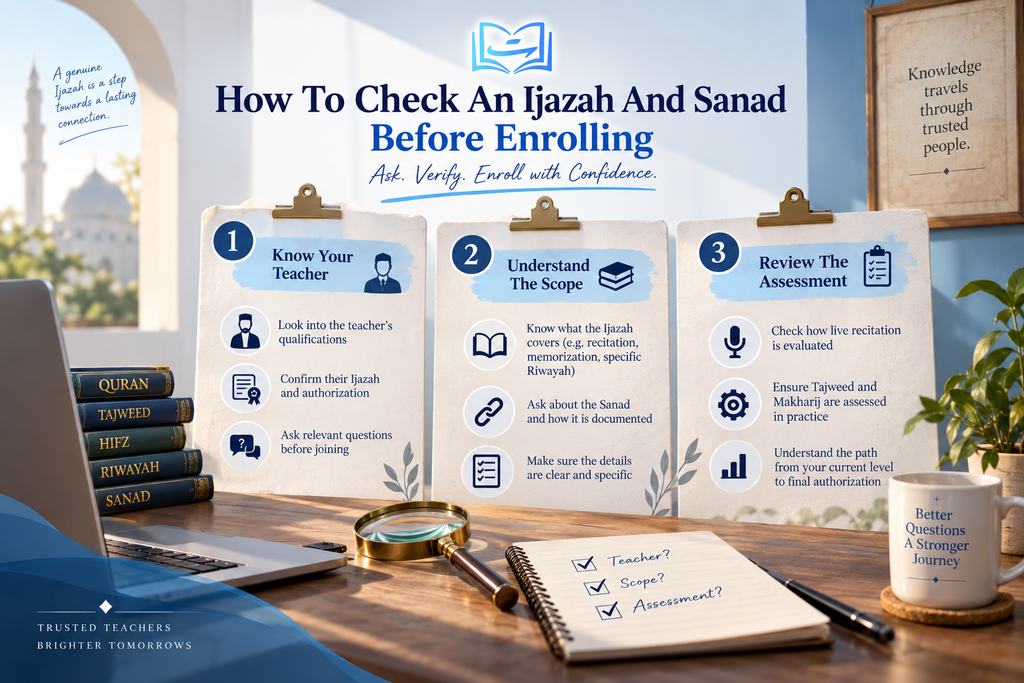
A serious student should look beyond the promise of receiving a certificate. The teacher, scope, chain, assessment, and recitation pathway all deserve attention.
1. Check Who Will Grant The Ijazah
Start by asking who actually grants the authorization. A general institutional certificate and a teacher’s scholarly authorization are not automatically the same thing.
You should understand the teacher’s relevant Ijazah and whether that teacher is authorized within the specific recitation or memorization pathway you intend to pursue.
This question becomes especially important online, where phrases such as “certified teacher” can describe several different types of qualifications.
2. Check What The Ijazah Covers
Ask whether the Ijazah covers Tilawah, Hifz, a particular Riwayah, or another clearly defined area. An impressive-looking document is less useful if you do not understand what it actually authorizes.
You should also ask about the accompanying Sanad and how the transmission chain is documented. This brings the difference between Ijazah and Sanad into a practical context.
Clear documentation allows students to understand both sides: what they have been authorized to transmit and the transmission lineage associated with that authorization.
Learners who are not yet sure whether they are ready for advanced Ijazah study can begin by strengthening their overall recitation through Tabarak Academy’s Online Quran Classes.
Private one-to-one instruction allows the tutor to identify the student’s current level, correct Tajweed and pronunciation weaknesses, and build the Quran skills needed for more advanced study rather than pushing the learner prematurely toward certification.
3. Ask About The Assessment Process
Find out how much live recitation is required and what happens when mistakes are identified. A serious pathway should allow enough interaction for recurring weaknesses to be detected and corrected.
Ask whether Tajweed and Makharij are evaluated practically rather than only through theoretical questions. Students pursuing Hifz authorization should likewise understand the memorization assessment requirements.
Transparency matters. Before enrolling, you should be able to understand the pathway from your current level to final assessment rather than simply being promised an Ijazah at the end.
Don’t miss: How to Stay Consistent With Quran Memorization?
Your Trusted Path to Quranic Certification With Tabarak Academy
Understanding the difference between Ijazah and Sanad is only the first step. Reaching an Ijazah-ready level requires accurate recitation, consistent Tajweed, careful correction, and direct guidance from a qualified teacher.
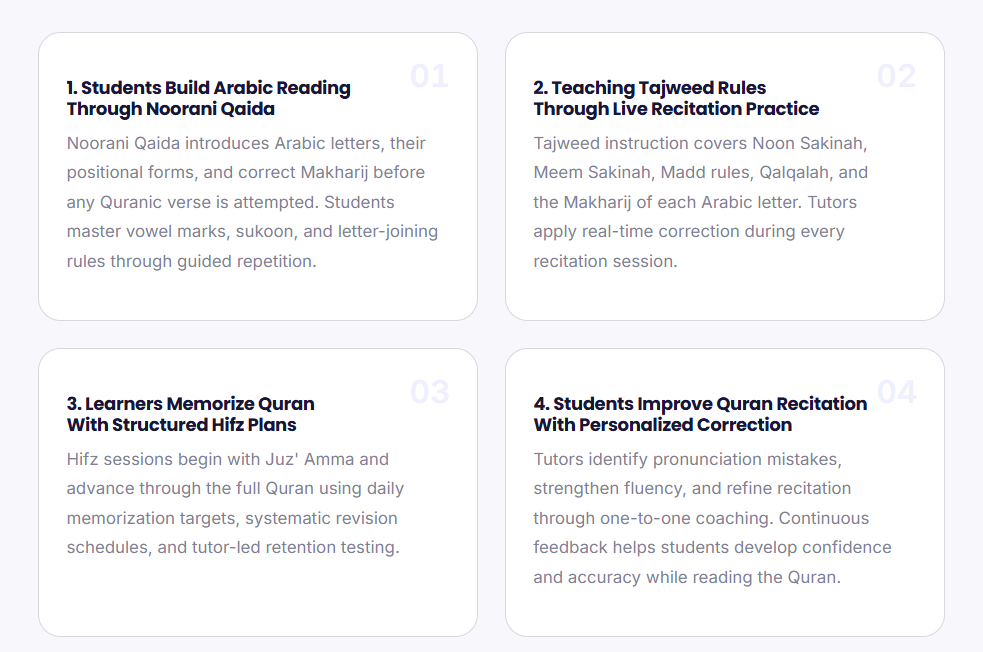
Tabarak Academy provides one-to-one instruction that allows teachers to focus on each learner’s Makharij, Tajweed, fluency, and recurring recitation mistakes. This personalized approach helps students strengthen the specific skills they need before moving toward formal assessment.
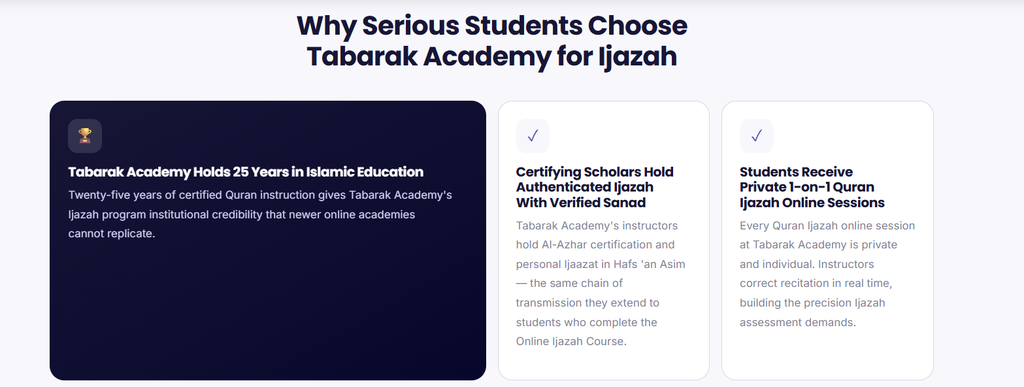
For advanced learners, Tabarak Academy’s Online Ijazah Course provides a structured pathway through teacher-led recitation, correction, assessment, and Sanad verification. The focus is not simply on receiving a certificate, but on developing the accuracy required to earn an Ijazah with confidence.
Step Inside Our Virtual Classrooms
See our engaging teaching methods in action! watch real snippets of our live classes and discover how our expert instructors make learning interactive, memorable, and inspiring for every student.
Take The Next Step Toward Your Quran Ijazah!
If your Quran recitation is already strong and you want to know whether you are ready for Ijazah, the most useful next step is an individual assessment. It can reveal whether you are ready to begin formal recitation or whether specific Tajweed and Makharij areas need strengthening first.
Tabarak Academy offers one-to-one instruction with qualified Quran teachers and a structured Ijazah pathway for advanced learners. The academy also provides a free trial, giving you an opportunity to experience the teaching approach before committing.
Book your free trial with Tabarak Academy and begin working toward an authenticated Quran Ijazah with a verified Sanad.
Our Quran Courses
- Online Quran Classes
- Online Quran Classes for Beginners
- Online Quran Classes for Kids
- Online Quran Classes for Adults
- Online Quran Classes for Men
- Online Quran Classes for Sisters
- Quran Reading Course
- Quran Recitation Course
- Online Ijazah Course
- Online Qirat Course
- Quran for Toddlers / Young Children
- Weekend Quran Classes
- Intensive Quran Course
- Al-Azhar Quran Course
- Zoom Quran Classes
- Noor Al-Bayan Course

Conclusion
The difference between Ijazah and Sanad becomes clear once you understand the role of each.
An Ijazah is the authorization granted by a qualified teacher after a student demonstrates the required level of recitation or memorization, while a Sanad is the documented chain of transmission connecting that learning through successive teachers. They are closely related, but they are not interchangeable terms.
For Quran students, this distinction is important when evaluating an Ijazah program. Rather than focusing only on receiving a certificate, check who grants the authorization, what the Ijazah covers, how the Sanad is documented, and what level of recitation, Tajweed, or memorization must be demonstrated before it is granted.
Ultimately, both Ijazah and Sanad reflect a learning process built around direct instruction, correction, assessment, and transmission.
Understanding their different roles helps you approach advanced Quran study with clearer expectations and focus on what matters most: developing accurate, consistent recitation before pursuing formal authorization.
Frequently Asked Questions
Does Ijazah Mean Degree?
No. An Ijazah is traditionally an authorization to transmit or teach specific knowledge, rather than an academic degree in the modern university sense. For Quran students, its meaning and scope depend on what the qualified teacher has specifically authorized.
What Is An Ijazah Certificate?
An Ijazah certificate documents that a qualified teacher has granted a student authorization in a specified area, such as Quran recitation or memorization. Students pursuing this level can prepare through Tabarak Academy’s structured Ijazah learning and assessment pathway.
What Does “Sanad” Mean?
“Sanad” literally carries the sense of support or authority, while in Islamic scholarly contexts it commonly refers to a chain through which knowledge is transmitted. In Quran learning, it can document the succession of teachers through whom a particular recitation has been transmitted.
What Does “Ijazah” Mean In English?
“Ijazah” is commonly translated into English as “authorization,” “permission,” or “license,” depending on the scholarly context in which it is used. For Quran students, “authorization” often communicates the concept more accurately than simply translating Ijazah as “certificate.”
What Is Called Sanad In English?
Sanad is commonly rendered in English as a “chain of transmission” or “chain of authorities” when discussing Islamic scholarly traditions. Tabarak Academy helps advanced Quran students understand the role of this chain as they prepare for Ijazah and Sanad verification.
What Is The Difference Between Sanad And Isnad?
Sanad generally refers to the chain of transmitters itself, while isnad refers more precisely to attributing or tracing transmitted material through that chain. The terms are nevertheless closely related and are sometimes used interchangeably depending on the scholarly context.