

Is Tajweed Obligatory? A Clear Answer for Quran Learners
Is tajweed obligatory, or is it simply a recommended way to make Quran recitation sound more beautiful? This is one of the most common questions among new and intermediate Quran students, especially non-Arabic speakers learning to read the Quran for the first time.
The honest answer is that scholars have discussed this question for centuries, and the ruling is more nuanced than a simple yes or no.
Understanding the difference between the obligatory core of correct pronunciation and the recommended refinements of tajweed will change how you approach your own recitation.
This article explains what tajweed actually is, the two main scholarly positions on its ruling, the recitation mistakes every Muslim must avoid, and how you can start reciting the Quran correctly, even as a complete beginner.
What You Will Learn?
- The exact meaning of tajweed and the reason it exists as a science.
- Whether tajweed is a personal obligation (fard ayn), a communal obligation (fard kifayah), or simply recommended (mustahabb).
- The difference between lahn jali (clear errors) and lahn khafi (hidden errors) in recitation.
- What scholars such as Ibn Baz, Ibn Uthaymin, and Ibn Al-Jazari said about this ruling.
- Practical steps to start reciting the Quran correctly with proper guidance.
Is Tajweed Obligatory?
Yes, learning enough Tajweed to recite the Quran correctly and avoid clear pronunciation errors is obligatory for every Muslim who recites it. This includes correctly pronouncing Arabic letters and avoiding mistakes that could change a word or its meaning.
However, scholars distinguish this basic responsibility from mastering the full theoretical science of Tajweed. Detailed terminology, classifications, and finer aspects of recitation are not generally treated as an individual obligation for every Muslim, although learning and applying them improves the precision and quality of Quran recitation.
Some scholars have taken a stricter position regarding the application of Tajweed rules, so the issue contains scholarly detail. The practical principle for learners is straightforward: you do not need to become a Tajweed scholar, but you should learn enough to recite the Quran accurately and avoid significant pronunciation mistakes.
What Is Tajweed in Quran Recitation?
Before exploring the ruling in more detail, it helps to understand exactly what tajweed refers to and why Muslim scholars developed it as a distinct science.
The Definition of Tajweed
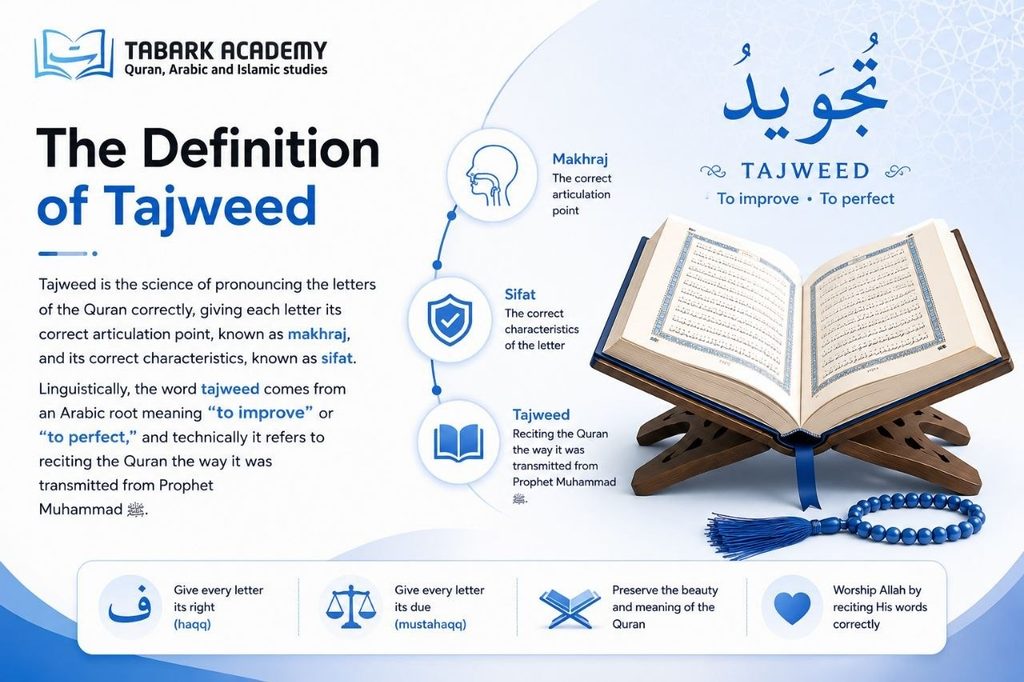
Tajweed is the science of pronouncing the letters of the Quran correctly, giving each letter its correct articulation point, known as makhraj, and its correct characteristics, known as sifat.
Linguistically, the word tajweed comes from an Arabic root meaning “to improve” or “to perfect,” and technically it refers to reciting the Quran the way it was transmitted from Prophet Muhammad ﷺ.
The Purpose of Tajweed
The purpose of tajweed is to protect the meaning of the Quran and preserve the exact way it was passed down from the Prophet ﷺ through an unbroken chain of reciters.
Allah describes this protection directly in the Quran:
إِنَّا نَحْنُ نَزَّلْنَا الذِّكْرَ وَإِنَّا لَهُ لَحَافِظُونَ
“Indeed, it is We who sent down the Qur’an and indeed, We will be its guardian”
Read also: The Ideal Roadmap for Learning Tajweed Step by Step
Tajweed is one of the tools that supports this preservation in oral recitation, since it keeps the sound of the Quran consistent across generations and across different native languages.
Experience Our Interactive Learning
Curious about how we teach? Watch these brief video clips from our recent live sessions to see our structured curriculum, advanced learning platform, and dynamic student-teacher interactions firsthand.
The Two Scholarly Opinions on Whether Tajweed Is Obligatory
Islamic scholars across different eras have held two main positions on this question, and understanding both helps clarify where the real disagreement lies.
1. The View That Tajweed Is Fully Obligatory
Some scholars, most notably Ibn Al-Jazari, held that applying the detailed rules of tajweed is obligatory on every reciter. They based this position on the following verse:
وَرَتِّلِ الْقُرْآنَ تَرْتِيلًا
“And recite the Qur’an with measured recitation”
This school of thought reads the command to recite “with tartil” as a binding instruction rather than a mere suggestion.
Ibn Al-Jazari wrote in his famous poem on tajweed that whoever does not correct the Quran according to these rules is sinful, reflecting how seriously this position treats precise recitation.
2. The View That Tajweed Is Recommended, Not Obligatory
Other scholars, including Sheikh Ibn Baz and Sheikh Ibn Uthaymin, held that the detailed rules found in tajweed books are recommended rather than obligatory.
Ibn Uthaymin explained that tajweed is only an improvement of pronunciation, and that declaring someone sinful for not applying every detailed rule lacks clear supporting evidence.
Under this view, the only strict requirement is pronouncing the letters correctly enough that no letter is confused with another and no mistake changes the meaning of the verse being recited.

What Is Actually Required From Every Reciter?
Regardless of which scholarly opinion a person follows, there is agreement on one essential point: certain mistakes in recitation are never acceptable for someone capable of avoiding them.
a. Fard Kifayah – Learning the Science of Tajweed
Learning the detailed rules of tajweed as an academic science is a communal obligation, known as fard kifayah, rather than a personal one. This means the Muslim community as a whole must have qualified teachers and scholars who preserve this knowledge, but it is not required that every individual Muslim study tajweed theory in depth.
b. Fard Ayn – Reciting Without Distorting Meaning or Structure
Correcting your pronunciation enough to avoid changing a word’s meaning or structure is a personal obligation, known as fard ayn, on every Muslim who recites the Quran.
For example, confusing similar-sounding letters in words like the following changes the meaning entirely:
مَّسْطُورًا “inscribed / written in a line” (Surah Al-Isra, 17:58)
مَّسْتُورًا “hidden / concealed” (Surah Al-Isra, 17:45)
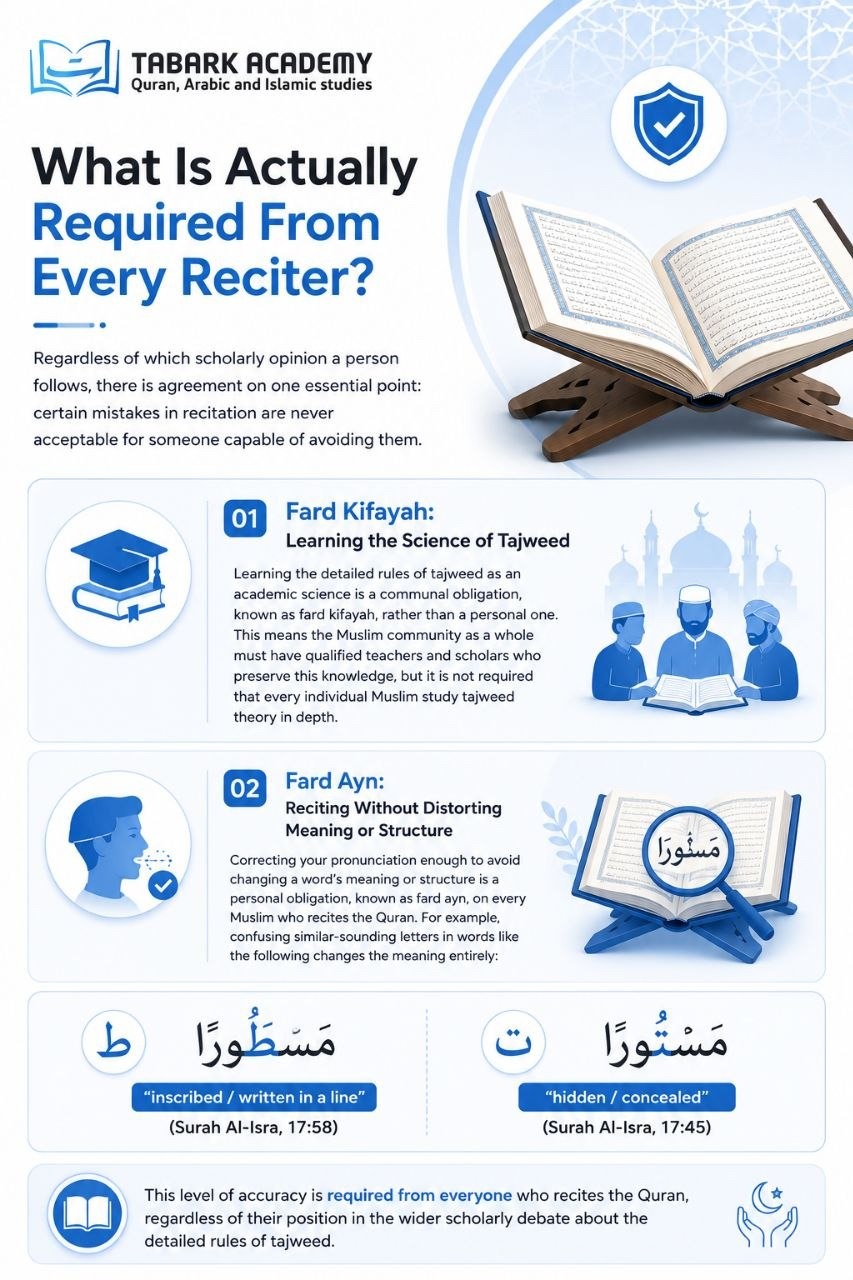
This level of accuracy is required from everyone who recites the Quran, regardless of their position in the wider scholarly debate about the detailed rules of tajweed.
Read also :How Long Does It Take to Master Tajweed?
The Types of Recitation Errors
Scholars of tajweed classify recitation mistakes, known as lahn, into categories that explain why some errors carry more religious weight than others.
1. Lahn Jali – Clear, Obvious Errors
Lahn jali is a clear mistake that changes the structure or pronunciation of a word, such as swapping one letter for another or mispronouncing a vowel. This type of error is not excused for a person capable of correcting it, since it can be avoided with basic learning and consistent practice.
2. Lahn Khafi – Subtle, Hidden Errors
Lahn khafi is a subtle mistake that does not change the letter itself but affects finer details described in tajweed books, such as shortening a required elongation or dropping a nasal sound.
Scholars differ on how strictly to treat this category, with simpler hidden errors generally worth correcting, while extremely subtle ones, noticeable only to expert reciters, are excused for average learners.
Many learners only discover these hidden pronunciation mistakes once a certified teacher listens to their recitation directly and corrects it in real time, which is one of the main reasons dedicated Quran classes remain valuable even for reciters who already read fluently.
Why Learning Tajweed Still Matters, Even When It Isn’t Fully Obligatory
Even scholars who consider the detailed rules of tajweed recommended rather than obligatory still describe it as the ornament of recitation, and they encourage every Muslim to pursue it for the sake of excellence in worship.
The Prophet ﷺ said, “Beautify the Qur’an with your voices,” as narrated by Abu Dawud, showing that improving one’s recitation carries real spiritual reward beyond the bare minimum requirement.
Learning tajweed properly also protects a reciter from lahn jali, the clear errors that are never excused, since a structured course teaches correct pronunciation from the very first lesson instead of leaving it to guesswork.
This kind of guided, letter-by-letter correction is exactly what a qualified Quran teacher, such as those at Tabarak Academy, can offer through live, one-on-one online sessions for children, adults, and families.
Step Inside Our Virtual Classrooms
See our engaging teaching methods in action! watch real snippets of our live classes and discover how our expert instructors make learning interactive, memorable, and inspiring for every student.

Start Reciting the Quran Correctly With Tabarak Academy
Tabarak Academy offers live, one-on-one online Quran and tajweed classes for children, adults, and families around the world, taught by qualified instructors who correct your pronunciation letter by letter in real time.
Watch a real life at our academy:
Free Tajweed Maqra -Sura Al-Nisaa
Whether you are just learning the Arabic alphabet or refining advanced tajweed rules, a structured class with direct, personal feedback is the fastest way to move from uncertain guesswork to confident, correct recitation.
Our Tajweed Courses
- Online Tajweed Classes
- Tajweed Course for Beginners
- Tajweed Course for Kids
- Tajweed Course for Adults
- Tajweed Course for Sisters
- Advanced Tajweed Course
- Amali (Practical) Tajweed Course
- Learn Quran with Tajweed
- Learn Quran with Tajweed for Kids
- Learn Quran with Tajweed for Sisters
Stop searching. Start reciting. Book your free lesson with a certified teacher today.

Conclusion
Correcting your pronunciation enough to preserve a word’s meaning and structure is a personal obligation on every Muslim who recites the Quran, while mastering the full, detailed rules found in tajweed books is recommended by most scholars and treated as obligatory by others, such as Ibn Al-Jazari.
Either way, tajweed remains the ornament of Quran recitation and a means of following the way the Quran was transmitted from the Prophet ﷺ through an unbroken chain of reciters.
Frequently Asked Questions
Is it a sin to recite the Quran without tajweed?
Reciting the Quran without applying the full, detailed rules of tajweed is not a sin according to most scholars, as long as the letters are pronounced correctly and the meaning of the words is not changed.
It only becomes sinful when a mistake alters the structure or meaning of a word and the reciter is capable of correcting it but does not try to.
What is the difference between fard ayn and fard kifayah in tajweed?
Fard ayn in tajweed refers to the personal obligation on every Muslim to pronounce letters correctly without distorting meaning, while fard kifayah refers to the communal obligation for some Muslims to study and preserve the detailed science of tajweed.
If enough qualified scholars and teachers exist within the community, this second obligation is fulfilled on behalf of everyone else.
Can I recite the Quran in Salah without knowing tajweed?
Yes, a prayer remains valid if the reciter avoids clear errors, known as lahn jali, that change a word’s meaning or structure, even without full mastery of tajweed.
Learning correct pronunciation gradually, ideally with a qualified teacher, is still strongly recommended to improve both the prayer and personal recitation over time.
What did Ibn Al-Jazari say about the ruling of tajweed?
Ibn Al-Jazari held that applying the rules of tajweed is obligatory and that whoever does not correct their Quran recitation according to these rules is sinful, basing this view on the command to recite with tartil in Surah Al-Muzzammil, 73:4.
His position represents the stricter of the two main scholarly opinions on this question.
How can beginners start learning tajweed correctly?
Beginners should start by learning the correct articulation points of the Arabic letters, known as makharij, then move on to basic rules such as noon and meem rulings, before progressing to elongation, or madd, rules.
Working with a qualified teacher who can listen and correct mistakes in real time is the most reliable way to build these skills accurately from the start.
Is tajweed only about beautifying the voice?
No, tajweed is primarily about accurate pronunciation and preserving the correct transmission of the Quran, not simply about having a beautiful voice.
A reciter with a plain voice who applies the rules of tajweed correctly is following the science properly, while a beautiful voice without correct pronunciation does not fulfill the actual purpose of tajweed.