


In What Order Should I Learn Tajweed Rules? A Learning Path for Beginners
Many new Quran students ask the same question: in what order should I learn Tajweed rules so each lesson builds on the last instead of feeling scattered? Jumping between topics at random often leads to confusion and slows down real progress in recitation.
This guide lays out the correct, teacher-recommended sequence for learning Tajweed, starting with the articulation points of the Arabic letters and moving step by step toward advanced rules such as stopping and starting correctly (Waqf and Ibtida).
You will also see how each stage connects to the next, why the order matters for accurate recitation, and how guided practice with a qualified teacher turns memorized rules into correct, natural recitation.
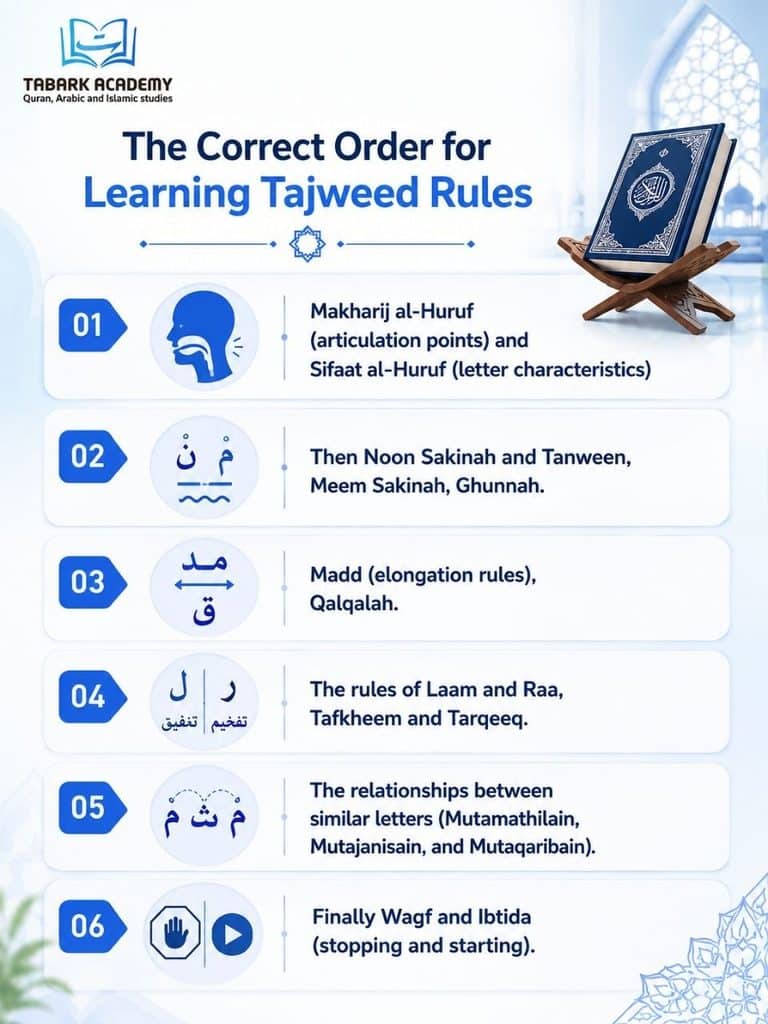
The correct order for learning Tajweed rules is:
- Makharij al-Huruf (articulation points) and Sifaat al-Huruf (letter characteristics)
- Then Noon Sakinah and Tanween, Meem Sakinah, Ghunnah.
- Madd (elongation rules), Qalqalah.
- The rules of Laam and Raa, Tafkheem and Tarqeeq.
- The relationships between similar letters (Mutamathilain, Mutajanisain, and Mutaqaribain).
- Finally Waqf and Ibtida (stopping and starting).
Continuous practice with a teacher runs alongside every stage.
1. Master Makharij and Sifaat to Build Correct Arabic Letter Pronunciation
Makharij al-Huruf is the science of articulation points — the precise location in the mouth, throat, or nasal passage from which each Arabic letter originates.
Sifaat al-Huruf is the companion science of letter characteristics, describing the qualities that accompany each sound, such as whether it is whispered or voiced (Hams and Jahr), whether the airflow stops completely or continues (Shiddah and Rakhawah), or whether the sound resonates through the mouth (Isti’la) or stays low (Istifal).
Together, these two sciences ensure that a student is producing each letter correctly before applying any rule to it. A rule applied to a wrong letter only reinforces the mistake.
For beginners, the most productive focus at this stage is on the letter pairs that are most easily confused by non-native Arabic speakers: س and ص, ت and ط, د and ض, and ذ and ظ. Each pair shares a general sound but differs in where and how it is produced:
- The first of each pair is light.
- The second is heavy and originates deeper in the mouth.
These distinctions are the most common source of mispronunciation among new students, and they are far easier to correct at the start than after years of embedded habit.
Read more about: What is tajweed quran?
A qualified teacher is indispensable at this stage. Articulation points cannot be reliably corrected by ear alone — the student needs live feedback on what their mouth is actually doing, not just what it sounds like to them.

2. Learn Noon Sakinah, Tanween, Meem Sakinah, and Ghunnah for Connected Recitation
Once letters are being produced correctly, the student is ready for the first major set of applied rules.
Learn the Four Rules of Noon Sakinah and Tanween
Noon Sakinah and Tanween govern what happens when a silent Noon (نْ) or a Tanween ending (ـً ـٍ ـٌ) is followed by another letter. There are four distinct outcomes:
- Izhar (clear pronunciation): the Noon is pronounced clearly before the throat letters ء ه ع ح غ خ.
- Idgham (merging): the Noon merges into the following letter, with or without a nasal sound (Ghunnah), depending on which of the six letters يرملون follows it.
- Iqlab (conversion): before a Baa (ب), the Noon converts to a Meem sound with Ghunnah.
- Ikhfa (concealment): before the remaining fifteen letters, the Noon is partially hidden with a nasal sound, held for two counts.
These four rules appear on nearly every page of the Quran, which is why they are introduced immediately after the articulation and characteristics of the letters. Mastering them early gives the student a practical framework they can apply in actual recitation almost at once.
Read also: The Ultimate Guide to Pronouncing the Arabic Letter Ain (ع)
Learn the Three Meem Sakinah Rules
Meem Sakinah rules describe what happens when a silent Meem (مْ) meets the following letter. There are three outcomes, which follow logic similar to the Noon Sakinah rules:
- Ikhfa Shafawi (labial concealment): before a Baa, the Meem is concealed with Ghunnah.
- Idgham Shafawi (labial merging): before another Meem, the two Meems merge with Ghunnah.
- Izhar Shafawi (clear labial pronunciation): before all remaining letters, the Meem is pronounced clearly.
Because the underlying logic is familiar from the Noon Sakinah rules, most students find this stage more manageable and progress through it quickly.
Control Ghunnah Correctly When Reciting Noon and Meem
Ghunnah is the sustained nasal resonance produced through the nose when a Noon or Meem carries a Shaddah (the doubling mark), held for approximately two counts.
Although Ghunnah is a brief topic in terms of rules, it is taught alongside and after Noon and Meem Sakinah because it appears as a component inside several of those rules — including Idgham with Ghunnah and Ikhfa. Understanding it as a standalone concept first makes those sub-rules far clearer.
Experience Our Interactive Learning
Curious about how we teach? Watch these brief video clips from our recent live sessions to see our structured curriculum, advanced learning platform, and dynamic student-teacher interactions firsthand.
Book Your Free Trial Class Of Tajweed course

3. Master Madd and Qalqalah to Control Elongation and Sound Release
Once you can apply the core rules of Noon and Meem confidently, the next step is to develop greater control over how long sounds continue and how certain letters are released during recitation.
Madd teaches you when a vowel sound must be extended and for how many counts, while Qalqalah teaches you how to release specific Sakin letters clearly without adding an extra vowel. Together, these rules help make your Quran recitation more measured, precise, and consistent.
Learn the Main Madd Rules
Madd is the prolongation of a vowel sound (Alif, Waw, or Yaa) beyond its natural length, and it forms one of the most detailed and frequently applicable sections of Tajweed. The study of Madd begins with its root form and expands outward:
- Al-Madd Al-Tabi’i (natural Madd): the base two-count elongation that applies whenever a long vowel letter is not followed by a Hamzah or Sukoon.
- Al-Madd Al-Muttasil (connected Madd): the long vowel followed immediately by a Hamzah within the same word, elongated for four or five counts.
- Al-Madd Al-Munfasil (separated Madd): the long vowel at the end of one word followed by a Hamzah at the start of the next, elongated for four or five counts.
- Madd Al-Badal (substitute Madd): a Hamzah followed by a long vowel letter within the same word, elongated for two counts.
- Al-Madd Al-‘Aridh Lis-Sukoon (temporary Madd before a pause): a natural Madd that is lengthened when the reader pauses on the following letter, for two, four, or six counts.
- Al-Madd Al-Lazim (obligatory Madd): a long vowel followed by a Sukoon that is permanent in the word, always elongated for six counts.
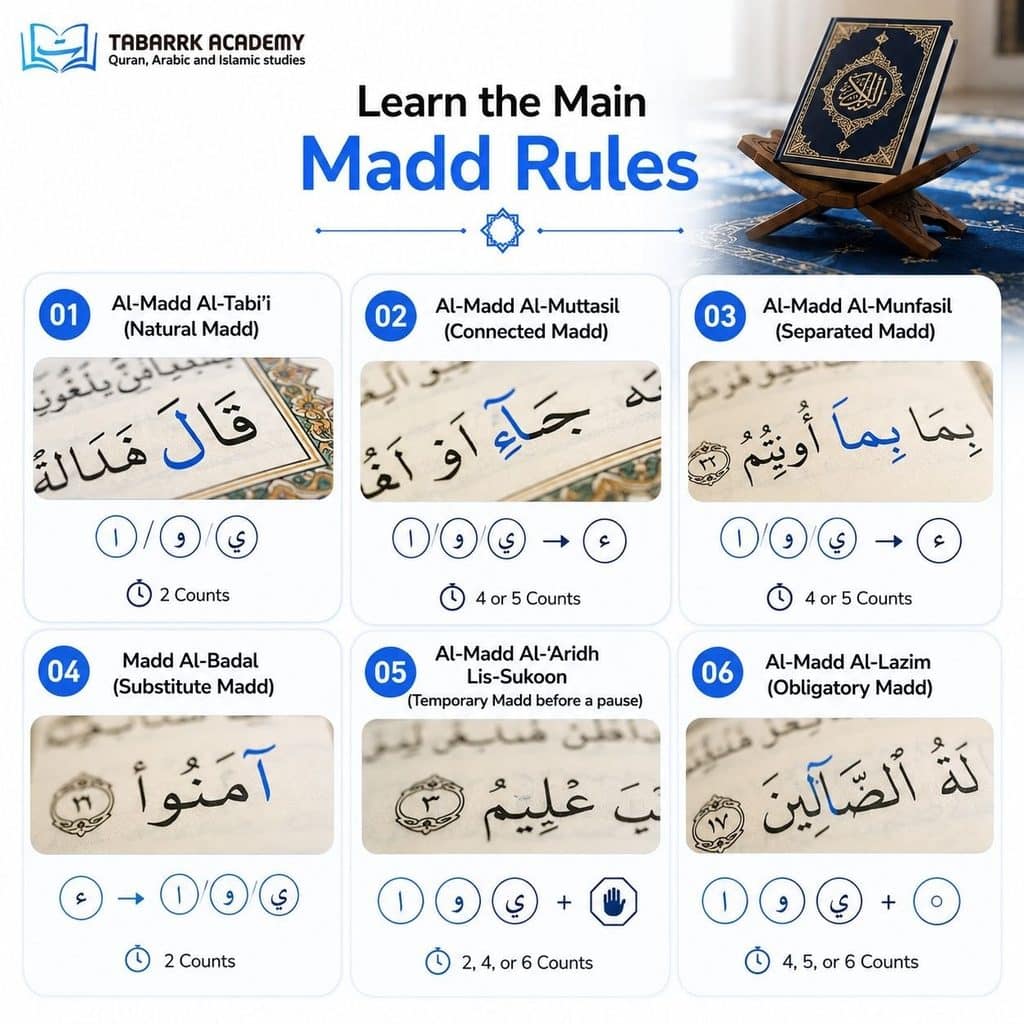
The Quran itself prescribes the unhurried recitation style that Madd rules help produce:
“Or add to it, and recite the Qur’an with measured recitation.” (Surah Al-Muzzammil, 73:4)
Correct application of Madd rules is one of the primary means by which a student achieves the measured, deliberate style of recitation that this verse commands.

Apply Qalqalah Correctly to the Five Echoing Letters ق ط ب ج د
Qalqalah is a slight vibrating or echoing sound produced when one of five specific letters — ق ط ب ج د (remembered by scholars with the mnemonic phrase “Qutb Jad”) — carries a Sukoon (no vowel). The echo prevents the letter from sounding flat or swallowed and is a distinctly recognizable feature of beautiful Quran recitation.
Qalqalah is studied after Madd for a simple reason: it applies to only five letters, and its rules are comparatively contained. The focus at this stage is learning to calibrate the strength of the echo. A Qalqalah in the middle of a word is lighter; a Qalqalah at the end of a verse where the reader pauses is noticeably stronger and more resonant.
Read also: Learning Tajweed: How Long Does It Really Take?
4. Learn When Arabic Letters Become Heavy or Light in Quran Recitation
After mastering Madd and Qalqalah, the next stage is learning how heaviness and lightness affect the sound of Arabic letters during Quran recitation.
Some letters are consistently pronounced with Tafkheem or Tarqeeq, while others—particularly Laam (ل) and Raa (ر)—can change depending on their position and surrounding vowels.
Understanding these differences helps you maintain the correct quality of each letter without making light sounds too heavy or heavy sounds too weak.
Learn When Laam and Raa Are Pronounced Heavy or Light
The letters Laam (ل) and Raa (ر) each have their own rules governing when they are pronounced heavily and when they are pronounced lightly — and those rules depend on context, not on the letter alone.
For Laam, the heavy pronunciation (Tafkheem) applies in only one specific situation: inside the word Allah (اللّٰه) when it is preceded by a Fathah or Dammah vowel. In every other position, Laam is always light (Tarqeeq).
The student also learns at this stage that the Laam of the definite article “Al” (ال) is either pronounced or silent depending on whether the following letter is a Sun Letter (Al-Huroof Ash-Shamsiyyah, which assimilate the Laam) or a Moon Letter (Al-Huroof Al-Qamariyyah, before which the Laam is heard clearly).
For Raa, the picture is more complex. Whether Raa is heavy or light depends on its vowel (Fathah and Dammah make it heavy; Kasrah makes it light), its position at the end of a word, and whether it follows certain letters in the same word.
This stage is more detailed than any of the previous ones, and it is placed here precisely because the student has already been introduced to the concept of heaviness and lightness through the letter Allah and through Qalqalah — making this expanded treatment easier to absorb.

Distinguish Tafkheem and Tarqeeq to Pronounce Heavy and Light Letters Correctly
Tafkheem is the heavy, full-mouth pronunciation in which the back of the tongue rises toward the roof of the mouth and the sound has a rounded, deep quality. Tarqeeq is the light, thin pronunciation in which the tongue stays low and the sound is bright and open.
Seven Arabic letters always carry Tafkheem regardless of their vowel or position, and they are grouped in the traditional mnemonic phrase “خُصَّ ضَغْطٍ قِظْ” (khusa dhaghtin qidh).
This stage completes and generalizes the concept of heaviness and lightness that was introduced in a limited form through the Laam and Raa rules. Once the student has worked through both stages, they will have a comprehensive understanding of which letters are always heavy, which are always light, and which — like Laam and Raa — change depending on their environment.
Read also:Can You Learn Tajweed Without a Teacher? Guide
5. Learn How Identical, Similar, and Neighboring Letters Affect Each Other
This section of Tajweed addresses what happens when two neighboring letters are the same letter, share the same articulation point with different characteristics, or are close in articulation point and characteristics. The three categories are:
- Mutamathilain (the two identical): two letters of the same type meet in sequence.
- Mutajanisain (the two homogeneous): two letters share the same articulation point but differ in characteristics.
- Mutaqaribain (the two approximate): two letters are close — but not identical — in both articulation point and characteristics.
In each case, the rule may require the letters to be merged (Idgham) or pronounced clearly (Izhar), depending on the specific letters and context.
This section is placed late in the sequence for good reason: it requires the student to identify letters by their articulation points and characteristics at speed, and to apply that knowledge within the flow of recitation.
A student who does not yet have Makharij and Sifaat firmly internalized will struggle here. A student who does will find the logic of these rules largely intuitive.
Read also: Clear Guide to Lahn Jali and Lahn Khafi Mistakes
6. Master Waqf and Ibtida to Stop and Resume Quran Recitation
Waqf is the practice of pausing correctly at the end of a phrase or verse. Ibtida is the practice of resuming recitation correctly afterward, choosing a starting point that does not break or distort the meaning of the verse.
Together they represent the most meaning-sensitive aspect of Tajweed — not because the sound rules are more complex here, but because applying them correctly requires the student to understand what the words of the Quran are actually saying.
Waqf is classified into several types, each reflecting how complete the meaning is at that point in the text:
- Al-Waqf At-Tam (the complete stop): the meaning is fully complete at this point, and pausing here is appropriate and encouraged.
- Al-Waqf Al-Kafi (the sufficient stop): the meaning is independent at this point even though the following sentence relates to it; a pause is acceptable.
- Al-Waqf Al-Hasan (the acceptable stop): the meaning is not yet complete, but a pause for breath is acceptable, provided the student resumes from the same point.
- Al-Waqf Al-Qabih (the disliked stop): the sentence is cut at a point where the remaining words are syntactically or semantically inseparable, and stopping here distorts the meaning — this is the stop to avoid.
Waqf and Ibtida comes last because it depends on everything that preceded it. The student needs to understand Al-Madd Al-‘Aridh Lis-Sukoon to know how elongation changes when pausing.
They need their Makharij and Sifaat to be automatic, because they cannot be thinking about letter production while also tracking meaning and structure. They need their Madd types secure, their heavy and light letters internalized, and their Mutaqaribain rules in place.
Waqf and Ibtida is where all of Tajweed comes together in service of the meaning of the Quran — and that is exactly why it is the final stage.
Read also: Noon Sakinah and Tanween Rules: A Tajweed Guide
Why You Need a Qualified Tajweed Teacher at Every Stage of Learning
One point has been consistent across all ten stages: the teacher. Tajweed is a transmitted science. Every rule in this sequence was passed from teacher to student in an unbroken chain stretching back to the way the Prophet Muhammad ﷺ received and recited the Quran.
Rules in a book can be read and understood intellectually — but they cannot produce correct recitation without a human ear that knows what to listen for and a voice that can model what correct sounds like.
At the Makharij stage, a teacher corrects wrong articulation points before they become habits. At the Madd stage, a teacher helps the student hear the difference between two and four counts when the student’s own ear has not yet been trained to measure.
At the Waqf stage, a teacher guides decisions about meaning that a grammar-level student cannot yet make independently.
No stage in this sequence replaces the teacher. The sequence simply tells the student which door to knock on first.
Book With Strong Teachers Of Our Academy

Why the Right Learning Order Matters
Tajweed rules do not exist in isolation. They build on one another in a specific direction, and skipping that direction has real consequences.
Makharij al-Huruf is the foundation beneath every rule that follows. A student cannot correctly apply Idgham, Ikhfa, or any form of Madd if the underlying letters are being produced from the wrong point in the mouth or throat. The error is invisible in the rulebook but audible in recitation — and once a wrong pronunciation is practiced for weeks or months, it becomes a deeply rooted habit that takes far more effort to correct than it would have taken to learn it right the first time.
This is why scholars have always insisted on a structured sequence. The Prophet Muhammad ﷺ himself acknowledged the difficulty of learning to recite correctly and encouraged perseverance in it:
وَالَّذِي يَقْرَأُ الْقُرْآنَ وَيَتَتَعْتَعُ فِيهِ وَهُوَ عَلَيْهِ شَاقٌّ لَهُ أَجْرَانِ
“And the one who recites the Quran and struggles with it, finding it difficult, will have a double reward.” (Sahih Muslim)
This hadith is not permission to stay at the level of struggle indefinitely – it is an encouragement for the beginner who finds the early stages hard. The goal is still to improve. Following the correct order is the most direct path to doing so.
Read also: Do Muslims Have to Read the Quran with Tajweed?
Combining Tajweed Study with Quran Memorization
Tajweed rules are best learned alongside real verses rather than in isolation, since the goal is correct recitation of the Quran itself, not simply memorizing a list of definitions.
Reflecting on the Quran’s own words reinforces this purpose:
كِتَابٌ أَنْزَلْنَاهُ إِلَيْكَ مُبَارَكٌ لِيَدَّبَّرُوا آيَاتِهِ وَلِيَتَذَكَّرَ أُولُو الْأَلْبَابِ
“[This is] a blessed Book which We have revealed to you, [O Muhammad], that they might reflect upon its verses and that those of understanding would be reminded.”
(Surah Sad, 38:29)
Many students find it easier to progress when a step-by-step curriculum pairs each Tajweed stage with matching verses from the Quran.
At Tabarak Academy, certified teachers guide learners of all ages through this exact sequence, correcting pronunciation in real time so that each rule is applied correctly from the very first lesson rather than practiced incorrectly and fixed later.
Step Inside Our Virtual Classrooms
See our engaging teaching methods in action! watch real snippets of our live classes and discover how our expert instructors make learning interactive, memorable, and inspiring for every student.

Start Your Tajweed Journey with Expert Guidance Today
Tabarak Academy offers live, one-on-one online Quran and Tajweed classes for children, adults, and families around the world, following a structured curriculum that takes students from the articulation points of the letters through to fluent, correctly recited Quran.
Book a trial class and start learning Tajweed in the right order, with a certified teacher guiding every step.
Watch a real life at our academy:
Full TAJWEED Course | Raa Rules in Tajweed
Our Tajweed Courses
- Online Tajweed Classes
- Tajweed Course for Beginners
- Tajweed Course for Kids
- Tajweed Course for Adults
- Tajweed Course for Sisters
- Advanced Tajweed Course
- Amali (Practical) Tajweed Course
- Learn Quran with Tajweed
- Learn Quran with Tajweed for Kids
- Learn Quran with Tajweed for Sisters

conclusion
Learning Tajweed rules in order starting with Makharij al-Huruf and Sifaat al-Huruf, then Noon Sakinah and Tanween, Meem Sakinah, Ghunnah, Madd, Qalqalah, Laam and Raa, Tafkheem and Tarqeeq, the relationships between similar letters, and finally Waqf and Ibtida builds each rule on a solid foundation instead of leaving gaps that are harder to fix later.

Frequently Asked Questions
How long does it take to learn all the Tajweed rules?
Most students complete the core Tajweed rules in six months to a year of regular study, though the exact timeline depends on how many lessons per week are attended and how much time is spent reviewing recorded recitation between sessions.
Can I learn Tajweed rules without a teacher?
Books and apps can introduce Tajweed rules, but a teacher is needed to correct pronunciation, since some articulation and elongation mistakes cannot be identified from written explanations alone. Live correction is the fastest way to fix Makharij and Madd errors before they become habits.
Should I memorize the Quran and learn Tajweed at the same time?
Yes, learning Tajweed rules alongside Quran memorization is recommended, because applying each rule to real verses reinforces it far more effectively than memorizing definitions in isolation.
What is the first Tajweed rule a beginner should learn?
Makharij al-Huruf, the articulation points of the Arabic letters, is the first rule every beginner should learn, since every other Tajweed rule depends on pronouncing the letters correctly.
Is Tajweed obligatory in Islam?
Reciting the Quran without major errors that change its meaning is obligatory, while perfecting every remaining detail of Tajweed is considered a recommended communal practice (Sunnah Kifayah) that raises the overall quality of recitation.