


How To Learn Quran As An Adult Who Cannot Read Arabic When You Have A Full-Time Job?
Roughly 80% of the world’s Muslims live outside the Middle East and North Africa, according to figures published by Pew Research Center. If you have ever felt like the only person in the room who cannot follow along in the mushaf, you are actually in the global majority.
That single fact reframes the whole question of how to learn quran as an adult who cannot read arabic. This is not a rare problem or a late start. It is the normal starting point for most believers on earth.
At Tabarak Academy, adult beginners arrive every week with the same quiet worry: that their tongue is too old and their schedule too full. Within a few months, most of them are reading short surahs directly from the Arabic text.
This guide walks you through the exact sequence that gets you there, how long each stage takes, and the mistakes that keep motivated adults stuck for years.
1. Set A Realistic Goal And A Weekly Study Schedule
Decide on one measurable target before your first lesson, such as reading Surah Al-Fatihah unaided within eight weeks. Vague intentions collapse; dated targets survive.
Almost everyone asking how to learn quran as an adult who cannot read arabic stalls here, not at the alphabet. They start with enthusiasm, no calendar, and no definition of success.
The two sections below give you a goal you can defend and a schedule that survives a busy month.
A. Define What “Learning The Quran” Means For You Right Now
Pick one of three outcomes: reading fluently, reciting with tajweed, or memorizing. Trying to chase all three at once is the single most common reason adult beginners stall.
For someone who cannot yet read the script, the correct first outcome is always reading. Memorization built on a shaky reading foundation produces recitation errors that take years to unlearn.
Once reading is stable, memorization becomes a separate project with its own method. If that is your longer-term goal, Tabarak Academy’s guide on how to memorize the Quran by yourself at home explains the workflow to use later, not now.
B. Choose A Weekly Schedule You Can Actually Keep
Book three sessions of 30 minutes per week rather than one 90-minute block. istributed practice is what moves letter recognition into long-term memory.
Fix the days and the times in your calendar the way you would a work meeting. A slot with no place in the week is the first thing to disappear the moment the week gets busy.
Quranic decoding typically takes adult learners 30 to 60 focused hours in total. That is one hour a day for two months — a workload almost any schedule can absorb once it is actually booked.

2. Learn The 28 Arabic Letters By Sight And Sound
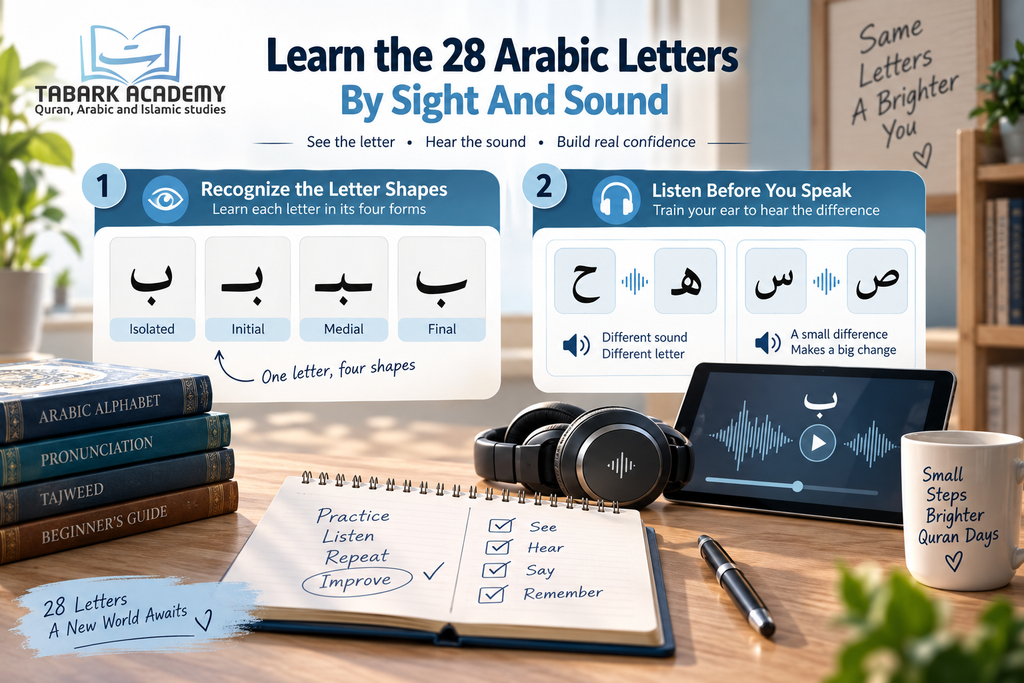
Start with letter recognition and pronunciation together, never separately. Learning a letter’s name without its sound creates a delay you will spend months undoing.
Adults have a real advantage at this stage: you already understand what a writing system is. Children spend months on that concept; you can skip straight to pattern recognition.
The two sections that follow cover the two skills this step demands — visual recognition and auditory discrimination.
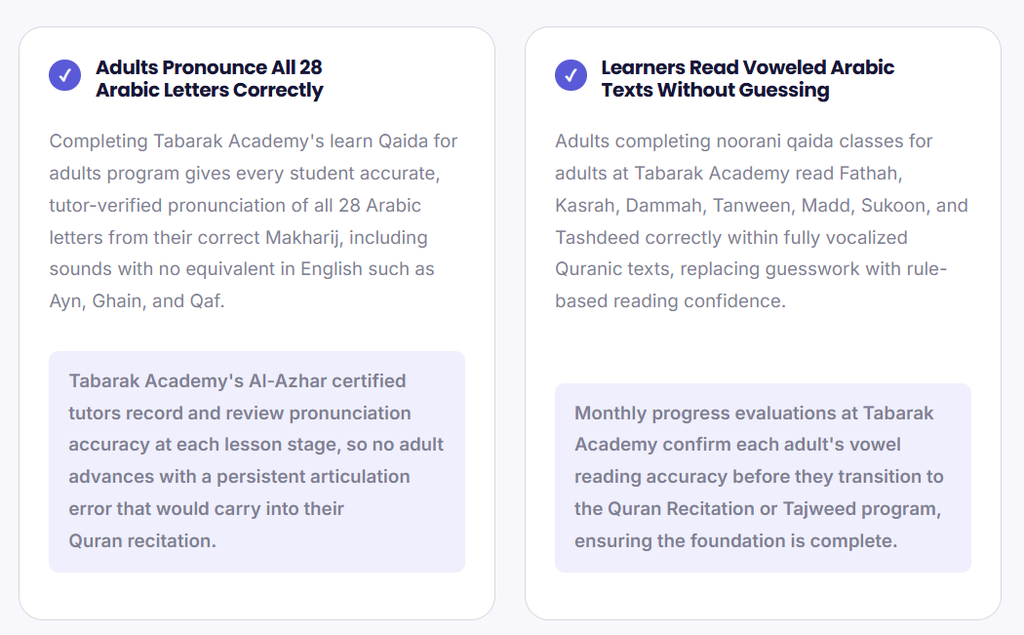
A. Master Letter Shapes In Their Four Positions
Learn each letter in its isolated, initial, medial, and final forms from day one. Arabic letters change shape depending on position, and this is where most self-taught adults quietly give up.
The good news is that the changes are systematic. Once you notice that most letters simply lose their tail when connected, twenty-eight letters stop feeling like a hundred separate symbols.
This is precisely what the classical Noorani Qaida method was designed to teach, and Tabarak Academy delivers it through the Noorani Qaida Course for Adults, which moves at adult pace rather than children’s pace.
B. Train Your Ear Before You Train Your Tongue
Listen to each letter ten times before attempting to say it. English speakers cannot initially hear the difference between ح and ه or س and ص, and you cannot reproduce a sound you cannot distinguish.
Spend the first two weeks on minimal pairs: قلب and كلب, سيف and صيف. Five minutes of daily listening does more for your pronunciation than an hour of unguided repetition.
This is also the honest limit of self-study. You will not know that your ع is wrong until a qualified teacher tells you, which is why the next steps assume live feedback rather than videos alone.
Experience Our Interactive Learning
Curious about how we teach? Watch these brief video clips from our recent live sessions to see our structured curriculum, advanced learning platform, and dynamic student-teacher interactions firsthand.
3. Add Short Vowels And Join Letters Into Words
Introduce harakat only after letter recognition is automatic. Adding vowel marks to letters you still have to think about doubles the cognitive load and slows everything down.
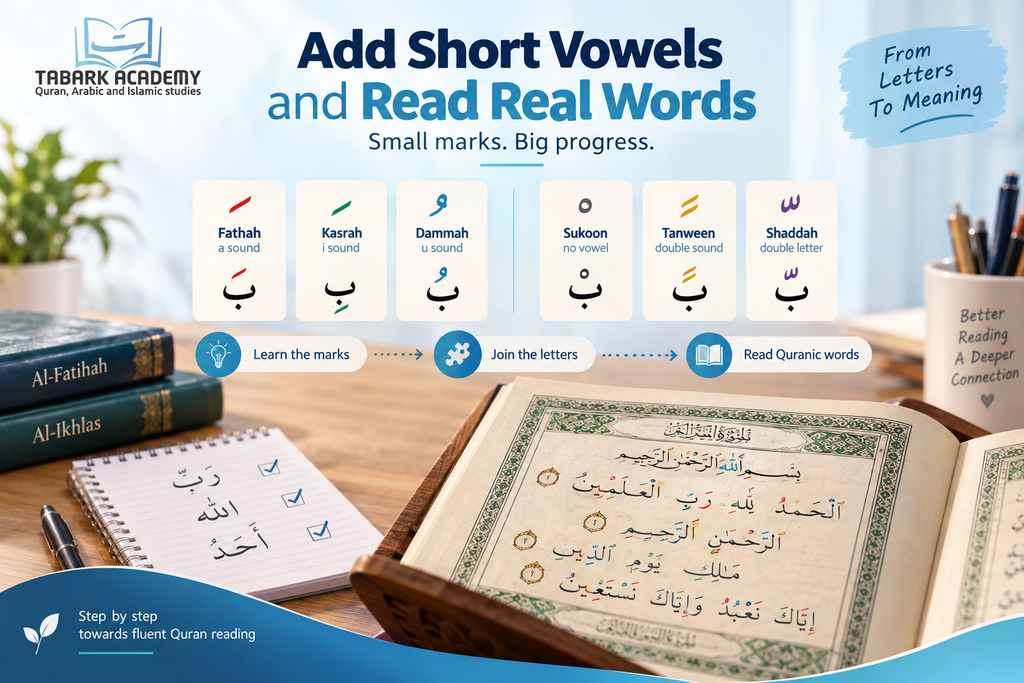
Vowels are where Arabic reading becomes genuinely readable. Three marks — fathah, kasrah, and dammah — unlock the pronunciation of virtually every word in the mushaf.
Work through the sub-steps below in strict order; skipping ahead is the main cause of stalled progress here.
A. Work Through Harakat, Sukoon, Tanween, And Shaddah In Sequence
Master the three short vowels first, then sukoon, then tanween, then shaddah. Each builds on the last, and reversing the order produces predictable confusion.
Shaddah in particular deserves patience. It doubles a letter, changes the rhythm of a word, and in some cases changes the meaning entirely — رب and ربّ are not interchangeable.
Structured Arabic instruction handles this progression far more efficiently than trial and error, which is why many adults pair their Quran work with Tabarak Academy’s Arabic Course for Beginners to lock the foundations in place.
B. Practice On Real Quranic Words, Not Random Syllables
Read actual words from Surah Al-Ikhlas and Surah Al-Fatihah as soon as you can decode three-letter combinations. Motivation collapses when practice feels disconnected from the goal.
There is a second benefit. Quranic vocabulary repeats heavily, so the words you decode in week three will reappear hundreds of times across the mushaf.
Ten minutes of daily reading from a real page beats thirty minutes of worksheet drills. Choose a large-print mushaf with clear vowel marks and keep it open beside you.
Discover more here: Is It Too Late to Learn to Read the Quran as an Adult? Practical Steps to Start Today
4. Replace Transliteration With Direct Reading From The Mushaf
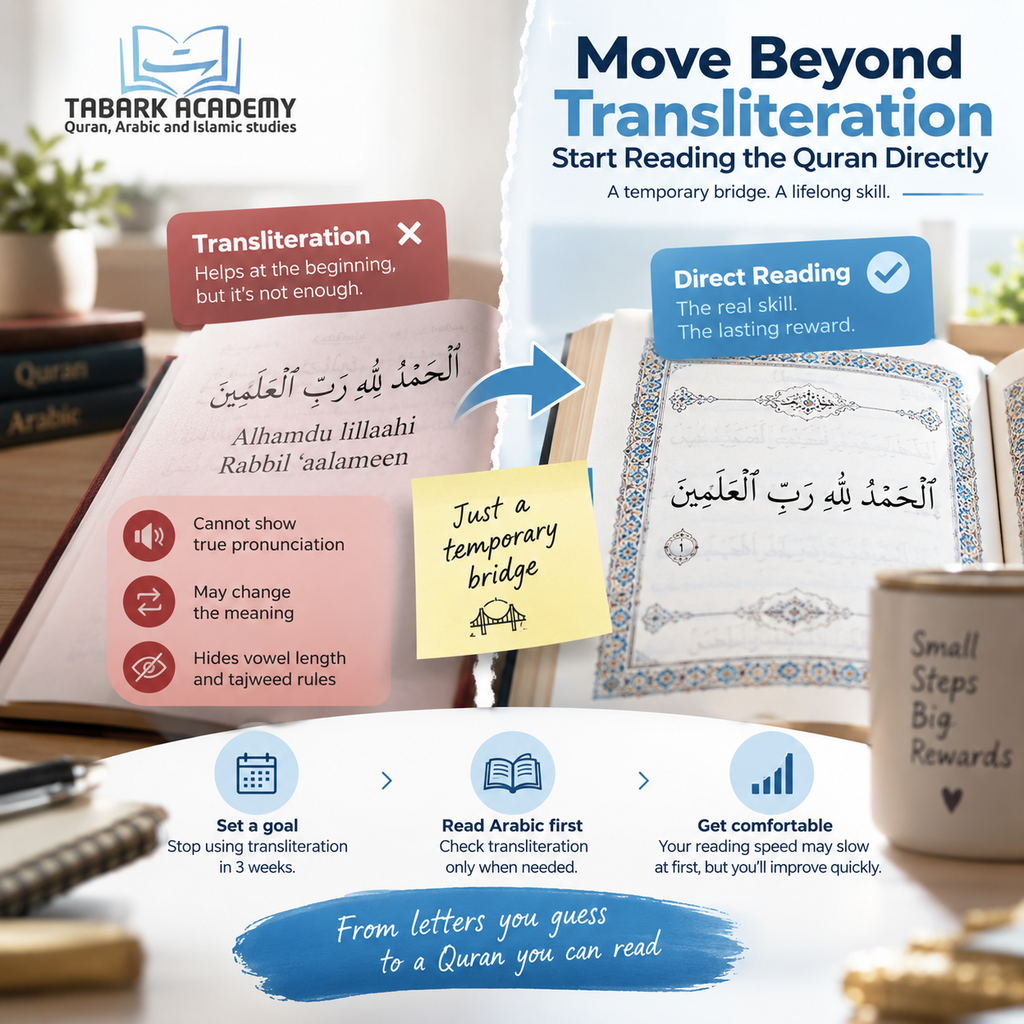
Set a hard deadline to stop using transliteration — three weeks from your first lesson. Transliteration is a temporary bridge, and adults who never cross it stay dependent for years.
This is the most important of all the practical learn quran as an adult who cannot read arabic tips, and it is also the least popular. Roman letters feel safe precisely because they let you avoid the real skill.
The sections below explain why transliteration fails and how to phase it out without losing your ability to pray.
Why Transliteration Cannot Represent Quranic Sounds Accurately
English has no equivalent letters for ع, ح, ق, ط, ص, or ض. Writing “a,” “h,” or “k” for these sounds trains your mouth to make the wrong articulation every single time.
The consequences are not cosmetic. Substituting ه for ح in Surah Al-Fatihah changes “الحمد” into a non-word, and similar substitutions elsewhere can alter meaning outright.
Transliteration also hides vowel length. The difference between a short fathah and a long alif is invisible in Roman script but audible — and rule-governed — in recitation.
Read also: Online Quran Classes for Adults: A Practical Guide
Phase Out Transliteration In Two To Three Weeks
Read the Arabic first, then check the transliteration only when stuck, and cover it entirely by week three. Reversing that order keeps your eyes on the crutch.
A simple physical trick works well: place a sticky note over the transliteration line. Removing the option is more effective than resolving not to use it.
Expect your reading speed to drop by half for about ten days. That dip is the sound of a real skill forming, and it reverses quickly once letter recognition becomes automatic.
Worth checking out: 10 Strategies Of How To Memorize Quran Fast And Never Forget
5. Apply Basic Tajweed Rules While You Read, Not After
Learn tajweed alongside your reading practice rather than as a separate later course. Correcting habits is far harder than forming them correctly the first time.
Many adults postpone tajweed because it sounds advanced. In reality, the foundational rules are simple, and applying them early prevents the errors that take longest to fix.
The two areas below deliver the most benefit for beginners: articulation points and applied practice on familiar surahs.
A. Start With Makharij, The Articulation Points Of The Letters
Learn where each letter is physically produced — throat, tongue, lips, or nasal cavity. Makharij is the mechanical explanation for every pronunciation problem you have.
There are seventeen articulation points grouped across five zones of the vocal tract. Once you know that ق comes from the deepest part of the tongue and ك from slightly forward, the distinction stops being mysterious.
Tabarak Academy has mapped the full system in its guide to the 17 Makharij Of Arabic Letters, which is a useful reference to keep open while you practise between lessons.
Read also: The Difference Between the Arabic Letters Haa and Khaa
B. Apply The Rules To Short Surahs You Already Recite In Prayer
Practise tajweed on Al-Fatihah, Al-Ikhlas, and Al-Nas before touching anything longer. You already know the words, so all your attention goes to the rules.
Focus first on noon sakinah, meem sakinah, and madd — the three rule families that appear in almost every ayah. Everything else can wait until these are automatic.
Guided correction accelerates this enormously, and Tabarak Academy’s Online Tajweed Classes are built for exactly this stage, when a learner can read but cannot yet hear their own errors.
The Prophet ﷺ said:
“مَثَلُ الَّذِي يَقْرَأُ الْقُرْآنَ وَهْوَ حَافِظٌ لَهُ مَعَ السَّفَرَةِ الْكِرَامِ الْبَرَرَةِ، وَمَثَلُ الَّذِي يَقْرَأُ الْقُرْآنَ وَهُوَ يَتَعَاهَدُهُ وَهُوَ عَلَيْهِ شَدِيدٌ، فَلَهُ أَجْرَانِ”
“Such a person as recites the Qur’an and masters it by heart, will be with the noble righteous scribes. And such a person who exerts himself to learn the Qur’an by heart, and recites it with great difficulty, will have a double reward.” — Sahih al-Bukhari 4937
Your difficulty is not a deficiency. It is explicitly recorded as a doubled reward.

6. Build Meaning And Momentum With A Qualified Tutor
Add vocabulary and live correction once you can decode a page slowly. Reading without understanding eventually feels mechanical, and mechanical practice is what people abandon.
This step is also where the best way to learn quran as an adult who cannot read arabic separates from the average way: consistent expert feedback rather than accumulated self-study hours.
The final two sections cover meaning and accountability — the two things that keep adult learners going past month three.
A. Learn The Most Repeated Quranic Words First
Study the roughly 300 most frequent Quranic words before any grammar textbook. Those words account for a very large share of the total text you will ever recite.
The effect is immediate and motivating. Once you recognise رب, عبد, كتاب, and علم, whole ayat stop being opaque sound and start carrying recognisable meaning.
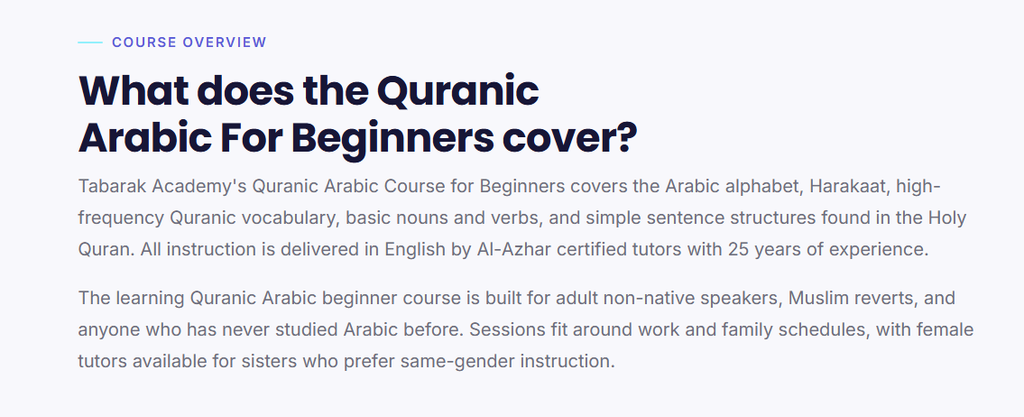
Tabarak Academy’s Quranic Arabic Course for Beginners is designed around exactly this frequency-first principle, teaching the vocabulary you will actually meet rather than vocabulary you might one day need.
B. Get Live Feedback And Measure Progress Weekly
Record yourself once a week and review it with your tutor. Self-assessment fails in Arabic because your ear cannot yet detect the errors your mouth is making.
Set checkpoints instead of open-ended goals: all 28 letters by week two, joined words by week four, Al-Fatihah unaided by week eight. Visible progress is what sustains adult learners.
A weekly review also catches drift early. A single unnoticed pronunciation habit repeated for a month becomes a correction project; caught in week one, it takes five minutes.
Read also: Online Weekend Quran Classes for Busy Adults

Tabarak Academy Is Built For Adults Who Are Starting From Zero
Every adult programme at Tabarak Academy is built around one question: how to learn quran as an adult who cannot read arabic without being handed a children’s curriculum at a slower speed.
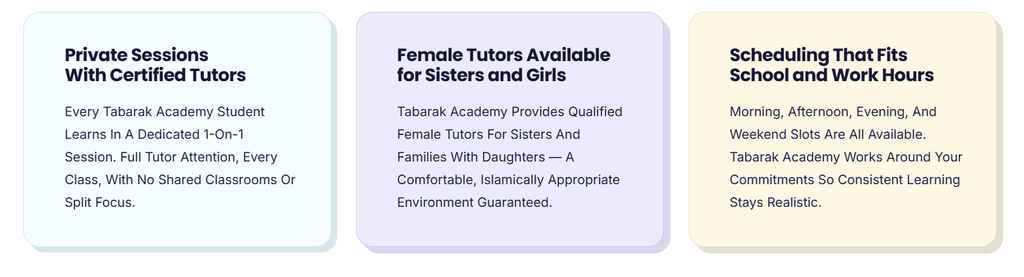
Lessons are one-to-one and live, never pre-recorded and never group-paced. Your tutor hears your ع on the first attempt and corrects it before it becomes a habit, which is the one thing self-study structurally cannot provide.
Tutors are Al-Azhar certified and teach in fluent English, so explanations of makharij, harakat, and tajweed rules arrive in a language you already think in. You are never decoding the explanation and the Arabic at the same time.
Scheduling flexibility matters just as much for working adults. Sessions run 30, 45, or 60 minutes, two to five times a week, across time zones — so a demanding job or a young family adjusts the plan rather than ending it.
There is also the dignity of learning privately: no classroom of eight-year-olds, no reading aloud in front of peers, no explaining why you are starting at forty. Just you, a tutor, and measurable progress — which is why over 6,800 students across 15+ countries have chosen Tabarak Academy.
Step Inside Our Virtual Classrooms
See our engaging teaching methods in action! watch real snippets of our live classes and discover how our expert instructors make learning interactive, memorable, and inspiring for every student.
Start With One Free Session and a Tutor Who Meets You at Zero!
You now know how to learn quran as an adult who cannot read arabic in theory — take the first concrete step this week. Tabarak Academy offers a free trial session where a certified tutor assesses your level and maps your personal route to the mushaf.
You will finish that first session knowing exactly which letters you can already recognise, which sounds need work, and how many weeks stand between you and reading Surah Al-Fatihah without help. No obligation, no pressure, no prior Arabic required.
If you prefer to start with recitation from day one, Tabarak Academy’s Online Quran Classes pair you with a tutor who builds the reading foundation and the recitation together. Book your session, and let this be the year the Arabic text finally opens.
Our Quran Courses
- Online Quran Classes
- Online Quran Classes for Beginners
- Online Quran Classes for Kids
- Online Quran Classes for Adults
- Online Quran Classes for Men
- Online Quran Classes for Sisters
- Quran Reading Course
- Quran Recitation Course
- Online Ijazah Course
- Online Qirat Course
- Quran for Toddlers / Young Children
- Weekend Quran Classes
- Intensive Quran Course
- Al-Azhar Quran Course
- Zoom Quran Classes
- Noor Al-Bayan Course

Conclusion
Reading the Quran is a decoding skill, and decoding is exactly what adult brains do well. The path runs in a fixed order: a realistic weekly schedule, the 28 letters by sight and sound, short vowels and letter joining, a firm exit from transliteration, foundational tajweed on surahs you already know, then vocabulary with live weekly feedback.
Skipping a stage is what costs years — not age, not a busy calendar, and not a late start. Sixty focused hours, spread across two or three short sessions a week, is enough to take a complete beginner to independent reading.
The ultimate takeaway is this: knowing how to learn quran as an adult who cannot read arabic is far less about talent than about sequence and consistent correction. Start with the alphabet, keep the sessions short, and let a qualified tutor hear you every week.
Frequently Asked Questions
What Is The Easiest Way To Memorize The Quran?
Memorize small daily portions and revise yesterday’s portion before adding a new one, because consistency beats volume every time. Tabarak Academy starts hifz only after your reading is accurate, so you never memorize an error and repeat it for years.
Can I Learn The Quran By Myself?
You can learn letter shapes alone, but you cannot hear your own pronunciation errors, which is where self-taught adults plateau. Tabarak Academy pairs self-study with weekly one-to-one correction so mistakes are caught in week one, not month six.
How Long Does It Take To Learn Quranic Arabic?
Recognising the most repeated Quranic vocabulary takes most adults three to six months of steady weekly study. Full grammatical comprehension of the text is a longer project, usually measured in years rather than months.
Which App Is Good For Learning The Quran?
Apps are useful for listening practice and daily review, but no app can hear your ع or correct your makharij. Tabarak Academy replaces that gap with a live certified tutor, and you keep any app you like for practice between sessions.
What Is A Good Beginner’s Quran Book?
Start with a Noorani Qaida primer for the alphabet, then a large-print mushaf with clear, well-spaced vowel marks. Avoid transliterated editions entirely, since they train the wrong sounds from your very first page.