


How To Memorize Quran By Yourself At Home?
Quran memorization at home fails for one reason more than any other: not lack of commitment, not lack of time, but lack of a system that accounts for how memory actually works.
Hundreds of thousands of Muslims around the world have completed their hifz without ever setting foot in a formal classroom — and what they have in common is not extraordinary ability. It is a method.
This guide covers exactly how to memorize Quran by yourself at home using techniques drawn from classical hifz pedagogy and adapted specifically for independent learners. Every step is concrete enough to apply today.
Discover Tabarak Academy’s Learn Quran with Tajweed for Kids Course

1. Start From The Back Of The Quran
Beginning at Surah Al-Baqarah is logical on paper and counterproductive in practice. Long surahs require months before the learner experiences any sense of completion — and for someone memorizing alone at home, that absence of milestone moments is a real motivation drain.
Starting with Juz Amma reverses this dynamic. The surahs are short enough to complete in days or a few weeks. Completion creates a felt sense of progress, and that felt progress sustains the daily effort.
Many surahs in Juz Amma are already partially familiar from years of prayer — building on existing memory is always faster than building from nothing.
Once the habit is established and you understand how your own memory responds to this system, transitioning to longer surahs becomes a natural extension rather than an intimidating new challenge.
Read also: What Can We Learn From The Life Of Prophet Muhammad? — Moral Lessons and Examples from His Sunnah
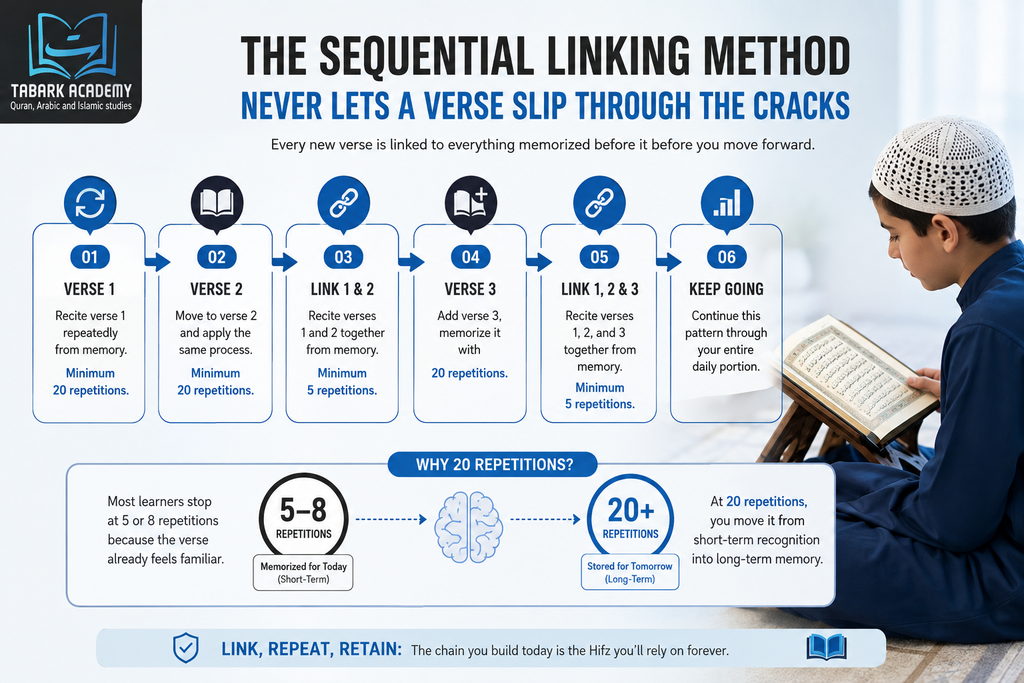
2. The Sequential Linking Method Never Lets A Verse Slip Through The Cracks
This is the most reliable method for independent learners precisely because it refuses to allow gaps. The governing principle: every new verse is linked to everything memorized before it before you move forward.
Here is the exact process:
- Recite verse 1 repeatedly from memory – minimum 20 repetitions.
- Move to verse 2 and apply the same process.
- Recite verses 1 and 2 together from memory, 5 times minimum.
- Add verse 3, memorize it with 20 repetitions.
- Recite verses 1, 2, and 3 together from memory, 5 times.
- Continue this pattern through your entire daily portion.
The 20-repetition threshold deserves particular attention. Most learners stop at 5 or 8 repetitions because the verse already feels familiar — and familiarity is not the same as retention.
At fewer than 20 repetitions, most learners have memorized the verse for today.
At 20, most have moved it from short-term recognition into long-term memory. That distinction is the difference between waking up the next morning with the verse intact and having to relearn it.
3. The Seven-Line Technique Makes Every Session Manageable
A full page as a daily target feels reasonable at the start of a hifz journey. For many independent learners, it quietly becomes a source of guilt when life intervenes. The seven-line technique – roughly half a page in the standard Madinah Mushaf — sets a target achievable even on difficult days.
Divide your seven lines into two groups (three and four lines). Apply the sequential linking method to the first group, then the second group separately, then combine both and recite all seven lines from memory without assistance.
The sense of completing something each day compounds significantly over time. Seven lines per day, maintained consistently, equates to completing the full Quran in approximately four years — a timeline that compares favorably to learners who aim for a full page, burn out, and restart more than once.
Begin Mastering Arabic with Tabarak Academy’s Advanced Course

4. Reading the Meaning Before You Memorize
Sound memorization without meaning is possible but structurally fragile. When a verse carries understood content, your brain creates a semantic memory alongside the auditory one — and two memory types supporting the same material are substantially more durable than one.
This doesn’t require deep tafseer study during every session. A brief read of a simplified commentary — Al-Tafseer Al-Muyassar or similar — before beginning a new passage takes five to ten minutes and measurably accelerates retention.
The verse is no longer a sequence of unfamiliar sounds with no anchor. It becomes a statement with a context, and context is one of the brain’s strongest retrieval cues.
For learners curious about the structural richness of the language they are memorizing, the resource on Facts about the Arabic language offers an illuminating look at what makes Quranic Arabic linguistically distinct — and why that distinctiveness rewards careful engagement.

5. Use Daily Prayers for Review
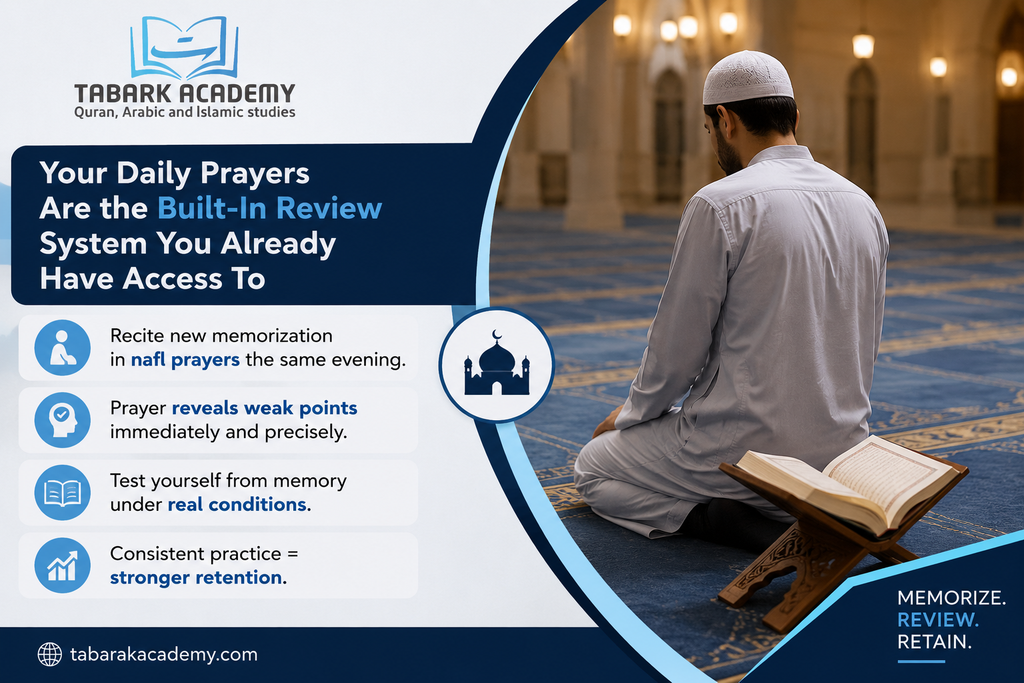
Once a passage is memorized, recite it in voluntary prayers (nafl salah) that same evening. This single habit does more for retention than almost any deliberate standalone review method. The reason is the test condition. In prayer, you recite from memory with no page visible, under mild pressure, in a context that matters.
When you hesitate, you know immediately and precisely which verse or word is weak. That information is significantly more useful than a review session where you gloss over the same weak point without noticing it.
Students who recite new memorization in nafl prayers the same day consistently report fewer gaps when they test themselves the following morning — the prayer session identifies exactly what needs work before the night consolidation window closes.
Experience Our Interactive Learning
Curious about how we teach? Watch these brief video clips from our recent live sessions to see our structured curriculum, advanced learning platform, and dynamic student-teacher interactions firsthand.
6. Prepare Your Memorization the Night Before
This is among the most practical memorize Quran by yourself at home tips that most guides do not mention. The technique is straightforward: the night before a memorization session, read through the passage you plan to memorize the next morning five times and listen to it from a certified reciter three times. Do not attempt to memorize it yet.
What happens overnight is not fully explained by any single theory, but the pattern among experienced hifz students is consistent: morning memorization of pre-exposed material proceeds faster, feels less effortful, and holds better under subsequent testing.
The pre-session preparation the following morning — a further 15-minute read-through before starting to memorize — creates a triple priming effect. The verse arrives at the memorization session as something already partially absorbed rather than an entirely unfamiliar encounter.
Start your Journey with Tafseer Al-Quran Course with a Free Trial Today

7. A Dedicated Notebook For Similar Verses Avoides Silent Errors
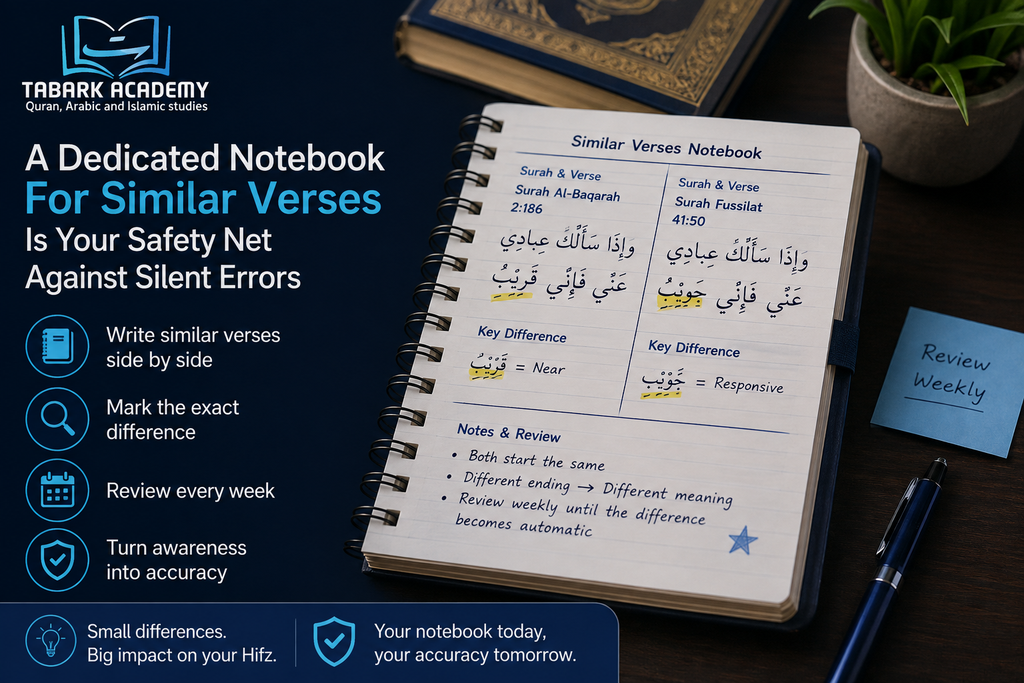
The Quran contains many mutashabihat — verses that begin or end in nearly identical ways, sometimes across different surahs. These are the most common source of undetected error in home memorization. The mistake is made confidently, with no awareness that anything is wrong, and it can persist uncorrected for months.
Keep a small notebook exclusively for similar verses. When you encounter a verse that closely resembles one already memorized, write both versions side by side, record the surah and verse number for each, and mark the specific word or phrase that distinguishes them.
Review this notebook every week. The conscious, deliberate attention forces your brain to treat them as distinct items rather than interchangeable variants — and that distinction, built through regular review, eventually becomes automatic.
8. One Solid Review Day a Week Protects Everything You Built
New memorization draws attention. Older memorization quietly erodes. This imbalance is the primary reason independent home memorizers plateau; they continue adding pages while earlier pages weaken. The traditional solution is a dedicated review day with no new memorization.
Classical hifz practice commonly designated Thursday and Friday for this purpose, and the structure exists for good reason. On this day, the sole focus is reciting previously memorized material from memory, identifying anything that has weakened, and reinforcing it.
An hour of pure recitation from memory, covering older portions without reference to the Mushaf, is worth more for the long-term integrity of your hifz than three additional pages of new memorization in the same time. Without this practice, the foundation is being built on sand.
Explore our Free Tajweed Quran Course at Tabark Academy

9. Starting Small And Compounding Daily Beats Memorizing Hard
This principle cuts against the instinct of motivated beginners. When the desire is strong, the temptation is to memorize as much as possible as quickly as possible.
Among hifz teachers who work with adult learners, that approach produces the same result with remarkable consistency: an energetic start, a period of mental fatigue, inconsistency, and often a complete stop followed by a later restart.
A practical rule used across classical hifz pedagogy: your daily portion should feel slightly easy, not slightly difficult. The real challenge lies in doing it every single day without exception — not in the volume of each session.
A learner who memorizes half a page every day for twelve months has accomplished far more than one who memorizes three pages some days and nothing most days. Protect the habit first. Expand the quantity only once the habit is so ingrained it requires no decision.
Read also:The easiest way to memorize quran
10. Knowing When To Call In Expert Guidance Keeps The Journey On Track
Independent home memorization has one structural limitation that technique alone cannot resolve: no external verification. Errors go unchecked. Progress that stalls has no outside perspective to diagnose what is going wrong.
The signal that it is time to bring in a qualified teacher is specific — when you have been working on the same passage for more than two weeks without clear progress, or when you suspect your recitation carries embedded errors you cannot identify yourself.
Online one-to-one sessions with a certified teacher make this possible without restructuring your schedule or giving up the flexibility of home study.
Tabarak Academy‘s instructors hold formal ijazah themselves, meaning their guidance comes with an authenticated chain of transmission they can help you work toward.
For learners who want their own memorization formally recognized, understanding how to get ijazah — the certification that connects your recitation back to the Prophet ﷺ through an unbroken chain — clarifies what that goal involves and how to work toward it alongside your hifz.

The Habits That Set Apart Those Who Finish From Those Who Stall
The ten steps above address the technical structure of home memorization. But technique alone doesn’t explain why some learners complete the Quran while others stall at the same passage for months.
The difference almost always comes down to two factors that operate below the surface of any memorization method.
Read also:How Long Does It Take To Memorize
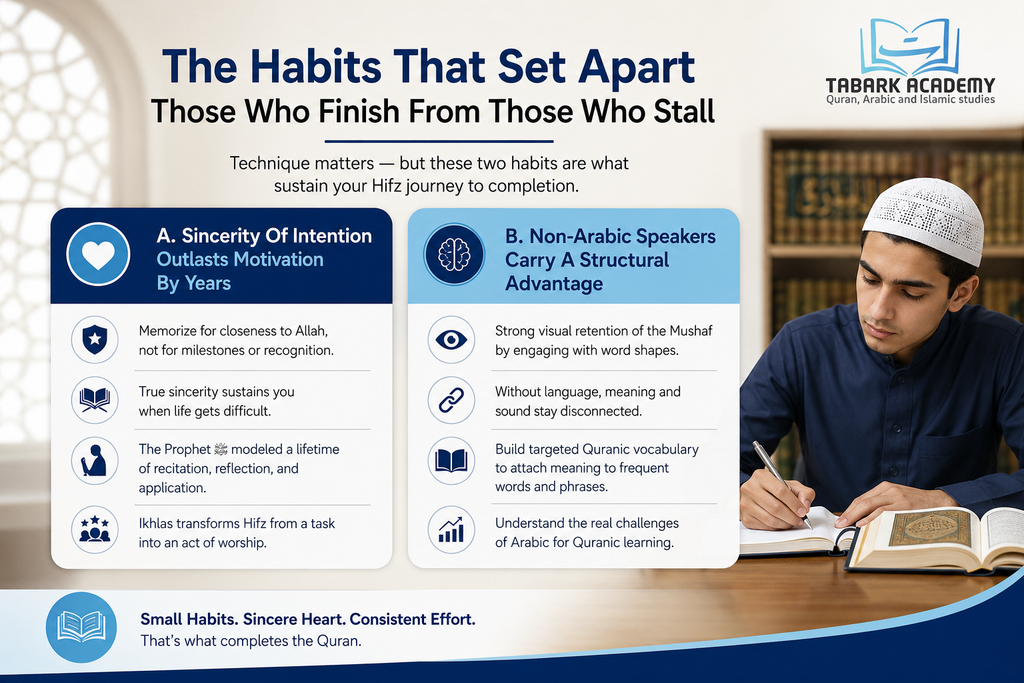
A. Sincerity Of Intention Outlasts Motivation By Years
Every scholar who has written seriously on hifz begins with sincerity of intention (ikhlas) — and this is not a ritual preamble. It is a practical observation about what sustains effort across years.
Memorizing to reach a milestone, or for social recognition, or to complete a goal on a spiritual checklist, tends to falter when life becomes complicated.
Memorizing as an act of closeness to Allah continues even when progress is slow, because the act itself carries meaning independent of the outcome. The Prophet ﷺ modeled this relationship with the Quran through a lifetime of recitation, reflection, and daily application.
Exploring what can we learn from the life of prophet Muhammad offers a grounded perspective on how that daily engagement with revelation shaped his character — and what that model means practically for a learner working at home today.
B. Non-Arabic Speakers Carry A Structural Advantage
Counterintuitively, learners who do not speak Arabic natively often develop stronger visual retention for the Mushaf.
Without the ability to process the text as flowing familiar language, they must engage more carefully with the visual shape of each word and that additional visual attention reinforces exactly the page-based memory described in the foundation section.
The limitation is that without any linguistic anchor, sound and meaning stay disconnected, which weakens long-term retention. The practical solution is targeted vocabulary building not fluency, but enough Quranic Arabic to attach meaning to the most frequently repeated words and phrases.
Resources on how to Learn Arabic Language specifically for Quranic purposes are the right entry point for most learners.
For those who have heard Arabic is uniquely difficult and are uncertain whether the effort is realistic, a closer look at 3 reasons why Arabic is difficult helps calibrate which obstacles are genuinely significant for non-native speakers and which ones are considerably less daunting in the specific context of Quranic study than general-purpose language learning.
Memorise Quran By Yourself At Home Without A Teacher With 1 Condition
The traditional Islamic position holds that the Quran should be transmitted person to person, preserving the oral chain of recitation that stretches back to the Prophet ﷺ.
In practice, many learners today begin memorizing independently before connecting with a teacher, and this is widely accepted among scholars provided recitation quality is actively maintained.
You can already read Arabic with basic Tajweed accuracy, you use high-quality audio recordings of a certified reciter as your primary pronunciation reference, and you periodically record your own recitation to check for errors.
Sheikh Mahmoud Khalil Al-Husary‘s murattal recordings are widely recommended for independent learners because the pace is deliberate and every Tajweed rule is clearly audible.

For learners who want to understand the breadth of valid recitation traditions beyond the commonly used Hafs ‘an Asim narration, reading about the types of Qirat in the Quran provides useful context on how the seven accepted transmission lines relate to each other — knowledge that becomes relevant if formal certification is ever the goal.
Step Inside Our Virtual Classrooms
See our engaging teaching methods in action! watch real snippets of our live classes and discover how our expert instructors make learning interactive, memorable, and inspiring for every student.
Build Your Hifz With Tabarak Academy
If the methods in this guide resonate but the idea of applying them entirely alone gives pause, Tabarak Academy offers exactly the combination that works best for most serious learners: the flexibility of studying from home, with the structure and accountability that a qualified certified teacher brings.
Tabarak Academy‘s instructors are native Arabic speakers who hold formal ijazah themselves — meaning their own recitation carries the authenticated chain of transmission they help students work toward.
Sessions run over Zoom, are scheduled around the learner’s timetable, and focus on exactly the areas where independent study most frequently develops blind spots.
Pronunciation verification, mutashabihat identification, and recitation fluency testing. Students consistently report that even a weekly session alongside their independent daily practice accelerates progress in ways that solo memorization alone cannot replicate.
It is also worth knowing that the memorization process itself, carried out with genuine engagement, strengthens Arabic language comprehension in ways that extend beyond recitation.
Tabarak Academy’s Courses
Students who commit seriously to their hifz often find their vocabulary and linguistic intuition developing alongside it — a dimension of Quranic study explored in the article on how you can improve your language skills with Quran.
Our Quran Memorization / Hifz Courses
- Online Hifz Program
- Juz 30 Memorization
- Hifz for Kids
- Hifz for Adults
- Hifz for Sisters
- Short Surah Memorization Course
- Hifz Ijazah Course
Start Your Memorization Journey with Tabarak Academy Today
The methods are proven. The system is clear. What remains is the decision to start — and having qualified teachers beside you for the stretches where the road gets long.
Tabarak Academy‘s certified instructors are ready to support your hifz from wherever you currently are, at a schedule that works for your life.
Enroll now and begin your Quran and Arabic journey with Tabarak Academy

Conclusion
Knowing how to memorise Quran by yourself at home is a matter of system, not willpower alone. The learners who complete their hifz use one consistent Mushaf, listen before memorizing, apply the sequential linking method with sufficient repetition, prepare the night before, use daily prayers as a review mechanism, protect older memorization with a dedicated weekly review day, and address similar verses deliberately.
They start smaller than feels necessary, review more than feels sufficient, and bring in expert guidance when independent practice reaches its limits. The best way to memorize Quran by yourself at home is the one you can maintain every day without exception — including ordinary days when time is short and energy is low.
The seven-line technique and the night-before preparation are not shortcuts. They are sustainability tools that allow the daily habit to survive real life rather than requiring ideal conditions.
All the memorize Quran by yourself at home tips in this guide work best as a continuous integrated practice, not as occasional interventions. The Quran is a lifelong companion.
The work of memorizing it deserves the same long-view thinking that any meaningful long-term commitment requires — begin with care, sustain with structure, and protect what you build.
Frequently Asked Questions
How many verses should I memorize per day when studying at home by myself?
Between 3 and 5 verses per day is a practical starting target for most independent adult learners. The first month should prioritize consistency over volume. Once daily memorization feels routine and your review workload is manageable, gradually increase the portion — but only if doing so does not destabilize the retention of what you’ve already memorized.
Can I memorise Quran by myself at home without any teacher involvement?
Independent memorization is valid when you can already read Arabic with basic Tajweed accuracy. The safeguard is using high-quality audio recordings of a certified reciter as your primary pronunciation reference and periodically recording your own recitation to check for errors.
A teacher is not required to begin, but periodic sessions — even monthly — prevent the gradual accumulation of undetected errors that become increasingly difficult to correct over time.
What is the best time of day to memorize Quran at home?
After Fajr prayer is the most consistently recommended time across both classical scholarship and contemporary hifz teachers. The mind is rested, distractions are minimal, and the clarity that follows early morning prayer supports retention. If early morning is not possible, any quiet period offering 30–45 uninterrupted minutes produces comparable results.
How do I prevent forgetting the verses I have already memorized?
The review portion of your routine must receive at least as much time as new memorization — usually more. A reliable ratio: for every new page memorized, review three to five older pages. Reciting older portions in voluntary prayers throughout the day reinforces retention without requiring additional dedicated sessions, and it doubles as a performance test in conditions that closely replicate formal recitation.
How long does it realistically take to memorize the full Quran at home independently?
At half a page per day with consistent daily practice and proper review, the full Quran takes approximately four years. At one page per day with serious, sustained commitment, approximately two years. The timeline matters far less than continuity — multi-week breaks lose ground that takes just as long to rebuild, and restarting repeatedly after gaps is the most common reason home memorization projects remain incomplete.
Is it better to memorize Quran with a teacher or by yourself at home?
Both produce results when applied correctly. Independent memorization suits disciplined learners with solid existing Arabic reading ability and offers flexibility that a fixed classroom schedule cannot. A teacher adds pronunciation verification, accountability, and the ability to identify weaknesses that self-assessment misses.