


How To Make Quran Memorization Fun For Kids?
Quran memorization turns into a chore for children the moment it becomes pure repetition; no play, no story, no praise attached to it. The fix isn’t a longer schedule; it’s turning each session into something a child actually wants to sit down for.
Making Quran memorization fun for kids comes down to one shift. Replace flat drilling with games, storytelling, and short daily rhythms that respect how children naturally learn and stay engaged, instead of fighting their instincts. But How to do so?
Children get bored with Quran memorization when sessions rely on repetition alone. They also lose interest when play and movement are ignored, and when every mistake gets corrected without encouragement. None of this reflects boredom with the Quran itself — only with how it’s being taught.
Allah describes this ease directly in the Quran:
وَلَقَدْ يَسَّرْنَا الْقُرْآنَ لِلذِّكْرِ فَهَلْ مِن مُّدَّكِرٍ
“Wa laqad yassarna al-Qur’ana lildhikri fahal min muddakir”“And We have indeed made the Qur’an easy to understand and remember: then is there any that will receive admonition?” (Al-Qamar 54:17)

1. Five Ways To Make Quran Memorization Fun For Kids
The best way to make Quran memorization fun for kids is to attach each verse to something they enjoy. A game, a story, a sound, or a small visible reward works far better than isolated text to repeat.
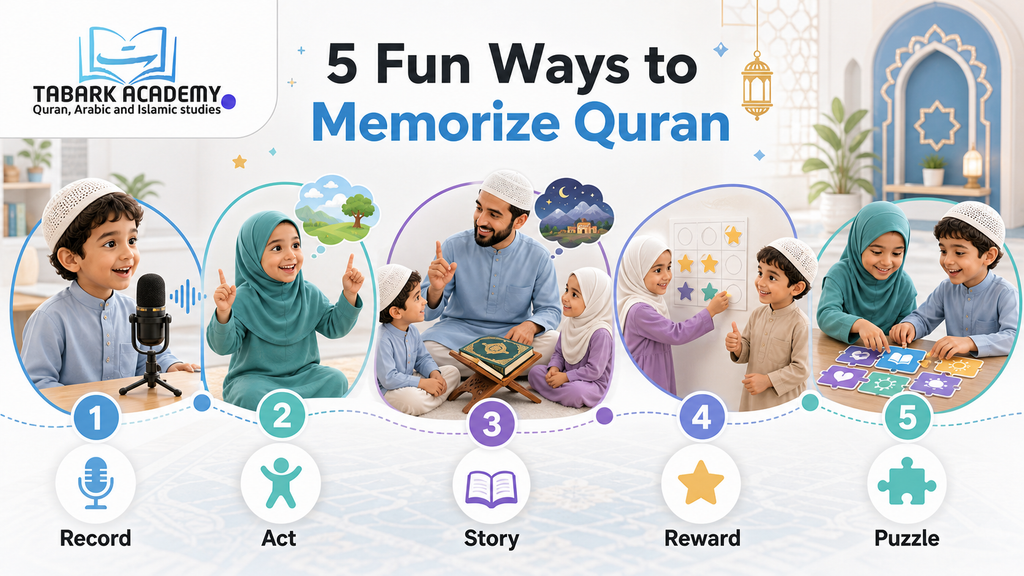
a- Turn Recitation Into A Recording Game
Record your child reciting the verses they’re working on, then play it back for them. Hearing their own voice recite correctly builds visible pride and turns a repetition drill into a small performance moment.
b- Act Out the Meaning of the Verse
Pair simple verses with movement or gesture to make the meaning physical rather than abstract. A child who acts out a word connects to it far faster than one who only hears it repeated.
c- Tell the Story Behind the Surah First
Before asking a child to memorize a surah, tell them the short story connected to it. Understanding what happened first makes the words that follow feel familiar rather than foreign.
d- Use Achievement Charts and Friendly Competitions
Let your child color in a square or place a sticker for every verse memorized, turning the process into a visible daily achievement board. A light, friendly challenge between siblings can add the same motivating effect without turning into pressure.
e- Turn New Words Into Visual Puzzles
Design colorful cards showing the words of a verse, then let your child arrange them in the correct order like a puzzle. This turns word-by-word memorization into an activity they solve rather than a line they repeat.
Many parents look for structured support once they’ve tried these ideas at home. Tabarak Academy‘s Hifz for Kids course builds this kind of play directly into daily sessions, so the games aren’t occasional — they’re the method.
Watch Tabarak Academy classes in action with young learners
Experience Our Interactive Learning
Curious about how we teach? Watch these brief video clips from our recent live sessions to see our structured curriculum, advanced learning platform, and dynamic student-teacher interactions firsthand.
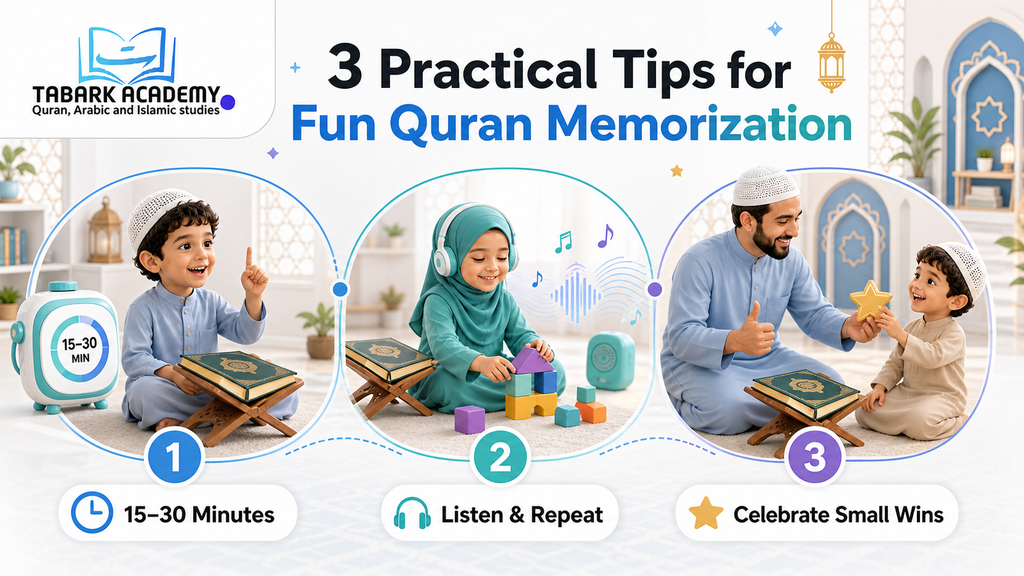
2. Practical Tips For Making Quran Memorization Fun For Kids
Beyond individual activities, a few habits determine whether the fun actually lasts. These apply regardless of which games or methods you use at home.
a- Keep Sessions Short
A session that runs 15 to 30 minutes holds a child’s attention far better than a long, tiring one. Once focus drops visibly, more repetition stops helping and starts building resentment toward the material.
b- Repeat Verses Through Melodic, Playful Listening
Play the verses in a pleasant, rhythmic voice, or repeat them while your child plays quietly nearby. Repetition absorbed through listening feels effortless compared to repetition demanded through direct drilling.
c- Celebrate Every Small Win Immediately
A single line memorized correctly deserves genuine praise in the moment, not just the finished surah. Small, immediate encouragement keeps a child associating Quran time with success rather than judgment.
Read also: Make Hifz Fun: 5 Brilliant Quran Memorization Games Kids Will Love
3. Parents Can Support Fun, Pressure-Free Memorization at Home
Parents support fun, pressure-free memorization by modeling the habit themselves. Playing the Quran through daily sound and routine, and connecting their child with same-age peers, reinforces the habit further.
Reading Quran aloud yourself, even briefly, shows a child what genuine attachment to the Quran looks like. Playing a favorite reciter’s voice during car rides or before bed lets children absorb verses passively, without any formal sitting required.
Joining a group of same-age peers working on memorization together adds a social pull that solo sessions can’t replicate. Any app or digital tool used alongside this should stay clearly educational and supervised, never a replacement for guided correction.
Common Mistakes to Avoid When Teaching a 4-Year-Old the Quran
At four years old, Quran learning should feel natural, encouraging, and manageable. Even a good teaching method can become ineffective when memorization feels like pressure or a test the child must pass.
Avoiding a few common mistakes can help protect the child’s motivation and build a positive relationship with the Quran from the beginning.
- Pushing long sessions or forcing memorization at a time the child is tired or unwilling.
- Comparing one child’s pace to a sibling’s or classmate’s progress.
- Focusing only on errors instead of praising the attempt itself.
- Using the same method for a 5-year-old and a 12-year-old, ignoring how differently each age learns.
At this age, consistency, encouragement, and positive exposure to the Quran matter more than how quickly a child memorizes.
Step Inside Our Virtual Classrooms
See our engaging teaching methods in action! watch real snippets of our live classes and discover how our expert instructors make learning interactive, memorable, and inspiring for every student.
Start Your Child’s Fun Hifz Journey With Tabarak Academy Today
Turning memorization into something a child looks forward to is easier with a tutor trained specifically to teach that way. Building the entire system alone at home is harder.
Tabarak Academy’s Hifz for Kids course gives children aged 6 to 14:
- Al-Azhar certified tutors carrying a verified Ijazah, trained in teaching young learners specifically.
- Private 1-on-1 sessions — Tabarak Academy never places children in group classes.
- Point-based revision games and verbal Surah challenges built into every session, not offered as an extra.
- Flexible morning, afternoon, evening, and weekend slots available seven days a week.
- A free trial class with no lock-in contract, so you can see the fit before enrolling.

Check Our Courses
- Online Quran & Arabic Classes | Foundation
- Recitation Of Quran with Tajweed Course
- Islamic Studies Course Online
- Arabic Alphabet Learning Course
- Noorani Qaida Course for Adults
- Quranic Arabic Course for Kids
- Arabic and Quran Classes for Kindergarten
- Islamic Summer Camp
- Hifz for Kids Course
- Hifz Course for Sisters
- Hifz for Adults Course
- Online Hifz Program
- Noor Al-Bayan Course
Conclusion
Children don’t lose interest in the Quran itself. They lose interest in memorization methods that ignore how they naturally learn — through play, story, movement, and encouragement.
Short sessions, recording games, story-first learning, and visible achievement boards turn repetition into something a child chooses to engage with rather than resists.
Sustained progress comes from pairing this playful approach with structured, patient guidance. That holds true whether it happens at home or through a tutor trained specifically to teach children this way.
Frequently Asked Questions
What Are Some Ideas to Motivate Kids to Memorize Quran?
Ideas that motivate kids to memorize Quran usually combine a few elements. Visible reward systems, voice-recording feedback, gentle sibling or friend competitions, and stories that give verses context all help.
A star or sticker board that gets exchanged for a small reward once a surah is complete gives children a tangible goal to work toward. Letting a child hear their own recitation played back tends to build more genuine enthusiasm than any external prize.
How Can I Make My Child Love Quran Memorization Without Pressure?
You make a child love Quran memorization without pressure by treating it as a warm daily habit, not an obligation. Respond to mistakes with patience instead of correction alone.
Praise the attempt before addressing the error, and keep comparisons with other children out of the conversation entirely. Let your own example — reading, reciting, enjoying the Quran — do most of the teaching.
How Long Should a Quran Memorization Session Be for a Child?
A child’s Quran memorization session works best between 30 and 40 minutes, split into distinct blocks rather than one long stretch of repetition.
Tabarak Academy’s Hifz for Kids sessions follow a structured pattern for children aged 6 to 14. Each session covers about ten minutes reviewing prior memorization, twenty minutes on new verses, and five minutes correcting Tajweed.
New verses get repeated aloud around twenty times before a child tries them alone, which keeps the pace playful rather than rushed.