

Can you really memorize the entire Quran in just one year while managing school, work, or family responsibilities? Yes, a one-year Hifz goal is possible for some dedicated learners, but it requires a realistic daily schedule, correct recitation, and consistent revision.
The most important question is not simply how many pages you can memorize, but how well you can retain them. Whether you are a beginner, a parent planning your child’s Hifz journey, or an adult returning to memorization, the aim is to help you begin with a clear and sustainable method.
This guide explains how to plan Quran memorization for kids and adults, calculate a manageable daily target, and build a revision routine that protects previous lessons.
You will also learn how to approach similar verses, recover after missed sessions, and decide whether you need a qualified Quran teacher.
Takeaways: What You Will Learn
- How to calculate a one-year Quran memorization target.
- How to organize daily, weekly, and monthly Hifz sessions.
- Why Tajweed, teacher correction, and revision are essential.
- How to manage similar verses and missed memorization days.
- How children and adults can adapt the plan to their routines.

Is It Possible to Memorize the Quran in One Year?
Yes, it is possible to memorize the Quran in one year with a suitable pace, strong commitment, and qualified guidance.
A common planning reference is the 604-page Madinah Mushaf. At two pages per day for six memorization days each week, a learner completes approximately 12 pages weekly and reaches the full Mushaf in around 50–51 weeks.
This leaves a small amount of time for additional revision, although the exact completion date depends on the learner’s reading ability, pace, and retention. The Quran reminds us of the accessibility of its message — Surah Al-Qamar 54:17:
“And We have certainly made the Qur’an easy for remembrance, so is there any who will remember?”
وَلَقَدْ يَسَّرْنَا ٱلْقُرْءَانَ لِلذِّكْرِ فَهَلْ مِن مُّدَّكِرٍۢ
This ayah offers encouragement, while a practical Hifz plan turns that encouragement into daily action. A one-year target should be treated as a structured goal rather than a guarantee for every student.
Beginners who need to establish Arabic reading and Tajweed first may require additional preparation before following a full memorization schedule.

How Many Pages Should You Memorize Each Day?
The traditional two-page daily target is one possible route, not a universal requirement. For a student using a 604-page Mushaf, the approximate calculation is:
| Time period | Memorization target |
| Daily | 2 pages |
| Weekly | 12 pages |
| Monthly | 48–50 pages |
| Full Mushaf | Approximately 50–51 weeks |
The calculation assumes six days of new memorization each week. If you need more time for revision, begin with one page or half a page and increase gradually. A smaller target that you can maintain is more useful than a demanding target that repeatedly causes you to stop.
Who Can Follow a One-Year Hifz Plan?
Children, teenagers, and adults can all work toward Quran memorization. Young learners may benefit from parental support, shorter sessions, and a teacher who makes lessons age-appropriate.
Adults may need to divide their study time around work, family, and other responsibilities. The right pace depends on reading fluency, available time, and how reliably the student can retain previous lessons.
For beginners, a reading foundation is essential. Tabarak Academy’s Online Quran Classes for Beginners introduce Arabic letters, Noorani Qaida, and foundational Quran reading through live one-to-one lessons.
Students can develop the skills needed for memorization before moving toward a more demanding Hifz schedule.
Experience Our Interactive Learning
Curious about how we teach? Watch these brief video clips from our recent live sessions to see our structured curriculum, advanced learning platform, and dynamic student-teacher interactions firsthand.

How to Memorize the Quran in One Year With a Monthly Plan
A monthly roadmap helps you divide a large goal into smaller milestones. Instead of thinking about all 30 juz’ at once, focus on the portion you can complete while protecting time for revision.
The following framework uses the 604-page Mushaf and a six-day memorization week as its planning reference.
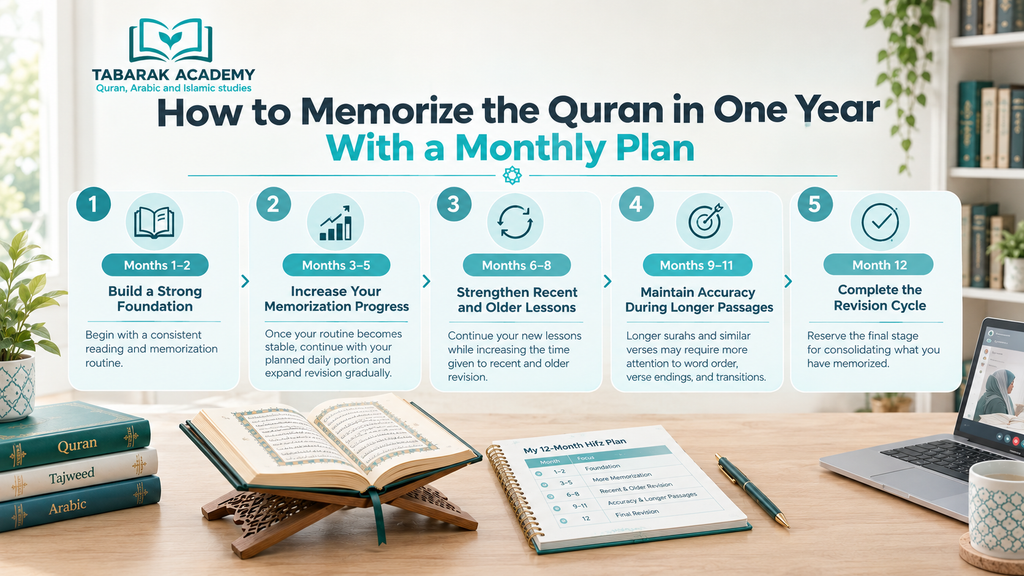
Months 1–2: Build a Strong Foundation
Begin with a consistent reading and memorization routine. If you already read fluently, you may start with Juz’ Amma or another familiar portion to build confidence. If you are a beginner, use this stage to strengthen Arabic pronunciation, Makharij, and basic Tajweed before increasing the daily load.
Months 3–5: Increase Your Memorization Progress
Once your routine becomes stable, continue with your planned daily portion and expand revision gradually. The goal is to make new memorization and previous lessons part of the same daily process. If you are following the two-page pace, your monthly target is approximately 48–50 pages, but you should adjust it when retention becomes difficult.
Months 6–8: Strengthen Recent and Older Lessons
At this stage, the amount of previously memorized Quran is growing. Continue your new lessons while increasing the time given to recent and older revision. Do not judge your progress only by new pages; the ability to recite earlier portions accurately is equally important.
Months 9–11: Maintain Accuracy During Longer Passages
Longer surahs and similar verses may require more attention to word order, verse endings, and transitions. Read each passage carefully and ask your teacher to correct recurring mistakes. If a section becomes difficult, reduce the new memorization temporarily rather than allowing errors to accumulate.
Month 12: Complete the Revision Cycle
Reserve the final stage for consolidating what you have memorized. If your schedule allows you to finish the Mushaf earlier, use the remaining time for comprehensive revision. A strong completion standard is to recite each completed juz’ from memory and identify weak passages before the final assessment.
Read also : Can You Memorize the Quran in 100 Days?
How to Build a Daily Quran Memorization Schedule
A successful schedule should include new memorization, recent revision, and older revision. The three-layer routine below can be adapted to children and adults, with session length adjusted to the learner’s age and ability.
Daily Hifz routine
For a learner memorizing two pages per day, the routine should include three layers: new memorization, recent revision, and older revision. After Fajr, read and repeat the day’s portion with correct Tajweed before reciting it from memory.
At midday, revise yesterday’s lesson and selected pages from the previous week. In the evening, recite a rotating portion of older memorization, giving extra attention to passages that need strengthening before adding new material.
Use a Weekly 6+1 Structure
A six-day memorization schedule with one revision day provides a clear rhythm. On the first six days, learn your planned new portion and complete your daily revision. On the seventh day, recite the week’s new pages without adding another lesson.
This structure can be adjusted for busy adults or younger children. For example, a student who cannot maintain six days of new memorization may choose fewer new-lesson days while keeping revision in the routine. The purpose of a weekly review day is to strengthen recall, not to create pressure to compensate for every missed page.
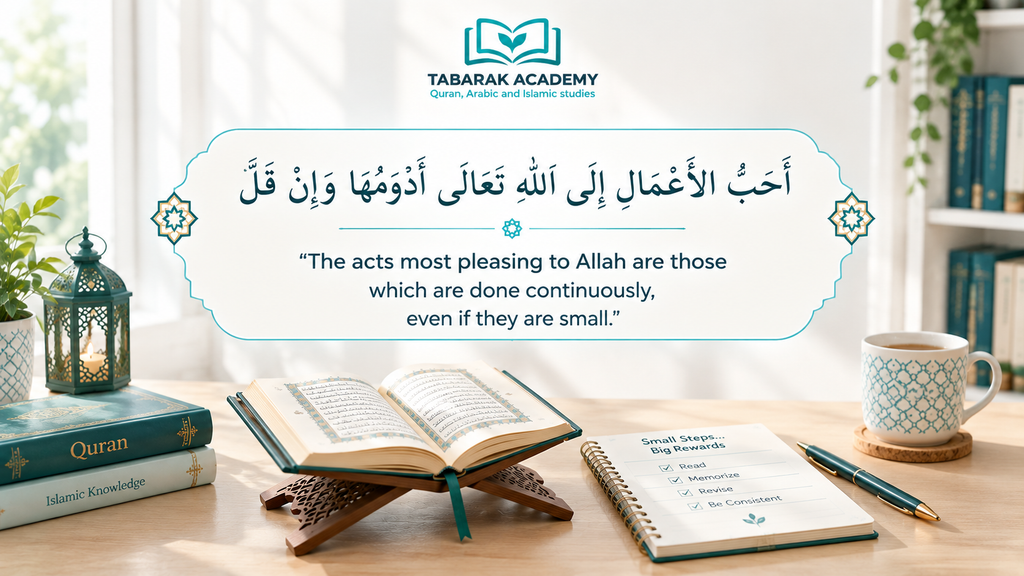
In Sahih Muslim 783b, the Prophet ﷺ said: “The acts most pleasing to Allah are those which are done continuously, even if they are small.”
” أَحَبُّ الأَعْمَالِ إِلَى اللَّهِ تَعَالَى أَدْوَمُهَا وَإِنْ قَلَّ ”
Consistency is especially important for Hifz because every new lesson adds to the amount that must be reviewed. A steady schedule helps students protect the work they have already completed.
How Tajweed and Teacher Guidance Support Memorization
Correct recitation should be part of memorization from the beginning. A student who learns a verse with incorrect pronunciation may repeat that mistake until it becomes difficult to correct.
A qualified teacher can listen to the recitation, identify errors, and help the student improve before moving forward.
Tabarak Academy’s Tajweed for beginners course provides live one-to-one instruction in Makharij, Tajweed rules, and Quranic recitation for beginners and intermediate learners. The course can help students develop accurate reading alongside their memorization routine.
For students who already read Arabic but need to improve fluency and pronunciation, the Quran Recitation Course focuses on Tarteel, Tajweed application, and correction of recitation habits. This makes it a useful option for strengthening the reading skills that support Hifz.

Understand the Meaning of What You Memorize
Understanding the meaning of an ayah can help you connect its words and remember the sequence of a passage. Before starting a new lesson, read a clear translation and, when suitable, a brief explanation of its meaning. You can also divide longer passages into sections according to their themes.
Quranic Arabic study may support this process by helping you recognize recurring vocabulary and sentence patterns. Tabarak Academy’s Quranic Arabic Classes teach Nahw, Sarf, and Quranic vocabulary through the verses of the Mushaf, giving learners tools to understand what they recite.

How to Revise the Quran and Prevent Forgetting
Revision is the foundation of a lasting Hifz journey. New memorization may feel exciting, but older lessons need regular attention to remain strong. A practical approach is to use the Sabaq–Sabqi–Manzil system, which divides revision into three layers.
Sabaq: Today’s New Lesson
Sabaq is the portion you are memorizing today. Read it carefully, listen to an accurate recitation, and repeat each line until you can recite it without looking. Do not move forward simply because you have reached the end of your study time; make sure the lesson is sufficiently secure.
Sabqi: Recent Memorization
Sabqi is the recent portion you have memorized over the previous days or weeks. Recite yesterday’s lesson and selected earlier pages before beginning new memorization. This practice helps you connect new verses with the passages that came before them.
Manzil: Older Memorization
Manzil is the older portion of your Hifz that you revise on a rotating basis. As your memorized Quran grows, you may need more time for this layer. If older pages become weak, reduce the new lesson temporarily and give attention to the sections that need repair.
For additional guidance, see Tabarak Academy’s Online Hifz program. Its Quran programs include recitation, Tajweed, and Hifz instruction through live one-to-one lessons.

How to Handle Similar Quran Verses During Hifz
Similar verses, known as Mutashabihat, can create confusion during memorization. Two passages may share most of their wording while differing in one or two words.
A learner who memorizes quickly without comparing these passages may confuse their endings or recite a phrase in the wrong location.
When you encounter a similar verse, open the Mushaf to both passages and compare them word by word. Identify the exact difference, repeat the distinguishing phrase, and then recite both verses in sequence.
You can also write difficult differences in a notebook and review them before your next lesson.
Use a Mistake Log
A mistake log is a simple tool for tracking repeated errors. Write down the surah, ayah, and specific word or transition that causes difficulty. During revision, focus on correcting those errors rather than repeatedly rereading entire pages.
This method can be especially helpful for adults and children who are learning longer surahs. It gives the student and teacher a clear record of what needs more attention.
Read also:Learn Quran Working Full-Time Without Arabic
What to Do If You Fall Behind Your Hifz Schedule
Missing a memorization session does not mean that your goal is over. Illness, exams, travel, and family responsibilities can interrupt even a well-organized routine. The best response is to return to the plan without allowing missed pages to become a source of stress.
If you miss a day, begin with revision and check the strength of your recent lessons. If the previous pages are weak, repair them before adding new material. Avoid automatically doubling the next day’s memorization, because a larger lesson may increase the revision burden.
For a longer break, you may need to adjust your completion date. A realistic plan that extends beyond one year is more useful than a rushed plan that leaves many passages uncertain. Your teacher can help you decide whether to reduce the daily target, add a revision-only day, or change the schedule temporarily.
How Kids and Adults Can Memorize the Quran in One Year
The same Hifz principles can serve different age groups, but the daily routine should reflect the learner’s needs. Children may need shorter lessons, encouragement, and support from parents. Adults may need flexible sessions around work, family, and other responsibilities.
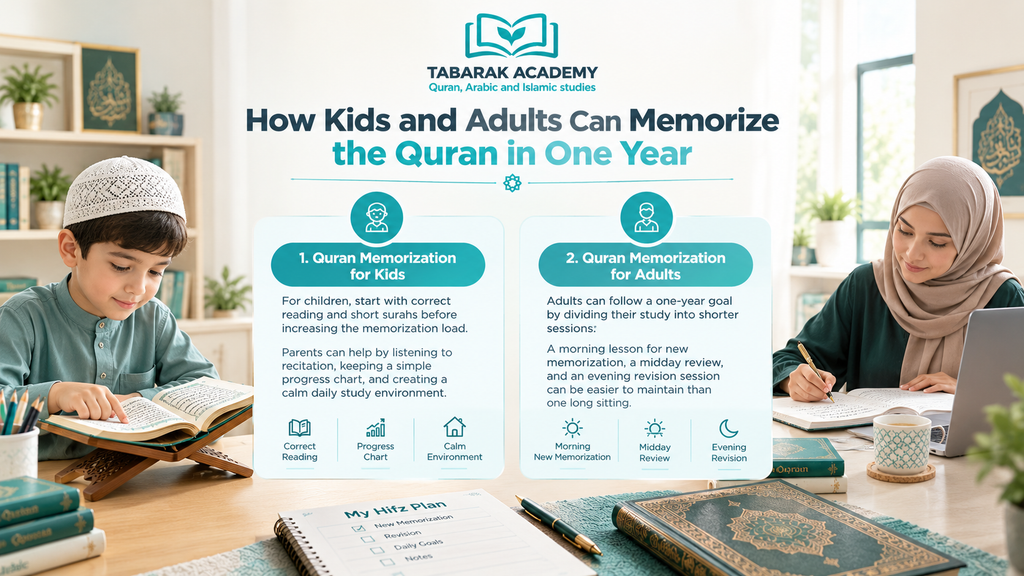
1. Quran Memorization for Kids
For children, start with correct reading and short surahs before increasing the memorization load. Parents can help by listening to recitation, keeping a simple progress chart, and creating a calm daily study environment.
Tabarak Academy’s Arabic and Quran Classes for Elementary Students combine Quranic reading, Tajweed, Arabic vocabulary, and short-surah memorization in a structured program for children. The lessons are delivered privately and include progress tracking to help families follow their child’s development.
2. Quran Memorization for Adults
Adults can follow a one-year goal by dividing their study into shorter sessions. A morning lesson for new memorization, a midday review, and an evening revision session can be easier to maintain than one long sitting.
If you work full-time or have family commitments, begin by identifying the time you can protect most reliably. You can then build a plan around that period and adjust the daily portion according to your reading level and retention.
Step Inside Our Virtual Classrooms
See our engaging teaching methods in action! watch real snippets of our live classes and discover how our expert instructors make learning interactive, memorable, and inspiring for every student.
Build Your Quran Memorization Journey With Tabarak Academy
Tabarak Academy offers Quran, Tajweed, and Arabic learning for kids and adults through live, one-to-one lessons. A structured learning environment can help you develop accurate recitation, maintain a revision routine, and receive guidance as your memorization progresses.
Begin your Hifz journey with expert guidance and learn Quran, Tajweed, and Arabic with a structured program for your level.
Tabarak Academy’s qualified tutors help learners develop correct pronunciation, build memorization habits, and study at a pace that fits their routine. A free trial class is available through the academy’s course pages.
Our Quran Memorization / Hifz Courses
- Online Hifz Program
- Juz 30 Memorization Course
- Hifz for Kids Course
- Hifz for Adults Course
- Hifz for Sisters Course
- Short Surah Memorization Course
- Hifz Ijazah Course

Conclusion
Is It Possible to Memorize the Quran in One Year? Yes, memorizing the Quran in one year is a realistic goal for some students when the daily pace, reading level, and revision time are suitable.
A two-page daily target over six days per week is one common calculation, but it should be adjusted whenever the student needs more time to strengthen retention.
The most important part of a Hifz plan is the connection between new memorization and revision. Sabaq, Sabqi, and Manzil help students protect earlier lessons while continuing to learn new passages.
Correct Tajweed and teacher feedback also support accurate recitation throughout the journey. Just set a clear goal, choose a manageable routine, and remain consistent
The takeaway message is simple: If you are wondering, “Is it possible to memorize the quran in one year?”, begin with your current reading ability and build a plan that you can sustain. With patience, sincere effort, and appropriate guidance, you can work toward memorizing the Quran while strengthening your connection with its words and meaning.
FAQs
Is it possible for a beginner to memorize the Quran in one year?
Yes, but a beginner should first develop correct Quranic reading and Tajweed. A student who cannot yet read Arabic fluently may need additional preparation before starting a full one-year Hifz schedule.
How many pages a day should I memorize to finish the Quran in one year?
A common reference is two pages per day for six days each week, using the 604-page Madinah Mushaf. This produces approximately 12 pages weekly and reaches the full Quran in around 50–51 weeks.
What is the best time to memorize the Quran?
Many students prefer the time after Fajr because it offers a quiet opportunity for focused study. However, the best time is the period you can protect consistently and use for attentive memorization.
How long does it take to memorize the Quran for adults?
There is no single duration for every adult. Some learners may complete a one-year plan, while others need more time because of work, family responsibilities, or reading preparation. A suitable pace should be based on retention and available study time.
How can I memorize the Quran without forgetting?
Revise yesterday’s lesson, review recent pages, and rotate older memorization through a Manzil schedule. Correct recurring mistakes and reduce new memorization when previous lessons become weak.
Do I need a Quran teacher to memorize the Quran in one year?
A qualified teacher is strongly recommended for regular recitation correction and accountability. Guided lessons can help students avoid persistent pronunciation errors and adjust their memorization plan when difficulties arise.



0 Comments